In spring 2026, 67% of Broward students in grades 3 through 8 scored on grade level in math1, which leaves about one in three Plantation-area students below grade level.
For many of those students, math gaps developed gradually, one missed concept at a time, but can follow them into middle school, Algebra 1, and beyond. Plantation parents can catch those gaps early through FAST, the state test students take three times a year.
Today, we'll talk about how to read your child's FAST scores, find the missing concept, explore support options around Plantation, and recognize when your child needs structured support.
1. Start With Your Child's FAST Scores
Your child's FAST scores give you a starting point for understanding their current math progress. The score report shows how your learner performed against Florida's grade-level math standards and which areas may need more attention.
Here's what to keep in mind when you review the report:
-
Check the Achievement Level. FAST scores fall into five levels, and Level 3 means on grade level. Florida describes students at Levels 1 and 2 as likely to need substantial support for the next grade.
-
Find Where the Scale Score Falls. Each achievement level covers a range of scores, so the scale score shows where your child's result falls within those ranges. For example, in grade 5 math, a score of 219 falls just below Level 3, which starts at 222.
-
Look Past the Overall Score. Each report also shows your child's performance in every reporting category, the broad areas of math the test covers. The weakest category is where support should start.
-
Track Growth From Fall to Winter. Each round covers the full year's content, so a low fall score is expected. If your child is still at Level 1 or 2 by winter, with little change since fall, the gap likely needs more targeted help.
To view your child's scores, log in to your Focus parent portal to open the state's Family Portal. Plantation Elementary's FAST page explains how to find your child's access code.
📕 You May Also Like: Florida's B.E.S.T. Math Standards: Grade 3 to High School
2. Bring the Right Questions to Your Teacher Conference
Your child's teacher sees how they work through math every day, which makes a conference one of the best ways to confirm what the FAST scores suggest.
Bring the score report and a few recent homework pages or quizzes, with the problems where your child got stuck marked. Then ask three things.
-
Start with the skills the FAST results point to. Does the teacher see the same areas in class?
-
Check whether your child needs more practice with current-year skills or needs to revisit an earlier concept.
-
Find out what support your child already receives at school and what you can reinforce at home before PM2.
Do not forget to write down the teacher's answers, since you can use them to find the gap behind the struggle.
3. Find the Gap Behind the Struggle
The fastest way to help a child who is behind in math is to identify the exact concept or skill where a gap first developed.
Kids who are behind in math usually have one of two kinds of gaps, and sometimes both.
-
Concept gap. Your child can follow the steps when a problem looks familiar but gets lost when the format changes. For example, a student who adds \(\Large\frac{1}{3}\) + \(\Large\frac{1}{4}\) and gets \(\Large\frac{2}{7}\) is usually missing the idea of what a fraction represents, not just a step.
-
Procedure gap. Here, a learner understands the idea but makes errors along the way, such as dropping a negative sign, lining up digits incorrectly, or skipping a step. They know what to do but can't yet do it accurately every time.
This is our starting point at Mathnasium. We begin by understanding each student’s true skill level, including their knowledge gaps. To do this, we first engage through conversation.
You can do this at home. Our tutors recommend:
-
Asking for an explanation. Have your child walk you through a problem they just solved. If they can list the steps but can't say why each one works, they likely have a conceptual gap.
-
Changing the format. Turn a familiar problem into a short word problem. Children who solve the original but get stuck on the new version may be following memorized steps without understanding the idea behind them, which points to a conceptual gap.
-
Asking for an estimate first. Students who can't predict a reasonable answer usually lack a clear sense of the numbers involved, which is another sign of a conceptual gap.
-
Watching for repeated slips. Some students understand the idea but make the same errors each time they work through the steps, such as dropping a negative sign or misaligning digits. Those patterns point to a procedural gap, which improves with focused practice.
The difference between the two explains why extra homework doesn't close the gap. More practice helps a child with a procedure gap build accuracy. For a child with a concept gap, repeating the same steps can reinforce a routine they don't understand, and the gap stays in place.
📕 You May Also Like: Is My Child 'Bad at Math' or Just Missing Foundational Skills?

At Mathnasium, we identify the specific concepts and skills a student needs to work on, then build practice around those gaps so each new skill has a solid foundation.
4. Explore Math Help Around Plantation and Broward County
Plantation families have several options for extra math help beyond what parents can provide at home, both at school and in the community.
Many of these resources also change how kids experience math. In group sessions and game-based activities, your child gets to practice alongside peers, which can turn math into something fun and social that they look forward to.
-
Math intervention at your child's Broward school (K–4). Under Florida law, students in kindergarten through grade 4 who are identified with a substantial math deficiency must receive extra help at school. That help comes through either daily small-group intervention or support before or after school.
-
Brainfuse online tutoring through Broward County Library. With a Broward County Library card, students can connect with a live tutor online. It works best for quick help with a specific homework problem.
-
Drop-in homework help at Broward County Library branches. Some branches host free in-person homework help, where volunteers work with students in grades 1–5 on math, reading, and science while parents stay in the library.
-
SAT® and ACT® workshops at West Regional Library. Plantation's West Regional Library has hosted multi-session college readiness workshops for high school students in grades 10–12.
-
Mathnasium of Plantation. If your child's FAST scores or schoolwork keep pointing to math gaps, our center provides structured, targeted support to identify where those gaps began and what your child needs next. We begin with a diagnostic assessment that helps us understand your child's current skill level, learning goals, and learning style, so we can build a personalized learning plan around the concepts that need more practice.
📕 You May Also Like: Why Personalized Math Tutoring Makes All the Difference
5. Know When Your Child Needs Structured Support
Occasional help can work well for a difficult homework problem, extra practice, or enrichment. More consistent support becomes useful when the same difficulties keep showing up over time.
Watch for these signs.
-
A familiar skill keeps causing problems. The concept may seem clear at first, then become difficult when it comes up again.
-
FAST scores stay flat. Your child's score shows little growth from PM1 to PM2.
-
Confidence is slipping. You start hearing comments like "I'm just bad at math."
-
The gap sits grades back. If your child is struggling with this year's work because of a skill from two or three grades earlier, help with current homework will only cover the problem, not fix it.
When these signs show up, Mathnasium of Plantation can provide the structured, targeted support your child needs to address the specific skills holding them back.
📕 You May Also Like: Building Confidence in Math: How Tutoring Can Help
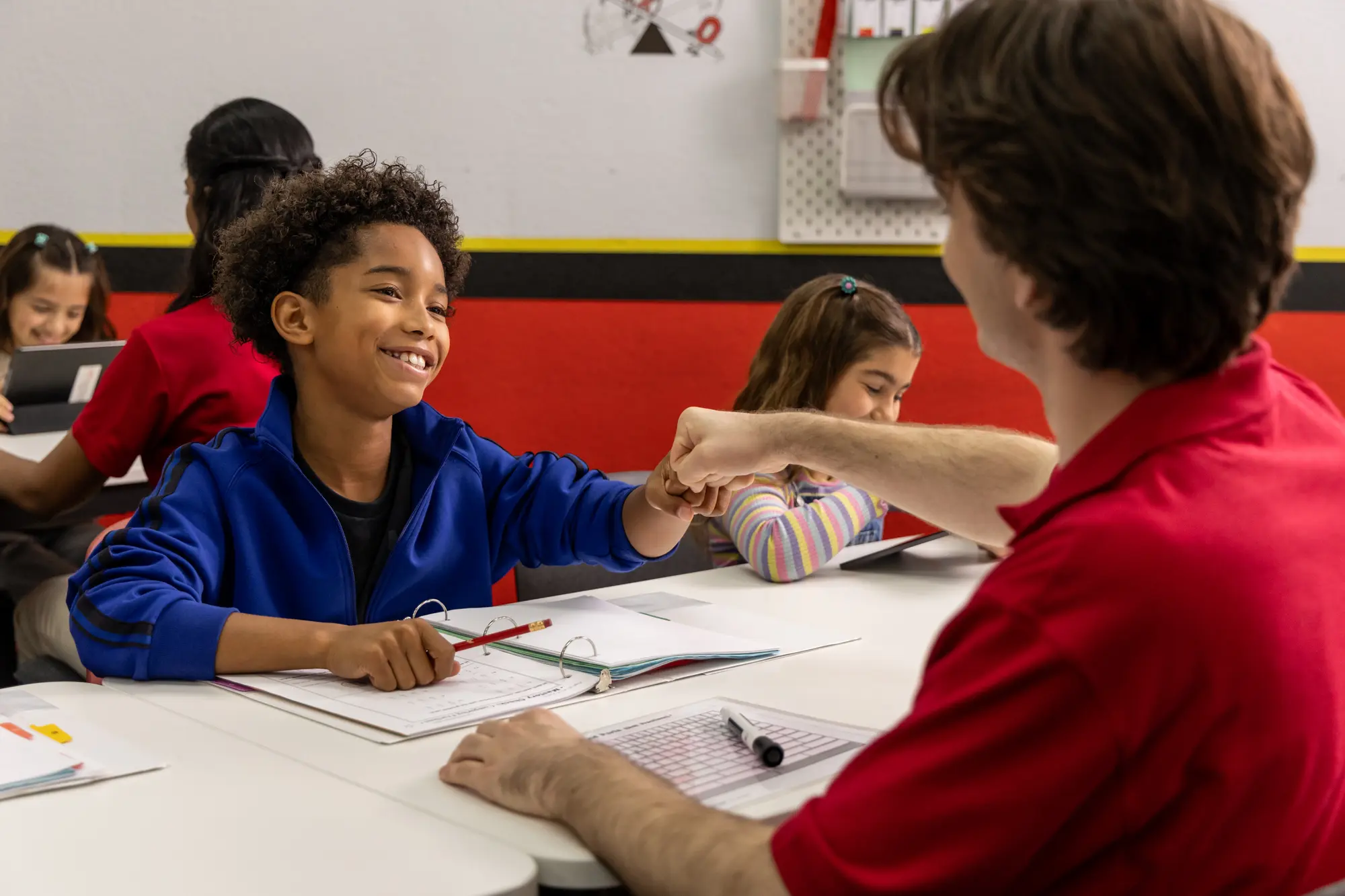
Mathnasium of Plantation provides consistent math support focused on the specific skills each student needs to work on, with a personalized plan that evolves as those needs change.
How Mathnasium of Plantation Helps Students Catch Up in Math
Mathnasium is a math-only learning center that helps students of all skill levels learn and master math.
Whether a child is falling behind because of a foundational gap or struggling to keep up with current classwork, our tutors focus on the skills they need to move forward.
By addressing gaps in foundational skills, we help students build the understanding they need for current and future math concepts.
Instead of using a fixed curriculum, we personalize each student’s learning experience through the Mathnasium Method™, our proprietary teaching approach. The approach starts with a diagnostic assessment, which helps us identify the specific skills a student has learned, the areas where they are struggling, and where a gap may have started.
From there, we build a personalized learning plan tailored to their needs.
Our tutors teach for understanding, which means stripping out math jargon and phrasing concepts in natural, everyday language. Each session draws on a combination of verbal, visual, mental, tactile, and written techniques, weighted toward the way your child learns best. For a visual learner, for example, our tutor will lean more on drawings and models to make each concept click.
Fun is an important part of our approach, which is why we incorporate game-based activities, reward everyday progress, and celebrate every student's wins, big or small. This keeps kids motivated and excited to learn.
Parents consistently report meaningful progress:
-
94% of parents report an improvement in their child's math skills and understanding
-
93% of parents report an improved attitude toward math after attending Mathnasium
-
90% of students saw an improvement in their school grades
With over 1,100 learning centers across the U.S., Mathnasium brings our proven approach close to you.
Mathnasium of Plantation is a trusted local center, serving families in Plantation and the surrounding Broward communities.
Our team works with students to identify math gaps, address foundational skills, and build the knowledge they need to keep up with their classwork.
📅 Schedule a Free Assessment at Mathnasium of Plantation
Not near Plantation?
📍 Find a Mathnasium Learning Center Near You
Source:
-
Vazquez, H. (2026, June 30). Students in South Florida schools see test score improvements. WLRN. https://www.wlrn.org/education/2026-06-30/fast-florida-test-score-improvements


 (954) 441-6284