Four Methods for Solving Proportions (and When to Use Each)
Jun 23, 2026
| Plantation
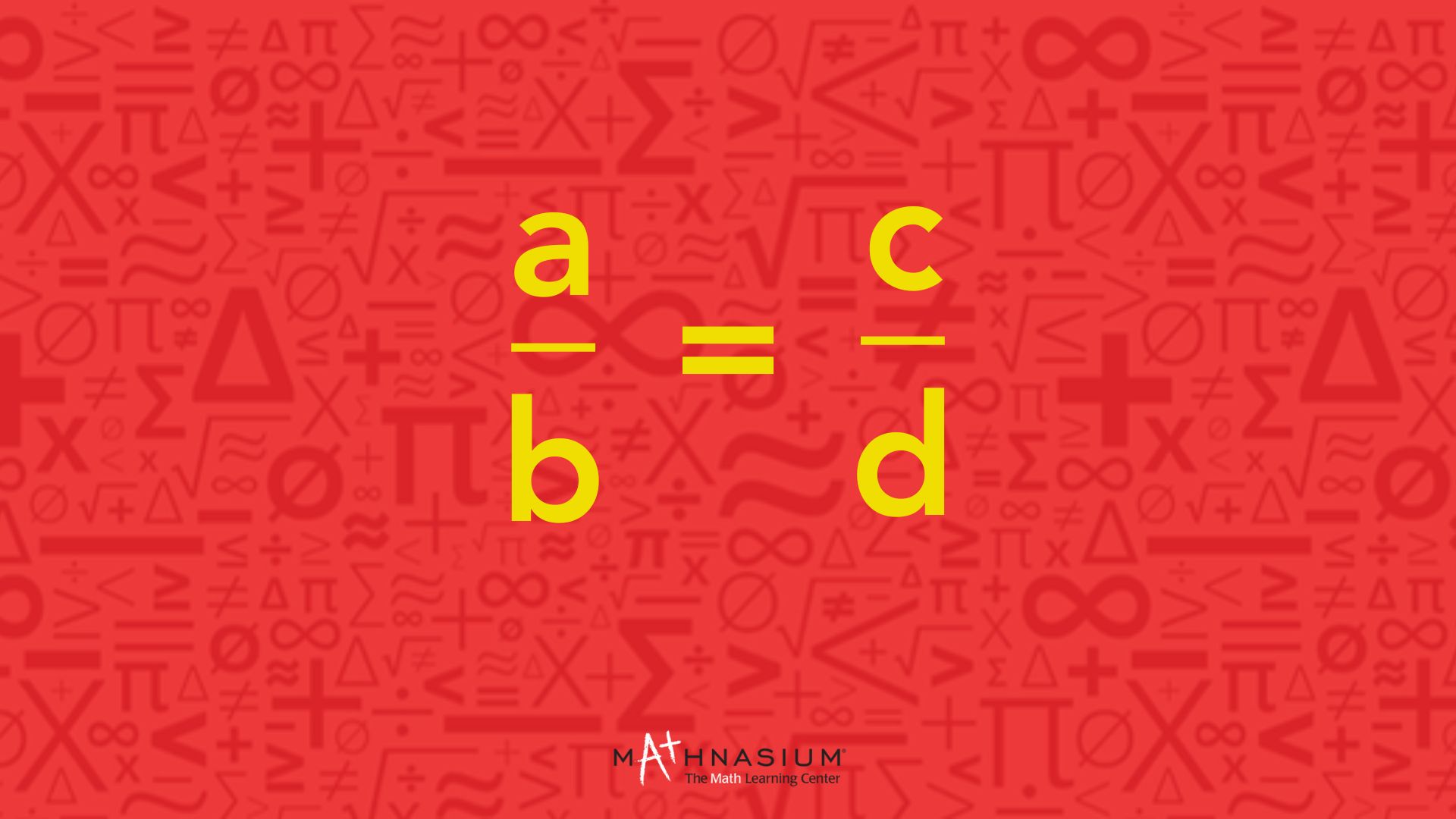
Proportion problems look different on the surface but share the same underlying structure. We have two ratios set equal to each other, with one value missing. Our goal is to find that missing value.
Our Mathnasium tutors use four core methods to solve these equations. Today, we will walk through each method together, see how to choose the right tool for the job, and solve the same problem four different ways.
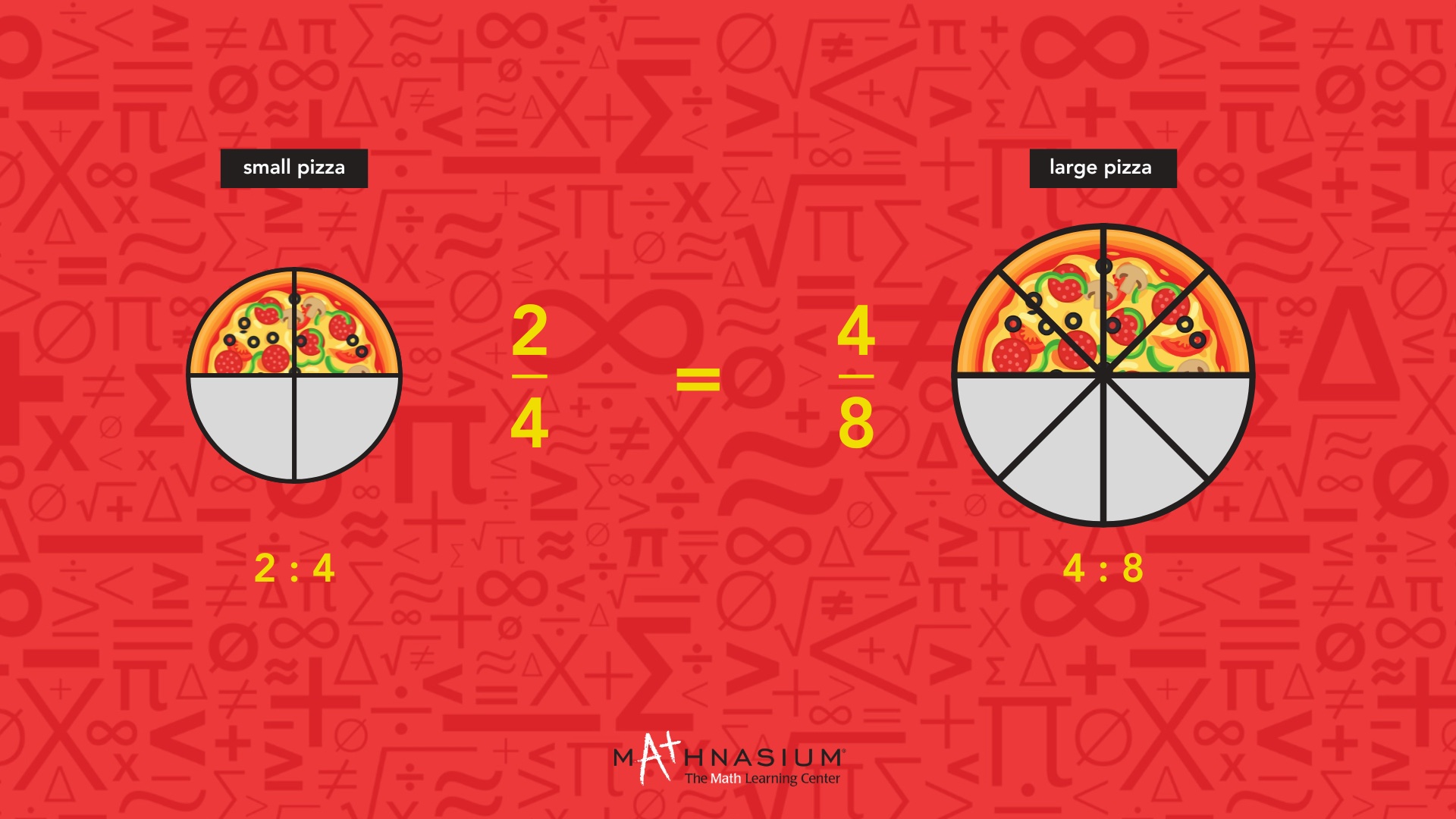
Picture two pizzas. We cut a small pizza into 4 slices, and we take 2. We cut a large pizza into 8 slices, and we take 4. The pizzas have different sizes and different slice counts, yet the relationship stays the same. In both cases, we take exactly half the pizza.
Now, let us write that same relationship as a math statement. Two slices out of four and four slices out of eight give us:
\(\Large\frac{2}{4}\) = \(\Large\frac{4}{8}\)
Two ratios are set equal to each other. That is a proportion.
So a proportion is more than two fractions sitting next to each other. It is a statement that two different situations share the same relationship.
The pizza changed size. The ratio of slices stayed the same. That is proportion in action.
Proportions can be written two ways. The fraction form is the most common:
\(\Large\frac{2}{4} = \Large\frac{4}{8}\)
They can also be written using a colon:
2 : 4 = 4 : 8
Both say the same thing.
In algebra, one of the values is usually unknown, and our job is to find it:
\(\Large\frac{2}{4} = \Large\frac{x}{8}\)
What value of x keeps the two ratios equal? We already know from the pizza: x = 4.
For proportions where the answer takes more work, we need a method.
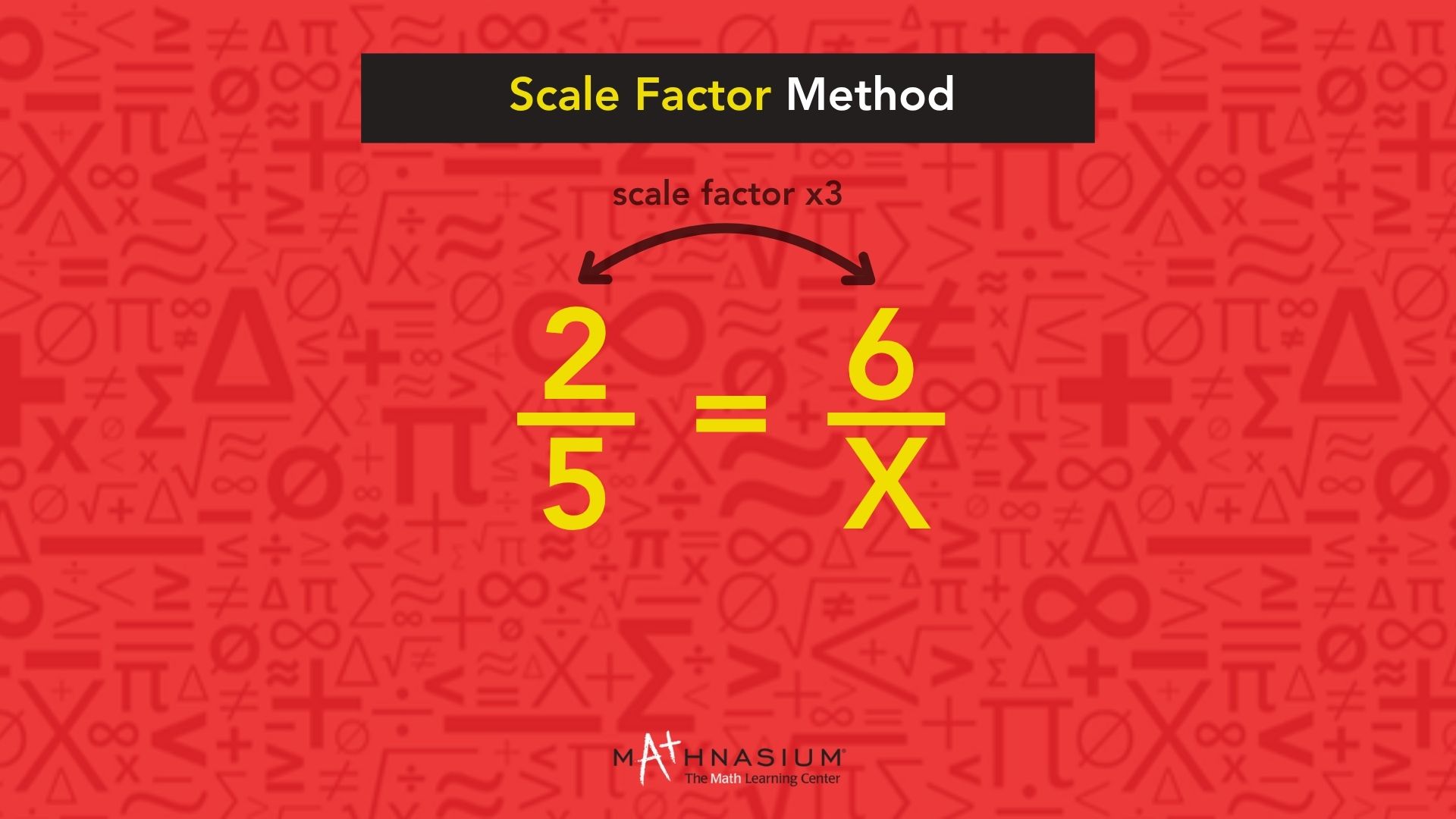
The scale factor method solves a proportion by finding the number that connects one ratio to the other and using it to find the missing value.
We already know this instinct from the pizza. The small pizza had 4 slices, and the large one had 8. We saw immediately that the large pizza was exactly twice the size of the small one.
That multiplier, the number that takes us from one ratio to the other, is the scale factor.
Let us see that same thinking applied to a proportion with a missing value.
A map uses a scale of 2 inches for every 5 miles. A road measures 6 inches on the map. How many miles is that in real life?
We set up the proportion:
\(\Large\frac{2}{5} = \Large\frac{6}{x}\)
Look at the numerators. We have 2 and 6. To find the scale factor, we divide the larger by the smaller:
6 ÷ 2 = 3
The scale factor is 3.
The same approach works when the unknown is in the numerator instead. We look at the denominators, divide the larger by the smaller, and apply that scale factor to the numerator we know.
Because the two ratios are equal, the scale factor connects both pairs of numbers. So we multiply the denominator we know by 3:
5 × 3 = 15
x = 15
The road is 15 miles long.
So the scale factor method works by finding the multiplier that connects one pair of numbers and applying it to the other. The proportion stays balanced because both sides scale by the same amount.
This method works best with numbers that share a clean factor.
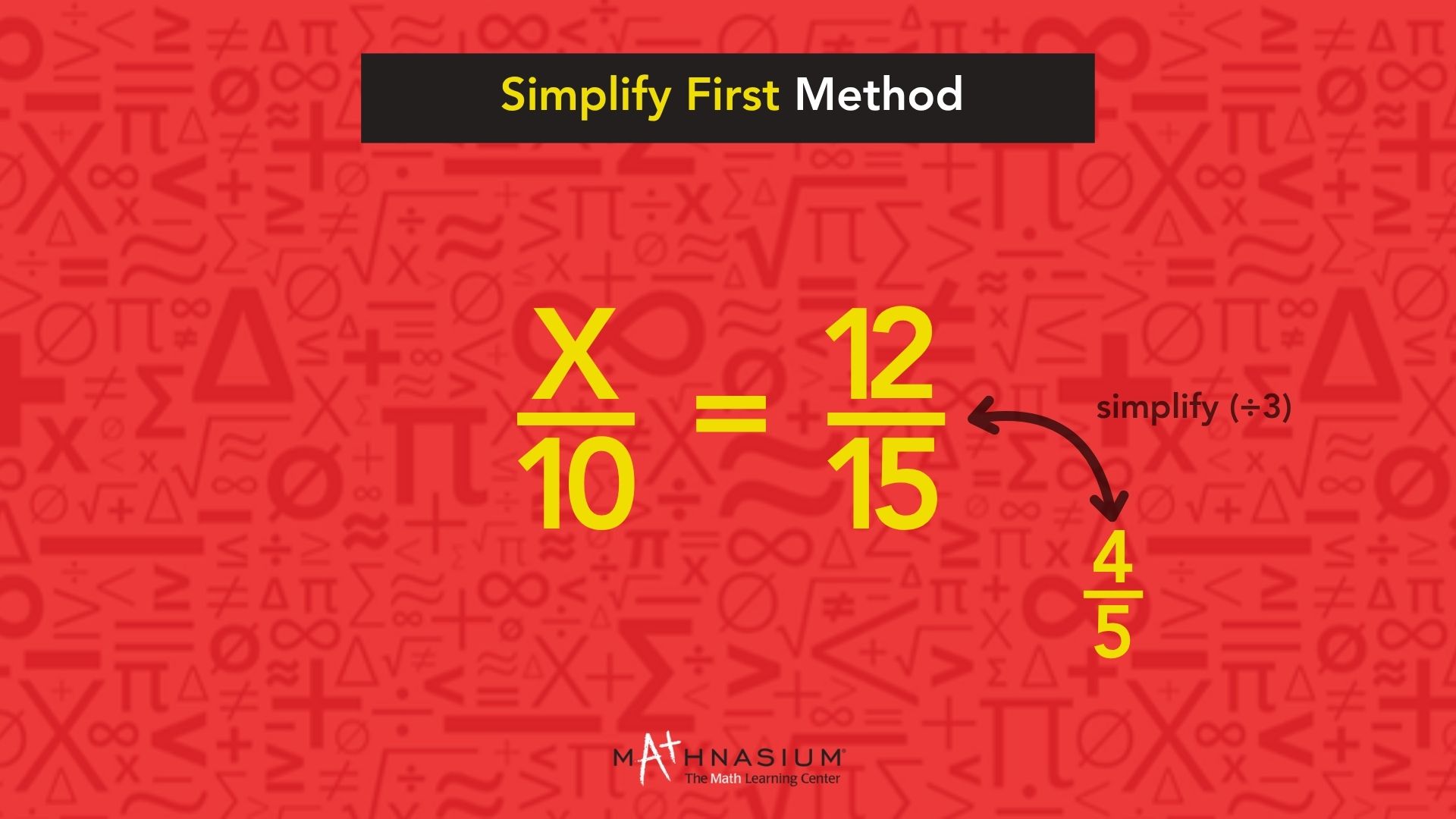
The simplify-first method solves a proportion by reducing one of the known fractions to its simplest form first, then finding the scale factor. A simplified fraction makes the relationship between the two ratios immediately visible.
Think about a runner who completes 12 laps in 15 minutes. At first glance, 12 and 15 hide their relationship. But what if we simplify that ratio? Both 12 and 15 are divisible by 3:
\(\Large\frac{12}{15} ÷ 3 = \Large\frac{4}{5}\)
Now the relationship is clear. For every 4 laps, the runner takes 5 minutes. The rate was always there. The larger numbers were hiding it.
That same instinct applies to proportions. Let us say we need to solve this:
\(\Large\frac{x}{10} = \Large\frac{12}{15}\)
The right side \(\Large\frac{12}{15}\) looks complicated at first. But we already know we can simplify it to 45.
So we can rewrite the proportion:
\(\Large\frac{x}{10} = \Large\frac{4}{5}\)
Now the scale factor is visible. We have 5 and 10. We divide the larger by the smaller:
10 ÷ 5 = 2
The scale factor is 2. So we apply it to the numerator we know:
4 × 2 = 8
x = 8
This method works by stripping a complicated fraction down to its simplest form first. That step keeps the proportion intact and makes the scale factor visible.
With messy numbers that resist simplification, a different method will serve us better.
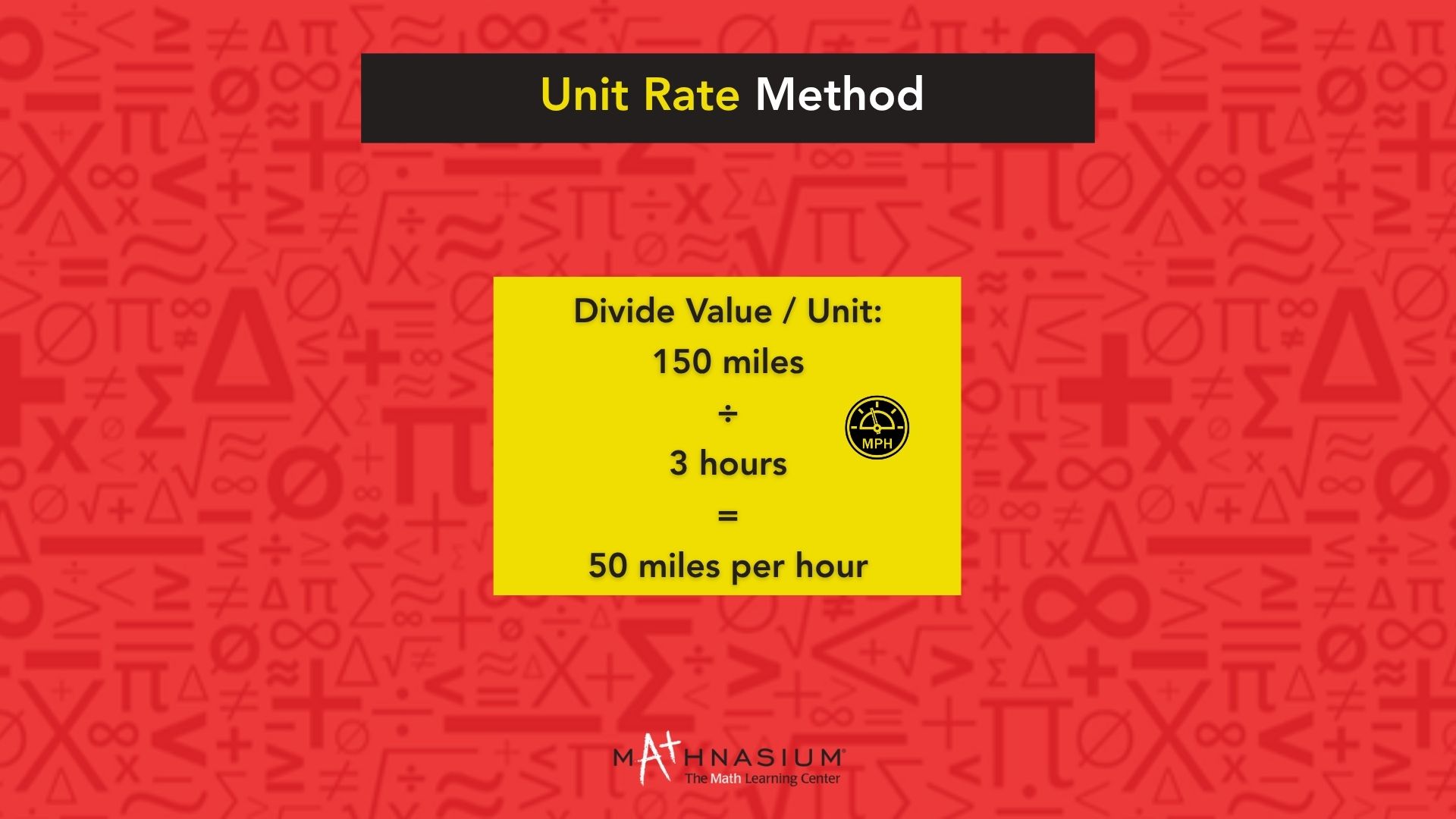
The denominators 3 and 5 share no obvious whole-number multiplier. Let us look within the first fraction and ask: How many miles does the car cover in a single hour?
We divide the total distance equally across 3 hours:
150 ÷ 3 = 50 miles per hour
That gives us the unit rate: 50 miles per hour.
So, if a car travels 50 miles per hour, how far does it go in 5 hours?
50 × 5 = 250
x = 250 miles
The unit rate method works best when the problem asks us to scale a known rate to a new quantity.
Numbers that produce a messy unit rate call for cross-multiplication instead.
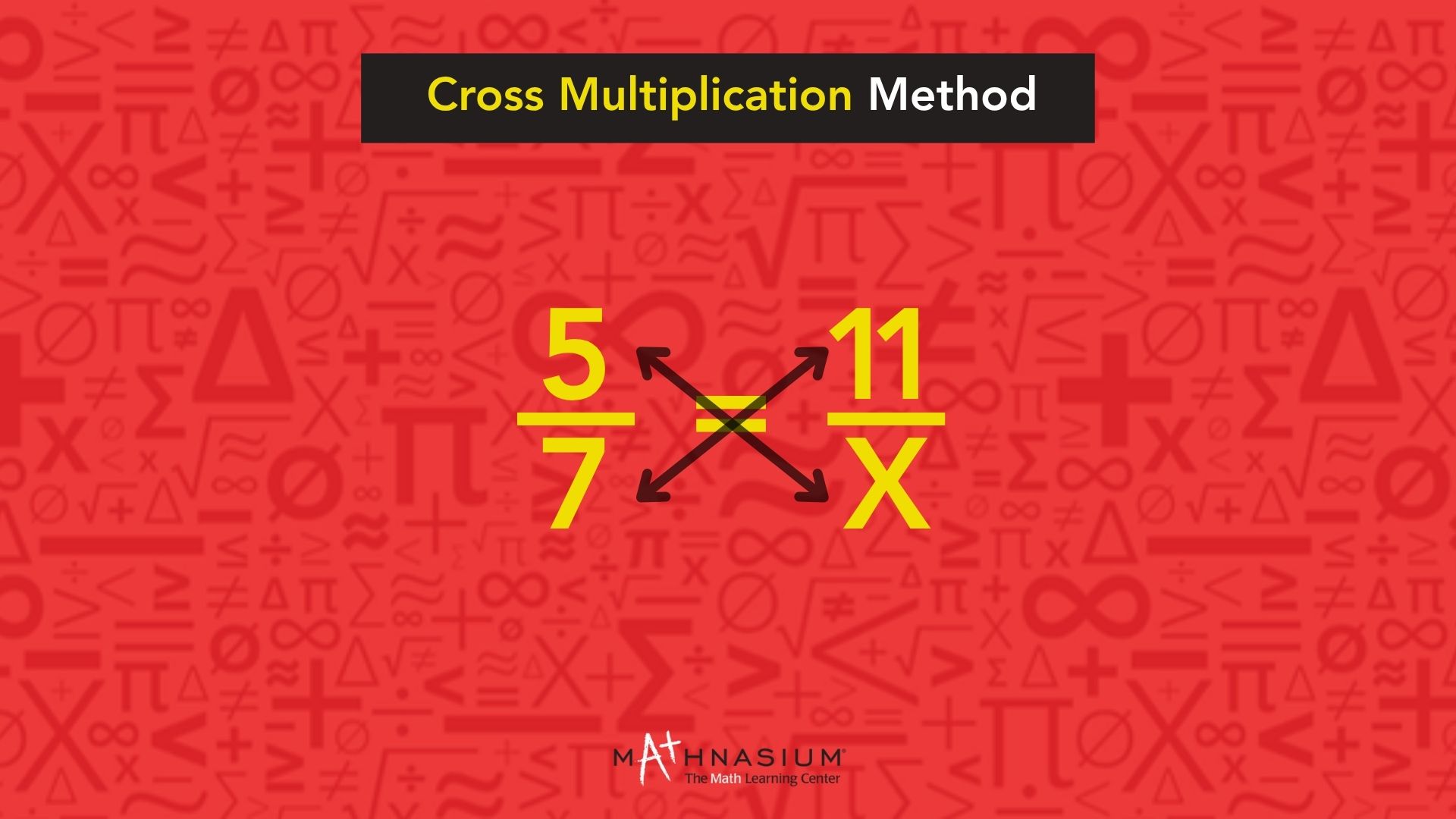
Cross-multiplication solves a proportion by multiplying diagonally across the two fractions, eliminating the denominators and leaving a simple equation to solve.
It is the universal tool, working on any proportion regardless of how unfriendly the numbers are.
Think about scaling up a recipe. The original recipe uses 5 ounces of chocolate for every 7 ounces of butter. We want to use 11 ounces of chocolate. How much butter do we need?
We look for a scale factor. Does 7 multiply cleanly into 11? No.
Does \(\Large\frac{5}{7}\) simplify to something friendlier? No, it doesn’t.
The unit rate gives us 5 ÷ 7 = 0.714, a repeating decimal that makes mental math unreliable.
Our previous three methods all hit a wall here. That is where cross-multiplication earns its place.
We set up the proportion. Five ounces of chocolate for every 7 ounces of butter, and 11 ounces of chocolate for x ounces of butter:
\(\Large\frac{5}{7} = \Large\frac{11}{x}\)
Cross-multiplication works by multiplying each numerator by the denominator on the opposite side:
5 × x = 7 × 11
5x = 77
Now we solve for x by dividing both sides by 5:
x = 77 ÷ 5
x = 15.4
We need 15.4 ounces of butter.
So cross-multiplication works by clearing the denominators in one step, turning the proportion into a straightforward equation.
This is a method for proportions where the numbers share no common factor, simplification leads nowhere, and the unit rate produces a messy decimal.
The right method depends on what the proportion looks like at first glance. The table below turns that into a quick scan. We look at the proportion, find the condition that matches, and the method follows directly.
Method
Reach for it when:
Scale Factor
The denominators or numerators share a common factor
Simplify-First
One fraction simplifies cleanly before the scale factor is visible
Unit Rate
The problem involves a rate, price, speed, or distance
Cross-Multiplication
The numbers share no clean factor, and simplification leads nowhere
For a deeper look at proportions, watch our Mathnasium tutors walk through everything in detail.
Practice: Which Method Would You Use?
Our tutors at Mathnasium put together four problems, one for each method we covered. For each problem, identify the best method first, then solve.
Problem 1
\(\Large\frac{5}{8} = \Large\frac{x}{24}\)
Problem 2
\(\Large\frac{x}{9} = \Large\frac{10}{15}\)
Problem 3 A car travels 180 miles on 6 gallons of gas. How far does it travel on 9 gallons?
Problem 4
\(\Large\frac{7}{9} = \Large\frac{x}{13}\)
Take as much time as needed on each problem. The answers are at the bottom of the guide.
Mathnasium tutors work through proportion problems alongside students, building the strategic thinking to choose the right method every time.
How Mathnasium Helps Students Master Any Math Concept
Mathnasium is a math-only learning center serving K–12 students, focusing on building confident, independent math thinkers through personalized instruction and targeted support.
Students come to us working through proportions, ratios, and the algebra that connects them, at different points in their understanding. Effective support starts with knowing where each student is, what gaps exist, and how they approach problem-solving.
We do that through the Mathnasium Method™, our proprietary teaching approach built around personalized learning and proven instructional techniques.
Here is what that looks like in practice:
Diagnostic Assessment and Personalized Learning Plans. Each student begins with a diagnostic assessment that identifies both visible skill gaps and the reasoning patterns behind them. From that starting point, we build a personalized learning plan tailored to their needs and goals, helping them build lasting math mastery at a pace that works for them.
Teaching for Understanding. Our specially trained tutors use plain, everyday language and a mix of verbal, visual, mental, tactile, and written techniques so concepts land in a way that makes sense to each student.
Problem-Solving and Critical Thinking. Our tutors know when to offer support and when to let a student push through on their own. That balance is what builds lasting independence.
An Engaging and Fun Learning Environment. Sessions are designed to keep students motivated and enjoying the process. We celebrate every bit of progress, and that consistent recognition builds confidence with each session. Over time, students develop a more positive relationship with math and greater confidence in their own abilities.
The results reflect that approach:
94% of parents report improvement in their child's math skills and understanding
93% of parents report an improved attitude toward math after attending Mathnasium
90% of students saw improvement in their school grades
We operate over 1,100 centers across North America, bringing our proven approach to communities everywhere.
Families across Plantation, Sunrise, Davie, and Lauderhill can visit Mathnasium of Plantation, a trusted local center with a proven record of building confident math thinkers.
Whether your student is looking to catch up, keep up, and get ahead in math, our local team is happy to help!
Mathnasium of Plantation is a math-only learning center for K-12 students in Plantation,
FL. Trusted by over a million parents, Mathnasium uses personalized learning plans
and the proprietary Mathnasium Method™ to help students catch up, keep up, and get ahead on their math journey.
Our specially trained tutors deliver face-to-face instruction in a supportive and fun small-group environment,
working with students to develop a deep understanding of math, build confidence,
and improve academic performance.
Mathnasium education specialists share 5 research-backed signs your child may be hiding math struggles before grades drop and what to do about each one.


 (954) 441-6284