(805) 261-1234











Early Math Struggles? Don’t Wait Until Report Cards
Oct 19, 2026 | Simi Hills

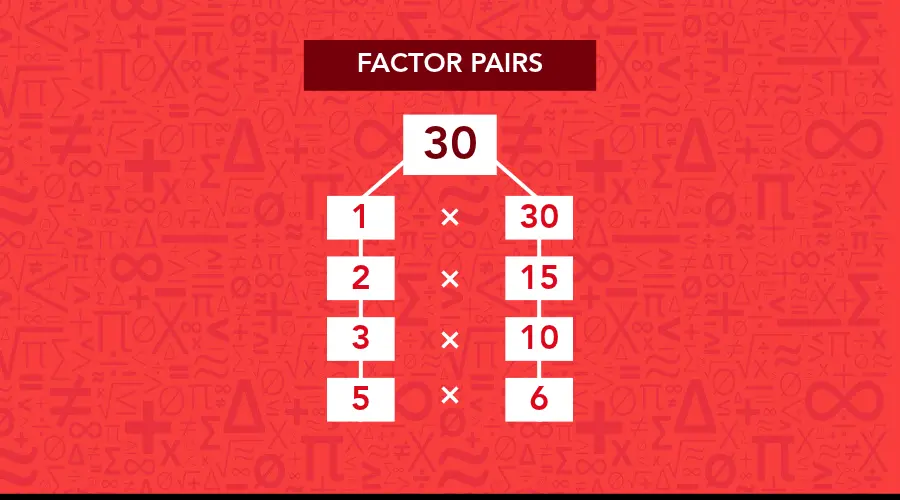
Ever wonder how to find every single factor of a number without worrying that you missed one? Factor pairs make this process straightforward for us. By treating factors as matching partners that multiply to the same total, we can test numbers systematically and know the exact moment to stop searching.
Today, our Mathnasium tutors cover what factor pairs are and how to find every one of them, step by step.

A factor is a whole number that divides evenly into another number, with no remainder left over.
Let's check this with 12. Does 3 divide evenly into 12?
Yes, it does, four times exactly. That makes 3 a factor of 12.
What about 5?
Divide 12 by 5, and we get 2 with a remainder of 2. That leftover tells us 5 is not a factor of 12.
So a quick way to test any number is to ask: Does it divide in cleanly, with nothing left over?
If we try every number from 1 to 12 this way, the ones that divide cleanly are 1, 2, 3, 4, 6, and 12. Those six numbers are the factors of 12.
📕 You May Also Like: What Is a Factor in Math? Explain It to a 9-Year-Old
A factor pair is two factors that multiply together to give a specific number.
Picture 12 desks in a classroom, and we need to arrange them into neat rows. We could set them up as 1 row of 12, 2 rows of 6, or 3 rows of 4. Each arrangement uses all 12 desks, just grouped differently.
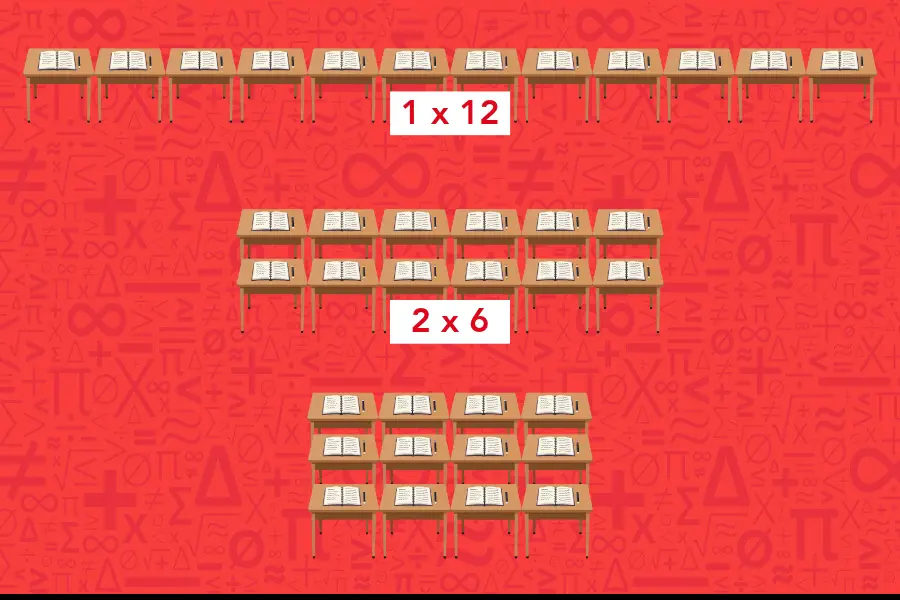
A factor pair works the same way. Two numbers multiplied together that reach the same total.
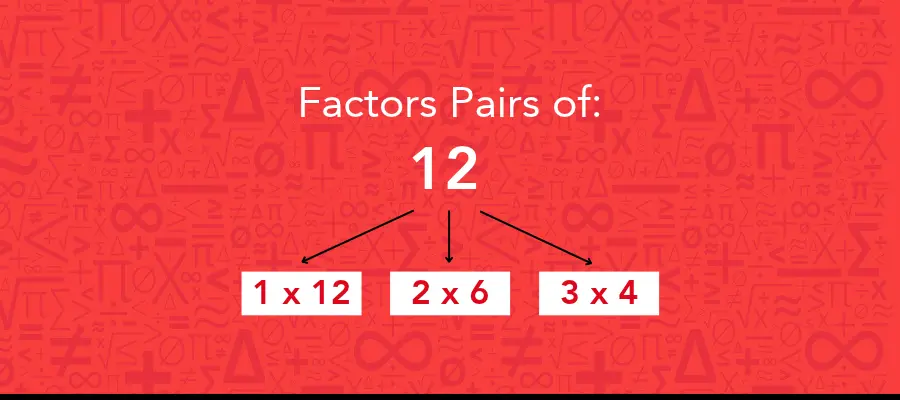
Let's write out every factor pair for 12:
1 × 12 = 12
2 × 6 = 12
3 × 4 = 12
Three pairs with six numbers in total, and every single one is a factor of 12.
Did you notice something here?
Every number in a factor pair already appeared on our factors list from the last section. That's not a coincidence. Factor pairs are simply factors matched up two at a time.

We find every factor pair of a number by testing numbers in order, starting at 1, and pairing each factor with its matching partner.
Here's the logic. Every time a number divides cleanly, we divide our starting number by it to get its partner. Together, they make a factor pair.
Let's try this with 18.
1 goes first. 18 ÷ 1 = 18. Nothing left over, so 1 divides in cleanly. That completes our first pair, 1 and 18.
Next up is 2. 18 ÷ 2 = 9. With no remainder, 2 is a factor too. Our second pair is 2 and 9.
Then we check 3. 18 ÷ 3 = 6, dividing in cleanly again. That gives us a third pair, 3 and 6.
4 comes next. 18 ÷ 4 = 4, remainder 2, so 4 doesn't make the cut.
5 follows. 18 ÷ 5 = 3, remainder 3, so 5 isn't a factor either.
6 is up after that, but 6 already showed up in our last pair, matched with 3.
A number that already appeared as someone else's partner tells us every pair from here on just repeats what we already found, in reverse order. That's our signal to stop.
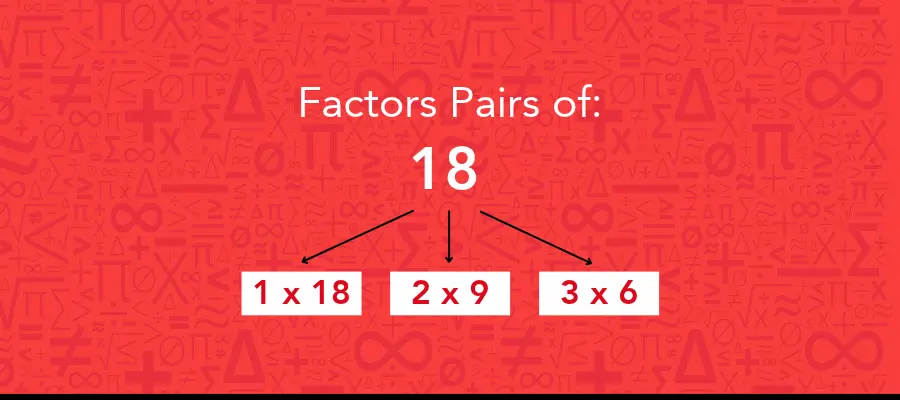
The factor pairs of 18 are 1 × 18, 2 × 9, and 3 × 6.
Now let's try a number where the stopping point looks a little different: 36.
We begin at 1. 36 ÷ 1 = 36, with nothing left over, so 1 is a factor. That's our first pair, 1 and 36.
2 divides in next. 36 ÷ 2 = 18, no remainder at all, giving us a second pair, 2 and 18.
We check 3 next: 36 ÷ 3 = 12, clean all the way through. Our third pair is 3 and 12.
Moving on to 4, we get 36 ÷ 4 = 9, another clean result. That's a fourth pair, 4 and 9.
We test 5 after that: 36 ÷ 5 = 7, remainder 1, so 5 isn't a factor.
Last, we test 6. 36 ÷ 6 = 6, dividing in with nothing left over.
This time, the factor pairs with itself. A number pairing with itself marks the middle of the full list, with no new pairs left to find beyond it.
The factor pairs of 36 are 1 × 36, 2 × 18, 3 × 12, 4 × 9, and 6 × 6.
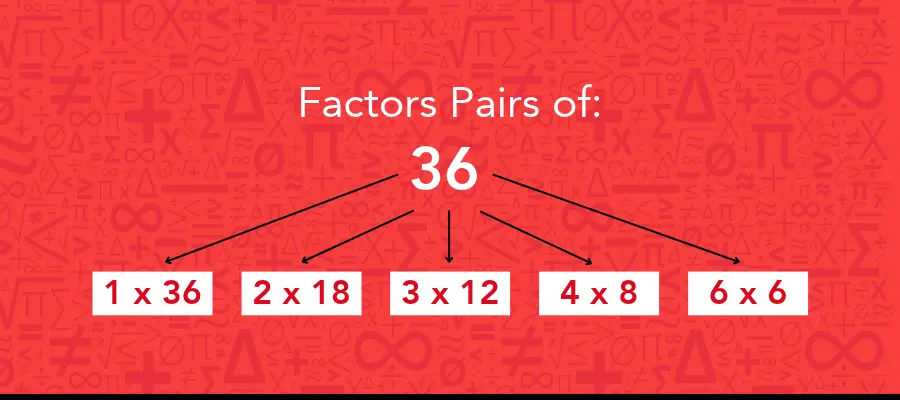
Two different numbers led to two different stopping points, but the same method carried us there both times. Start at 1, test every number in order, and pair each factor with its partner, until the pairs repeat themselves or meet in the middle.
📕 You May Also Like: Finding All the Factors of Any Number: A Kid-Friendly Guide
Factor pairs are important because they hand us a complete, reliable list of factors, exactly what we need the next time we simplify a fraction.
The Greatest Common Factor: To simplify a fraction, we need the greatest common factor, or GCF, the largest number that divides evenly into both the numerator and the denominator. We find it by comparing the factor lists of both numbers and picking the biggest one they share, the same lists our factor pairs already handed us.
A Faster, More Reliable Method: A random, number-by-number check leaves room for error. We might skip a number, check one twice, or miss one entirely. Factor pairs remove that risk. Every pair gives us a clear stopping point, either a repeated number or a number that pairs with itself, so we always know the exact moment we've found every factor.
📕 You May Also Like: What Is the Greatest Common Factor? A Complete Overview
Our tutors put together a practice set, one number for each level of difficulty.
Find every factor pair for each one below. Start at 1, test each number in order, and stop the moment a pair repeats or the pair lands on the same number twice.
20
28
48
64
The answers are at the bottom of the guide.

Mathnasium tutors use hands-on methods to help students find every factor pair with confidence and accuracy.
Mathnasium is a math-only learning center that helps K–12 students of every skill level learn and master math.
Students come to us at different points in their math journey. Some arrive working to master factors and factor pairs for the first time. Others are already past that point, ready to push further into fractions, the greatest common factor, and the algebra that builds on both.
Wherever a student is starting from, their path forward is built directly from that exact point.
We do that through the Mathnasium Method™, our proprietary teaching approach built around personalized learning and proven instructional techniques.
Here is what that looks like in practice:
Diagnostic Assessment and Personalized Learning Plans: Every student begins with a diagnostic assessment that identifies both visible skill gaps and the reasoning behind them. From that starting point, we build a personalized learning plan tailored to their needs and goals.
Teaching for Understanding: Our specially trained tutors use plain, everyday language and a mix of verbal, visual, mental, tactile, and written techniques, so concepts land in a way that makes sense to each student.
Problem-Solving and Critical Thinking: Our tutors know when to offer support and when to let a student work through a problem on their own. That balance builds lasting independence.
An Engaging and Fun Learning Environment: We design sessions to keep students motivated, and we celebrate every bit of progress along the way. Over time, students build a more positive relationship with math and greater confidence in their own abilities.
The results reflect that approach:
94% of parents report improvement in their child's math skills and understanding.
93% of parents report an improved attitude toward math after attending Mathnasium.
90% of students see improvement in their school grades.
We operate over 1,200 centers across North America, bringing our proven approach to communities everywhere.
Families across Simi Valley, Moorpark, Thousand Oaks, and the surrounding area can visit Mathnasium of Simi Hills, a trusted local center with a proven record of building confident math thinkers.
Whether your student is looking to catch up, keep up, or get ahead in math, our local team is happy to help.
📅 Schedule a Free Assessment at Mathnasium of Simi Hills
Not near Simi Hills?
📍 Find a Mathnasium Learning Center Near You
Here are the factor pairs for each number.
20: 1 × 20, 2 × 10, 4 × 5.
28: 1 × 28, 2 × 14, 4 × 7.
48: 1 × 48, 2 × 24, 3 × 16, 4 × 12, 6 × 8.
64: 1 × 64, 2 × 32, 4 × 16, 8 × 8.
Mathnasium of Simi Hills is a math-only learning center for K-12 students in Simi Valley, CA. Trusted by over a million parents, Mathnasium uses personalized learning plans and the proprietary Mathnasium Method™ to help students catch up, keep up, and get ahead on their math journey.
Our specially trained tutors deliver face-to-face instruction in a supportive and fun small-group environment, working with students both in center and online to develop a deep understanding of math, build confidence, and improve academic performance.
Schedule Free Assessment