Students first meet prime numbers in upper elementary, usually working with small, familiar numbers like 2, 3, 7, and 11. At that stage, it is easy enough to just remember them.
Then the numbers get bigger, and memorization stops working. Is 97 prime? What about 143? Suddenly "just knowing" is not an option anymore, and that is where a lot of students get stuck.
Don’t worry; you do not need to test every possible divisor to figure it out. There are a handful of quick checks that rule out most composite numbers in seconds, and we will walk you through all of them today.

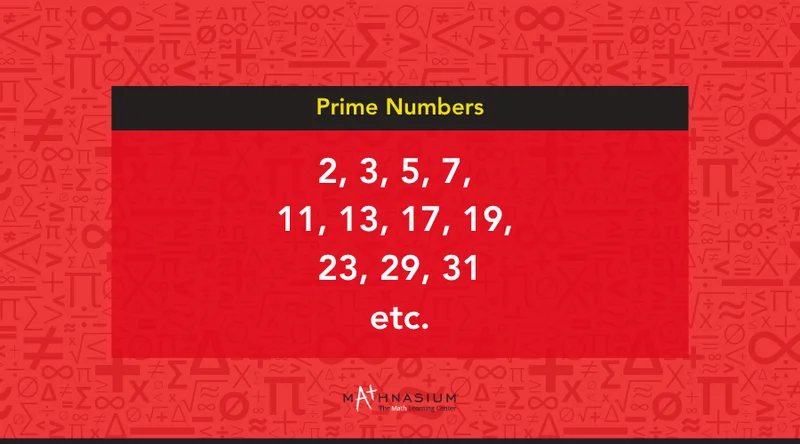
What Is a Prime Number? A Quick Recap
A prime number is a whole number greater than 1 that has exactly two factors, 1 and itself.
Factors are the numbers that divide evenly into a given number with no remainder. So when we check whether a number is prime, we’re asking: does anything divide into this number cleanly, other than 1 and the number itself? Any whole number greater than 1 that is not prime is called a composite number.
What about 1?
It has only one factor, itself. The definition of a prime number requires exactly two, so 1 is neither prime nor composite. It’s a special case that stands alone.
📕 You May Also Like: Why Is 1 Neither Prime nor Composite? A Complete Overview
How to Test Whether a Number Is Prime
When a number has three or four digits, listing every possible factor by hand may take too long. Instead, we can use a trial division method.
Trial division is a step-by-step way to test whether a number is prime. Here is how it works:
1. Test Prime Numbers in Order
Instead of trying random numbers, we test primes in order: 2, 3, 5, 7, 11, and so on.
If one of these primes divides the number evenly, we have found a factor, so the number is composite, and we can stop here. Otherwise, we need to proceed.
2. Watch for Factor Pairs That Repeat
We do not have to test prime numbers forever. Every factor pair has one smaller and one larger number. Once we've tested the smaller one, the larger one adds nothing new, we would have already caught it.
Take the number 91. We can write it as: 13 × 7 = 91. We would have discovered that 91 is divisible by 13 when we tested 7
📕 You May Also Like: What Is Prime Factorization? Explain It to a 10-Year-Old
3. Stop When the Division Answer Gets Smaller
As we test larger and larger primes, we can stop when the result of the division becomes smaller than the prime we are testing.
For example, suppose we want to test whether 97 is prime.
-
97 ÷ 2 = 48.5
-
97 ÷ 3 ≈ 32.3
-
97 ÷ 5 = 19.4
-
97 ÷ 7 ≈ 13.9
-
97 ÷ 11 ≈ 8.8
Notice what happens when we divide by 11. 97 ÷ 11 is about 8.8. The result is now smaller than 11, which tells us we have reached the stopping point.
From here, any new factor pair would only repeat the same numbers in reverse order. For example, a factor larger than 11 would need to pair with a factor smaller than 11. But we have already tested the smaller prime numbers and found no factors.
That means 97 can be divided evenly only by 1 and itself, so 97 is prime.
For most three-digit numbers, trial division is still reasonable to do by hand. We usually only need to test primes up to 31. For numbers bigger than three digits, the method still works, but there are too many steps to check comfortably by hand.
📕 You May Also Like: 3 Ways to Help Your Child Finally Understand Division
Quick Ways to Tell if a Number Is Divisible by a Prime
Before testing a number by long division, you can use a few quick checks to see whether it can be divided by certain prime numbers evenly. These checks can save time and help us spot factors more easily.
Check Divisibility by 2, 3, and 5
These three prime numbers, 2, 3, and 5, are fast enough to do in seconds, with no division needed:
-
Divisibility by 2: when the number is even, like 22, 40, 54, or 126, it is divisible by 2, so we know straight away it’s a composite number, unless the number itself is 2.
-
Divisibility by 3: to check whether a number is divisible by 3, add all its digits. If the sum is divisible by 3, then the original number is also divisible by 3. For example, 63 is divisible by 3 because 6 + 3 = 9 and 9 is divisible by 3. When the number is greater than 3, and its digits add to a multiple of 3, it is composite.
-
Divisibility by 5: We can say a number is divisible by 5 when it ends in 0 or 5. Why? Multiples of 5 always end in 0 or 5 (5, 10, 15, 20, 25, etc). So numbers, like 35 or 120, can be divided by 5 without a remainder. This means that any number greater than 5 and divisible by 5 is composite, as it has at least three factors: 1, itself, and 5.
After we rule out these three quick checks, we can move on to other primes.
Check Divisibility by 7
To test the prime number 7, instead of full long division, we can pull out a friendly multiple we already know, like 70, 140, or 210 for 7, and check what’s left over. When the leftover is also divisible by that prime, the whole number is. We informally call this technique chunking.
Let’s see whether 161 and 127 are divisible by 7, using the chunking method:
Is 161 divisible by 7?
-
Largest friendly multiple that fits: 140 (7 × 20)
-
161 − 140 = 21
-
Is 21 divisible by 7? Yes, 21 = 7 × 3.
-
161 = 7 × 23. Our number is composite.
Is 127 divisible by 7?
-
Largest friendly multiple that fits: 70 (7 × 10)
-
127 − 70 = 57
-
Is 57 divisible by 7? 57 ÷ 7 = 8.1... No.
-
127 is not divisible by 7. We need to keep going and check other primes.
In case no friendly multiple comes to mind, divide directly and check for a remainder of zero.
📕 You May Also Like: Divisibility Rule for 7: Definition, Practice, and FAQs
Check Divisibility by 11
For a three-digit number, there is a quick way to test divisibility by 11. We can add the first and third digits and then subtract the middle digit from the sum of the first and the third digits, if the difference is 0 or 11. If yes, the number is divisible by 11.
Is 143 divisible by 11?
-
First digit: 1. Third digit: 3. Sum: 1 + 3 = 4.
-
Middle digit: 4. Subtract the middle digit from the sum: 4 – 4 = 0.
-
143 = 11 × 13. The number 143 is composite.
Is 127 divisible by 11?
-
First digit: 1. Third digit: 7. Sum: 1 + 7 = 8.
-
Middle digit: 2. Subtract the middle digit from the sum: 8 – 2 = 6, which is not 0 or 11.
-
127 is not divisible by 11. We need to test other primes.
For numbers beyond three digits, we can chop into two-digit blocks from the right and add them. When the result is a multiple of 11, the number is too. Let’s check the divisibility by 11 for a five-digit number:
Is 15246 divisible by 11?
-
We chop it into blocks from the right: 1, 52, and 46. The front number can be single.
-
Then, we add the blocks: 1 + 52 + 46 = 99.
-
Is 99 a multiple of 11? Yes (11 × 9). So, 15,246 is divisible by 11 and is a composite number.
Check Divisibility by 13, 17, 19, 23, 29, and 31
To test divisibility by larger primes like 13, 17, 19, 23, 29, and 31, we can use the chunking method. With chunking, we break the number into a friendly multiple of the prime and a leftover.
The friendly multiple already works, so the leftover decides the answer. A leftover divisible by the same prime means the whole number is divisible by that prime too.
It is quite easy to find a friendly multiple for 7 because we can use the 7 times table. But what about primes larger than 11, like 13, 17, 19, 23, 29, or 31? A simple shortcut is to multiply the prime by 10 or 20. These targets are quick to calculate and give us friendly numbers to chunk from.
For example:
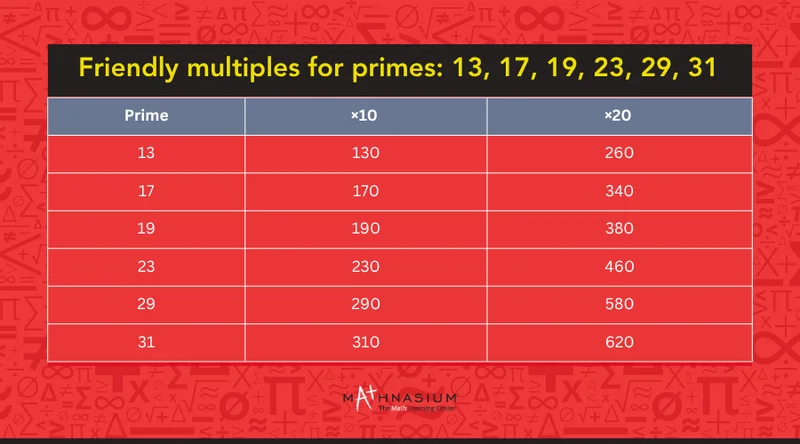
Now, we’ll work through the prime number 13. Friendly targets for 13: 130, 260, 390.
Is 221 divisible by 13?
-
Largest friendly multiple that fits: 130 (13 × 10)
-
221 − 130 = 91
-
Is 91 divisible by 13? 91 = 13 × 7. Yes.
-
221 = 13 × 17. The number is composite.
Is 127 divisible by 13?
-
The closest friendly multiple is 130, but it’s too big. The number 127 is close to 130, but it is 3 less: 130 − 3 = 127
-
Since 130 is divisible by 13, we only need to think about the leftover difference. The difference is 3, and 3 is not divisible by 13.
-
So, 127 is not divisible by 13 without a remainder.
Now, we need to check whether we can stop testing the primes, because 127 ÷ 13 equals around 9.7, which is less than 13. This means we have passed the point where new factor pairs could appear.
Any larger divisor would have to pair with a smaller number, and we have already checked the smaller possible factors. So 13 tells us we are done testing larger primes.
After checking all possible prime divisors for 127, we can say that 127 has only two factors: 1 and itself. That makes 127 a prime number.
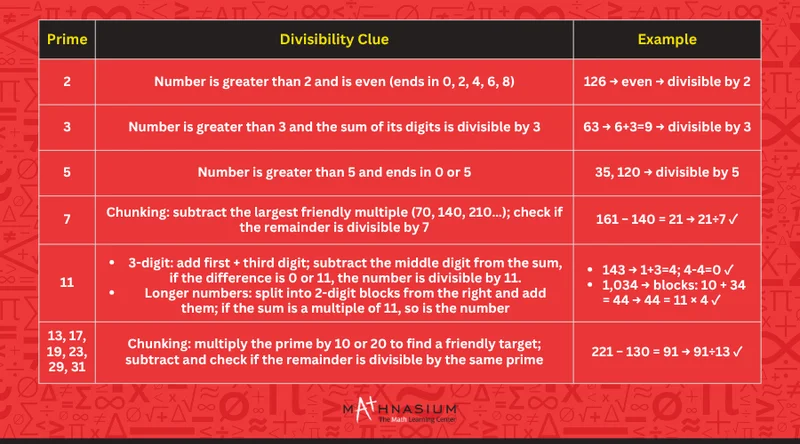
Your Prime-Testing "Cheat" Sheet
Use these divisibility clues to test any number for prime divisors without reaching for long division.
Testing If a Number Is Prime: Solved Example
Is 221 prime?
Let’s check if it has factors other than 1 and itself.
-
even? No.
-
divisible by 3? 2 + 2 + 1 = 5. Not a multiple of 3. No.
-
ends in 0 or 5? No.
-
divisible by 7? 221 − 140 = 81. 81 ÷ 7 = 11.6... No.
-
divisible by 11? 2 + 1 = 3. Subtract the middle digit from the sum: 3 – 2 = 1. Not 0 or 11. No.
-
divisible by 13? 221 − 130 = 91. 91 ÷ 13 = 7. Yes.
-
Including 13, 221 has at least 3 factors, which makes it a composite number. ✓

At Mathnasium, specially trained tutors meet each child exactly where they are, helping students build a solid understanding of prime numbers and how to identify them.
How Mathnasium Helps Students With Prime Numbers (And Any Other Math Topic)
Mathnasium is a math-only learning center dedicated to helping K–12 students of all skill levels excel in math.
To help students build a deep understanding of prime numbers and any other math concept, we use our proprietary teaching approach, the Mathnasium Method™.
Each student begins with a diagnostic assessment, which helps us identify their current skills, knowledge gaps, and how they think about math. From there, we build a personalized learning plan that targets their specific learning needs step by step, using the same clear, example-led approach we used today.
Our specially trained tutors deliver face-to-face instruction, in-center or online, using a mix of verbal, visual, written, tactile, and mental techniques. They give students room to think through problems independently, stepping in with the right question at the right moment to build both understanding and confidence.
Our approach also includes game-based activities and plenty of rewards to keep students motivated and engaged.
And the results? They speak for themselves:
-
94% of parents report improvement in their child’s math skills and understanding
-
93% of parents report a more positive attitude toward math after attending Mathnasium
-
90% of students saw improvement in their school grades
With over 1,100 learning centers across North America, there is likely a Mathnasium close to you.
For families in Arlington, TX, and the surrounding communities, Mathnasium of South Arlington brings that same approach close to home.
If your child needs structured support with prime numbers, factors, divisibility, or any other math topics, our team is ready to help.
📅 Schedule a Free Assessment at Mathnasium of South Arlington
Not near South Arlington?
📍 Find a Mathnasium Learning Center Near You


 (833) 579-6284