Math education took a hard hit in the wake of the pandemic, leaving many students struggling to regain lost ground. While recent results show signs of recovery, only 36% of Colorado elementary and middle school students are currently proficient in math.1
Contrary to what some might believe, regaining proficiency in math isn’t just about relearning formulas or memorizing steps. In our work with K-12 students at Mathnasium, we’ve seen that real progress often depends on something deeper: the ability to stay focused, work through frustration, and keep going when math gets hard.
To support families in Colorado and beyond, this guide explores what math stamina is, how to recognize when your child may need it, practical strategies to strengthen it at home, and how Mathnasium’s structured approach can reinforce those efforts over time.

What Is Math Stamina?
We find that naming concepts, whether they be challenges or even characteristics in this case, helps both kids and parents grasp the idea better, so let's talk about math stamina.
We define math stamina as the mental endurance it takes to stay engaged with a problem even when the solution doesn’t come quickly. It’s the difference between giving up at the first sign of difficulty and working through uncertainty with focus and determination.
Unlike rote memorization, which can fade under pressure, stamina supports deep understanding and lasting learning.
Psychologist Angela Duckworth says that grit, as she calls it, is critical in academic achievement, often more so than raw ability.2 In the context of math, that means students who persist through difficult concepts tend to see the greatest growth.
Think of two students working through a long division problem. One gets stuck midway and immediately shuts down, saying, “I’m just not good at this.” The other furrows their brow, erases a few steps, and tries a different approach. They may not get it right away, but they stay with it.
Over time, it’s the second student who builds both competence and confidence.
That kind of effort has a measurable impact on the brain.
Cognitive research shows that when kids stick with challenging math problems, it strengthens the brain’s problem-solving pathways.3 This process, called neuroplasticity, helps build and reinforce the areas of the brain responsible for memory, focus, and making sense of numbers.

Sticking with a problem step by step builds the persistence essential for long-term math success.
Spotting the Signs: How to Identify When Your Child Needs Stamina Support
Before students can build math stamina, it’s important to recognize when it’s missing. What may look like avoidance or frustration is often a sign of mental fatigue.
Based on our experience working with thousands of K–12 learners of all skill levels, here are several signs to watch for:
-
Rushing to Finish Without Checking Work: A common sign of low stamina is racing to the finish without thinking through each step. For example, when simplifying 2(x + 3) + 4(x – 1), a student might stop after distributing or guess an answer like 6x + 2, skipping steps to avoid the effort.
-
Avoiding Effort Altogether: Some students disengage the moment they see a problem that requires multi-step reasoning. This often happens with fractions, for instance, when presented with \(\Large\frac{3}{4}\) x 2\(\Large\frac{2}{3}\), a student might glance at the mixed number and say, “I don’t get this,” without attempting to convert or break it down.
-
Shutting Down After a Mistake: One wrong answer can cause a full stop. While working through 14 × 3 – 18 ÷ 6, a student might misapply the order of operations, subtracting before dividing, and get confused when the answer doesn’t make sense. Instead of rechecking their steps, they may go quiet or push the paper aside, feeling defeated before they’ve had a chance to recover.
-
Giving Up Midway Through Multi-Step Problems: Focus often fades when a task becomes more demanding partway through. In a problem like 587 ÷ 4, a student may begin long division confidently, but once a remainder appears or the steps start to feel repetitive, mental fatigue sets in. They lose focus or stop entirely, tapped out before the problem is complete.
📕 You May Also Like: Understanding Math Anxiety and How to Overcome It
Home Strategies to Foster Math Stamina
The first step is recognizing when stamina is lacking. The next is knowing how to help your child respond when math becomes difficult.
At Mathnasium, we’ve worked with thousands of students who’ve gone from avoiding challenges to tackling them with confidence. The strategies below reflect what we know works: practical ways to build focus and help kids stick with problems long enough to grow from them.
1. Break Problems into Smaller Steps
Educational psychology introduced the concept of scaffolding, a teaching strategy built on the idea that students benefit from temporary support as they take on tasks just beyond their current ability.4 One way this plays out in math is by breaking complex problems into smaller, more manageable parts.
Take \(\Large\frac{1}{2}\)+\(\Large\frac{1}{4}\).
A student might freeze, unsure how to start. But when the task is broken down, like visualizing each fraction as slices of a pizza, what once felt overwhelming becomes something they can approach step by step.
With repeated practice, this kind of structure helps students stay engaged longer and build confidence in their own reasoning.
📕 You May Also Like: 6 Activities to Strengthen Your Child’s Math Problem-Solving Skills
2. Use Visual Aids for Clarity
When math feels abstract, it becomes harder to stay with a problem. Visual aids, such as number lines, area models, or place value blocks, make ideas more concrete and reduce the mental effort needed to keep going.
By the way, if you’d like more ideas on how to use hands-on tools at home, we have a full guide on math manipulatives you might find helpful.
For example, plotting 3.5 miles on a number line helps anchor the value between whole numbers, reinforcing place value and scale. The clearer the representation, the less likely students are to disengage.
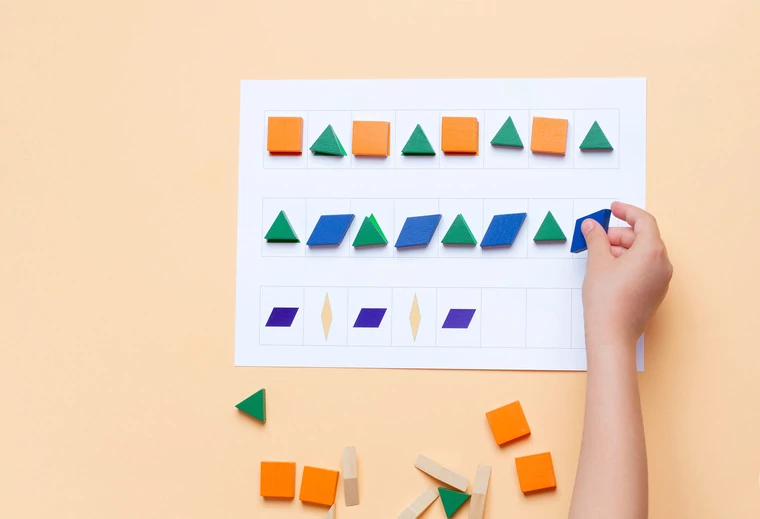
Hands-on tools help students visualize abstract math concepts, making ideas like patterns, grouping, and number sense easier to grasp.
3. Reframe Mistakes as Part of the Process
Mistakes are often the point where real learning begins. They reveal where a student’s understanding breaks down and offer a chance to rebuild it with better awareness.
Psychologist Carol Dweck’s research on growth mindset shows that students develop persistence when they learn to treat errors as a signal to reflect and adjust, not as a reason to stop.5
Take a student solving 36 × 4 and writing 124. Instead of jumping in with the right answer, guide them back with questions like:
-
“Let’s look at just one part. What’s 30 times 4?”
-
“You were close. I wonder if one step got skipped. Want to check the ones place?”
-
“This mistake actually tells us where your brain jumped ahead. That’s useful.”
When students are guided to re-engage without embarrassment or urgency, they learn to keep going even when the work doesn’t go perfectly.
📕 You May Also Like: A Parent’s Guide to Cultivating a Growth Mindset in Math
4. Connect Math to Real-Life Contexts
Abstract numbers can wear students down, especially when they don’t see a purpose behind the work. Math becomes easier to stick with when it feels grounded in something relevant or familiar.
Take ratios.
On paper, solving a problem like 2:3 = x:9 may feel like just moving numbers around. But when the same ratio is used to adjust a pancake recipe, 2 eggs for every 3 cups of flour, the numbers take on meaning.
Instead of checking out, the student has a reason to stay with the problem, because the outcome connects to something real.
5. Set Short, Timed Challenges
Multi-step problems are where focus tends to fade. Setting short, timed challenges helps students work through each part of a longer task without feeling overwhelmed by the whole.
Take a surface area problem for a rectangular prism. Instead of tackling the whole thing at once, set a timer for two or three minutes and focus only on finding the area of each face.
Once that’s done, take a quick break or review, then time the next part, adding the totals and labeling with correct units.
Segmenting the work this way trains students to stick with a task in manageable bursts while keeping their thinking sharp.
6. Encourage Verbal Reasoning
Explaining a math problem out loud helps students stay focused and work more deliberately through each step. It also reveals where their understanding breaks down.
For example, when solving an equation like 2x + 5 = 15, ask your child to walk you through what each part means and what they’d do first. Saying, “I need to subtract 5 from both sides to start isolating x,” activates reasoning and encourages persistence, even when the steps get more complex.

Talking through each step helps students clarify their thinking and stay engaged.
How Mathnasium Builds Resilience and Confidence in Math
As a math-only learning center, we’ve spent years helping students go beyond quick wins to develop real independence and long-term confidence. At the core of that growth is the Mathnasium Method™, our time-tested, personalized approach to teaching math.
It all begins with a diagnostic assessment that identifies each student’s strengths and areas for improvement. From these insights, we create a learning plan tailored to their specific goals.
Once the plan is in place, our tutors follow it closely, adapting instruction in real time. During sessions, we blend mental, verbal, visual, tactile, and written techniques to match how each child learns best.
When students are stuck, we break down problems into manageable bits. We also carve out time for students to work through problems on their own, then review their process together, because stamina is built not by giving answers, but by learning how to keep going when the work gets hard.
That approach delivers measurable impact:
-
94% of parents report improvement in their child’s math skills and understanding
-
93% of parents say their child’s attitude toward math improved
-
90% of students saw better grades in school
With over 1,000 centers nationwide, we bring this proven approach to communities across the country. For families in or near Westminster, CO, Mathnasium of South Westminster offers local expertise and a deep commitment to helping students reach their full potential.
📅 Schedule a Free Diagnostic Assessment at Mathnasium of South Westminster
Not near Westminster?
📍 Find Mathnasium Learning Centers Near You
References
-
The Colorado Sun PBC. (2025). MAP: Colorado student academic performance 2024-2025. The Colorado Sun. https://coloradosun.com/colorado-student-academic-performance-map/
-
Duckworth, A. (2016). Grit: The power of passion and perseverance. Scribner/Simon & Schuster. https://psycnet.apa.org/record/2016-30309-000
-
Menon, V., & Chang, H. (2021). Emerging neurodevelopmental perspectives on mathematical learning. Developmental Review, 60, 100964. https://doi.org/10.1016/j.dr.2021.100964
-
Wood, D., Bruner, J. S., & Ross, G. (1976). The role of tutoring in problem solving. Child Psychology & Psychiatry & Allied Disciplines, 17(2), 89–100. https://doi.org/10.1111/j.1469-7610.1976.tb00381.x
-
Dweck, C. S., & Yeager, D. S. (2019). Mindsets: A view from two eras. Perspectives on Psychological Science, 14(3), 481–496. https://doi.org/10.1177/1745691618804166


 (720) 524-4533
 (720) 524-4533