With the first quarter coming to a close in Sparta, your child’s first math report card gives you a clear picture of how they are handling the year’s math. It covers enough units to show a pattern, and it arrives early enough to act on it.
Whether the results met your expectations or revealed areas for growth, they offer valuable insight. With the right approach, you can build a plan to continue the good progress, address skill gaps, and prepare your student for what lies ahead.
To help you put that plan together, our team at Mathnasium of Sparta has outlined how to interpret math results and what steps to take in November for a successful second quarter.

1. Look Beyond the Report Card Grade
For families in Sparta Township Public Schools, the district’s Parent Resources page brings together links to the Genesis Parent Portal and standards-based report card information.
Start there to access the school’s resources, then review your child’s report card alongside recent math tests, quizzes, and homework.
Look for a pattern rather than focusing on the overall grade:
-
Where is your child doing well?
-
Does the same type of mistake appear across several assignments?
-
Are points being lost on incorrect answers, unfinished work, or both?
A or B alone won’t tell you whether your child struggled with one unit or needed help throughout the quarter. The schoolwork gives you something more specific to discuss.
Then reach out to your child’s math teacher with what you noticed. Instead of asking only how to improve the grade, try:
“We noticed repeated mistakes on fraction problems. Are you seeing the same difficulty in class, and which skill would you recommend we work on first?”
Compare the teacher’s feedback with the work you reviewed. Use that conversation to choose one clear starting point for your child’s plan.

2. Make a Focused Plan
Use what you learned from your child’s schoolwork and teacher to choose one priority for the second quarter. The plan should name what your child will work on, how they will get help, and when you will check progress.
-
Your child is doing well: Ask the teacher whether your child would benefit from reviewing a particular skill or taking on a new challenge. The goal is continued growth, not extra work for its own sake.
-
One skill needs attention: Make the goal specific. If the teacher identified comparing fractions with different denominators as the difficulty, write that down rather than “get better at fractions.”
-
Several skills need attention: Ask the teacher which one matters most for the upcoming classwork. Start there instead of trying to address everything at once.
We suggest keeping the plan simple enough for you and your child to follow. Here’s an example:
-
Goal: Compare fractions with different denominators independently.
-
Next step: Ask the teacher for practice problems that match this skill.
-
Progress check: Review new schoolwork together on an agreed date.
Before choosing that date, check the Sparta Township Public Schools district calendar, linked from the district website, alongside any upcoming assignments your child’s teacher has shared. Pick a time when you will have new work to review, rather than waiting for the next report card.
📕 You May Also Like: How to Turn Math Report Cards into Action Plans
3. Make Practice Targeted
After identifying the skill your child needs to work on, set up a practice routine with a regular time, manageable sessions, and problems that match the goal.
We recommend short practice sessions on a few school nights rather than one long session on the weekend. Try 15 minutes to start, and adjust based on how your child is managing. Spreading practice out also aligns with the Institute of Education Sciences’ recommendation to space learning over time to help students remember what they’ve learned.
Pick a time that fits your family’s routine, then give each session a clear purpose:
-
Match the problems to the goal: If your child is working on comparing fractions, choose a few problems that address the specific difficulty you identified with the teacher.
-
Ask your child to explain one solution: Try “How did you decide where to start?” or “Why does that step work?” If they get stuck explaining, ask them to show you what they mean.
-
Use a picture or objects when helpful: Draw equal-sized fraction bars, place fractions on a number line, or divide objects into equal groups. Have your child connect what they see to the written problem.
Before ending, point out something specific your child did more independently and note what to revisit next time. If the same step keeps causing difficulty, save an example to share with the teacher rather than simply adding more problems.
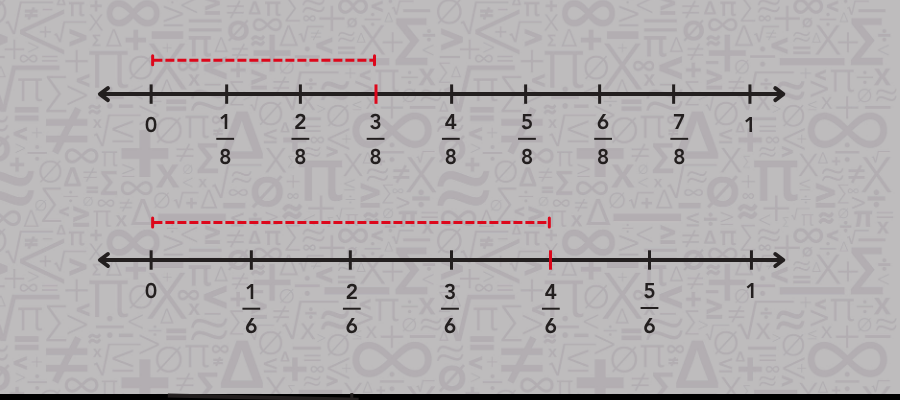 Visual and hands-on support, such as placing fractions on a number line, can help your child make sense of the math they’re practicing.
📕 You May Also Like: 5 Morning Routines for Math Success in the New School Year
 Short, 15-to-20-minute daily math practice sessions help students stay focused.
4. Help Your Child Take Ownership of the Plan
Give your child a say in how the plan will work. A review of 41 studies published in Psychological Bulletin found that offering choices can improve motivation and effort. You can still set expectations while letting your child help decide how to meet them.
Start with the schoolwork you reviewed, and keep the conversation focused on what would help, rather than what went wrong. Point to a specific example and ask, “Which part felt difficult?” or “What would make this easier to practice?”
Then involve your child in a few manageable decisions:
-
Choose a practice time together. Offer two options that work for your household, such as after a snack or before dinner.
-
Ask how they would like to work on the skill. For a fraction problem, they could try drawing a model or using objects to show their thinking.
-
Let them track completed sessions. A simple calendar gives your child a place to check off each practice session and see the effort they have put in.
During your progress check, point out specific changes. Instead of “You’re doing better,” try, “Last week, you needed help finding a common denominator. Today, you did that part on your own.”
Ask your child what they notice, too. What feels easier? Where do they still want help? Their answers can help you adjust the plan together, rather than leaving them with a routine they had no part in choosing.
📕 You May Also Like: How Positive Math Talk Encourages a Growth Mindset at Home
 When home practice stalls, structured math tutoring can help students close math skill gaps and build long-term confidence.
5. Consider Structured Support if Progress Stalls
Some gaps do not close with home practice alone, especially when a math skill depends on an earlier concept your child never fully learned. If your child is still frustrated with their math grade after a few weeks of following the plan, it may be time to consider structured math tutoring.
A structured math tutoring program may include:
-
An overall assessment of your child’s skills
-
A long-term plan for skill building
-
Regular progress checks
-
Adjustment of pace to your child’s needs
Students in Sparta and across Sussex County can find that kind of support at Mathnasium of Sparta. Our math-only learning center begins each student’s tutoring with a diagnostic assessment to identify their current skills and knowledge gaps.
From those insights, we create a personalized learning plan built around their exact needs, whether that means closing gaps, improving fluency with certain skills, or moving ahead.
📕 You May Also Like: 5 Benefits of Face-to-Face Math Tutoring
 Every student at Mathnasium begins with a diagnostic assessment that helps us understand their current skill level, knowledge gaps, goals, and how they think and feel about math.
How Mathnasium of Sparta Supports Year-Round Math Success
Mathnasium of Sparta is a math-only learning center dedicated to helping K–12 students of all skill levels excel in math. We’re part of a network of over 1,200 learning centers across North America.
We regularly help students from Sparta and all of Sussex County reach their math goals, whether they’re catching up on foundational skills, keeping up with math coursework in Sparta schools, or getting ahead with more advanced topics.
To meet those varying needs, we personalize each student’s learning experience through the Mathnasium Method™, our proprietary teaching approach built around individualized learning plans and proven teaching techniques.
Here’s how it works.
Each student begins with a diagnostic assessment that helps us understand their current skill level, knowledge gaps, goals, and how they think and feel about math. From those insights, we build a personalized learning plan aligned with your student's specific needs. For example, if your child's first-quarter grades fell short of expectations, their tailored plan might target foundational fraction concepts or prerequisite algebra skills that currently hold back their progress.
Our specially trained tutors follow that plan closely and provide live, face-to-face instruction in a caring and fun group environment. They use verbal, visual, mental, tactile, and written techniques to help students make sense of each math concept.
Students also get room to think through problems before tutors step in. Our tutors guide them to explain their reasoning, check their work, and choose effective strategies, which builds problem-solving and critical thinking skills. Homework help is built into every session once the day’s learning plan topics are done, so school assignments get support too.
Fun is an important part of the approach, too. We use game-based activities, rewards, and consistent encouragement to keep students engaged as they close gaps and rebuild confidence.
The results? Measurable progress:
-
94% of parents report an improvement in their child’s math skills and understanding
-
93% of parents report their child’s improved attitude toward math after attending Mathnasium
-
90% of students saw an improvement in their school grades
Whether your student is looking to catch up, keep up, or get ahead in math, our dedicated team is happy to help.
📅 Schedule a Free Assessment at Mathnasium of Sparta
Not near Sparta?
📍 Find a Mathnasium Learning Center Near You


 (973) 726-6284
 (973) 726-6284