We understand that report cards can feel high-stakes, particularly in math, where each concept builds on the last. A shaky grasp of fractions today can lead to challenges with algebra down the line.
With the introduction of Common Core, students are expected to do more than memorize steps or formulas. Now, math grades reflect how well they understand the ideas, explain their thinking, and apply what they’ve learned in new ways.
So when a grade falls short of expectations, it rarely means a student “isn’t good at math.” More often, it means a concept hasn’t fully clicked yet.
A report card works best as a guide. By focusing on what the grade reveals rather than how it feels, families can identify where to reinforce learning and help students rebuild confidence step by step.
Today, our tutors are breaking down what math report cards really tell you and how to turn that feedback into a clear, actionable plan for lasting progress in math.

What Today’s Math Grades Really Measure
Since the adoption of Common Core standards, math grades have come to reflect more than just correct answers. Today’s report cards are designed to show how well students understand core ideas, explain their thinking, and apply math in new situations.
Instead of a single number or letter, schools record progress across several strands. Teachers may note separate marks for accuracy, reasoning and problem solving, and participation or class habits.
Here are three key components that often shape how math understanding is assessed:
1. Conceptual understanding: Does your child see why a method works? For instance, do they understand what dividing by a fraction means, or have they only memorized “flip and multiply”?
2. Procedural fluency: Can they follow the right steps quickly and accurately? The National Council of Teachers of Mathematics defines fluency as a balance of efficiency, flexibility, and appropriate strategy.
3. Application and problem solving: Can they apply math to new situations, such as multi-step word problems or graph interpretation, where they must decide which concept fits best?
Look at it this way: two students might both earn a “C,” but for completely different reasons.
One may understand the concepts but work slowly, losing points to small mistakes under time pressure. The other may finish quickly but struggle to explain their thinking or set up problems independently.
The letter grade doesn’t capture those differences. The real insight often comes from the teacher’s comments and the rubric. Those brief notes can reveal how your child is thinking about math and where they might need more support.
📕 You May Also Like: How to Track Your Child's Math Progress in Grades 1-8
How to Interpret Teacher Comments on Math Report Cards
Teacher feedback often says more than the grade itself. Each report card comment points to a specific type of learning need. When parents understand what those comments really mean, it becomes easier to take the right next steps.
1. “Needs More Confidence”
This often means your child is unsure about key math concepts and hesitates to begin or complete problems independently.
You might notice them waiting for help, second-guessing correct answers, or avoiding challenging problems altogether.
To you as a parent, this should not be read as a sign they’re “not a math person.” It’s more often a signal that something hasn’t fully clicked yet, and the hesitation is showing up before the understanding hasn’t had a chance to settle.
📕 You May Also Like: Building Confidence in Math: How Tutoring Can Help
2. “Careless Errors” or “Rushing on Tests”
This usually means your child understands the steps but struggles to carry them out reliably under time pressure.
You might see small mistakes, like misreading a number, skipping a step, or writing something down incorrectly.
These aren’t signs of not knowing the math; they point to procedural fluency, which is the ability to follow a process accurately and consistently. When that fluency is still developing, small errors are common, even when the overall understanding is there.
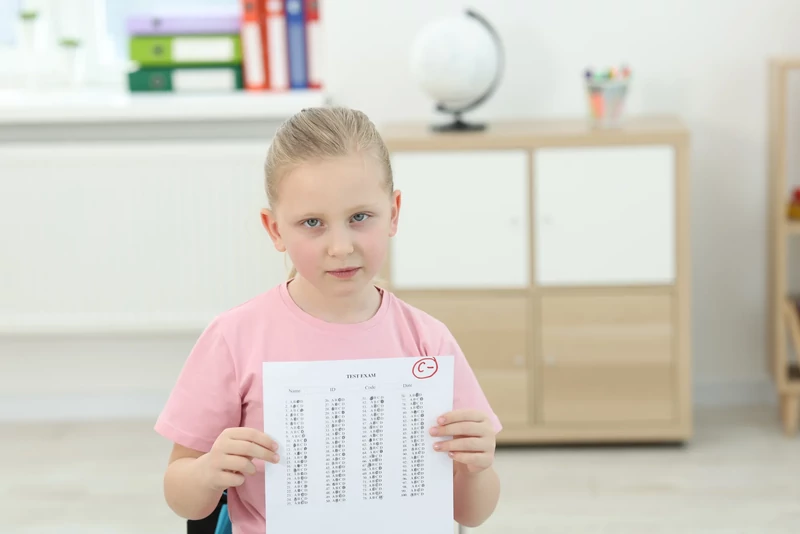
A few rushed mistakes can turn into a grade that doesn’t reflect what your child actually knows.
3. “Struggles with Key Concepts”
This kind of comment usually points to a gap in conceptual understanding, the ability to grasp how and why a math idea works.
Key concepts might include place value, number patterns, the relationship between multiplication and division, or what an equation represents.
A student may remember a rule but be unsure when to use it or what it really means. Without that solid understanding, it becomes harder to explain reasoning or apply ideas in new situations.
4. “Has Trouble Explaining Thinking”
This usually means your child can solve a problem but has difficulty putting their reasoning into words.
They may know what to do but struggle to explain why it works, how they chose a method, or what the answer means. Even when the understanding is there, not being able to explain it often signals that it hasn’t fully settled.
This kind of comment is also tied to conceptual understanding, just from a different angle. It reflects how well a student can connect their ideas and communicate them clearly.
📕 You May Also Like: How to Nurture Math Thinkers, Not Just Answer-Getters
From Report Card to Next Step: What to Do With the Feedback
Even though a report card may show where your child currently stands in math, it may also hint at where to go next.
When read carefully, the grades and comments can guide you toward a smarter, more focused response.
Let’s look at 6 strategies for using report card feedback to shape your child’s next steps in math:
1. Start with a Conversation, Not a Lecture
When a report card brings unexpected results, such as a lower grade or a worrying comment, it’s natural to feel concerned. But before jumping into problem-solving, begin with a calm conversation. Ask open-ended questions like:
“What’s been feeling hard in math lately?”
“Is there a part that feels easier than it used to?”
“Do you feel stuck, or just unsure of how to start sometimes?”
Your child’s answers may reveal what the report card doesn’t: whether they’re anxious about math or frustrated by certain topics. Starting with their perspective turns the report card from a judgment into a conversation.

Start with a conversation—your child’s mindset matters more than the numbers on the page.
2. Request a Parent-Teacher Conference If the Feedback Is Vague
Some report card comments, like “needs improvement” or “struggles with problem-solving”, can leave you guessing. If the feedback feels too general to act on, don’t hesitate to reach out. A quick conference or email exchange with your child’s teacher can help clarify:
• Which specific skills or concepts need attention
• What the teacher is seeing during math lessons
• How your child responds to different kinds of problems
This gives you a more complete picture of your child’s progress and helps you target support more effectively without having to interpret vague comments on your own.
📕 You May Also Like: How Parents, Teachers, and Tutors Can Empower Math Success
3. Focus on One Concept at a Time
When a report card points to several areas of concern, it’s tempting to try and tackle everything at once. But progress is more likely when you slow down and choose one concept to work on first, ideally the one that seems to trip your child up the most in classwork or homework.
For example, if your child is having trouble with multi-digit multiplication, check whether they’re still unsure about place value or basic facts.
Sometimes what looks like a new skill issue is really a sign that something earlier didn’t fully stick. Starting at the right level can make a big difference.
Sticking with one focus allows your child to build confidence, not just familiarity. Mastery grows faster with depth than with scattered review.
📕 You May Also Like: Is My Child “Bad at Math” or Missing Foundational Skills?
4. Use Low-Pressure Practice to Rebuild Fluency
If the report card mentions small mistakes, rushing, or inconsistent accuracy, your child may be struggling with fluency: knowing the steps, but not yet using them reliably.
In these cases, piling on extra homework rarely helps. What they need is low-pressure repetition in a calmer setting.
Set aside a few minutes each day for focused, judgment-free practice. Keep it short and predictable, just enough to build comfort, not stress. Some simple ways to do this include:
• Reviewing just 2–3 problems on paper without a timer
• Playing a math card game that reinforces facts or operations
• Using flashcards for number sense or math vocabulary
• Having your child talk through a process out loud (e.g., “how would you solve this?”)
• Practicing one skill across a few different formats (word problem, diagram, equation)

Low-pressure practice helps build fluency without the stress of worksheets or grades.
5. Ask “Why” and “How” During Practice, Not Just “What’s the Answer?”
If your child’s report card mentions trouble explaining their thinking, it often means they understand the steps but haven’t fully grasped the reasoning behind them.
Encouraging verbal explanation during homework helps strengthen that connection.
Try asking questions like:
• “Why did you choose that strategy?”
• “How do you know that answer makes sense?”
• “Could you explain this to someone else?”
You don’t need to know the math yourself to ask these questions. The goal is to help them think through what they’re doing. Learning to reason through math builds the conceptual understanding that’s central to Common Core.
6. Consider Targeted Tutoring for Persistent Gaps
If your child continues to struggle with a concept after several weeks of focused effort at home or if the same comments keep appearing across multiple report cards, it may be time to bring in outside support.
Efficient tutoring goes beyond reteaching lessons to pinpoint where the breakdown happened, explain the concept in a new way, and guide your child through steady, structured practice that builds real confidence.
One-on-one or small-group instruction can also help your child slow down, ask questions they might not feel comfortable asking in class, and reconnect with the material at their own pace.
Structured programs like Mathnasium’s can be helpful because they follow a clear, personalized learning plan based on diagnostic insight. This approach helps ensure the focus stays on what matters most: building skills that support long-term progress.
📕 You May Also Like: Why Personalized Math Tutoring Makes All the Difference
How Mathnasium Helps Build the Right Plan for Your Child
When report cards keep pointing to gaps, whether it’s poor conceptual understanding, weak fluency, or difficulty applying math to real-world situations, Mathnasium can help.
What’s our action plan?
It’s called a personalized learning plan, and it’s part of our broader teaching approach known as the Mathnasium Method™.
Everything starts with a diagnostic assessment: a clear window into what your child already understands, what needs reinforcement, and how they learn best, whether through visual models, hands-on learning, verbal explanation, or written practice.
With assessment-based insights, we create a learning plan tailored to your child’s specific needs, whether that means catching up on key number sense skills, building algebra readiness, or closing long-standing gaps.
Once the plan is in place, our specially trained instructors deliver face-to-face math instruction in an engaging, supportive setting designed to build both skills and confidence.
To adapt to each student’s learning style, we use a mix of verbal, mental, visual, tactile, and written techniques along with a blend of Socratic questioning and direct instruction. The goal isn’t just to find the answer, but to understand the how and why behind each concept.
As students work with our instructors, they begin to develop the critical thinking and problem-solving tools that serve them not only in math, but in all areas of learning.
Our approach brings visible results:
• 94% of parents report an improvement in their child's math skills and understanding
• 93% of parents report an improved attitude towards math after attending Mathnasium
• 90% of students saw an improvement in their school grades

At Mathnasium of Cherry Creek, multisensory strategies, tailored pacing, and positive reinforcement turn mistakes into growth and build lasting confidence.
With over 1,100 centers nationwide, Mathansium brings this proven approach close to your neighborhood.
Mathnasium of Cherry Creek is a trusted center, proudly serving Denver neighborhoods. With years of experience helping students strengthen not just their math skills, but their confidence and outlook, our work is widely recognized in the community.
Read how one parent described their child’s experience at Mathnasium of Cherry Creek:
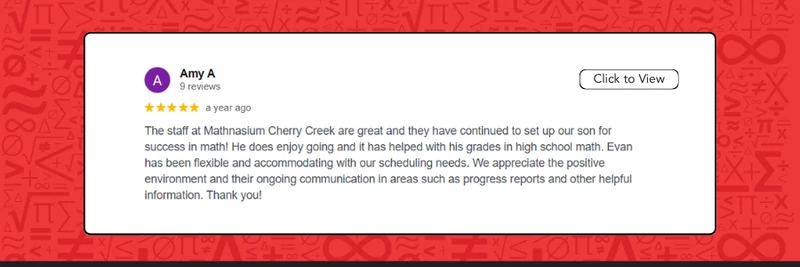
If you’re looking to turn report card comments into meaningful progress, reach out to our center. We’ll create a personalized action plan that meets your child right where they are and helps them move forward with confidence.


 (303) 333-6284
 (303) 333-6284