Linear pairs are one of the most specific and useful angle concepts we encounter in geometry. After we understand what makes a linear pair different from other angle relationships, we can use it to solve for missing angles and recognize it in real-world situations.
Today, Mathnasium tutors will walk you through what a linear pair of angles is, how it compares to supplementary angles, how to use it to find missing angles, and where it shows up in everyday life.

What Is a Linear Pair of Angles?
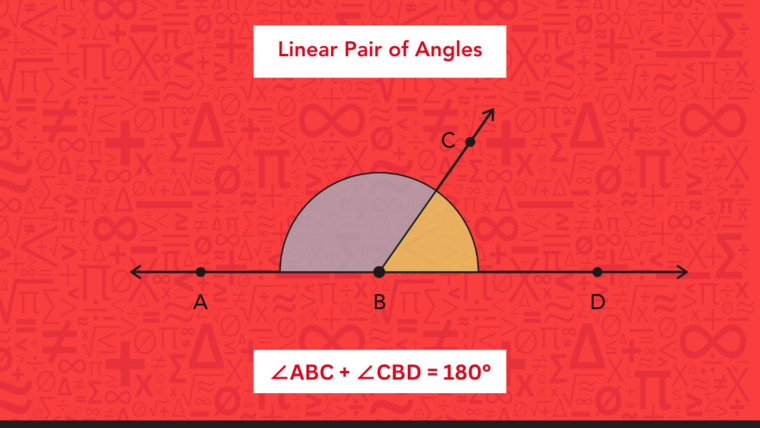
A linear pair consists of two adjacent angles whose non-common sides form a straight line.
To qualify as a linear pair, three things must be true at the same time:
-
Adjacent: The two angles share a common vertex and a common side (ray).
-
Non-common sides form opposite rays: The outer edges of the two angles stretch in opposite directions, forming a perfectly straight line.
-
Sum equals 180 degrees: Because their non-common sides form a straight line, the two angles always add up to exactly 180 degrees. This property is formally called the Linear Pair Postulate.
Most students encounter linear pairs in Grade 7 geometry when they begin using angle relationships to find missing angle measures and solve simple equations.
📕 You May Also Like: Types of Angles: How to Identify Straight, Right, Acute, and Obtuse Angles?
Linear Pair vs. Supplementary Angles: What's the Difference?
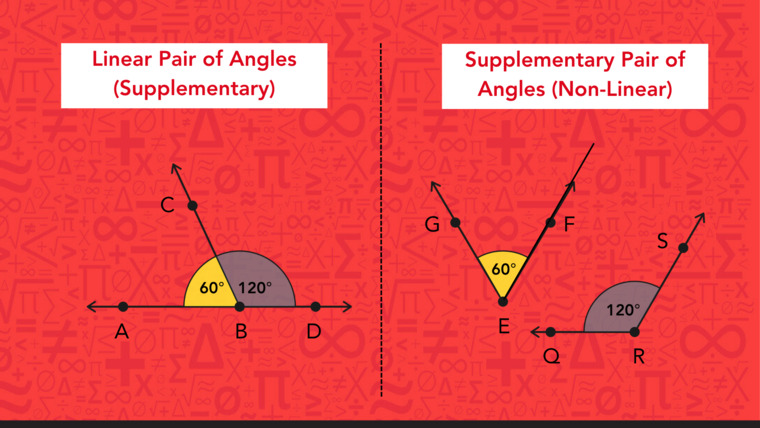
Every linear pair is supplementary, but not every pair of supplementary angles qualifies as a linear pair.
Both relationships involve two angles that add up to 180 degrees. The main difference is that supplementary angles do not need to touch each other.
Let's take a closer look at how the two compare.
| Feature |
Linear Pair |
Supplementary Angles |
|
Must be adjacent
|
Yes, share a vertex and a side
|
No requirement
|
|
Non-common sides
|
Form opposite rays (straight line)
|
Any orientation
|
|
Sum
|
Always 180 degrees
|
Always 180 degrees
|
|
Relationship
|
Always supplementary
|
May or may not be a linear pair
|
A linear pair is a specific type of supplementary angle relationship. What sets it apart is that the two angles must be adjacent.
📕 You May Also Like: Complementary and Supplementary Angles - A Complete Guide
Linear Pairs in Everyday Life
Linear pairs appear in objects and situations we encounter every day. We’ll share a few examples:
| Example |
Why It Is a Linear Pair |
| Open scissors |
The two blades form adjacent angles on a straight line, always summing to 180 degrees |
| Clock at 6:00 |
The two hands point in opposite directions to form a straight line, splitting the clock face into two side-by-side halves |
| T-junction road |
Two roads meeting a straight road create adjacent angles summing to 180 degrees |
| Straight pizza cut |
One straight slice across the whole pizza makes a flat line. A second cut, starting from the very center out to the crust, splits that line into two side-by-side angles |
📕 You May Also Like: Math for Life: Why Math Skills Matter Beyond School
How to Find a Missing Angle in a Linear Pair
Our tutors at Mathnasium love to move from visual understanding to problem-solving. Now that we know how linear pairs work, we can use that relationship to solve for missing angles.
Let's put what we've learned into practice.
Example 1: Arithmetic Approach
We will start with a simple example:
Angle A and Angle B form a linear pair. Angle A measures 115 degrees. Find Angle B.
Step 1: Write the relationship.
Angle A + Angle B = 180°
Step 2: Substitute the known value.
115° + Angle B = 180°
Step 3: Solve for the missing angle.
Angle B = 180° − 115° = 65°
Check: 115° + 65° = 180°
Once we become comfortable finding a missing angle, we can use the same idea with algebraic expressions.
Example 2: Algebraic Approach
Now, let's look at a problem that includes a variable. The process is the same, but we first need to solve an equation before finding the angle measures.
Angle 1 = 2x and Angle 2 = 3x − 5. The two angles form a linear pair. Find x and both angle measures.
Step 1: Write the relationship.
2x° + (3x − 5)° = 180°
Step 2: Combine like terms (2x, 3x).
5x° − 5° = 180°
Step 3: Add 5° to both sides.
5x° = 185°
Step 4: Divide both sides by 5.
x = 37
Step 5: Substitute the value of x back into both expressions.
Angle 1 = 2(37) = 74°
Angle 2 = 3(37) − 5 = 106°
Check: 74° + 106° = 180°
📕 You May Also Like: How to Solve Basic Equations — A Parent and Student Guide
Quick Checklist: Is It a Linear Pair?
Not sure whether two angles form a linear pair? We put together a quick checklist that can help you.
| Question |
Yes / No |
| Are the two angles adjacent? |
□ |
| Do their non-common sides point in opposite directions? |
□ |
| Do the non-common sides form a straight line? |
□ |
| Do the two angles add up to 180°? |
□ |
If the answer to all four is yes, the angles form a linear pair.
📕 You May Also Like: What Is a Vertex? Everything You Need to Know
FAQ About Linear Pairs
Let's wrap up today’s topic with a few common questions Mathnasium tutors often answer about linear pairs.
1. Can a Linear Pair Include Two Right Angles?
Yes. Two right angles, each measuring 90 degrees, can form a linear pair. Since 90° + 90° = 180°, all the requirements are met as long as the angles are adjacent, and their non-common sides form a straight line.
2. How Many Linear Pairs Form When Two Lines Intersect?
Two intersecting lines create four angles. Those four angles form four linear pairs because each angle forms a linear pair with the two angles next to it. Students who recognize this pattern find it easier to identify all angle relationships at an intersection at once.
3. What Is the Difference Between Vertical Angles and a Linear Pair?
Vertical angles are the opposite angles formed when two lines intersect. They are equal in measure rather than supplementary. A linear pair consists of adjacent angles that sum to 180 degrees. Both concepts involve the same intersection but describe different angle relationships within it.
📕 You May Also Like: 10 Geometry Concepts Students Should Master Before 10th Grade
 At Mathnasium, students learn to recognize geometry concepts through visual models, guided practice, and problem-solving.
How Mathnasium Supports Students in Geometry and Beyond
Mathnasium is a math-only learning center dedicated to helping K–12 students of all skill levels excel in math.
Whether students are working to understand foundational angle relationships, strengthen their geometry vocabulary, or tackle algebraic applications of geometric concepts, we can support them.
Our proprietary teaching approach, the Mathnasium Method™, is designed around each student's needs and learning style.
To help students build a deep understanding of any math or geometry concept, our approach includes:
-
Assessment and Personalized Learning Plans: Each student starts with a diagnostic assessment that identifies current skills, strengths, and gaps. From those findings, we build a personalized learning plan tailored to their goals, whether that means strengthening foundational angle concepts, improving algebraic problem-solving, or preparing for more advanced geometry.
-
Teaching for Understanding: Our specially trained tutors use natural language and a mix of verbal, visual, mental, tactile, and written techniques so each concept lands before we move forward.
-
Problem-Solving and Critical Thinking: We allow time for students to work through problems on their own. That productive struggle helps them learn to trust their own reasoning. When we do step in, we explain both the how and the why behind each answer, so students build problem-solving and critical thinking skills they can use in math and beyond.
-
An Engaging and Fun Learning Environment: Sessions include games, earned rewards, and consistent celebration of progress. Students build confidence alongside stronger math skills, and many develop a more positive relationship with math over time.
Our students' results reflect what personalized instruction can do:
-
94% of parents report improvement in their child's math skills and understanding
-
93% of parents report an improved attitude toward math after attending Mathnasium
-
90% of students saw improvement in their school grades
With over 1,100 learning centers across North America, there is likely a Mathnasium close to you.
Families across St. George and nearby areas, including Washington, Santa Clara, Ivins, and Hurricane, trust Mathnasium of St. George to help their children build lasting math confidence at every level.
If linear pairs or any other geometry concept is giving your child trouble, our team is ready to help.
📅 Schedule a Free Assessment at Mathnasium of St. George
Not near St. George?
📍 Find a Mathnasium Learning Center Near You


 (435) 767-0335
 (435) 767-0335