When we ask students to calculate the area of a triangle, they usually reach for the formula they've learned by heart: half the base times the height.
And that is great! But what happens if we do not have the height? What happens if we have the lengths of all three sides, or perhaps three points plotted on a graph, instead?
Today we're building up two more methods for exactly those situations, including Heron's Formula for side lengths alone and the Shoelace Formula for coordinates.

What Is the Area of a Triangle? A Quick Reminder
The area of a triangle is the amount of space enclosed inside its three sides, measured in square units like square inches or square centimeters.
If we painted only the flat space inside a triangle, area tells us how much paint that would take.
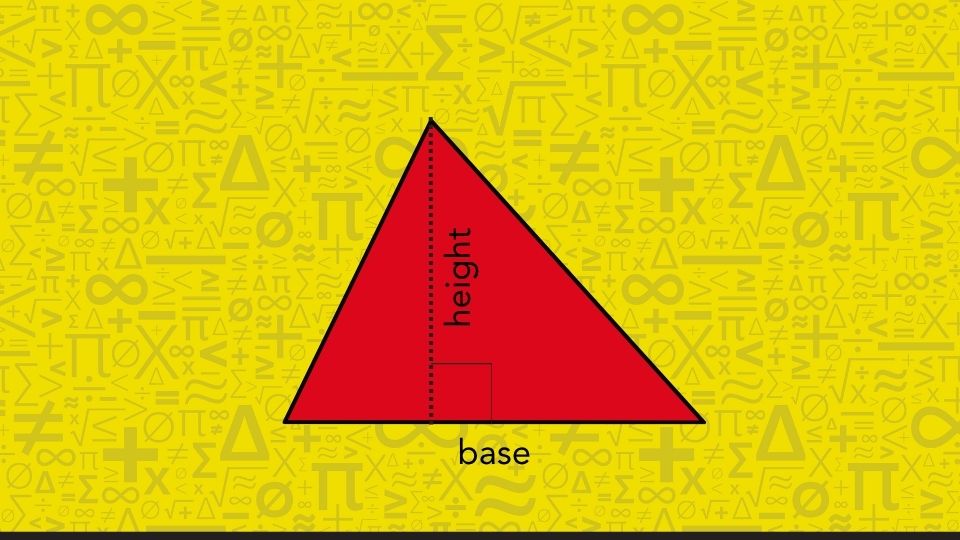
To find the area, we use the formula that asks us to multiply half the base by the height. That formula works whenever we have a base and a height to measure.
Here, we will introduce two more, Heron's Formula and the Shoelace Formula, but most importantly, we will teach you how to think about triangle area and choose the right approach to calculate it.

How to Choose the Right Method for Finding the Area of a Triangle
Before we pick a formula, we look at what we already know about the triangle. A base and a height give us one path. Three side lengths with no height give us a second path. Three points on a graph give us a third.
We reach for the base and height formula whenever we know both of those measurements. When all we have is the three side lengths, Heron's Formula picks up from there. When all we have are three coordinate points, the Shoelace Formula takes over.
Each path leads to the same area, just from different starting information, so knowing all three keeps us from ever getting stuck on a triangle problem.
📕 You May Also Like: Types of Triangles for Grades 4–8: A Complete Guide
Three Methods for Finding the Area of a Triangle
Here's how each of those three paths works, step by step.
1. How to Find the Area Using Base and Height
When we know a triangle's base and its height, we use the formula we usually learn first:
Area = \(\Large\frac{1}{2}\) × base × height
But why do we halve the base?
A triangle takes up exactly half the space of a parallelogram that shares the same base and height. That’s why we multiply base by height and then divide by two.
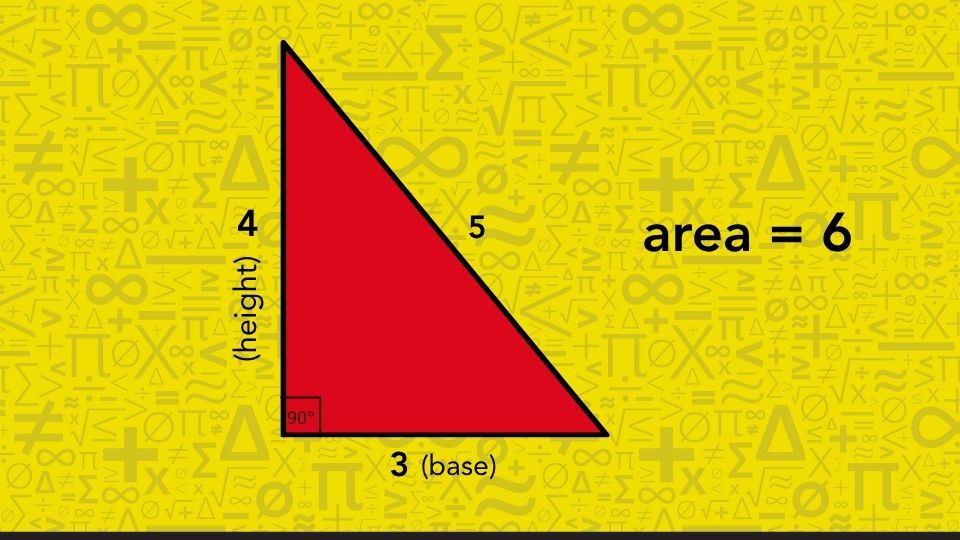
Let's try it with a triangle that has a base of 3 and a height of 4.
Step 1: Multiply the base by the height.
3 × 4 = 12
Step 2: Divide the result by 2.
12 ÷ 2 = 6
The area of this triangle is 6 square units.
The height in this formula runs straight up from the base to the opposite vertex, at a perfect right angle.
Picture a ladder standing straight up against a wall. That straight ladder shows the true height. A ladder leaning against the wall covers more ground, so measuring along that slanted line gives a number that's too large.
📕 You May Also Like: How to Calculate the Area of Triangles – A Beginner's Guide
2. How to Find the Area Using Heron's Formula
Sometimes a triangle only gives up its three side lengths, with no height in sight. That's exactly when Heron's Formula takes over.
Heron's Formula needs one building-block value before it can work, and that’s the semi-perimeter, half of the triangle's perimeter. We find it by adding all three sides together and dividing by 2, the same way the base and height formula needs a base and a height before it can run.
Area = √[s(s − a)(s − b)(s − c)]
The formula multiplies four values together: the semi-perimeter and three differences. That product comes out much larger than the actual area, so the square root at the end brings the number back down to the right size for square units.
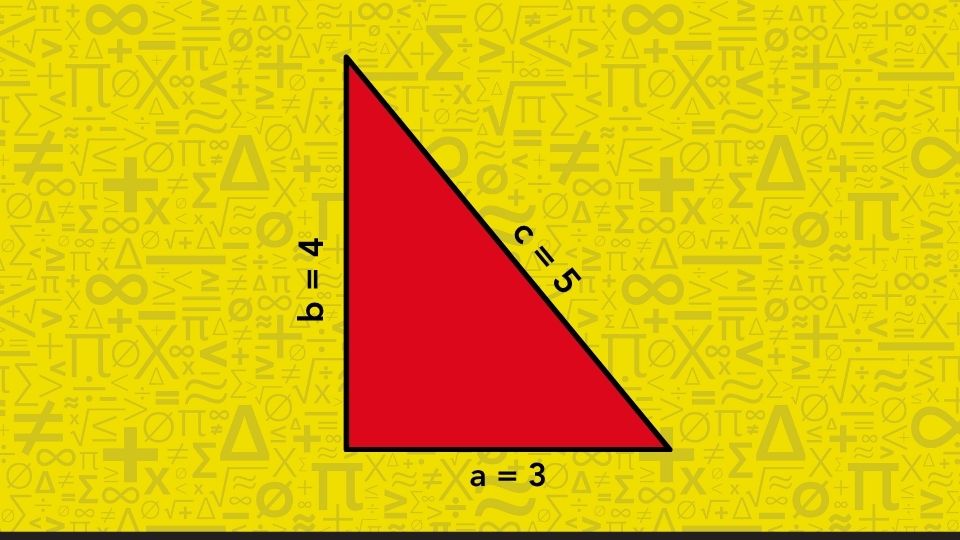
Let's use the same triangle from before, with sides 3, 4, and 5.
Step 1: Find the semi-perimeter.
(3 + 4 + 5) ÷ 2 = 6
Step 2: Subtract each side from the semi-perimeter.
6 − 3 = 3
6 − 4 = 2
6 − 5 = 1
Step 3: Multiply the semi-perimeter by each difference.
6 × 3 × 2 × 1 = 36
Step 4: Take the square root.
√36 = 6
The area comes out to 6 square units, the same answer we got from the base and height formula, even though we started from completely different information. Step 2 is where we're most likely to lose track. If we work through s − a, s − b, and s − c one at a time, in order, we'll keep the arithmetic from getting tangled.
3. How to Find the Area Using Coordinates (the Shoelace Formula)
Sometimes all we have for a triangle is three corners, plotted as points on a graph, with no side lengths or height anywhere in the picture. That's exactly when we reach for the Shoelace Formula. It turns three coordinate points alone into an area.
We list the three points in order first. Then we multiply each point's x-coordinate by the y-coordinate of the next point on our list, and we add all three results together. Next, we do the reverse. We multiply each point's y-coordinate by the x-coordinate of the next point, and we add those three results together too.
We subtract the second total from the first. Each x pairs with a y one step ahead, and each y pairs with an x one step ahead, so the two sets of products cross over each other the way laces cross between the eyelets of a shoe. We take half of that difference, and that gives us the triangle's area.
Area = \(\Large\frac{1}{2}\) |x₁(y₂ − y₃) + x₂(y₃ − y₁) + x₃(y₁ − y₂)|
Let's plot our familiar triangle at (0, 0), (3, 0), and (0, 4).
Step 1: Substitute the coordinates into the formula.
\(\Large\frac{1}{2}\) |0(0 − 4) + 3(4 − 0) + 0(0 − 0)|
Step 2: Simplify each term inside the bars.
0 + 12 + 0 = 12
Step 3: Multiply by one half.
\(\Large\frac{1}{2}\) × 12 = 6
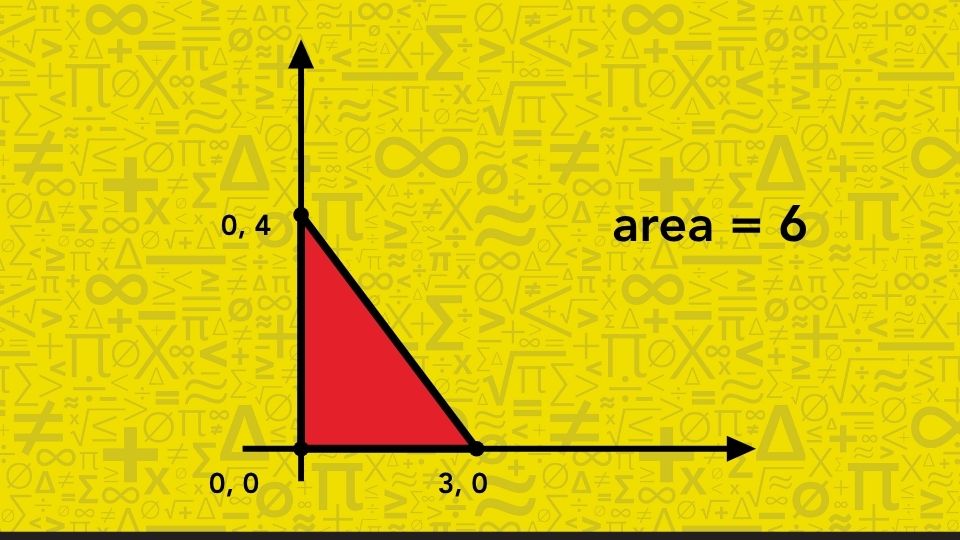
Once again, the area is 6 square units. All three methods agree.
Those bars around the expression mean absolute value, so if our result comes out negative, we drop the sign rather than treat it as the final answer, since area can't be negative.
📕 You May Also Like: Triangle Angle Sum and Exterior Angle Theorems Explained
Your Turn: Practice Finding the Area of a Triangle
Let's put all three methods to work. Try each problem before checking the answer key at the end of the article.
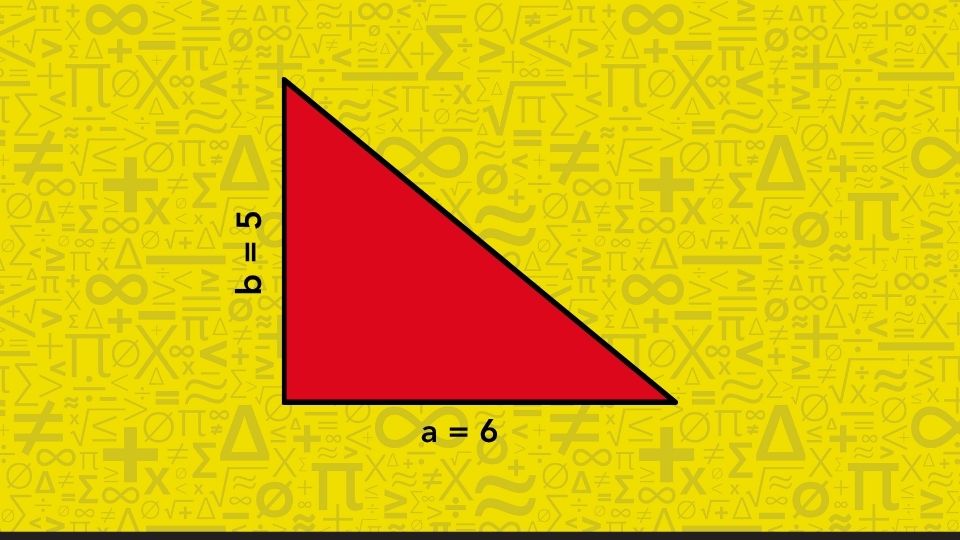
1. Find the area of a triangle with a base of 6 and a height of 5.
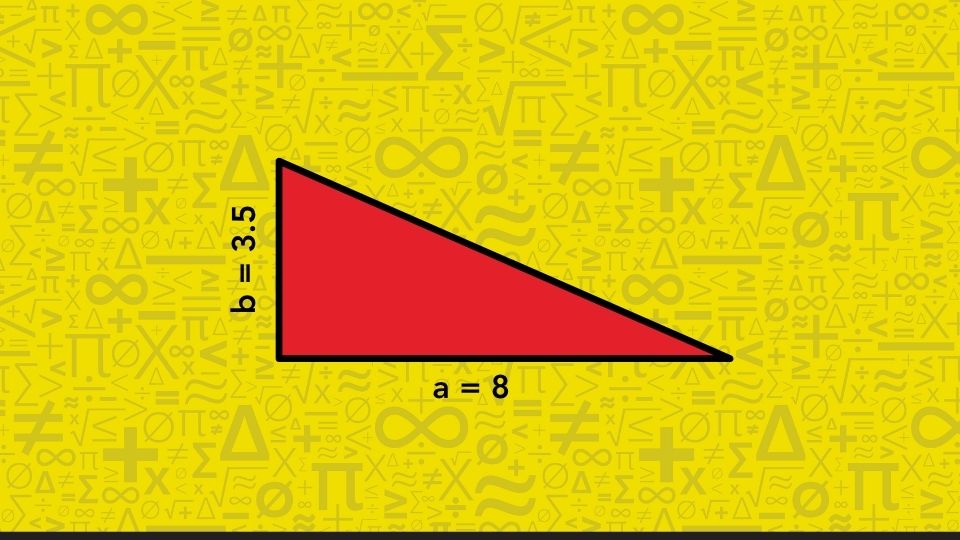
2. Find the area of a triangle with a base of 8 and a height of 3.5.
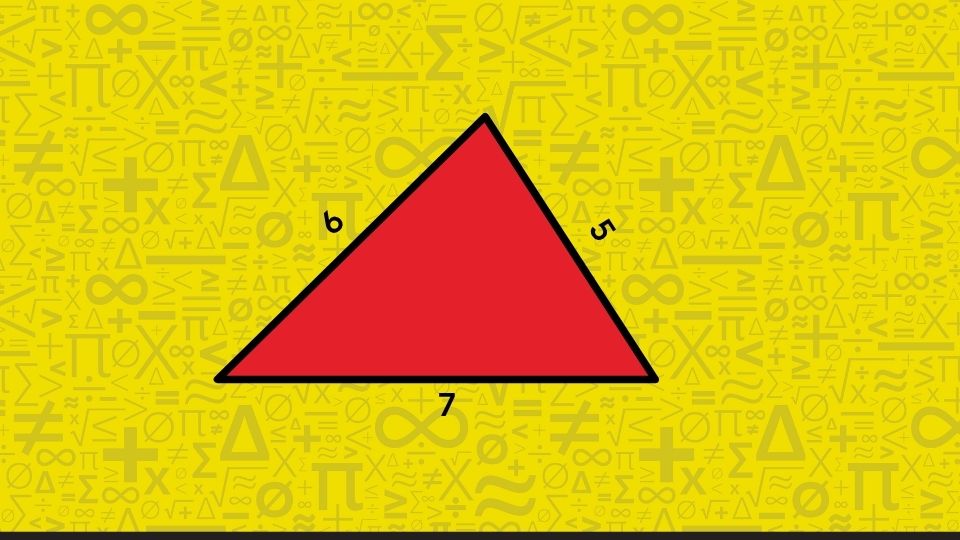
3. Find the area of a triangle with sides 5, 6, and 7 using the right method.
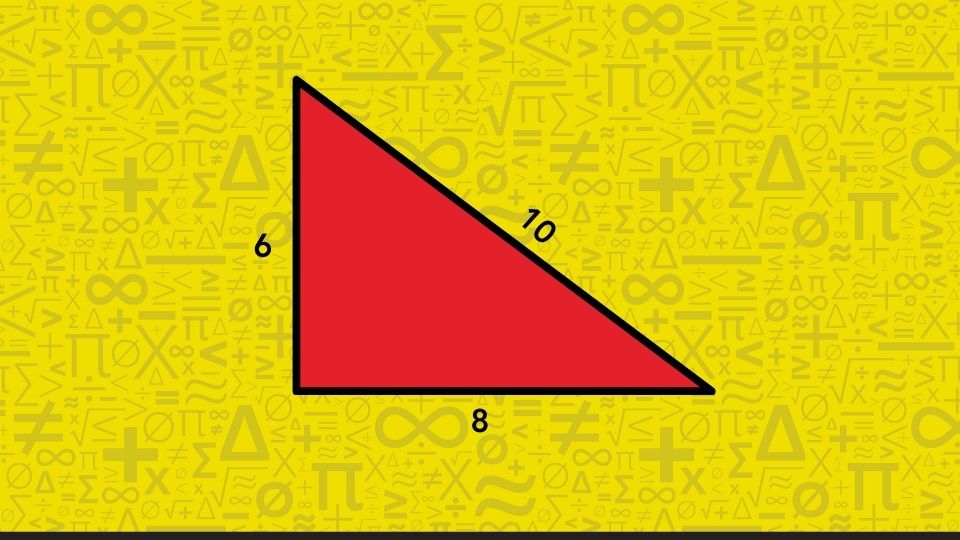
4. Find the area of a triangle with sides 6, 8, and 10 using the appropriate method.
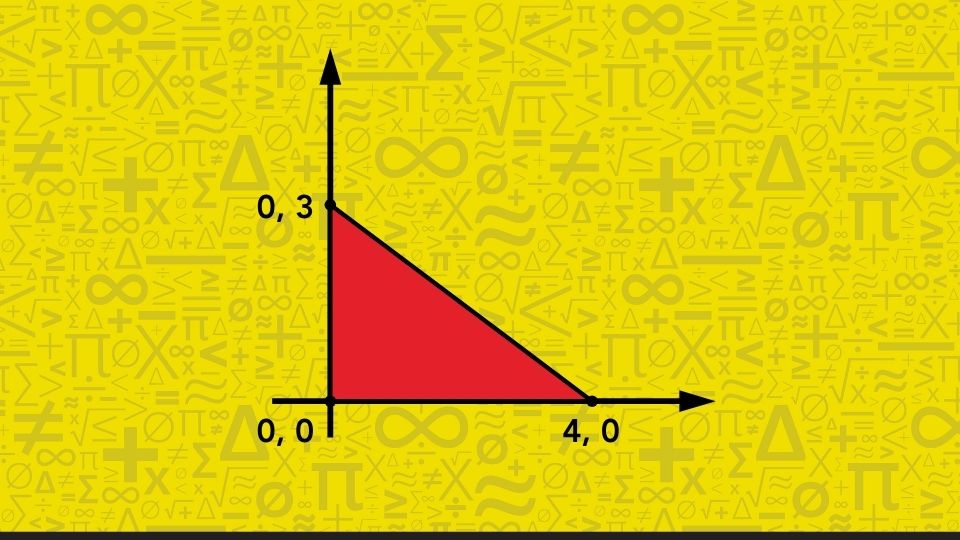
5. Find the area of a triangle with vertices at (0, 0), (4, 0), and (0, 3) using the right formula.
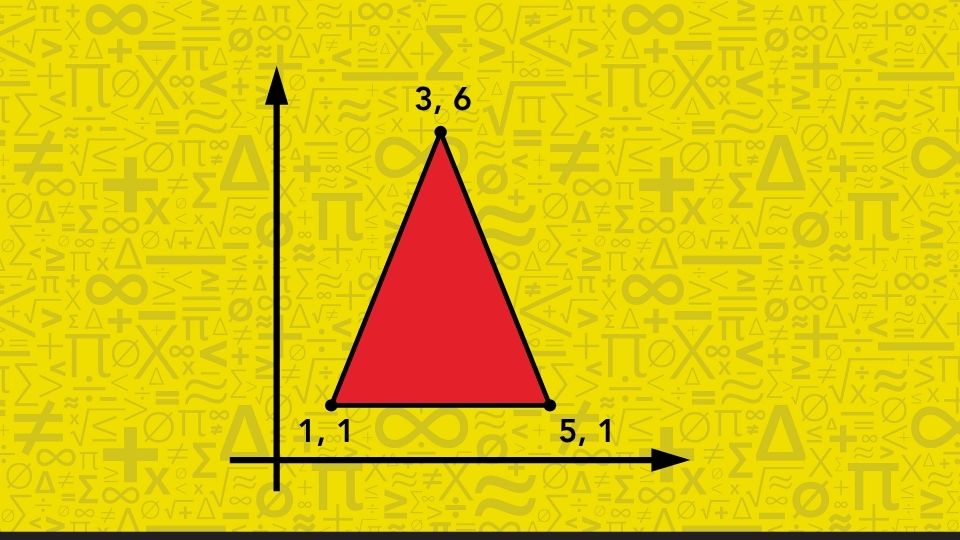
6. Find the area of a triangle with vertices at (1, 1), (5, 1), and (3, 6) using the right method.
Check your answers at the bottom of the guide.
FAQs About Finding the Area of a Triangle
A few questions come up as we work through triangle area problems.
1. Does the area formula change for a right triangle?
No, the formula stays the same, but a right triangle makes the base and height formula faster to use.
One of the two legs already sits at a right angle to the other, so that leg is already the height we need. We don't have to draw or measure a separate perpendicular line the way we would in a scalene or obtuse triangle.
2. Can any three side lengths form a triangle?
No, the three lengths have to satisfy one condition first. Any two sides added together must be longer than the third side.
Heron's Formula depends on this rule. If we plug in side lengths that can't form a real triangle, the expression under the square root turns negative, and we're left with no answer.
3. Which method is fastest when more than one applies?
The base and height formula is fastest whenever we have both those measurements, since it only takes one multiplication and one division.
Heron's Formula and the Shoelace Formula take a few more steps, but they're the only options once the height isn't part of the information we're given.

A Mathnasium tutor and student compare two ways of finding the same triangle's area.
How Mathnasium Helps Students Master Concepts Like Geometry
Mathnasium is a math-only learning center that helps K-12 students of all skill levels learn and master math.
Using our proprietary teaching approach, the Mathnasium Method™, we tailor instruction to each student’s unique learning needs, whether they are struggling with finding the area of a triangle, spatial skills, or something entirely different.
Our approach is based on:
-
Diagnostic Assessment and Personalized Learning Plans: Every student begins with a diagnostic assessment that identifies their current skill level, learning goals and style, and how they think about math, including the reasoning behind methods like the ones covered in this guide. From there, we build a personalized learning plan tailored to what they need next.
-
Teaching for Understanding: Our specially trained tutors deliver that plan through face-to-face instruction in a caring, supportive small-group setting, in-center or online, using visual, verbal, tactile, written, and mental techniques so a method like Heron's Formula makes sense instead of feeling memorized.
-
Problem-Solving and Critical Thinking: Our tutors give students room to work through a problem before stepping in, then explain the how and why behind each answer, building problem-solving skills and critical thinking students carry into every math topic ahead.
-
An Engaging and Fun Learning Environment: Our sessions include game-based learning, and students earn rewards along the way. We celebrate every bit of progress, too. Confidence grows session by session.
Families see the difference.
-
94% of parents report an improvement in their child's math skills and understanding
-
93% of parents report their child's improved attitude toward math after attending Mathnasium
-
90% of students saw an improvement in their school grades
With over 1,100 learning centers across North America, there is likely a Mathnasium center close to you.
For families in and around The Woodlands, TX, including Spring, Conroe, and Creekside, Mathnasium of The Woodlands is a trusted local center for geometry and every math concept that follows.
Whether your child needs to catch up, keep up, or get ahead, our team is happy to help.
📅 Schedule a Free Diagnostic Assessment at Mathnasium of The Woodlands
Not near The Woodlands?
📍 Find a Mathnasium Learning Center Near You
Psssst. Check Your Answers
Here's the breakdown for each problem.
-
Base 6, height 5. Area = \(\Large\frac{1}{2}\) × 6 × 5 = 15 square units.
-
Base 8, height 3.5. Area = \(\Large\frac{1}{2}\) × 8 × 3.5 = 14 square units.
-
Sides 5, 6, 7. Semi-perimeter s = 9. Area = √[9 × 4 × 3 × 2] = √216 = 6√6, or about 14.7 square units.
-
Sides 6, 8, 10. Semi-perimeter s = 12. Area = √[12 × 6 × 4 × 2] = √576 = 24 square units.
-
Vertices (0, 0), (4, 0), (0, 3). Area = \(\Large\frac{1}{2}\) |0(0 − 3) + 4(3 − 0) + 0(0 − 0)| = \(\Large\frac{1}{2}\) (12) = 6 square units.
-
Vertices (1, 1), (5, 1), (3, 6). Area = \(\Large\frac{1}{2}\) |1(1 − 6) + 5(6 − 1) + 3(1 − 1)| = \(\Large\frac{1}{2}\) (20) = 10 square units.


 (281) 465-4990