Angles in geometry can sometimes feel like a collection of random rules to memorize. But once you look at how a triangle's angles interact, everything fits together like a simple puzzle.
Whether you're trying to find a missing corner or figure out what happens when you extend a triangle's side, two foundational rules do almost all the heavy lifting. Together, the Triangle Angle Sum Theorem and Exterior Angle Theorem give us a reliable shortcut for finding any missing angle in a triangle.
That’s why today our Mathnasium tutors will show how these two theorems work, why they are true, and how to apply them.

Quick Review: What Is a Triangle?
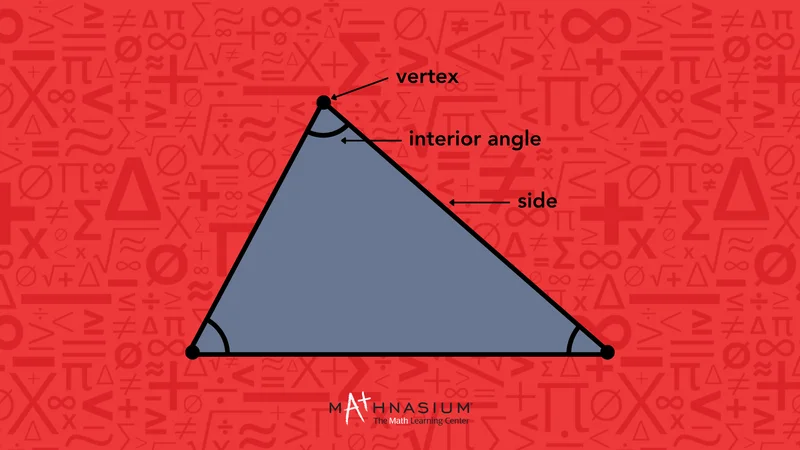
A triangle is a polygon with exactly three straight sides and three angles.
The word triangle comes from the Latin words tri, meaning three, and angulus, meaning angle or corner. Put the two together, and the name basically describes the shape for us.
Triangles belong to the same polygon family as quadrilaterals, pentagons, and hexagons. What sets a triangle apart is that it has the fewest sides any polygon can have.
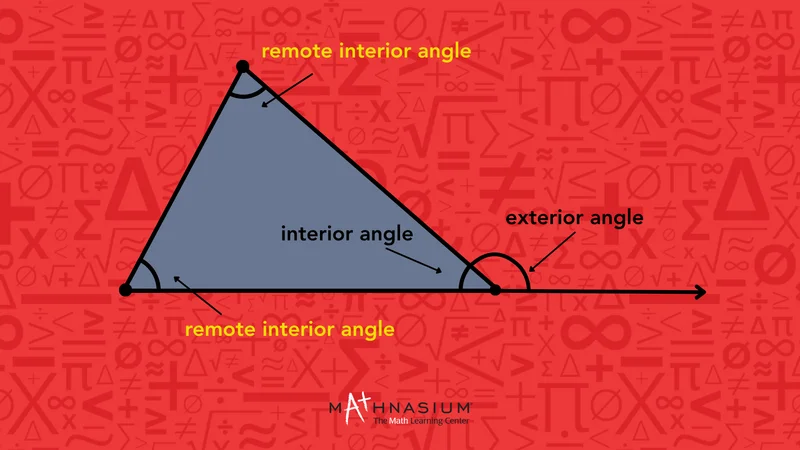
Every triangle, no matter how it's drawn, shares the same three parts:
📕 You May Also Like: Types of Triangles for Grades 4–8: A Complete Guide
2 Core Triangle Angle Rules
Every triangle, regardless of its shape or size, follows the same two rules for its interior and exterior angles.
-
Interior Angle Sum: The three interior angles always add up to 180°. If we know two angles, we add them together and subtract the result from 180° to find the third.
-
Exterior Angle Theorem: An exterior angle, formed by extending one side of the triangle, equals the sum of its two remote (non-adjacent) interior angles.
Now let's go through each rule one at a time so we can see exactly how they work.
1. Interior Angle Sum of a Triangle Rule
The three interior angles of any triangle always add up to 180°, whether the triangle is acute, right, or obtuse.
We can prove this ourselves. All we need to do is cut a triangle out of paper and tear off all three corners. Let's call them ∠A, ∠B, and ∠C.

Next, we draw a straight line on another piece of paper. Why a straight line?
Because a straight line is also a straight angle that measures 180°.
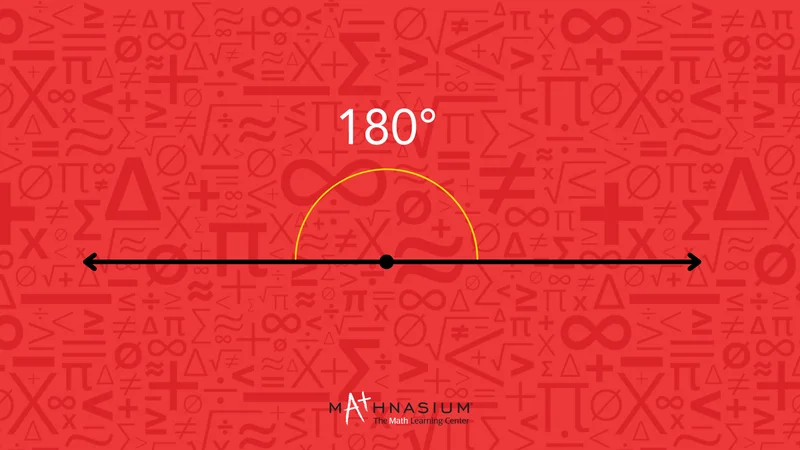
Now we can place our triangle's three interior angles side by side on the line.
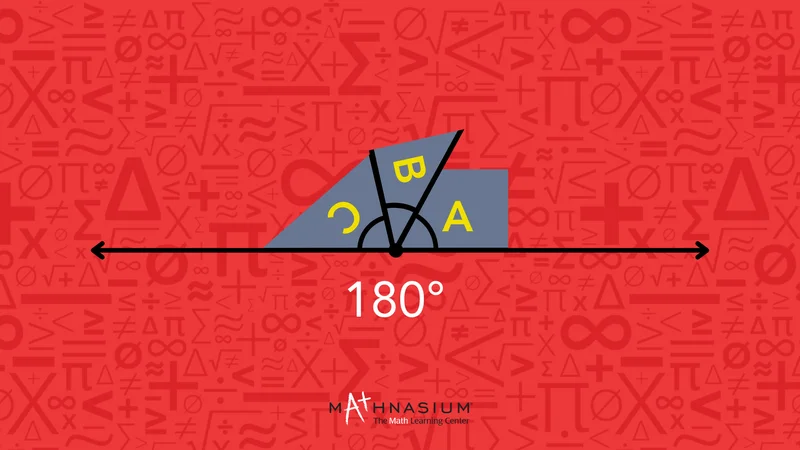
As we can see, the three corners fit together perfectly along the straight line, showing us that:
∠A + ∠B + ∠C = 180°
This simple paper-tearing example visually demonstrates the rule we call the Triangle Angle Sum Theorem, which tells us that the interior angles of any triangle always add up to exactly 180°.
This rule is useful for more than just proving a fact. If we know two of the three angles in a triangle, we can always find the third.
Let's apply this rule through a worked example to find a missing interior angle of a triangle:
A triangle has ∠A measuring 50° and ∠B measuring 70°. What is the measure of ∠C?
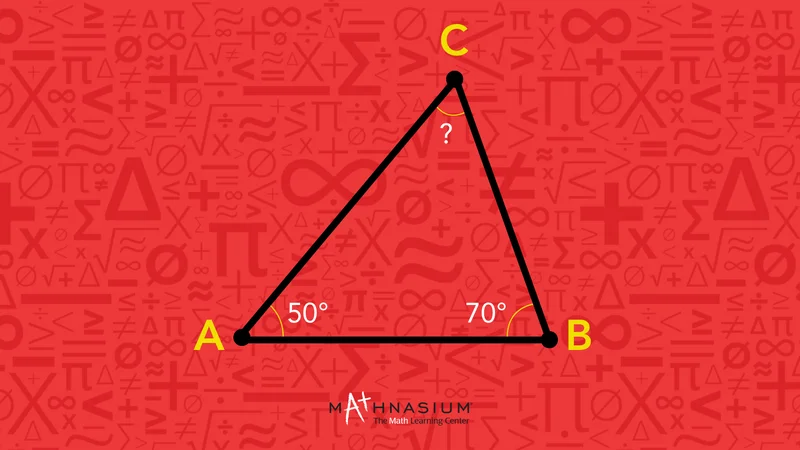
We know all three angles add up to 180°, so we can write:
∠A + ∠B + ∠C = 180°
50° + 70° + ∠C = 180°
Adding the two known angles together, 50° + 70° = 120°. Then we subtract that from 180°:
180° − 120° = 60°
∠C measures 60°.
📕 You May Also Like: How to Calculate the Area of Triangles - A Beginner's Guide
2. Exterior Angle Theorem of a Triangle
The Exterior Angle Theorem tells us that the measure of an exterior angle of a triangle equals the sum of the measures of its two remote (non-adjacent) interior angles.
If we extend one side of a triangle past its vertex, we create a new angle sitting just outside the triangle called an exterior angle.
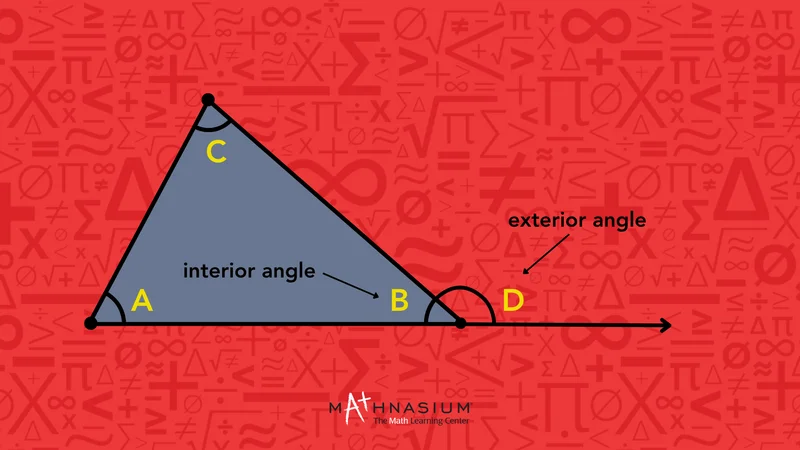
As we can see, ∠B and ∠D sit side by side along the same straight line. Since a straight line measures 180°, these two angles form a linear pair and add up to 180°:
∠B + ∠D = 180°
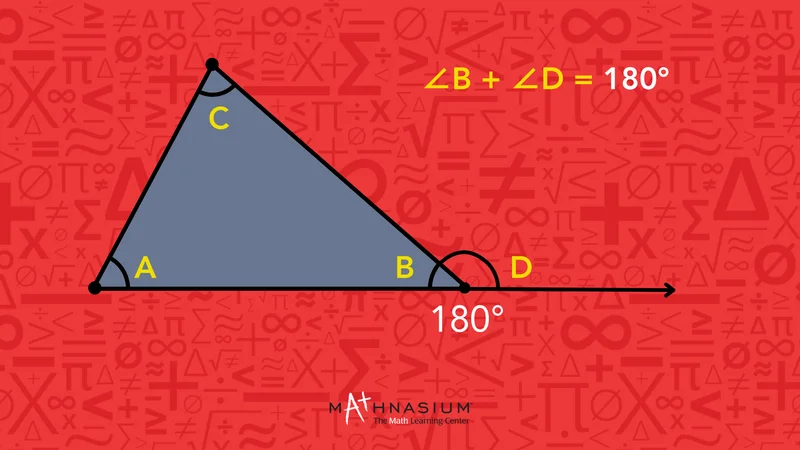
So, if we already know ∠B, finding ∠D is easy, we just subtract ∠B from 180°.
∠D = 180° - ∠B
But what if we don't know the size of our interior angle ∠B, and we still want to find exterior angle ∠D?
Let’s see. We already know from our Triangle Angle Sum Theorem that all three interior angles inside the triangle add up to 180°:
∠A + ∠B + ∠C = 180°
Notice that both equations equal 180° and both contain ∠B:
-
∠B + ∠D = 180°
-
∠B + (∠A + ∠C) = 180°
Since ∠B is the same in both equations, the remaining terms must be equal, too. That proves that the exterior angle equals the two remote interior angles added together:
∠D = ∠A + ∠C
This rule can save us a step. Instead of calculating the third interior angle first, we can jump straight to the exterior angle by adding the two remote interior angles together.
Let's apply this rule through a worked example to find an exterior angle of a triangle:
A triangle has ∠A measuring 65° and ∠C measuring 80°. What is the measure of the exterior angle at the third corner, ∠D?
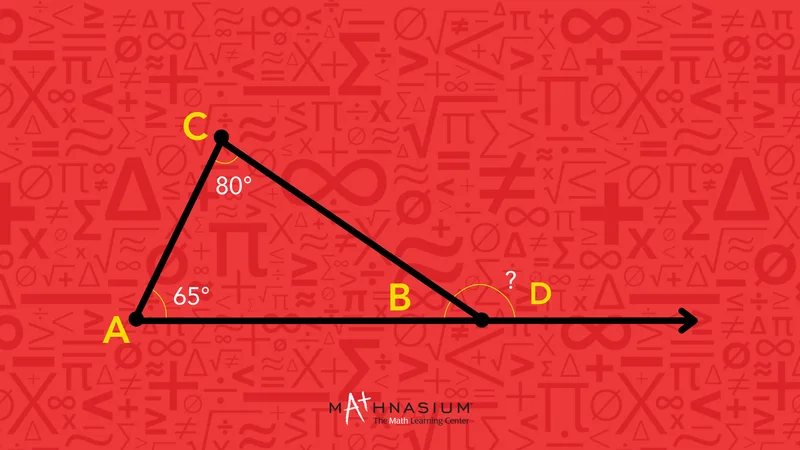
We know the exterior angle equals the sum of the two remote interior angles, so we can write:
∠D = ∠A + ∠C
∠D = 65° + 80°
∠D = 145°
Exterior angle ∠D measures 145°.

FAQ About the Triangle Angle Sum and Exterior Angle Theorems
We've gathered the questions we hear most often about these two rules and answered them below to clear up any confusion.
1. Can a triangle have two right angles or two obtuse angles?
No. A triangle's three interior angles always add up to 180°, so two angles that are each 90° or more would already total 180° or higher on their own. That leaves no room for a third angle at all.
Every triangle can have at most one right angle or one obtuse angle, never two.
2. How many exterior angles does a triangle have?
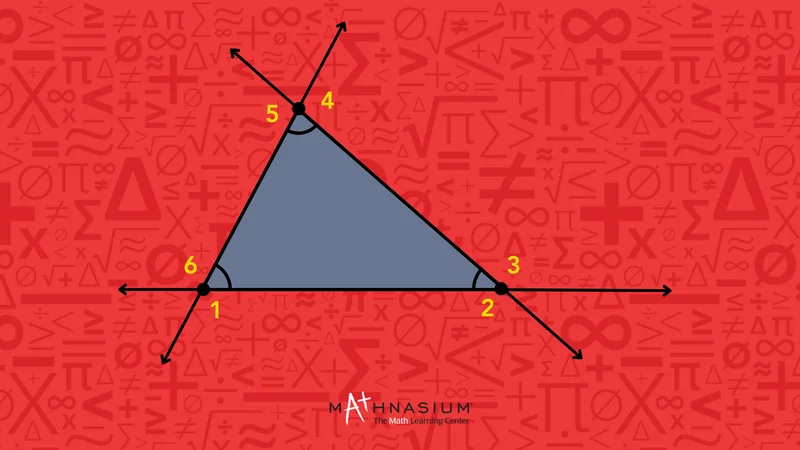
Six. Every vertex has two exterior angles, one on each side of it, since a side can be extended in either direction. That gives us three vertices with two exterior angles each: 3 × 2 = 6.
We might expect nine angles instead, since extending all three sides creates three angles at each corner. But the three angles sitting directly opposite the interior angles come from two extended rays meeting each other, not from an original side of the triangle meeting an extension. Those three don't count as exterior angles.
They're called vertically opposite angles instead.
📕 You May Also Like: Why Are Vertical Angles Always Equal? A Deep Dive
3. What is the sum of all the exterior angles of a triangle?
The sum of all the exterior angles for any triangle is always 360 degrees.
Each interior angle and the exterior angle right next to it sit on the same straight line, so together they add up to 180°. A triangle has three corners, so three of these pairs give us 3 × 180° = 540° in total.
That 540° includes both the interior angles and the exterior angles together.
To find the sum of exterior angles, we subtract the total of the interior angles from 540°:
540° − 180° = 360°
4. How do I know which two angles are the remote interior angles?
First, find the interior angle that sits right next to our exterior angle. That's the adjacent angle, and we rule it out. The remote interior angles are the other two that the exterior angle doesn't touch. Those are the two we add together.
📕 You May Also Like: Types of Angles in Geometry: A Kid-Friendly Guide
Practice: Find the Interior and Exterior Angles of a Triangle
Time to check what we've learned today.
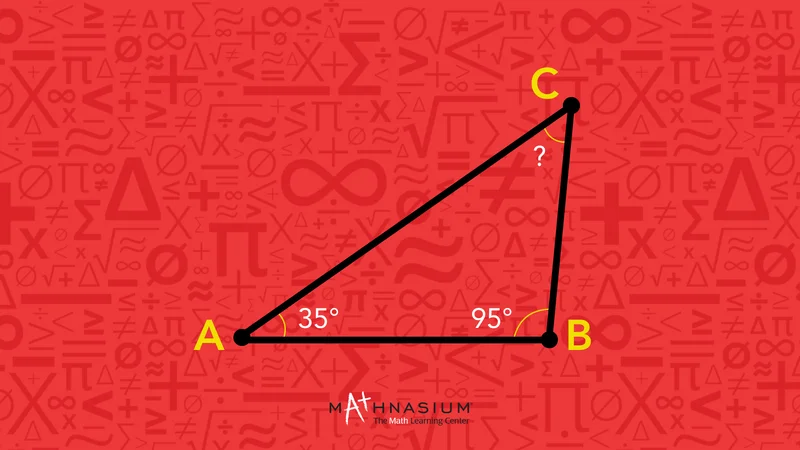
1. A triangle has ∠A measuring 35° and ∠B measuring 95°. What is the measure of ∠C?
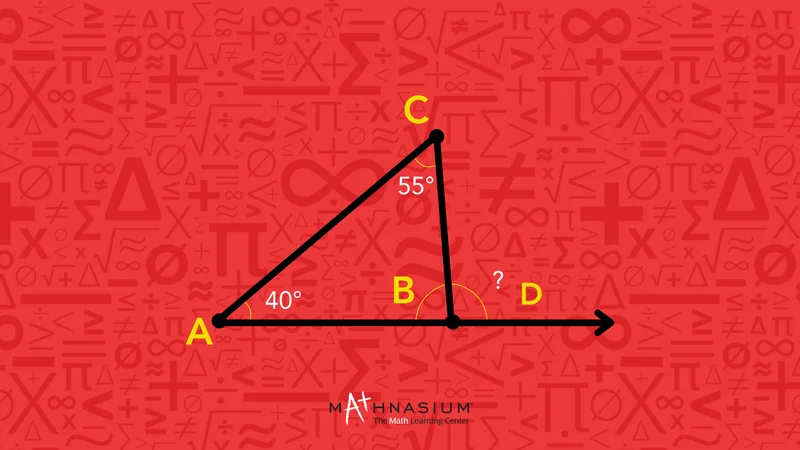
2. A triangle has ∠A measuring 40° and ∠C measuring 55°. What is the measure of the exterior angle at the third corner, ∠D?
Check your answers at the bottom of the guide.

Mathnasium tutors use hands-on proofs and clear examples to help geometry concepts truly make sense.
How Mathnasium Helps Students Master Geometry (and Beyond)
Mathnasium is a math-only learning center that helps K-12 students of all skill levels learn and master math.
Geometry is where abstract rules turn into something students can see and test for themselves, just like proving the Triangle Angle Sum Theorem with a piece of paper. That is why we anchor every lesson in that same hands-on approach, so students leave with a deep, lasting understanding of the concept.
We build this deep understanding through the Mathnasium Method™, our proprietary teaching approach tailored to each student's individual needs.
Here's how it works:
-
Diagnostic Assessment and Personalized Learning Plans: Every student begins with a diagnostic assessment. This helps us understand a student's current skill level, their learning goals, and how they think about math, including the reasoning behind rules like the ones covered in this guide. From there, we build a personalized learning plan tailored to what that student needs next.
-
Teaching for Understanding: Our specially trained tutors deliver that plan through face-to-face instruction, in a caring and supportive small-group setting, both in-center and online. We teach using a mix of visual, verbal, tactile, written, and mental techniques, so a concept like the Exterior Angle Theorem makes sense instead of feeling like something to memorize.
-
Problem-Solving and Critical Thinking: Our tutors give students room to work through a problem before stepping in. We explain both the how and the why behind each answer, which helps students build problem-solving skills and critical thinking they can carry into every math topic ahead.
-
An Engaging and Fun Learning Environment: Our sessions are often game-based, students earn rewards along the way, and we celebrate every bit of progress. Confidence grows session by session.
Families see the difference:
-
94% of parents report an improvement in their child's math skills and understanding
-
93% of parents report their child's improved attitude toward math after attending Mathnasium
-
90% of students saw an improvement in their school grades
With over 1,100 learning centers across North America, there is likely a Mathnasium close to you.
For families in and around The Woodlands, TX, including Spring, Conroe, and Creekside, Mathnasium of The Woodlands is a trusted local center helping students build confidence in geometry and every math concept that follows.
Whether your child needs to catch up, keep up, or get ahead, our team is happy to help.
📅 Schedule a Free Diagnostic Assessment at Mathnasium of The Woodlands
Not near The Woodlands?
📍 Find a Mathnasium Learning Center Near You
Check Your Answers Here
Ready to see how you did? Here are the answers.


 (281) 465-4990