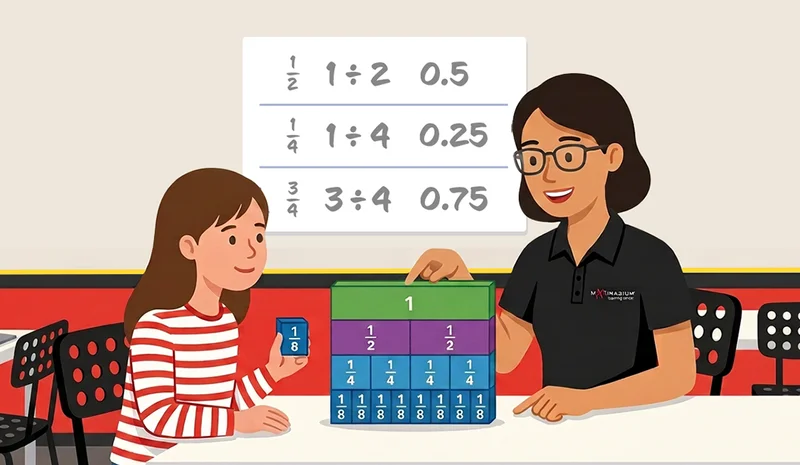
Sometimes a math problem has more than one correct way to write the answer. Fractions and decimals are a good example. Their notation looks completely different on the page, though both 12 and 0.5 represent the same quantity.
To learn how to move between these two forms, students usually start with fraction-to-decimal conversions in upper elementary or middle school and continue using this skill in algebra, science, and everyday problem-solving.
So where do we begin when a homework problem asks us to rewrite a fraction as a decimal?
Let's find out together. We'll use the same method our tutors teach students, watch for common mistakes, and finish with practice problems to check our understanding.

How Fractions and Decimals Relate
Fractions and decimals are two ways of representing the same value, but each uses its own format.
-
Fractions use a numerator and denominator to show how many equal parts we have out of a whole or group, such as \(\Large\frac{1}{4}\).
-
Decimals use place value, including tenths, hundredths, and thousandths, to represent an equivalent amount in another form, such as 0.25.
The coins in our pockets provide an easy way to see this relationship:
|
Visual Reference
|
Fraction
|
Math Operation
|
Decimal
|
|
Half dollar
|
\(\Large\frac{1}{2}\)
|
1 ÷ 2
|
0.5
|
|
Quarter
|
\(\Large\frac{1}{4}\)
|
1 ÷ 4
|
0.25
|
|
Three quarters
|
\(\Large\frac{3}{4}\)
|
3 ÷ 4
|
0.75
|
Notice the pattern in the Math Operation column. The fraction bar means “divided by,” so we convert a fraction to a decimal by dividing the numerator by the denominator. Next, we'll explain how this works with worked examples.
📕 You May Also Like: The Fraction Factor: Understanding Middle School Math Struggles
How to Convert Fractions to Terminating Decimals
Terminating decimals have a finite number of digits because the division eventually ends with a remainder of 0. We can find this type of decimal by using long division.
We start our fraction-to-decimal conversions with terminating decimals because they have a clear stopping point, which makes it easier to learn the long division method before adding the challenge of recognizing a repeating pattern, which we'll learn about later.
Before we begin, two guidelines will help us set up the division correctly:
-
The numerator always goes inside the long division bracket.
-
If the numerator is smaller than the denominator, write a decimal point and add zeros so you can continue dividing.
Now let's put these guidelines into practice with our first conversion.
Convert 3/8 to a Decimal
Let’s follow an 11-step walkthrough to convert \(\Large\frac{3}{8}\) into a decimal.
Step 1: Set Up the Long Division
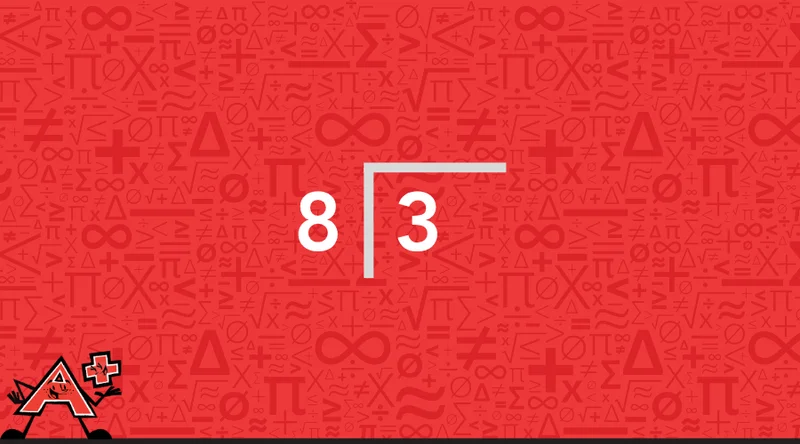
Since the fraction bar signals division, \(\Large\frac{3}{8}\) means 3 ÷ 8. Place the numerator (our dividend), 3, inside the division bracket and the denominator (our divisor), 8, outside it.
Step 2: Divide
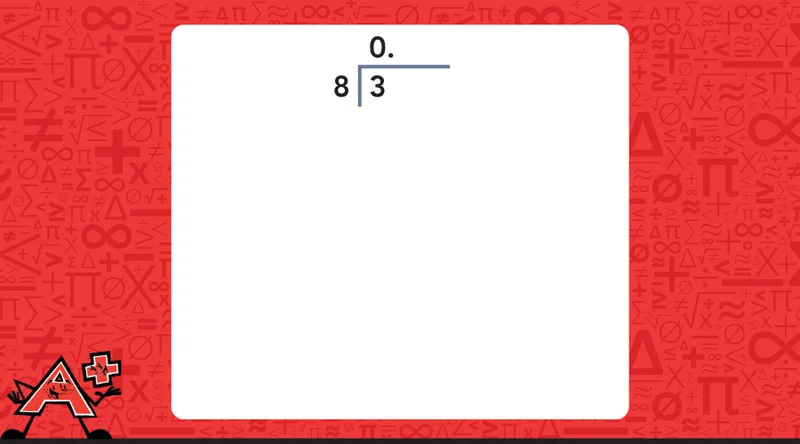
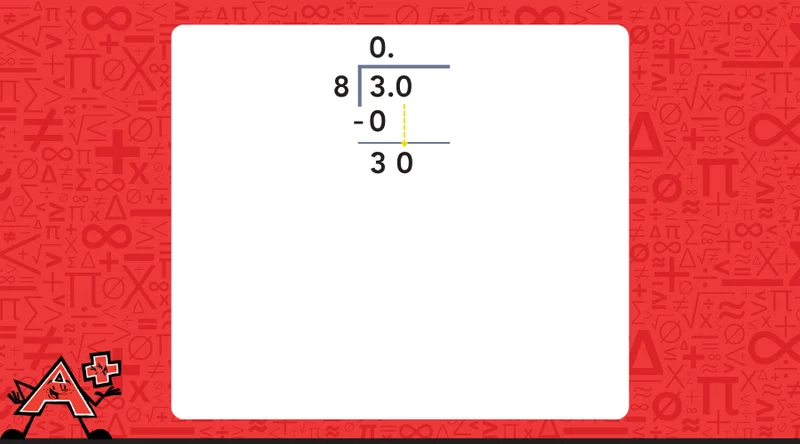
8 goes into 3 zero times, so write 0 in the quotient. Then place a decimal point after it.
Step 3: Multiply & Subtract
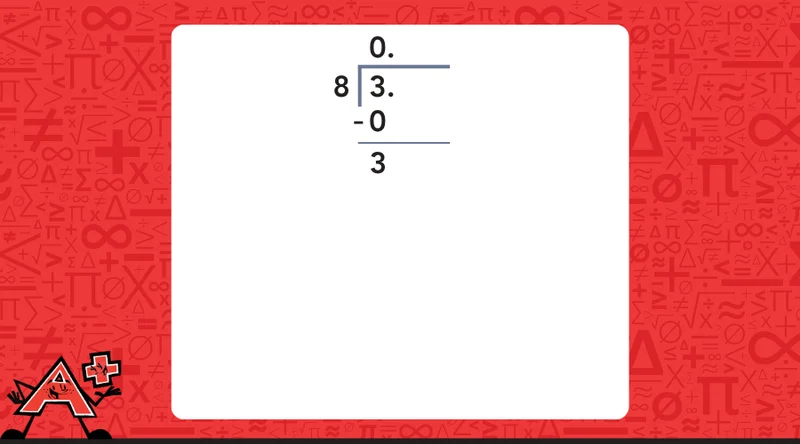
Multiply 0 by 8 to get 0. Then subtract 0 from 3 to get a remainder of 3.
Step 4: Bring Down
Write a decimal point after 3 and add a zero. This changes 3 to 3.0 without changing its value. We can now think of 3.0 as 30 tenths and continue dividing.
Step 5: Divide Again
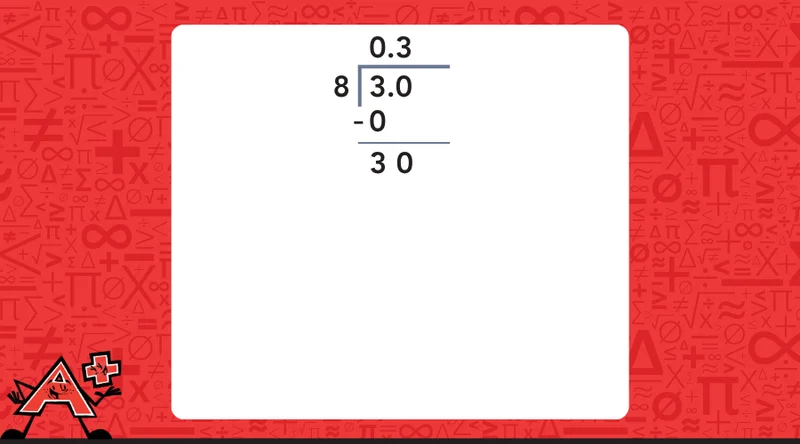
8 goes into 30 three times. Write 3 in the tenths place of the quotient.
Step 6: Multiply & Subtract Again
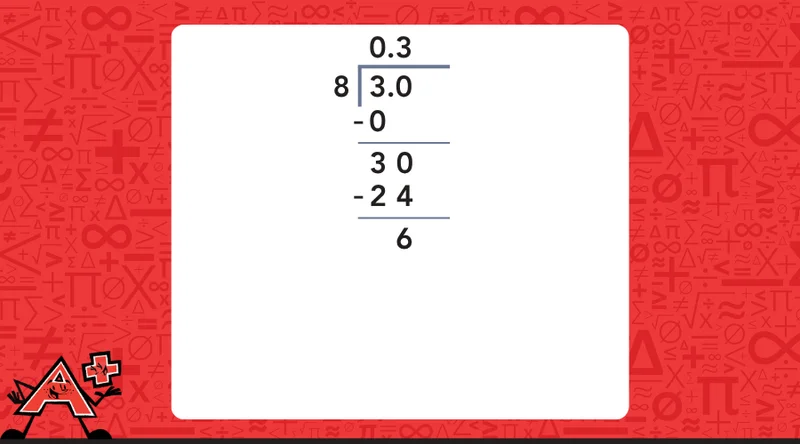
Multiply 3 by 8 to get 24. Then subtract 24 from 30 to get a remainder of 6.
Step 7: Bring Down Again
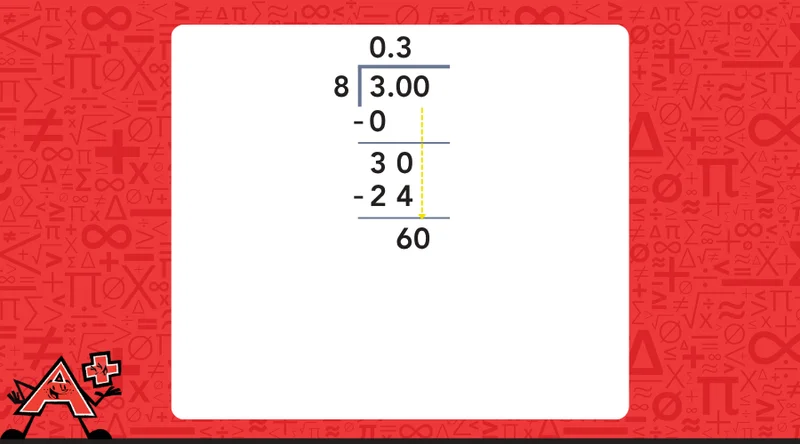
The remainder is not 0, so the division is not complete. Add another zero to the dividend and bring it down beside the 6 to make 60.
Step 8: Divide Again
8 goes into 60 seven times. Write 7 in the hundredths place of the quotient.
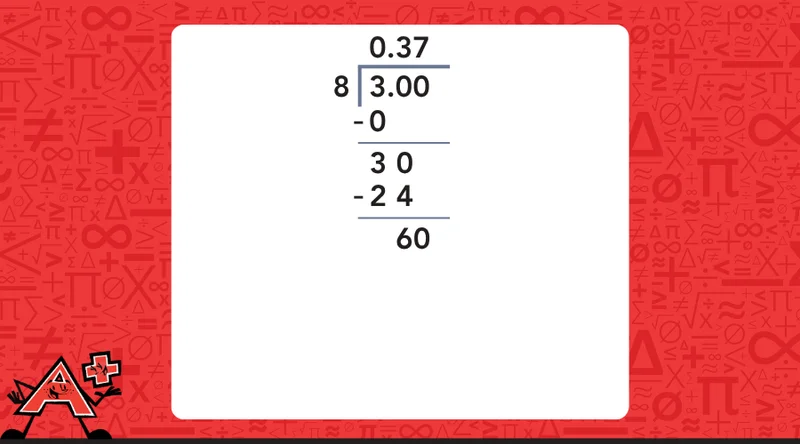
Step 9: Multiply & Subtract Again
Multiply 7 by 8 to get 56. Then subtract 56 from 60 to get a remainder of 4.
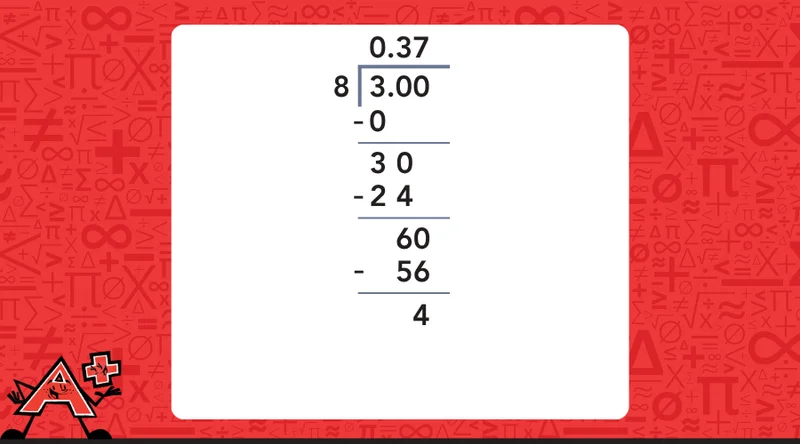
Step 10: Bring Down Again
The remainder is still not 0. Add another zero and bring it down beside the 4 to make 40.
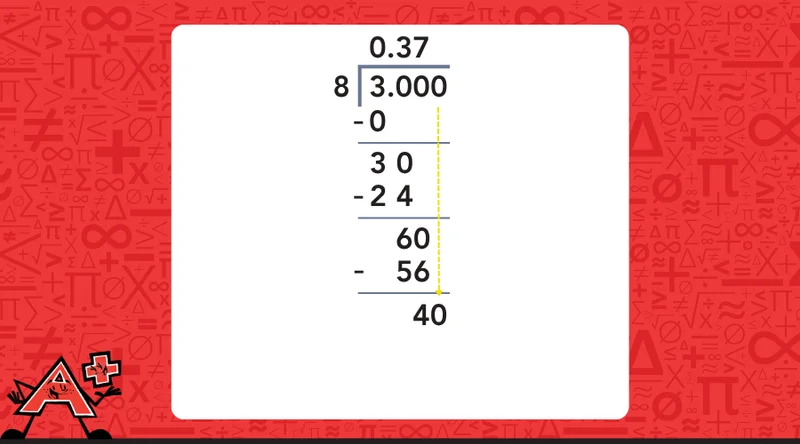
Step 11: Divide, Multiply & Subtract Again
8 goes into 40 five times. Write 5 in the thousandths place.
Multiply 5 by 8 to get 40, then subtract 40 from 40.
The remainder is now 0, so the division is complete. Therefore, \(\Large\frac{3}{8}\) = 0.375.
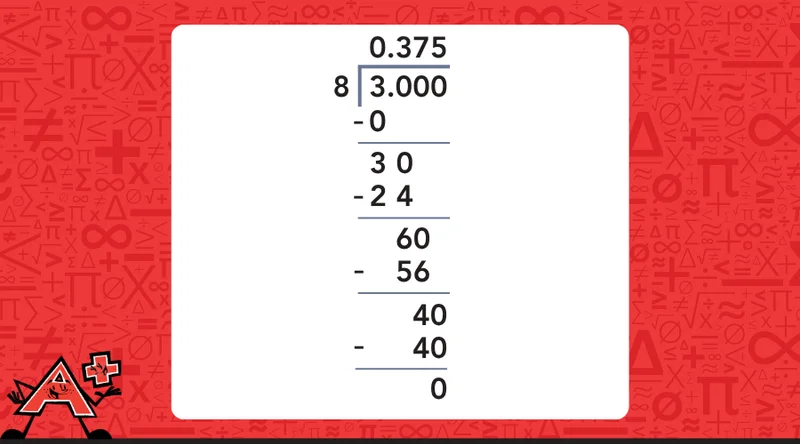
The decimal 0.375 is a terminating decimal because it ends after a finite number of digits.
📕 You May Also Like: What Is a Terminating Decimal? A Complete Overview
How to Convert Fractions to Repeating Decimals
When we divide the numerator by the denominator, we don’t always get a neat decimal. Sometimes the decimals repeat. Repeating decimals have one or more digits that continue indefinitely.
Just like with terminating decimals, we use long division to convert fractions into repeating decimals. We follow the same setup and division steps, but now we'll build on what we already learned by recognizing when the division starts to repeat rather than stop.
Instead of reaching a remainder of 0, we eventually reach a remainder we have already seen. The division would then repeat the same calculations and cause the same decimal digit or group of digits to repeat in the quotient.
We will look at two cases:
-
The repeating digits begin immediately after the decimal point.
-
One or more non-repeating digits appear before the repetition begins.
Now let’s put both scenarios into action, one at a time.
A. Convert 2/3 to a Decimal
We'll walk through the conversion in 11 steps as we rewrite \(\Large\frac{2}{3}\) into a decimal.
Step 1: Set Up the Long Division
The fraction \(\Large\frac{2}{3}\) means 2 divided by 3. Place the numerator, 2, inside the long division bracket and the denominator, 3, outside it.
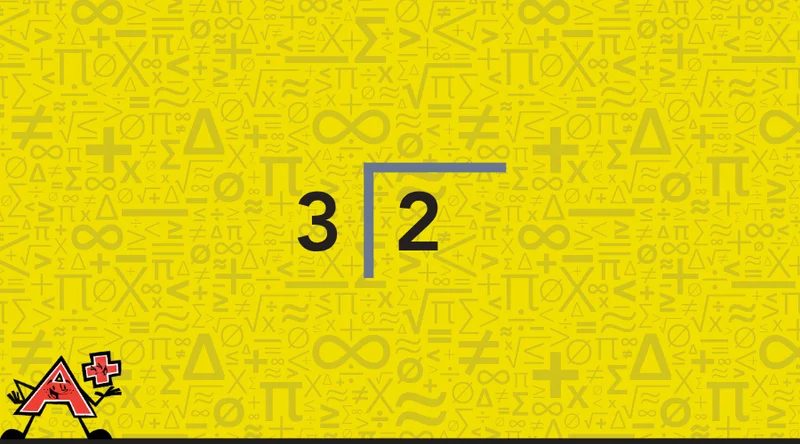
Step 2: Divide
3 goes into 2 zero times, so write 0 in the quotient. Then place a decimal point after it.
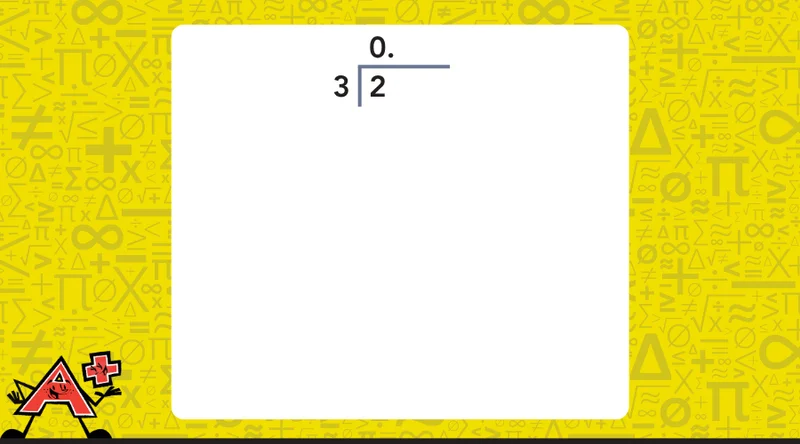
Step 3: Multiply & Subtract
Multiply 0 by 3 to get 0. Then subtract 0 from 2 to get a remainder of 2.
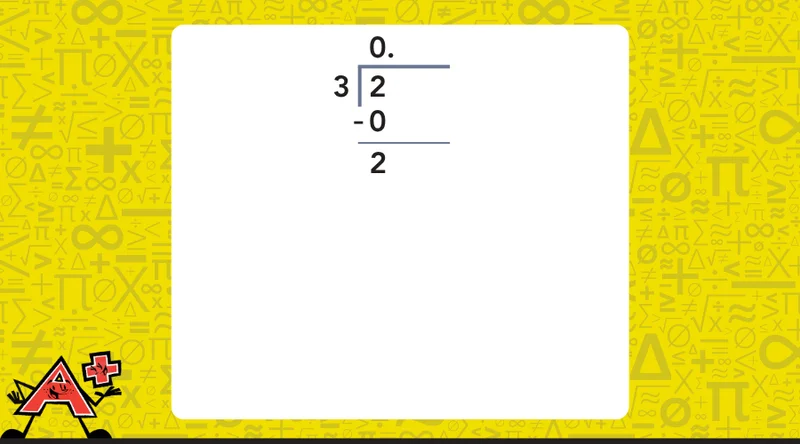
Step 4: Bring Down
Write a decimal point after 2 and add a zero. This changes 2 to 2.0 without changing its value. We can now think of 2.0 as 20 tenths and continue dividing.
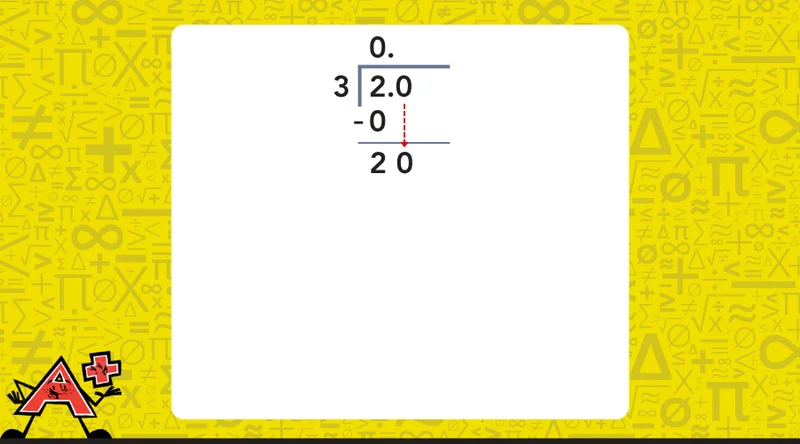
Step 5: Divide Again
3 goes into 20 six times. Write 6 in the tenths place of the quotient.
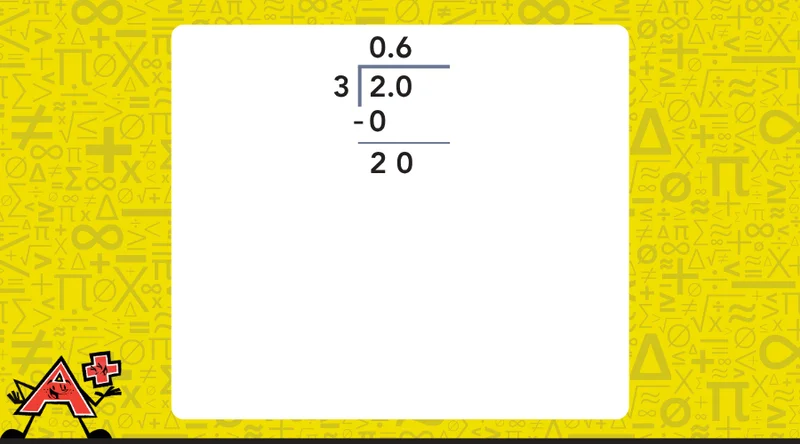
Step 6: Multiply & Subtract Again
Multiply 6 by 3 to get 18. Then subtract 18 from 20 to get a remainder of 2.
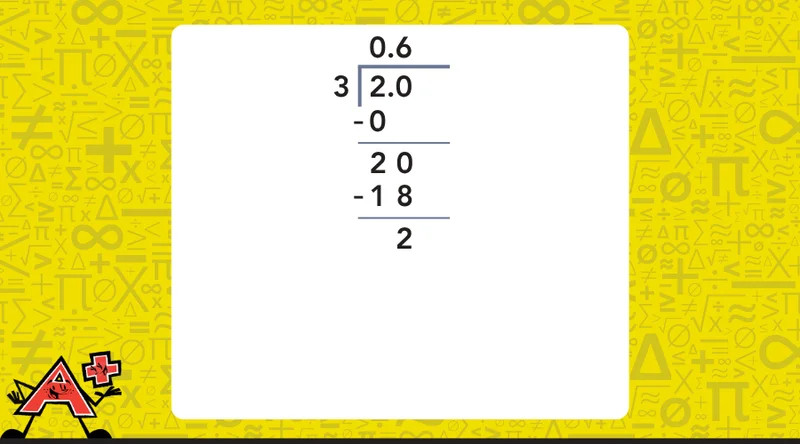
Step 7: Bring Down Again
The remainder is not 0, so the division is not complete. Add another zero to the dividend and bring it down beside the 2 to make 20.
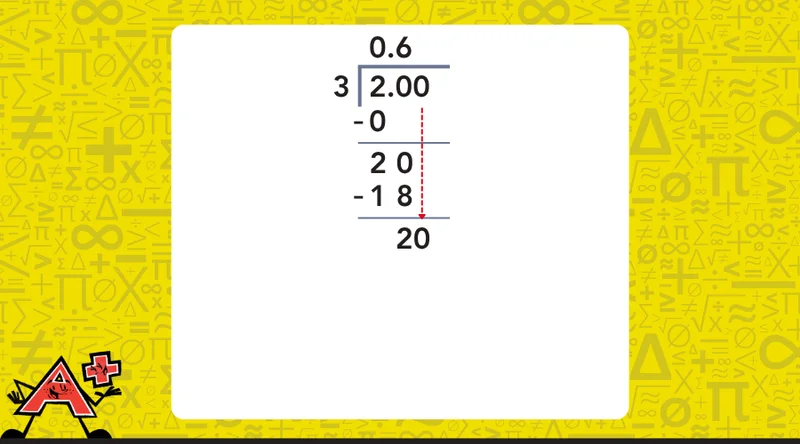
Step 8: Divide Again
3 goes into 20 six times. Write 6 in the hundredths place of the quotient.
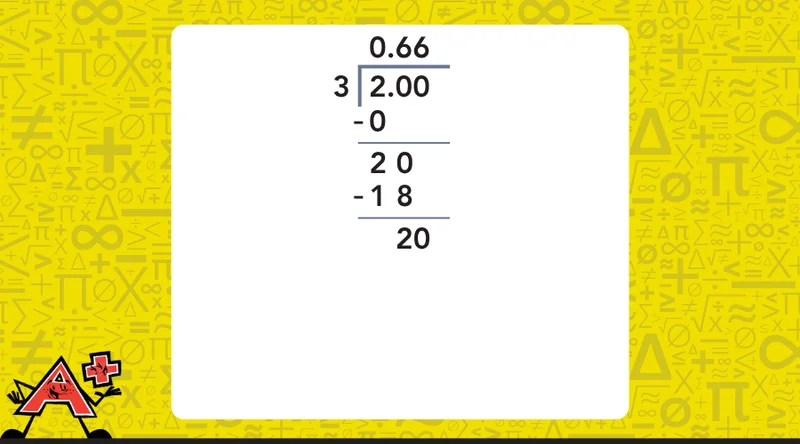
Step 9: Multiply & Subtract Again
Multiply 6 by 3 to get 18. Then subtract 18 from 20 to get a remainder of 2 again.
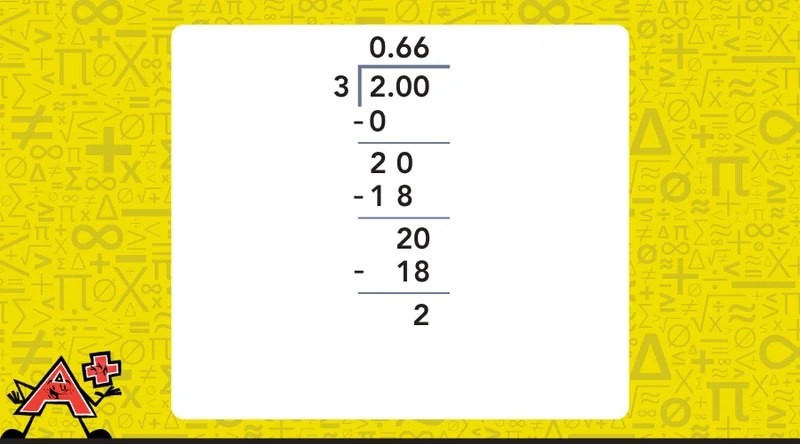
Step 10: Bring Down Again
The remainder is still 2. Add another zero and bring it down beside the 2 to make 20 again.
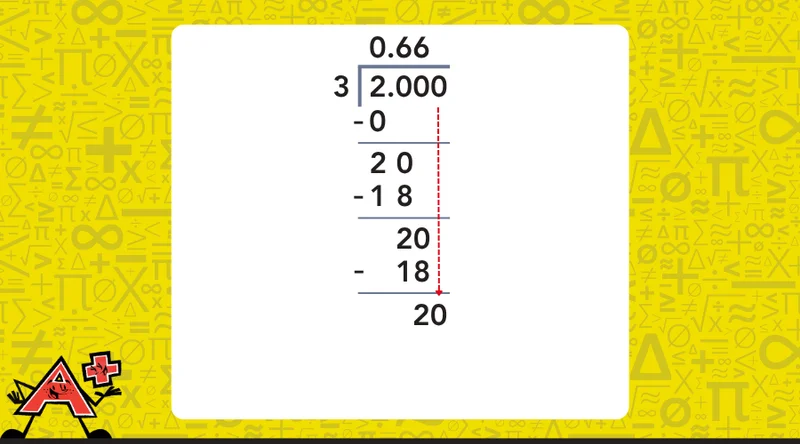
Step 11: Divide, Multiply & Subtract Again
3 goes into 20 six times again. Write 6 in the thousandths place.
Multiply 6 by 3 to get 18, then subtract 18 from 20.
The remainder is 2 once more, so the same division will continue repeating. We can write \(\Large\frac{2}{3}\) = 0.666...
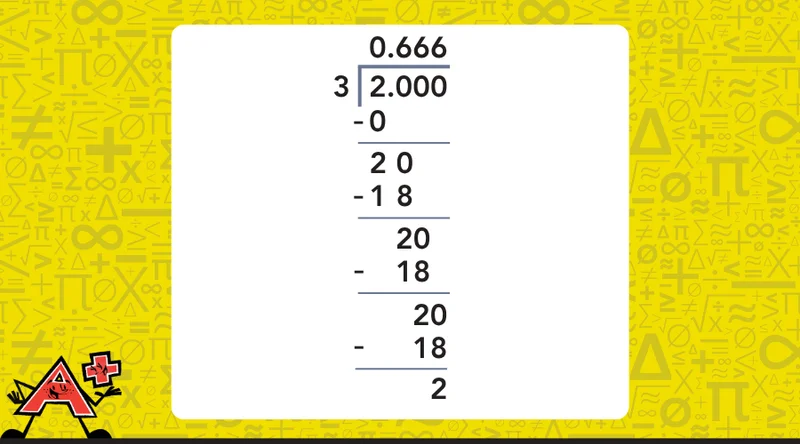
The decimal 0.666... is a repeating decimal because the digit 6 continues indefinitely. We label repeating decimals by placing a bar over the digit that repeats, writing it as \(0.\overline{6}\).
B. Convert 1/6 to a Decimal
This time, before the repeating pattern begins, we’ll see one non-repeating digit. Let’s go on our usual 11-step walkthrough, as we convert \(\Large\frac{1}{6}\) into a decimal.
Step 1: Set Up the Long Division
Since the fraction bar represents division, \(\Large\frac{1}{6}\) means 1 ÷ 6. Place the numerator, 1, inside the division bracket and the denominator, 6, outside it.
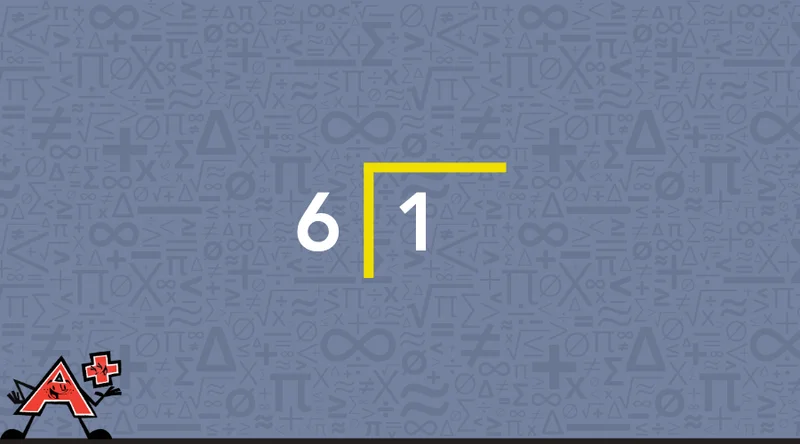
Step 2: Divide
6 goes into 1 zero times, so write 0 in the quotient. Then place a decimal point after it.
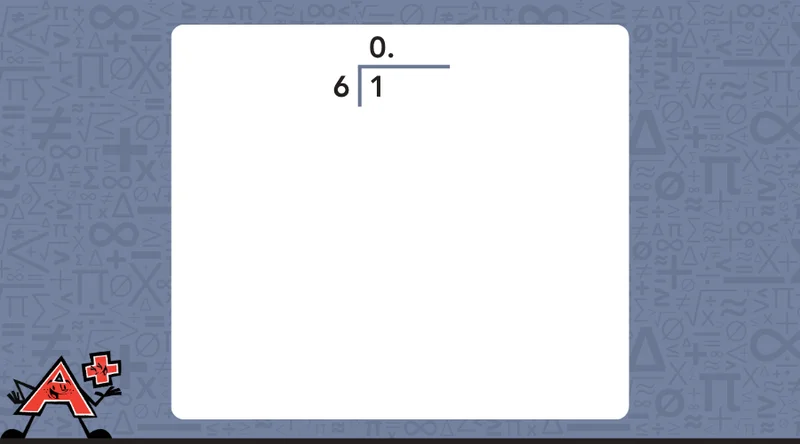
Step 3: Multiply & Subtract
Multiply 0 by 6 to get 0. Then subtract 0 from 1 to get a remainder of 1.
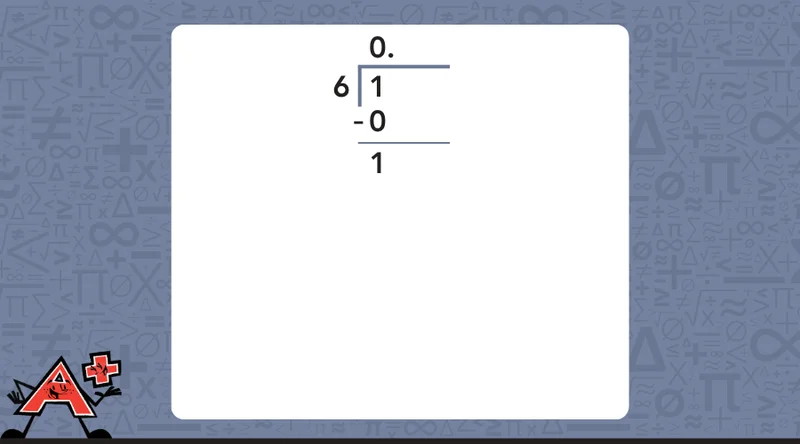
Step 4: Bring Down
Write a decimal point after 1 and add a zero. This changes 1 to 1.0 without changing its value. We can now think of 1.0 as 10 tenths and continue dividing.
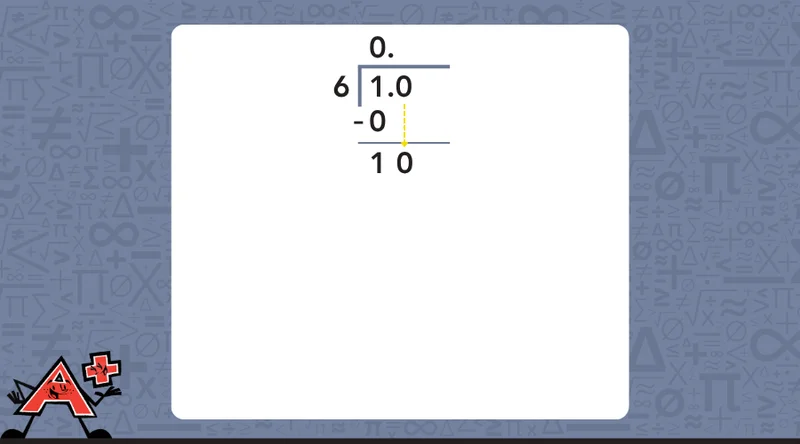
Step 5: Divide Again
6 goes into 10 one time. Write 1 in the tenths place of the quotient.
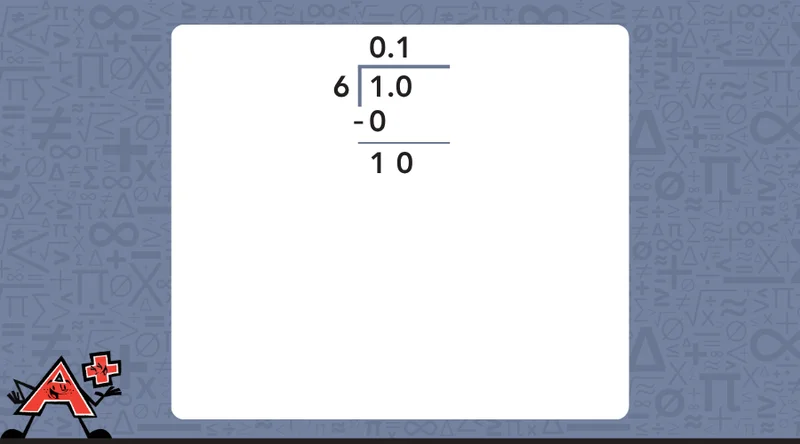
Step 6: Multiply & Subtract Again
Multiply 1 by 6 to get 6. Then subtract 6 from 10 to get a remainder of 4.
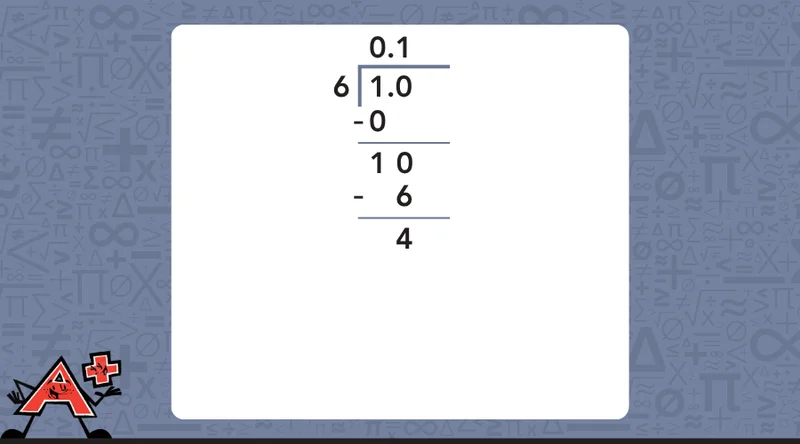
Step 7: Bring Down Again
The remainder is not 0, so the division is not complete. Add another zero to the dividend and bring it down beside the 4 to make 40.
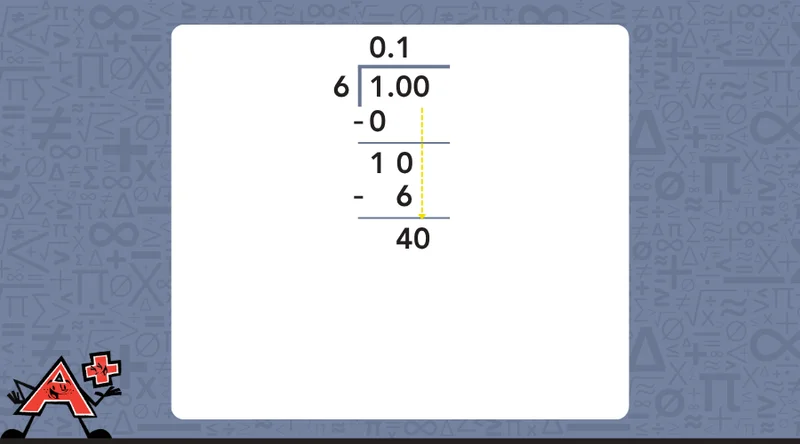
Step 8: Divide Again
6 goes into 40 six times. Write 6 in the hundredths place of the quotient.
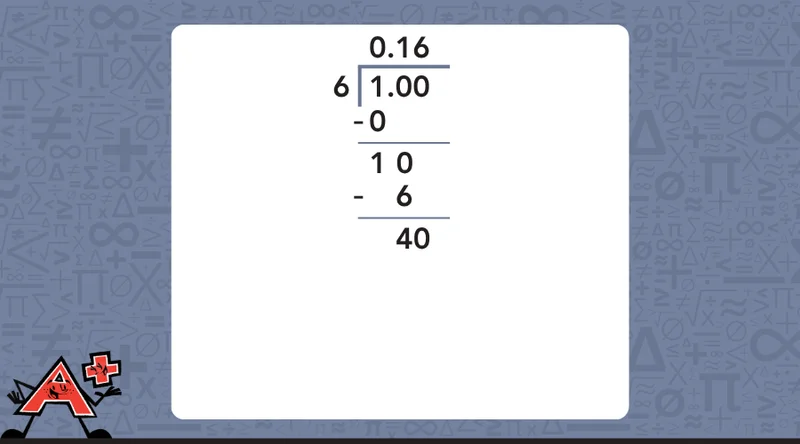
Step 9: Multiply & Subtract Again
Multiply 6 by 6 to get 36. Then subtract 36 from 40 to get a remainder of 4.
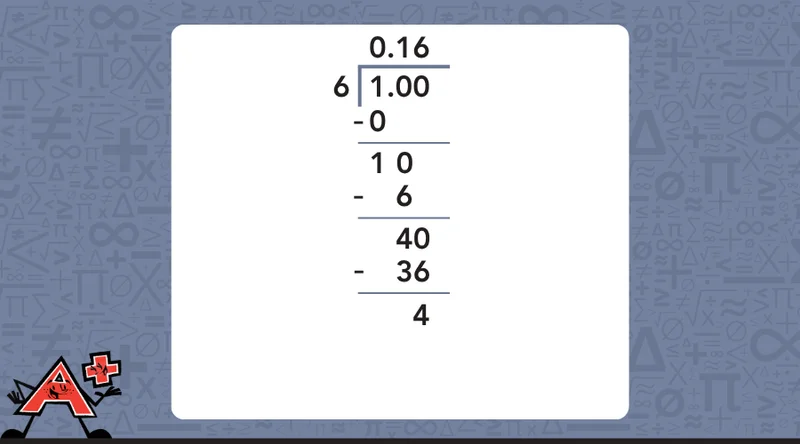
Step 10: Bring Down Again
The remainder is still 4. Add another zero and bring it down beside the 4 to make 40 again.
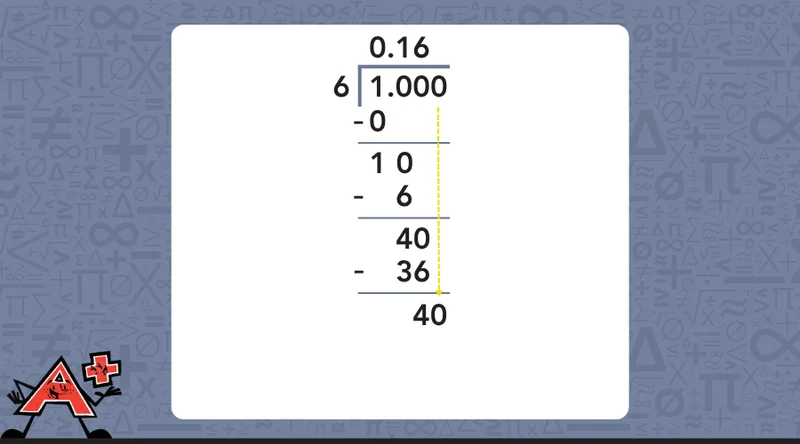
Step 11: Divide, Multiply & Subtract Again
6 goes into 40 six times again because 6 x 6 = 36.
Write another 6 in the thousandths place and subtract 36 from 40.
The remainder is 4 again, so the same division will continue repeating. We can write the results as \(\Large\frac{1}{6}\) = 0.1666...
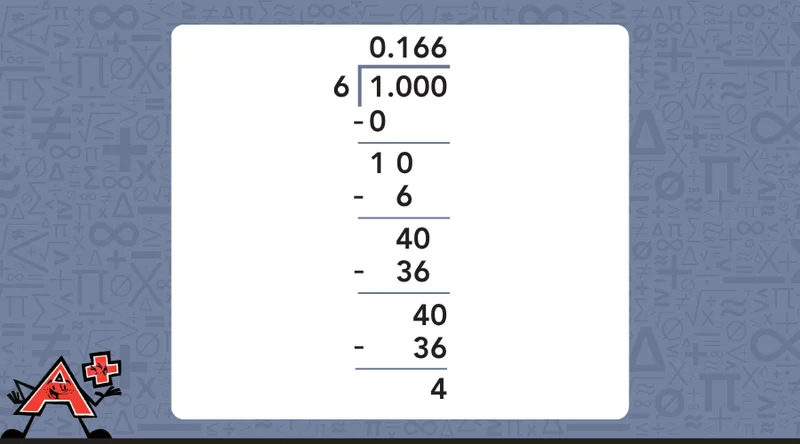
The decimal 0.1666... is a mixed repeating decimal because the digit 1 appears once before the repeating digit 6 begins. We can label it as \(0.1\overline{6}\).
📕 You May Also Like: How to Do Long Division with Decimals - Kid-Friendly Guide
The Base-10 Shortcut
Long division works for every fraction, but it isn't always the fastest option. When we can rewrite the denominator as 10, 100, or 1,000, we can use a much quicker shortcut instead.
To do that, we multiply both the numerator and denominator by the same number. This keeps the fraction's value the same while changing the denominator to a power of 10, so we can read the decimal directly from the numerator.
Let's see how this shortcut works with actual numbers.
Convert 3/5 to a Decimal
Let's convert \(\Large\frac{3}{5}\) into a decimal using the base-10 shortcut. We want a denominator of 10, so we ask, "What do we multiply 5 by to get 10?" The answer is 2.
Next, we multiply both the numerator and denominator by 2 to create an equivalent fraction: \(\Large\frac{3}{5} = \Large\frac{6}{10}\).
Now that the denominator is 10, we can read the decimal directly. The fraction \(\Large\frac{6}{10}\) means 6 tenths, which we write as 0.6. So, \(\Large\frac{3}{5}\) = 0.6.
We can use this shortcut whenever we can rewrite a fraction as an equivalent fraction with a denominator of 10, 100, or 1,000. When we cannot, we use long division instead.
📕 You May Also Like: How to Move the Decimal Point: A Place-Value Explanation
Common Mistakes When Converting Fractions
Let's look at two common mistakes we often see when students start converting fractions to decimals and how to avoid them.
1. Flipping the division setup
Some students may accidentally reverse the numbers when setting up long division by placing the denominator inside the division bracket instead of the numerator.
For example, when we are solving \(\Large\frac{6}{10}\), we know that the numerator (1) is our dividend and the denominator (6) is our divisor. Students sometimes flip the order and write:
The fraction bar tells us to divide the numerator by the denominator, so the numerator always goes inside the division bracket.
One quick way to check your work is to look at the answer, because a proper fraction should always produce a decimal that is less than 1. If your answer is greater than 1, you probably set up the division backwards.
2. Stopping too early on a repeating decimal
When working with repeating decimals, students often get confused about how to write the final answer. Unless told otherwise, a repeating decimal continues infinitely.
Before finishing the problem, check whether the instructions ask you to round to a specific place value.
For example, if the instructions say to round to the nearest hundredth, here's what the final answer should look like:
Always check the instructions before deciding whether to write the repeating decimal or round it to a specific place value. Both are valid, but the instructions tell us which one is expected.
📕 You May Also Like: How to Order Decimals from Least to Greatest: A Step-by-Step Method
Over to You: Practice Converting Fractions to Decimals
Let's put everything we've learned into practice. Solve each problem using the appropriate setup:
1. Convert \(\Large\frac{4}{5}\) to a decimal.
2. Convert \(\Large\frac{1}{8}\) to a decimal.
3. Convert \(\Large\frac{1}{3}\) to a decimal.
4. Convert \(\Large\frac{5}{6}\) to a decimal.
Once you've worked through all four problems, compare your thinking with the solutions at the end of the article.

At Mathnasium, every learning plan is designed to help students build understanding before moving on to new concepts.
How Mathnasium Helps Students Master Fractions and Decimals
Mathnasium is a math-only learning center dedicated to helping K–12 students of all skill levels excel in math.
Whether students are learning fractions for the first time, want to build fluency with fraction-to-decimal conversions, or are ready to tackle more complex problem-solving, we are here to support them.
Our proprietary teaching approach, the Mathnasium Method™, is designed around each student's needs and learning style to help them learn and master math. Our approach includes:
-
Assessment and Personalized Learning Plans: Each student begins their Mathnasium journey with a diagnostic assessment that identifies current skills, strengths, and gaps. From those findings, we build a personalized learning plan tailored to their goals, whether that means mastering fraction-to-decimal conversion, building fluency with place value, or preparing for the proportional reasoning required in middle school math.
-
Teaching for Understanding: Our specially trained tutors use natural language and a mix of verbal, visual, mental, tactile, and written techniques so each concept lands before we move forward.
-
Problem-Solving and Critical Thinking: We give students time to work through problems independently. That productive struggle helps them learn to trust their own reasoning. When we do step in, we explain both the how and the why behind each answer, so students build problem-solving and critical thinking skills they can use in math and beyond.
-
An Engaging and Fun Learning Environment: Sessions include games, earned rewards, and consistent celebration of progress. Students build confidence alongside fluency, and many develop a more positive relationship with math over time.
The impact extends beyond the classroom:
-
94% of parents report an improvement in their child's math skills and understanding
-
93% of parents report their child's improved attitude toward math after attending Mathnasium
-
90% of students saw an improvement in their school grades
With over 1,100 learning centers across North America, there is likely a Mathnasium close to you.
Whether your student is looking to catch up, keep up, or get ahead in math, your local Mathnasium center can help.
Start by booking a diagnostic assessment, and together we'll create a personalized plan for math mastery.

Psst! Check Your Answers Here
How did you do? Let’s find out together.
1. \(\Large\frac{4}{5}\): Multiply the numerator and denominator by 2 to get \(\Large\frac{8}{10}\), so the decimal is 0.8.
2. \(\Large\frac{1}{8}\): Long division gives 0.125, a terminating decimal because the division ends with no remainder.
3. \(\Large\frac{1}{3}\): Long division gives 0.333..., a repeating decimal because the remainder repeats, so the digit 3 continues indefinitely. We write it as \(0.\overline{3}\).
4. \(\Large\frac{5}{6}\): Long division gives 0.8333..., a mixed repeating decimal because the digit 8 appears once before the digit 3 begins repeating indefinitely. We write it as \(0.8\overline{3}\).