Ever looked at a math problem and thought, “Where do I even start?”
Whether it’s plugging in numbers or figuring out what goes where, solving equations can sometimes feel like trying to find your way through a maze without a map.
That’s where T-charts come in. For now, think of them as a simple way to spot patterns and make equations easier to solve and graph.
Today, we’ll take a close look at what T-charts are, how they help us solve and graph linear equations, give you some practice to try on your own, and wrap up by answering common questions students have about them.

What Is a T-Chart?
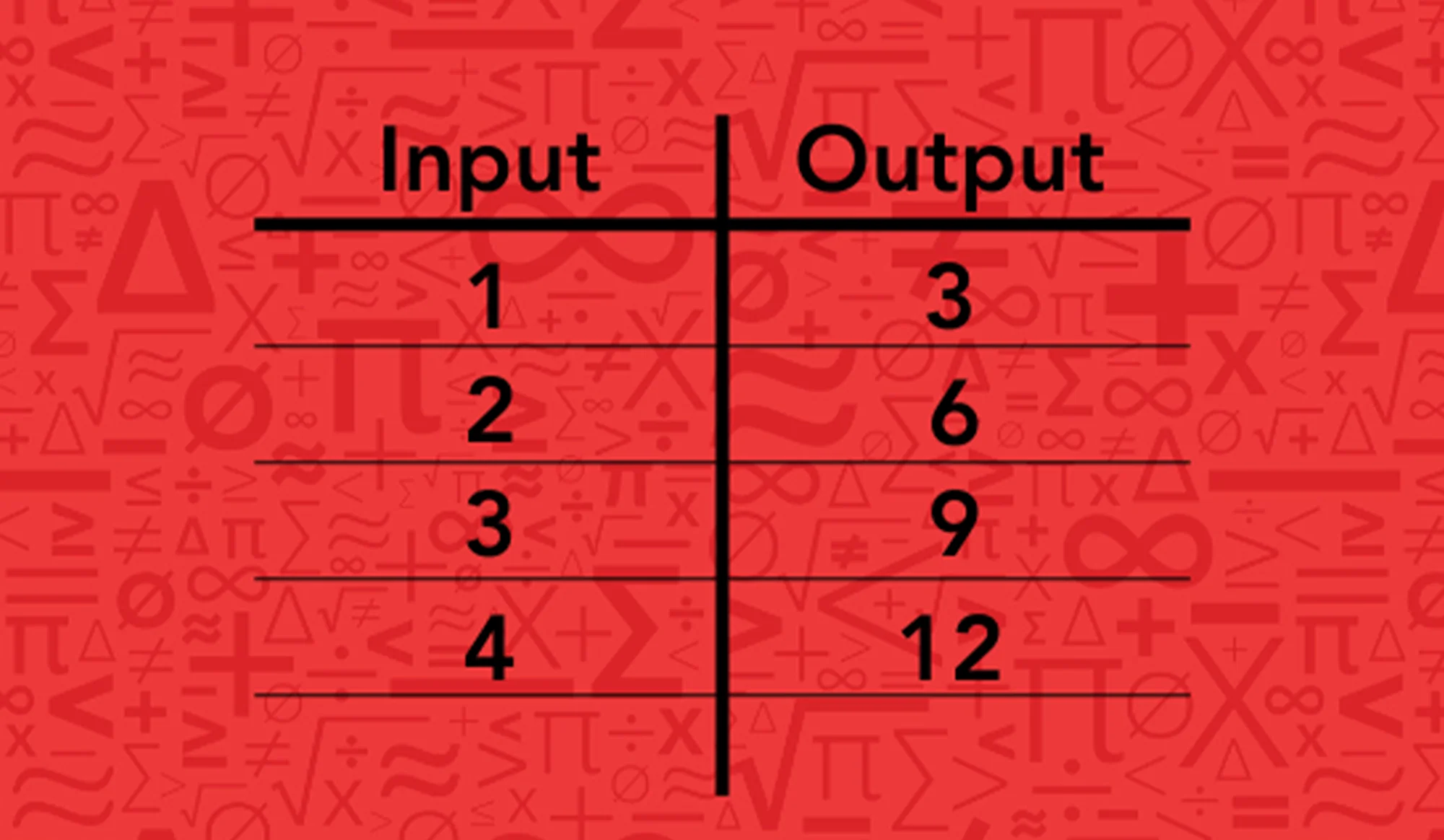
A T-chart, also known as a table of values, is a simple two-column chart used in math to organize and analyze relationships between numbers, especially in equations and functions.
In a T-chart, one column holds the inputs (often x-values from equations), and the other holds the outputs (often y-values that result from equations).
Here’s an example of what it can look like:
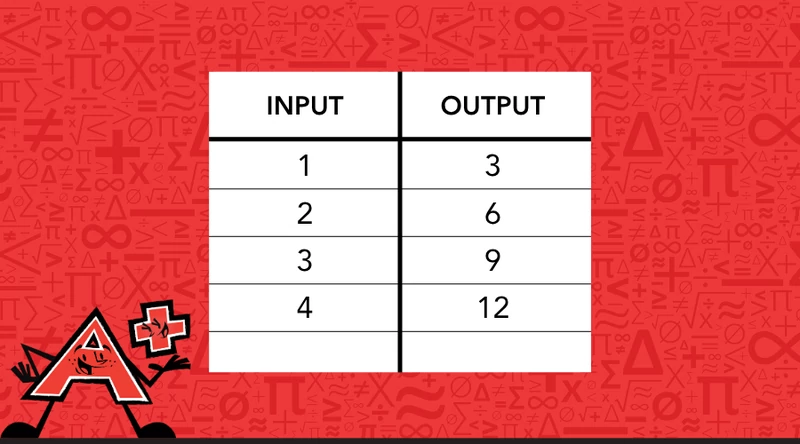
Looks familiar?
We’ll find T-charts in many areas of math, from early number patterns to real-world data sets to algebraic equations.
Anytime we want to track how one value affects another or test how an equation behaves, a T-chart helps lay it all out clearly.
📕 You May Also Like: How to Find the Slope of a Line – A Kid-Friendly Guide
How Do We Use T-Charts to Solve (and Graph) Linear Equations?
When working with linear equations, a T-chart gives us a space to test values, see how x and y interact, and make sense of the math before we ever touch a graph.
We’ll start with equations in slope-intercept form, then move on to equations in standard form.
Need a refresher on this topic? Here’s a simple guide to converting slope-intercept form to a standard form.
Using T-Charts for Slope-Intercept Form (y = mx + b)
Equations in slope-intercept form follow the pattern y = mx + b, where:
-
x is the input (we choose the value)
-
y is the output (we calculate it)
-
m is the slope (the rate of change)
-
b is the y-intercept (the point where the line crosses/touches the y-axis)
Let’s see this in action.
We’ll take the linear equation: y = 2x + 1
Start by picking a few values for x. Say -2 through 2.
Once we choose our x-values, we plug each one into the equation.
The goal is to figure out what y becomes each time.
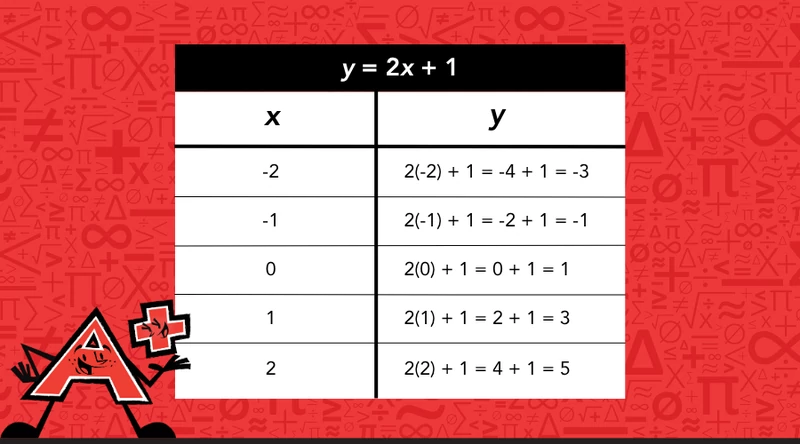
Let’s ask ourselves:
Do we see a pattern in the y-values?
Every time x increases by 1, y increases by 2. That’s the slope!
Now reading from our T-chart (left to right), we can easily pick up the x and y values of points on the line:
(-2, -3), (-1, -1), (0, 1), (1, 3), (2, 5)
That’s all we need to graph a straight line.
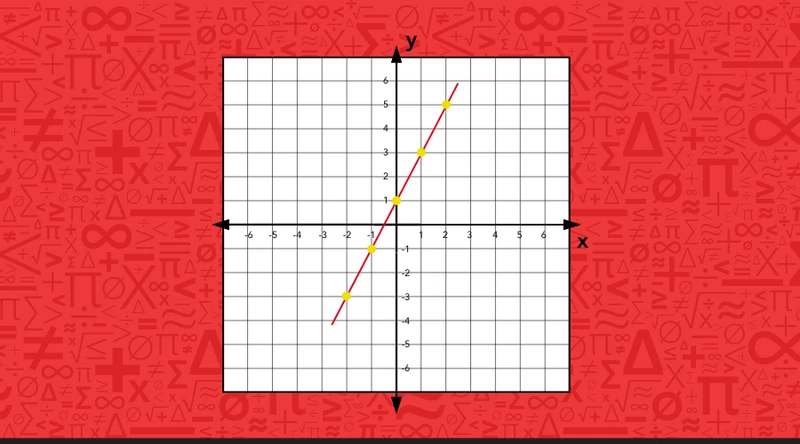
And that’s it. From equation to T-chart to graph, we just completed the full process.
Using T-Charts for Standard Linear Equation Form (Ax + By = C)
Now, let’s look at linear equations written in standard form, which follow this structure:
Ax + By = C
Here’s what each piece means:
Now, we want to use a T-chart to solve and graph an equation in this form. Let’s try this one:
4x + 2y = 16
At first glance, this looks more complicated than the slope-intercept form we did earlier. And it is slightly.
Why?
Because instead of seeing y = something, we now have both variables (x and y) together on one side:
4x + 2y = 16.
To use a T-chart easily, we’ll want to rewrite it in slope-intercept form: y = mx + b.
Let’s take it step by step.
Step 1: Solve for y
Our goal here is to isolate y on one side of the equation.
To get y by itself, we need to move the 4x to the other side of the equation. We do that by subtracting 4x from both sides:
4x + 2y =16
4x + 2y - 4x = 16 - 4x
On the left-hand side, the 4x and –4x cancel each other out. That leaves us with:
2y = 16 - 4x
To stay consistent with the slope form (y = mx + b), we’ll use the commutative property of addition to reorder the terms on the right-hand side:
2y = -4x + 16
Now y is on its own side of the equation, but still has a 2 next to it. We divide every term by 2 to isolate y.
2y ÷ 2 = ( -4x + 16) ÷ 2
y = (-4x + 16) ÷ 2
y = -2x + 8
Now that we’ve got the final equation in slope-intercept form, we can build our T-chart.
Step 2: Create a T-Chart
Now that the equation is in slope-intercept form, y = -2x + 8, we’re ready to plug in values for x and calculate the corresponding y values.
Let’s pick some x-values: 2, 3, and 5
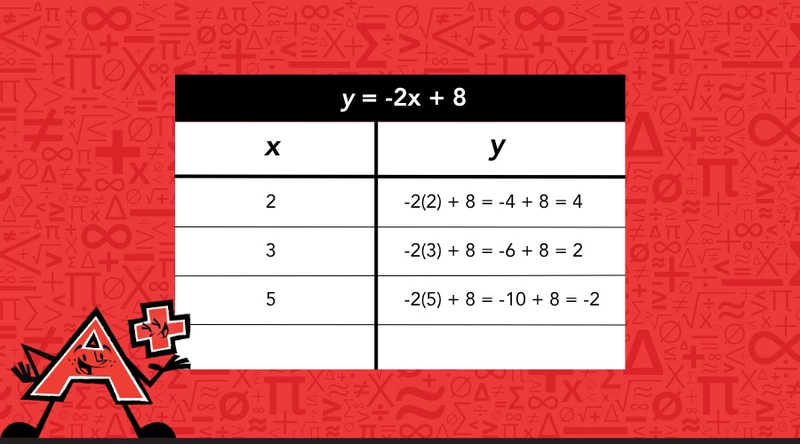
So we get the coordinate pairs:
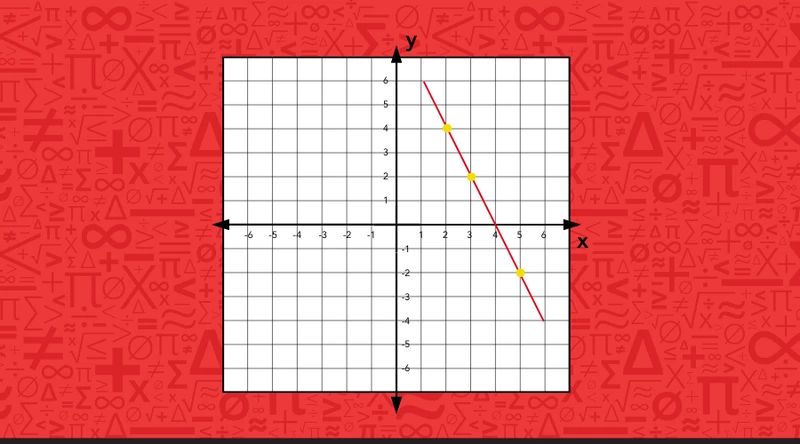
(2, 4), (3, 2), (5, -2)
From the coordinates, we can notice the pattern. Each time x increases by 1, y goes down by 2. That matches the slope, which is -2.
Step 3: Plot it Out
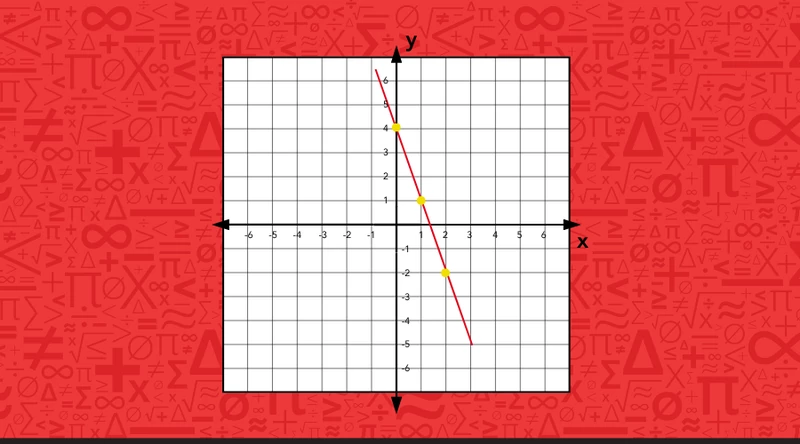
From here, we can read each pair from the T-chart and plot them on a graph. Connect the points and there’s our line.
Plot It Yourself: Solve and Graph with a T-Chart
Now that you've got the idea of how T-charts work, it’s time to test your skills. Try these practice problems to see how well you can set up a T-chart and graph the results.
When you’re done, check your answers at the bottom of the guide.
Task 1: Slope-Intercept Form
Use a T-chart to solve and graph the equation:
y = 3x – 1
Use these x-values: -1, 0, 1
Task 2: Standard Form
Use a T-chart to solve and graph the equation:
6x + 2y = 8
Use these x-values: 0, 1, 2
FAQs About T-Charts
When students learn to use T-charts in math, the questions usually follow.
Here are some of the most common ones we hear at Mathnasium, along with clear, helpful answers to clear up any confusion and keep things moving forward.
1. When do students start learning T-charts?
T-charts usually show up in upper elementary or early middle school, especially when students begin working with patterns, data tables, or graphing equations.
They’re one of the first tools students use to start thinking like mathematicians.
2. Are T-charts just for solving equations?
Not at all! While they’re great for equations, T-charts also help us with other math tasks like spotting number patterns, looking at proportional relationships, or solving word problems.
If we’re looking for patterns or connections, a T-chart is a simple and effective way to lay things out clearly.
3. Can T-charts be used outside of math?
Yes. T-charts often appear in science labs, reading activities, and even project planning—any situation that calls for comparing, sorting, or tracking two related sets of information.
4. Do I have to graph every point in my T-chart?
No, we just need enough points to see the pattern clearly. Usually, three is enough to draw a straight line, but adding a few extras can help us feel more confident before we graph.
Master T-Charts with Top-Rated Math Tutors at Mathnasium
Mathnasium is a math-only learning center dedicated to helping K-12 students of all skill levels reach their full math potential.
At the heart of our work is a proprietary teaching approach called the Mathnasium Method™.
Designed to help students truly understand and even enjoy math, our approach begins with a diagnostic assessment, which pinpoints what each student knows, where they may be struggling, and how they learn best. From there, we create a personalized learning plan that targets their unique needs and moves at the right pace, filling in gaps while building on strengths.
Our instructors use a mix of Socratic questioning, direct instruction, and multi-modal teaching, including mental, visual, verbal, tactile, and written techniques, so concepts like T-charts truly make sense. We don’t rely on memorization; we focus on understanding the why behind the how.
Along the way, students get time to think, practice, and explore on their own because real progress happens when they start seeing themselves as capable problem-solvers. Our goal is to develop independent mathematical thinkers, not just students who can follow steps.
Our centers are designed to build confidence as much as skill. Each of our tutors is not only trained in math but also in how to connect with students, celebrate growth, and create a learning space where kids feel seen, supported, and motivated to improve.
And the results?
-
94% of parents report improvement in their child’s math skills and understanding
-
93% say their child has a more positive attitude toward math
-
90% of students see better grades at school
If you’re ready to see your child thrive in math and build a real understanding of tools like T-charts and beyond, schedule a free diagnostic assessment at your local Mathnasium center.

Pssst! Check Your Answers Here
If you’ve given our T-chart exercises a try, check your answers below.
Task 1
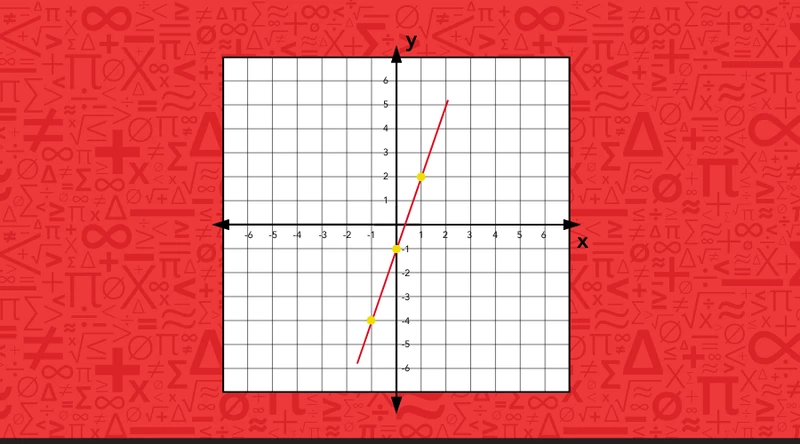
y = 3x – 1
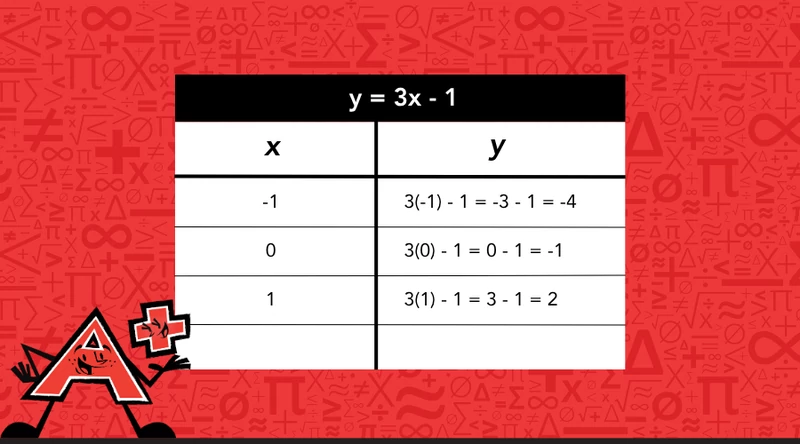
As x increases by 1, y increases by 3.
Task 2
6x + 2y = 8
Step 1: Solve for y
First, move 6x to the other side by subtracting it from both sides:
6x + 2y - 6x = 8 - 6x
Since 6x and -6x cancel each other out, we get:
2y = 8 - 6x
To stay consistent with the slope-intercept form, we will just reorder the terms on the right side:
2y = -6x + 8
Now divide every term by 2 to isolate y:
2y ÷ 2 = (-6x + 8) ÷ 2
y = (-6x + 8) ÷ 2
y = -3x + 4
Step 2: Create a T-Chart
With given values for x (0,1,2), we produce a T-chart.
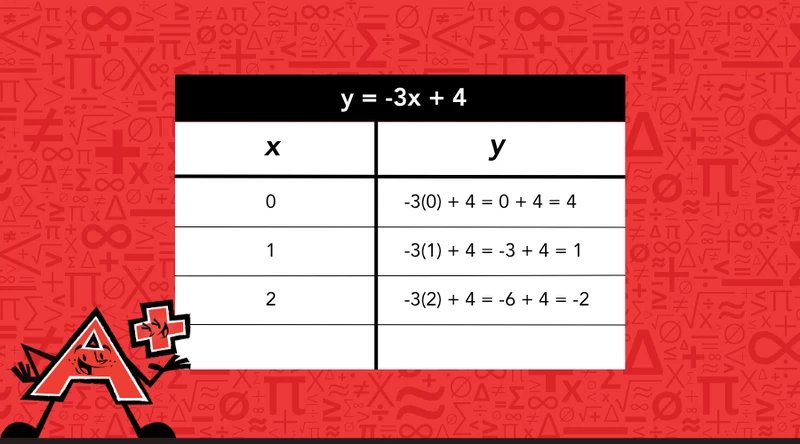
Every time x increases by 1, y goes down by 3.
Step 3: Plot It Out
Read the pairs from the T-chart and plot the line.