Transitioning to middle school math can be hard for students. Abstract concepts like proportional reasoning introduce a kind of thinking that feels very different from what came before, and many students have a hard time making sense of it at first.
What’s important to remember is that struggling at the start doesn’t mean your child won’t get it. With the right strategies and your help, your child can crack proportionality and start to better understand middle school math.
Read on for six simple, practical ways you can use at home to help your child crack proportionality and middle school math – brought to you by our seasoned (and might we add, top-rated) math tutors.

Why Proportionality Feels So Hard
In elementary school, math feels predictable: counting, memorizing facts, solving problems step by step.
Then middle school hits, and suddenly students are asked to compare quantities, scale relationships, and shift between graphs and equations.
That’s a big leap.
Proportional reasoning may sound simple, but in practice, it asks students to juggle ratios, rates, percentages, slopes, and constants, all while making connections and choosing the right strategy forward.
For a brain still developing abstract thinking, it’s a lot.
And if a child doesn’t fully understand fractions or division, proportional reasoning can feel impossible because they’re missing the foundational math skills.
One study posits that students tend to have the most trouble distinguishing when to use multiplicative reasoning versus additive reasoning in proportional problems, a core misunderstanding that often goes unnoticed.
Proportionality is also important because it’s the gateway to algebra. If a student doesn’t truly understand proportionality, algebra becomes a memorized maze of formulas.
Your kid doesn’t need to master all of this overnight.
With short, focused conversations at home, meaningful practice, and the right questions, posed with care and without pressure, they can make sense of proportionality in no time.
📕 You Might Also Like: Common Middle School Math Struggles & How to Bridge the Gaps

Proportional reasoning challenges students to think abstractly, often before they’re ready.
How to Help Your Middle Schooler Understand Proportionality
Middle schoolers often resist help coming from their parents.
At this age, they crave independence but still need structure and support, especially when it comes to math.
Here are 6 simple ways to help your child understand proportionality, even if you only have 15 minutes a day:
1. Start With Relevant Real-Life Examples
You don’t need to sit down for a formal “math talk.” Some of the best learning happens during downtime like car rides, making dinner, or unpacking groceries.
When the moment feels right, casually bring in a proportional idea.
For example:
“If one pack of strawberries costs $4, how much would three cost? Would five cost exactly $20?”
Or while cooking: “If the recipe serves 4 and we want to feed 6, what would we need to change?”
These are short, innocuous questions that invite your child to notice relationships.
If they respond, great. If they don’t, move on. You’re planting seeds. What matters is that you're modeling the kind of reasoning they’ll need in class.
Keep your tone curious, not corrective. Let them talk through it, even if it’s wrong. That process matters more than getting it right the first time.
2. Use Visual Tools
Kids often say they don’t understand word problems because they can’t picture them visually.
That’s where tape diagrams or bar models can help because they make math visible.
Instead of just saying, “A ratio of 2:3,” draw two rectangles next to three.
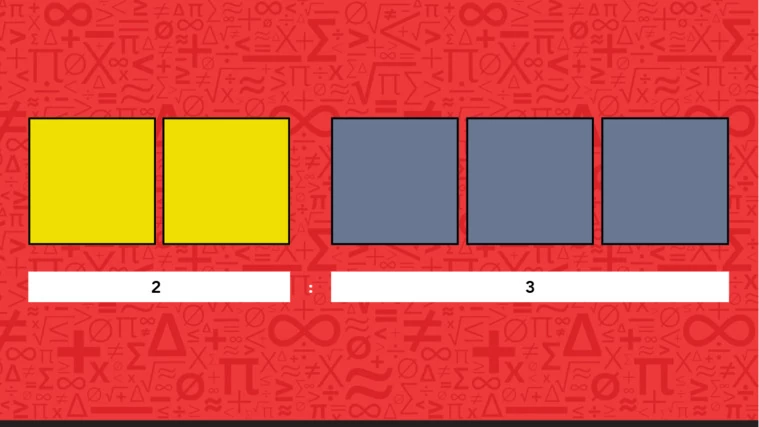
Ask: “If each one of these stands for a cup of water, what happens if we double the whole thing? Does the ratio change?”
You don’t need special tools. Graph paper, colored pencils, or even snacks, like pieces of fruit or crackers, can become ratio models. Your child may resist at first, but if they’re engaged in building or explaining something, their defenses tend to soften.
Even a simple “triple the recipe” challenge during dinner prep can become a meaningful moment.
Let them lead the math. If they mess up, ask, “What makes you think that?” rather than jumping in.
Mistakes often reveal what they almost understand.
📕 You Might Also Like: How to Teach Math to Visual Learners
3. Help Them Graph Something They Care About
Graphing can be one of the biggest stumbling blocks in proportionality. Students often don’t understand what it means for a line to go through the origin or how to interpret the “steepness” of a line.
Try flipping that. Start with data from their world.
-
Is your child into gaming? Track how long they play and how many levels they beat.
-
Into music? Log practice time and how many songs they’re working on.
-
Sports? Track points scored versus time on the field.
Plot it together on paper or in a free app like Desmos. Then ask, “Do you think this line would go through (0,0)? Why?” Or “If the line gets steeper, what does that tell us?”
These are entry points into thinking about unit rate and constant of proportionality without using those terms if they feel intimidating.
This is all about helping them connect math to something that feels real and relevant.
📕 You Might Also Like: How to Find the Slope of a Line—A Kid-Friendly Guide
4. Correct Misconceptions Early But Gently
Speaking of graphs, one of the most common myths students hold is that all straight lines on a graph represent proportional relationships. That’s not true. A line is only proportional if it passes through the origin and has a constant rate of change.
Even more confusing for them is the idea that the rate of change could be negative, like when y = –x. That’s still proportional, even though one value goes down while the other goes up.
If your child resists these conversations, it may help to explore together on a graphing calculator or app. Let them play around. Ask what they notice.
You don’t need to correct them right away. When they see something that doesn’t make sense, that’s your moment to guide, not fix.
📕 You Might Also Like: Why Parents Should Teach Kids to Embrace Math Mistakes
5. Focus on Small Wins and Praise Their Effort
If your child shuts down at the sight of a worksheet, that’s okay.
Start with one problem. Or even just one part of a problem. Show them how to create a table from an equation like y = 2x. Or ask them to predict the total before solving.
Keep it short. Keep it manageable.
Mindset matters a lot here.
You might say, “You stuck with that even when it was annoying, that’s what good problem-solvers do.”
Try not to tie praise to being right. Instead, focus on effort, reasoning, or persistence. Those are the traits that truly lead to long-term success in math.
And if your child struggles with fractions or decimals, don’t ignore it. Go back and review together, or ask their Mathnasium math tutor or teacher to focus on those areas.
📕 You Might Also Like: How to Cultivate a Growth Mindset in Math (At Home Guide)
6. Go Back If Needed
A lot of proportional thinking breaks down because students are still shaky on division or fractions.
If your child resists a proportional problem, it might not be the new concept; it might be earlier skills they’re embarrassed to admit they never mastered.
Watch for hesitation around dividing or simplifying.
If you see it, try revisiting basic fraction tasks together for a few minutes with no pressure, just practice.
Even short games or visuals, like cutting fruit into halves and thirds, can help reconnect them to these ideas.
And if that’s not realistic for you to do at home, talk to their teacher or Mathnasium math tutor. Gaps in foundational skills are incredibly common and easy to miss in middle school.
📕You Might Also Like: How Positive Math Talk Encourages a Growth Mindset at Home

Struggles with proportionality often trace back to shaky fraction or division skills, which are foundations worth revisiting.
When to Step In: Signs Your Child May Need Extra Support
Most parents worry about stepping in too late, but just as many step in too early.
Middle schoolers naturally push back against help, so it can be hard to tell the difference between normal growing pains and genuine academic struggles.
The key is to watch for patterns over time, not just one bad quiz or frustrating evening.
Look for these signs over several weeks:
-
Avoidance or shutdown during math homework (even after a good day at school)
-
Frequent confusion around unit rates, word problems, or graph interpretation
-
Panic during tests, even when homework seems okay
-
Negative self-talk like “I’m just bad at math” or “This never makes sense”
-
Skipping steps or guessing without thinking it through
-
Gaps in earlier skills like fractions, multiplication, or equation solving
These signs don’t mean your child isn’t trying.
More often, they signal a skills gap that’s causing frustration.
What you can do without overstepping:
-
Ask for the teacher’s perspective. A quick email can reveal a lot about in-class performance that isn’t visible at home.
-
Schedule a diagnostic assessment with Mathnasium. Our assessment pinpoints your child’s strengths and uncovers any gaps, whether it’s setting up equations or dividing accurately. You’ll walk away with a clear picture of where your child stands, even if you’re not ready to start with Mathnasium right away.
-
Keep emotions low and goals simple. Say things like, “I’ve noticed this part is tricky. Want to get a little help so it’s less frustrating?”

A diagnostic assessment at Mathnasium reveals where your child shines and where support can make all the difference.
Master Math with Top-Rated Tutors in Richardson West
Mathnasium is a math-only learning center dedicated to helping students of all skill levels build confidence and excel in math.
At our center in Richardson, TX, we work with children in middle school and students who need to catch up, stay on track, or move ahead to more advanced math.
At the core of everything we do is The Mathnasium Method™, our proven approach that goes beyond homework help and creates a deep, lasting understanding of math.
The Mathnasium Method™ builds math mastery through:
-
Diagnostic Assessment: Every student begins with a comprehensive assessment that identifies what they already know, where the gaps are, and how they learn best.
-
Personalized Learning Plan: Based on assessment results, we create a customized plan designed specifically for your child. No two plans are alike; each student progresses at the pace that works best for them.
-
Teaching for Understanding: Our specially trained math tutors explain math in ways that make sense, using simple language and real-world connections that help students “get it.”
-
Problem-Solving Skills: Instead of memorizing steps, students learn the why behind math. We use a blend of mental, visual, verbal, tactile, and written techniques to strengthen critical thinking and problem-solving skills important for success in school and in life.
The results speak for themselves:
-
94% of parents report improvement in their child’s math skills and understanding
-
93% of parents say their child’s attitude toward math has improved
-
90% of students see an improvement in their school grades
We proudly serve families right here in Richardson, TX, with both in-center and online options designed to fit busy schedules.
With over 100 positive Google reviews, we are a top-rated math learning center in the city. Mathnasium of Richardson West is also a winner of the Readers’ Choice Award in Living Magazine's Best of Richardson and Murphy for:
Ready to take the first step?
Schedule a free assessment at Mathnasium of Richardson West today and put your child on the path to math mastery.
Schedule a Free Assessment at Mathnasium of Richardson West
Looking for a different location?
📍 Find a Mathnasium Learning Center near you.


 (972) 231-6284
 (972) 231-6284