Happy World Chocolate Day!
What better way to celebrate than by combining two of our favorite things: chocolate and math?
You might have seen an image or video where someone cuts a chocolate bar into pieces, rearranges them, and somehow ends up with a full bar again... plus an extra square of chocolate. It seems like a delicious life hack. Is it possible to get infinite chocolate from one bar?
Let’s unwrap the mystery.
How the Illusion Works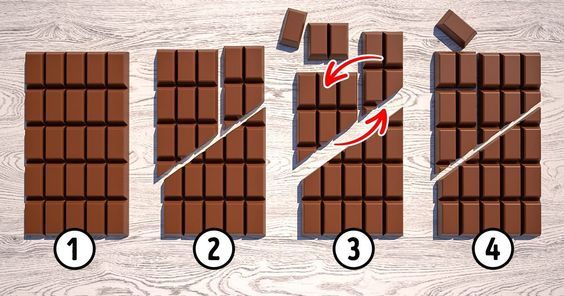
Take a look at the image above.
-
It starts with a regular chocolate bar made of evenly sized squares, often a 6x4 grid.
-
The bar is cut along specific lines, one diagonal and one horizontal.
-
The pieces are rearranged. One shifts down, another slides across, and somehow it all fits back together perfectly.
-
But wait! there’s a leftover square of chocolate.
It looks like a flawless rearrangement, but something doesn’t add up. Literally.
The Math Behind the Illusion
This is a classic visual illusion built on clever geometry and small changes that are hard to detect.
When the chocolate bar is cut and rearranged, the new shape appears identical to the original. But in reality, it is slightly smaller. The cut pieces don’t align perfectly. The angles are just a bit off, and the area of the final bar is reduced by exactly one square.
In simple terms, this illusion cheats the system by spreading out a small loss over the whole bar. The leftover square doesn’t come from nowhere. It comes from the tiny gaps introduced during rearrangement that most people don’t notice.
It’s not infinite chocolate. It’s an optical trick using geometry.
Why It Feels Like Magic
Our brains are wired to believe what we see. If something looks the same size and shape, we assume it is. The chocolate bar seems to keep its total number of squares, so we trust the illusion.
But math helps us see beyond appearances. It encourages us to think critically and look for hidden patterns or inconsistencies. That’s what makes this puzzle so fun to explore.
A Fun Lesson in Critical Thinking
This is more than just a cool trick. It’s a great way to introduce students to concepts like area, geometry, and logical reasoning.
It teaches us that:
-
What you see isn't always the full picture.
-
Precision matters in math.
-
Questioning and analyzing lead to deeper understanding.
Best of all, it shows how math can be fun and surprising.
Final Thought
While the idea of infinite chocolate is sadly just an illusion, the real treat is discovering how math makes sense of things that don’t always seem to add up at first.
So this World Chocolate Day, enjoy your favorite sweets. And remember — math is everywhere, even in your snack breaks.
Looking for more math fun?
At Mathnasium, we help students explore math in engaging and creative ways. From puzzles to problem-solving to building real-world skills, our personalized approach makes learning math enjoyable and meaningful.
📞 Contact us today to schedule a free assessment and see how we make math make sense.


 (613) 680-6284
 (613) 983-1677