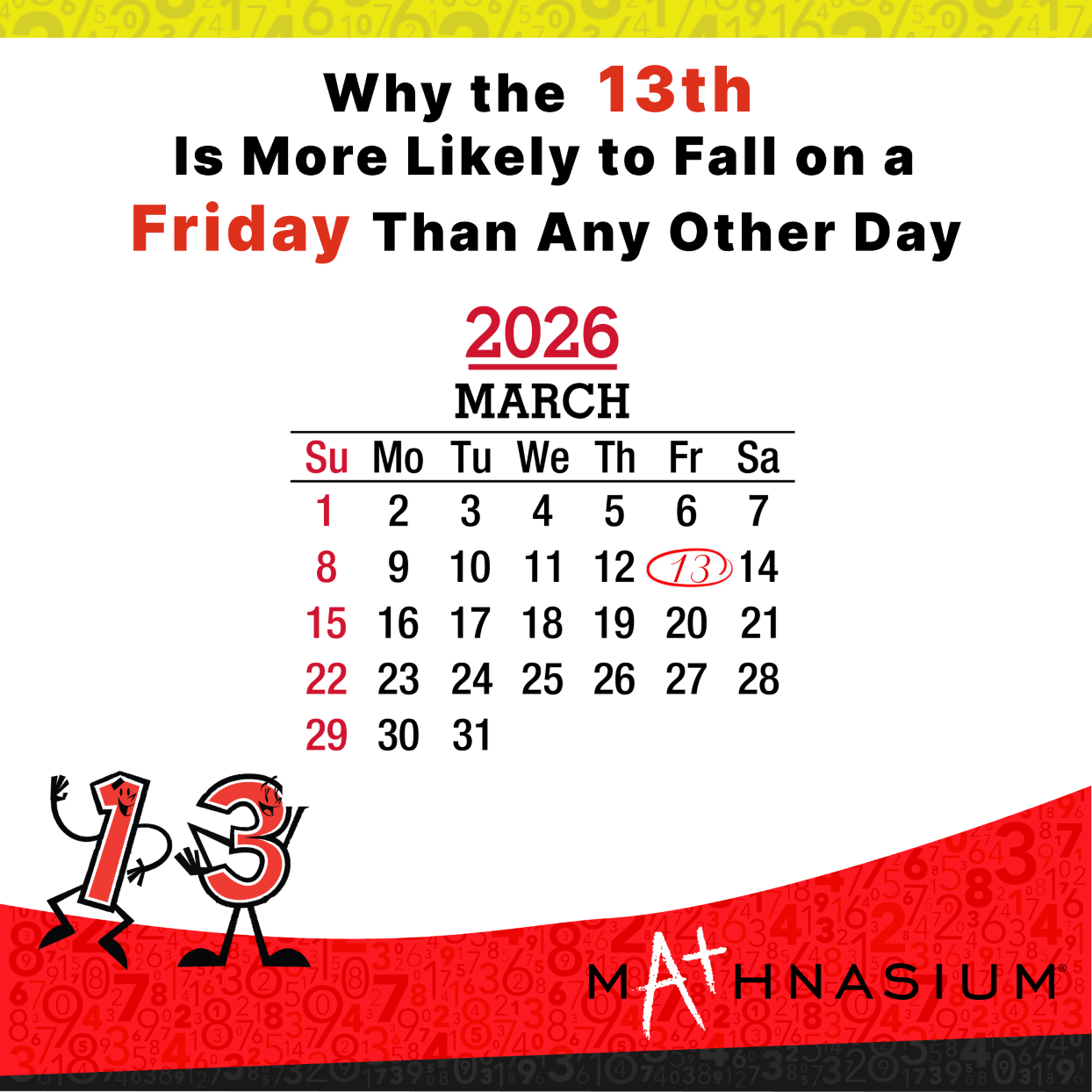
Friday the 13th has a reputation that goes far beyond math. Some people treat it as bad luck. Others barely notice it. But there is a genuinely interesting mathematical fact hiding behind the superstition:
In the Gregorian calendar, the 13th of the month falls on a Friday more often than on any other weekday.
This isn’t folklore or coincidence. It’s a direct result of how the modern calendar is structured.
Once you see why it happens, it becomes a surprisingly nice example of how patterns emerge from simple rules.
A quick way to see the pattern
The key observation is this:
If the first day of a month is a Sunday, then the 13th will be a Friday.
You can check it quickly.
| 1st |
Sunday |
| 2nd |
Monday |
| 3rd |
Tuesday |
| 4th |
Wednesday |
| 5th |
Thursday |
| 6th |
Friday |
| 7th |
Saturday |
| 8th |
Sunday |
| 9th |
Monday |
| 10th |
Tuesday |
| 11th |
Wednesday |
| 12th |
Thursday |
| 13th |
Friday |
So every time a month begins on Sunday, a Friday the 13th appears.
That means the question becomes: how often do months start on Sunday compared to other days?
At first glance, you might expect each weekday to occur equally often. But because of leap years and the way the calendar repeats, the distribution is not perfectly even.
The calendar cycle behind the scenes
The modern calendar follows the Gregorian system, introduced in 1582 to correct long-term drift in the earlier Julian calendar.
Its structure is simple:
-
A normal year has 365 days
-
A leap year has 366 days
-
Leap years occur every 4 years, except for century years not divisible by 400
Because of these rules, the Gregorian calendar repeats its exact weekday pattern every 400 years.
Within that 400-year cycle, there are:
-
146,097 total days
-
4,800 months
When mathematicians analyze all 4,800 months in the cycle and count which weekday the 13th falls on, the results look like this:
Weekday
|
Number of times the 13th occurs
|
| Friday |
688 |
| Sunday |
687 |
| Wednesday |
687 |
| Monday |
685 |
| Tuesday |
685 |
| Thursday |
684 |
| Saturday |
684 |
So Friday comes out on top.
Not by a huge margin, but consistently enough that Friday the 13th occurs more often than any other 13th day of the week.
Why the distribution isn’t perfectly even
The unevenness comes from two interacting pieces of the calendar:
-
A normal year shifts weekdays by one day.
Since 365 days is 52 weeks plus 1 day, the first day of the next year moves forward by one weekday.
-
Leap years shift weekdays by two days.
A leap year has 366 days, which is 52 weeks plus 2 days.
Because leap years occur regularly but not perfectly evenly across centuries, the starting weekday of months becomes slightly biased over long periods.
That small bias carries forward to the 13th of each month.
Over a single decade, you might not notice it. Over the full 400-year cycle, the difference becomes measurable.
A pattern students often enjoy exploring
This is actually a nice example of the kind of thinking we encourage when students are learning math.
Instead of memorizing a fact, you can ask questions like:
-
What structure produces the pattern?
-
What assumptions are built into the system?
-
Over what time scale does the pattern appear?
The Friday the 13th phenomenon only becomes clear when you zoom out and examine hundreds of years of data.
Students often enjoy exploring similar calendar questions, such as:
-
How often does February start on a Monday?
-
How many Friday the 13ths can occur in one year?
-
When will a specific calendar repeat exactly?
Those kinds of puzzles show that math is not only about solving equations. Sometimes it’s about noticing patterns hidden in systems we use every day.
A small twist: how many Friday the 13ths can a year have?
Once people hear this fact, the next question usually follows quickly.
How many Friday the 13ths can happen in one year?
The answer ranges from one to three.
Three occurs only when the 13th lands on Friday in:
This alignment happens occasionally but not frequently. The last time it occurred was in 2015, and this year in 2026.
Why this kind of math matters
Calendar math may seem like trivia at first, but it highlights an important idea.
Mathematics often reveals structure in places we normally overlook.
Something as ordinary as the calendar is governed by rules, cycles, and patterns. When those rules interact over time, surprising results appear.
For students, learning to notice these patterns builds the same skills used in algebra, probability, and higher-level math later on.
Curiosity about small questions often leads to deeper understanding.
And sometimes it leads to fun discoveries, like the fact that Friday the 13th really is the most common 13th of the month.
Not because of superstition.
Just because of math.


 (613) 680-6284
 (613) 983-1677