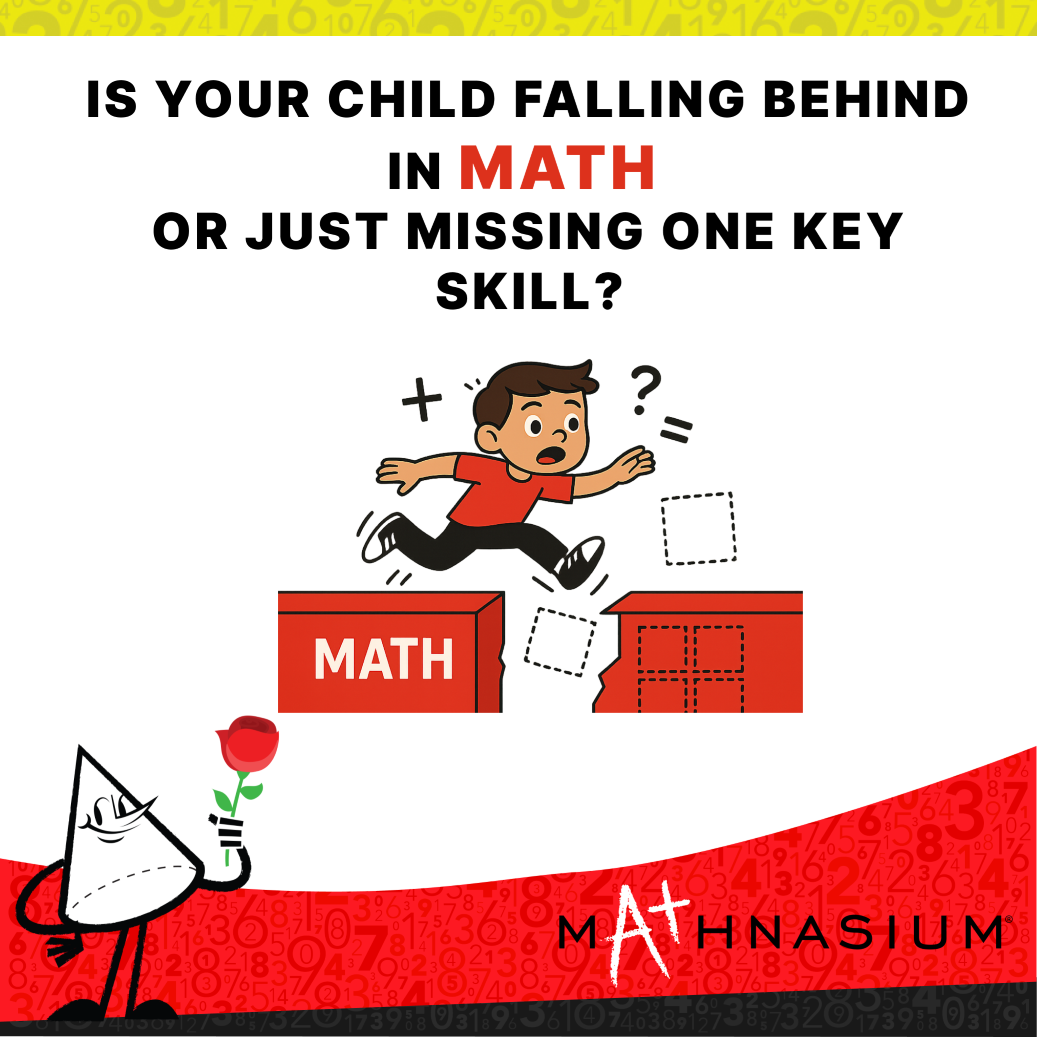
By February, many parents start to notice a low-level tension around math.
Nothing dramatic has happened yet. There hasn’t been a big drop in marks or a call home from school. But homework feels heavier. Math conversations get shorter. There’s more resistance than there used to be.
Grades may not have dropped dramatically. Homework is getting done. Tests are being written. And yet, math feels harder than it should. More stressful. More emotional.
In our experience working with students across Ottawa, this is often the point where families assume their child is “falling behind.” In reality, what we usually see is something more specific and more fixable.
A small missing skill.
When one small gap starts to matter
Math builds on itself. The Ontario curriculum is designed that way.
Concepts don’t disappear once a unit test is over. They come back later, often mixed with new material, and students are expected to remember how and why things work. When a student misses or only partially understands one concept, they can often compensate for a while.
That compensation doesn’t last forever.
A student who never fully mastered multiplication facts can still get through early fractions by guessing, counting, or relying heavily on calculators. But by the time ratios, algebraic expressions, or equations appear, everything slows down. What looks like a sudden drop in confidence is usually the result of that one unresolved gap finally catching up.
We see this pattern constantly. The math hasn’t suddenly become impossible. It’s just stopped being forgiving.
Why problems often show up around mid-year
Mid-year is when many math topics shift from review-based learning to application-based learning. Students are expected to combine multiple ideas at once and work more independently.
That’s when parents start to notice things like:
-
Homework is taking far longer than it used to
-
Increased frustration or avoidance around math
-
Mistakes that feel careless but happen repeatedly
-
A child saying they “understand it in class” but can’t explain it at home
None of these automatically means a student is behind overall. They often mean one foundational skill was never fully secured.
Signs that are easy to overlook
Some gaps are obvious. Others hide in plain sight.
A student may memorize steps without understanding why they work. They may perform well on short quizzes but struggle on cumulative tests. They may rely heavily on examples instead of reasoning through new problems.
One of the biggest red flags we see is when a child can’t explain their thinking. If they can’t tell you why they chose a method, chances are they’re operating on a fragile understanding.
Another sign is inconsistency. One day, the work looks solid. The next day, it falls apart. That’s rarely a motivation issue. It’s usually a shaky foundation.
A practical way to spot a gap at home
You don’t need to reteach math or download endless worksheets.
A simple first step is to ask your child to walk you through a recent problem and explain their reasoning out loud. Not just what they did, but why. Where they hesitate is often where the gap lives.
It also helps to look back, not just forward. If current topics involve fractions, variables, or word problems, ask whether the underlying skills were ever truly comfortable. Speed, accuracy, and confidence matter more than having seen the topic before.
Why this matters more than it seems
Small gaps don’t stay small. Left alone, they quietly compound and eventually affect grades, confidence, and test performance.
When gaps are identified early, students often experience a noticeable shift. Math feels more predictable. Mistakes make more sense. Confidence returns because the work finally connects.
This is one area where personalized instruction can make a real difference. Instead of pushing ahead and hoping things click, students get the chance to rebuild what’s missing and move forward with clarity.
In our centres, a lot of time is spent slowing things down enough to see where understanding actually broke down. Not rushing ahead, but making sure the foundation is solid before moving on.
For many families, realizing that their child isn’t “bad at math” but simply missing one key skill is a turning point.
And it often starts with asking the right question.


 (613) 680-6284
 (613) 983-1677