Students often mix up rates and ratios because both compare quantities.
It is natural to be confused, because ratios and rates look almost identical on the page, and students frequently see one term used interchangeably with the other. But knowing which one they are working with makes later topics, including unit rates, proportions, slope, and algebra, much easier to understand.
We will explain what each term means, compare them side by side, and give you a quick way to identify a rate or a ratio.

What Is a Ratio in Math?
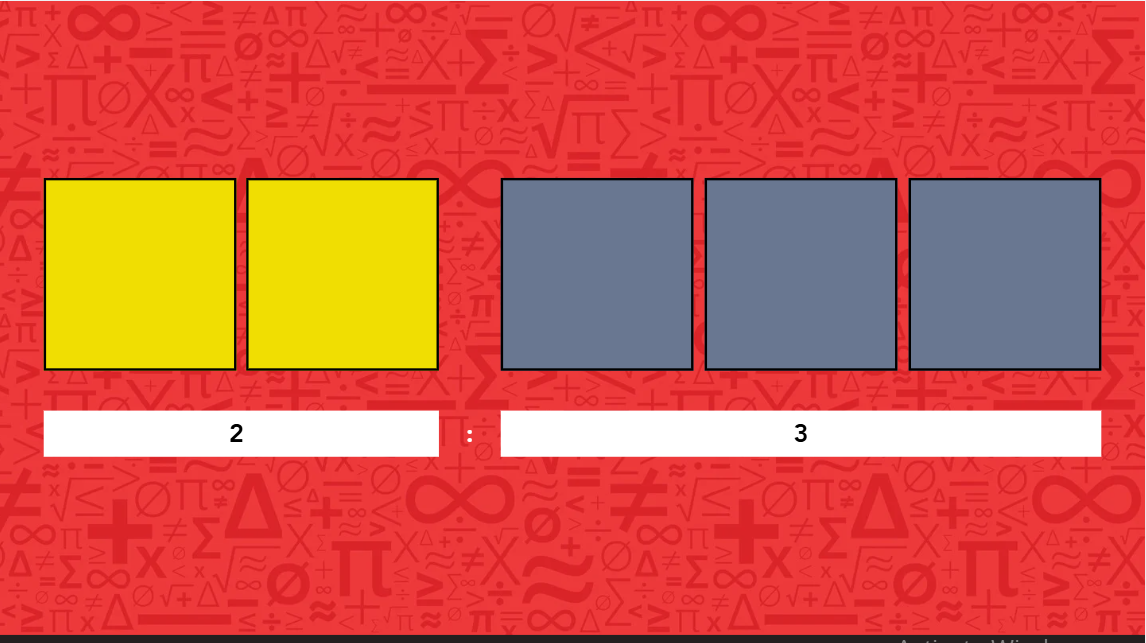
A ratio compares two quantities. It shows how much of one thing there is compared to another, without changing the units involved.
We can write a ratio a few different ways: 3:4, 3 to 4, or 3/4.
All three mean the same thing, so we might see any of them in a textbook or word problem.
While counting students in a classroom, a teacher might notice 12 boys for every 15 girls, so the ratio of boys to girls in their class is 12:15. Or, when a baker follows a recipe, they might use 2 cups of flour for every 1 cup of sugar, a cup-to-sugar ratio of 2:1.
In both cases, we measure the two amounts the same way; students to students, cups to cups.
A ratio tells us how two amounts relate to each other. It doesn't tell us how those amounts convert between different units, like turning cups into ounces or minutes into hours.
Some comparisons, though, involve different units entirely. That's where rates come in.
📕 You May Also Like: Ratios: What They Are and How They're Used in Real Life
What Is a Rate in Math?
A rate is a ratio that compares two quantities measured in different units, for example, traveling 60 miles in one hour or counting 60 heartbeats per minute.
In each case, the two amounts being compared use different types of metrics, such as miles and hours and beats and minutes. That mix of units is what sets a rate apart from the ratio.
We sometimes simplify rates into a unit rate, which shows the amount for just one unit of the second quantity. For example, when comparing prices, we might see that 4 apples cost $2. It’s quite easy to work out how much 2 apples cost, right? We just have to divide 4 apples by $2, and we’ll learn that 2 apples cost $1.
But how about 1 apple?
What times 2 equals 1? The answer is 0.5! So 1 apple, or one unit, costs $0.5. This is the unit rate and makes it much easier to compare our basket with a different basket of apples priced differently.
Let’s try one more!
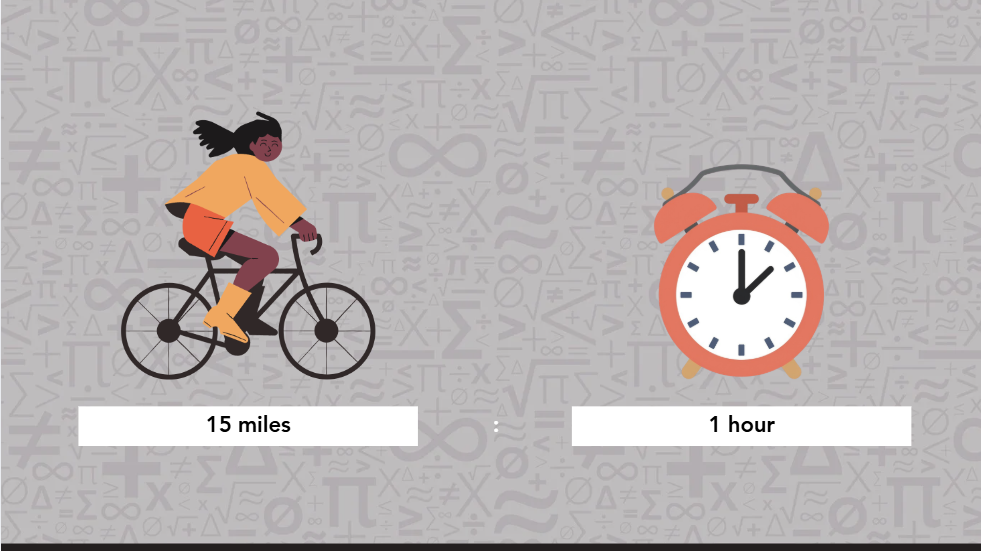
Say a cyclist rides 45 miles in 3 hours. The unit rate we want to find is the number of miles the cyclist rides per 1 hour. We simply divide 45 by 3, which comes out to 15 miles per hour.
📕 You May Also Like: 9 Math Skills Kids Use Every Day Without Realizing It
Rate vs. Ratio: What's the Difference?
Both rates and ratios compare two quantities, but we use them differently.
A ratio compares the size of one quantity to another of the same kind, while a rate is a special type of ratio that compares quantities for a practical purpose, such as measuring speed, cost, or productivity. Understanding when to use each one makes it much easier to interpret real-world math.
Let's compare rates and ratios side by side:
|
Ratio |
Rate |
| What it compares |
Two quantities, same or different type |
Two quantities in different units |
| Notation |
3:4, 3 to 4, 3/4 |
Amount per unit, like mph or $/item |
| Real-life use |
Comparing amounts |
Comparing speed, price or pace |
| Classroom example |
5 boys for every 8 girls |
60 miles per hour |
Both compare two numbers, but only the second one mixes two different units together.
The quickest way to tell them apart?
Look at the units first. If the two amounts share the same unit or have no units at all, it's a ratio. If the two amounts are measured in different units, it's a rate.
📕 You May Also Like: Ratio to Percentage: How to Convert Between the Two
5 Most Common Mistakes Students Make With Rates and Ratios
Rates and ratios look similar enough that mix-ups happen often, even after students learn the definitions. Here are five mistakes to watch for:
-
Assuming every fraction is a rate. Not every fraction represents a rate. The fraction \(\Large\frac{3}{4}\), for example, could simply mean that 3 out of 4 crayons are blue. Unless the top and bottom numbers measure different units, it's a ratio, not a rate.
-
Confusing a fraction with a ratio or rate. The fraction \(\Large\frac{1}{2}\) of a pizza represents part of a whole, not a comparison between two different quantities. Ratios and rates compare two amounts, while fractions describe equal parts of one whole.
-
Reversing a rate. 60 miles per hour and 1 hour per 60 miles may contain the same numbers, but they describe different things. The first measures speed, while the second measures the time needed to travel one mile.
-
Forgetting to simplify. Equivalent ratios don't always look the same at first glance. \(\Large\frac{4}{8}\) and \(\Large\frac{1}{2}\) represent the same value, but simplifying makes that relationship much easier to recognize.
Most of these mistakes come down to overlooking the units or rushing past what a number is actually measuring. Slowing down to check both of those things first usually clears up the confusion.
📕 You May Also Like: Mastering Ratios and Proportions: A Practical Approach
Where Do Students See Rates and Ratios in Real Life?
Rates and ratios show up long after the school day ends. When we learn to recognize them, they can change the way we see other activities or measure general success.
1. Mixing Colors and Drawing to Scale
Mixing paint relies on ratios to create consistent colors. For example, combining 2 parts blue with 1 part yellow produces the same shade of green every time.
Scaling a small sketch into a large mural also depends on ratios. Keeping each measurement proportional prevents the finished artwork from looking stretched or squished.
2. Moving to the Beat
Beats per minute are a rate that keeps music at a steady tempo, helping everyone perform together.
Dance routines also involve rates, with a certain number of steps fitting into each musical phrase so movement stays in sync with the rhythm.
3. Watching Animals or Athletes in Motion
A cheetah's speed of 70 miles per hour is a rate that describes how quickly it can travel.
Free throw accuracy is often expressed as a ratio, such as making 8 out of 10 shots. Ratios like this make it easier to measure performance and track improvement over time.
4. Everyday Moments at Home
Filling a fish tank can be measured using a rate, such as gallons per minute, to show how quickly the tank fills.
Recipes, on the other hand, depend on ratios to keep ingredients in the correct proportions, whether making one batch or doubling it for a larger group. Watering plants also involves rates, such as the amount of water needed each day to stay healthy.
Recognizing whether a comparison is a ratio or a rate helps students make sense of the world around them, not just answer a question correctly on a test. This same everyday fluency also carries students into proportions, percentages, algebra, and graphing, all topics that build directly on knowing how to compare two quantities.
 Understanding rates and ratios is an important step in building strong math skills, and Mathnasium helps students develop the confidence to solve these problems through personalized instruction.
How Mathnasium of Altadena Helps Elementary Students Build Lasting Math Skills
Mathnasium is a math-only learning center that works with students of all skill levels, helping them learn and master K-12 math.
Each student starts with a diagnostic assessment that helps us identify their current skills, knowledge gaps, and learning goals. From there, we build a personalized learning plan tailored to their needs and pace.
Our specially trained tutors use the Mathnasium Method™, a proprietary teaching approach that combines verbal, visual, mental, tactile, and written techniques to help students truly understand the math they are working with.
By teaching both the how and the why behind concepts like multi-step equations, we help students develop the problem-solving skills and critical thinking tools they carry into math and beyond.
Fun is a core part of how we work, too. Sessions are often game-based, students earn rewards along the way, and every bit of progress gets celebrated. That consistent encouragement keeps learning enjoyable and grows confidence with each session.
The results speak for themselves:
-
94% of parents report an improvement in their child's math skills and understanding
-
93% of parents report their child's improved attitude toward math
-
90% of students saw an improvement in their school grades
With over 1,100 centers, we bring the Mathnasium Method™ close to your community.
For families in Altadena, Pasadena, and La Cañada Flintridge, our learning center, Mathnasium of Altadena, is here to help you transform your child’s relationship with math.If you're ready to help your child build lasting confidence with ratios, rates, or any math concept, we would love to help.
📅 Schedule a Free Assessment at Mathnasium of Altadena
Not near Altadena?
📍 Find a Mathnasium Learning Center Near You


 (626) 254-6284
 (626) 669-4239