When we teach math, we always encourage students to look for it beyond the classroom.
If a child is learning about fractions, we might show them how a pizza is already doing the math. We remind them that geometry works the same way. It doesn't stay on the page but shows up in the world around them, in the things they pass every day without quite realizing it.
Our home state of Arizona is one vast geometry classroom. There's no better season to explore it than spring.
Today, we walk Arizona families through the geometric concepts hiding in plain sight across the spring landscape and offer some fun, practical ways to explore them together.
At the end of your journey, stop by our center in Anthem, and we’ll chat about your discoveries and paths to math mastery.

Nature and Geometry: What's the Connection?
Nature builds through growth, physics, and the everlasting pressure of survival. Shapes emerge from those forces long before anyone thinks to name them.
-
A honeycomb is made of hexagons because that shape packs the most storage into the least wax.
-
A nautilus shell spirals outward in a mathematically precise curve because that is the most efficient way to grow a larger chamber while keeping the same proportions.
-
A snowflake forms its six-sided symmetry because of the specific way water molecules bond in cold weather.
Geometry comes second. It is the mathematical language we reach for when we want to name, measure, and make sense of what nature has already built.
Calling a cactus arm a line segment, or tracing the spiral at the center of a wildflower, is simply reading what nature already wrote.
Arizona spring puts some of the most readable pages of that text right outside your door.
📕 You May Also Like: 10 Fantastic Examples of Fractals in Nature
Geometry in the Arizona Spring Landscape
Arizona spring is generous with its geometry. Saguaros flower at their crowns, brittlebush covers the hillsides in yellow, ocotillo lights up red at the tips, and running through all of it are the lines, angles, shapes, and spirals children encounter in the classroom. Next time you are out with your child, slow down and look closely.
1. Lines and Curves
We start with the simplest geometric forms: lines and curves. The Sonoran Desert has them everywhere.
The vertical ribs of a saguaro run from base to crown as equally spaced parallel line segments. Look up at an ocotillo, and you will find the same idea expressed differently: long, mostly straight branches extending outward from the base, each one a line segment a child can trace from ground to tip with their eyes.
For curves, the smooth, rounded edges of a barrel cactus offer a clean example, a continuous curve with no sharp angles that young learners can follow and sketch.
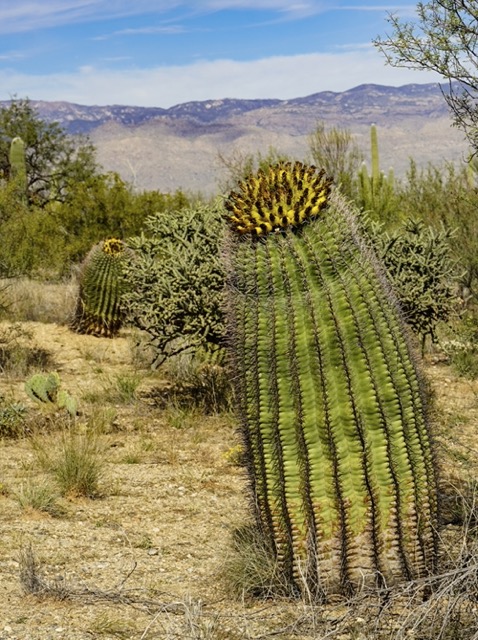
The vertical ribs of a barrel cactus form parallel lines from base to crown.
2. 2D Shapes
Lines lead naturally to shapes, and two of the most familiar ones are hiding in plain sight.
Saguaro blooms appear at the crown in late spring, and from below, they are clean, circular flowers that a child will notice before you do.
Prickly pear pads grow at child height, and their oval shape is easy to trace onto paper or sketch in a journal. Circle and oval, right there on the same trail.
📕 You May Also Like: How to Use Origami to Teach Geometry - Kid-Friendly Guide
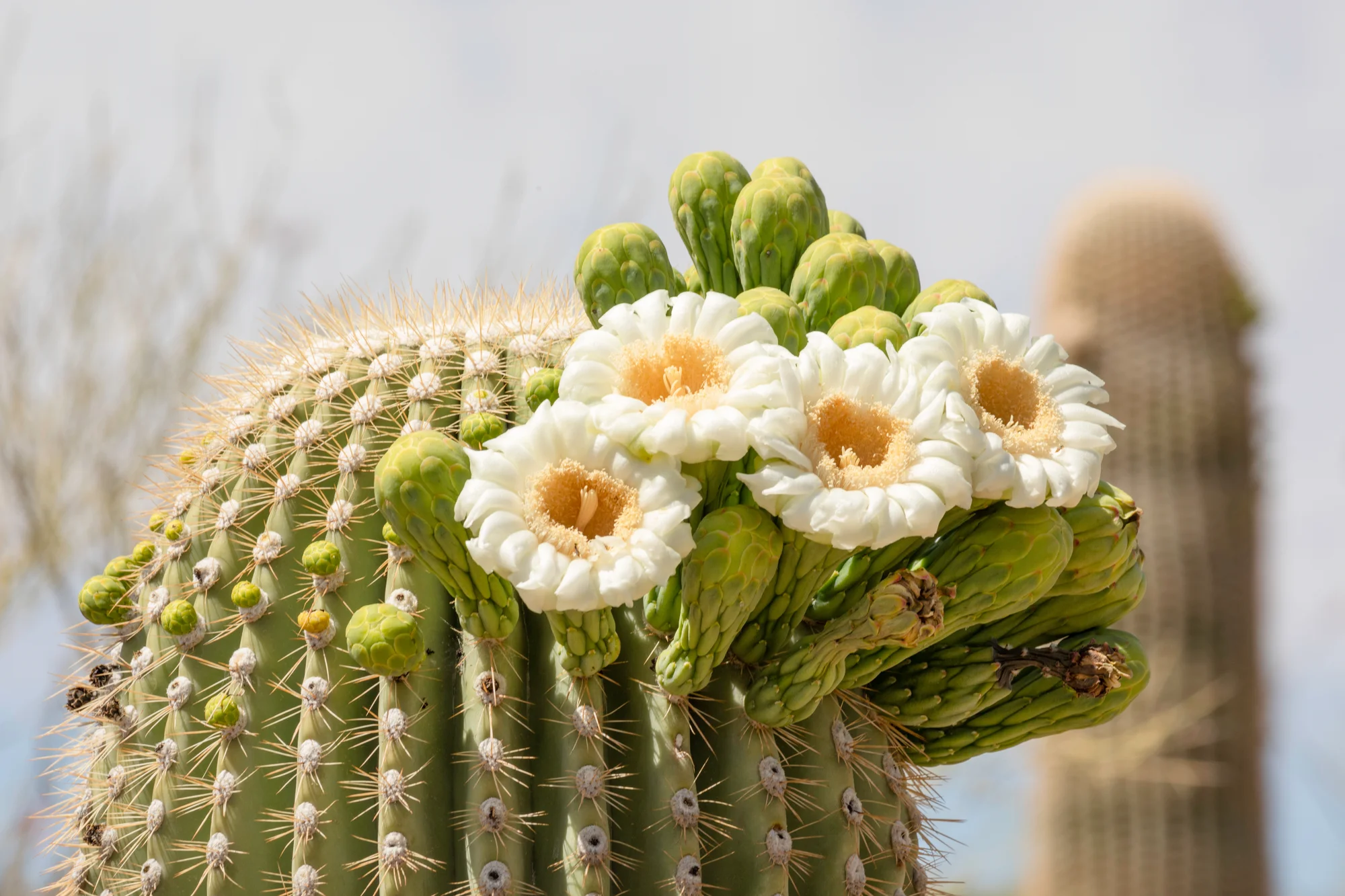
Saguaro blooms at the crown, each flower a circular arrangement of petals around a central point.
3. 3D Shapes
Three-dimensional shapes take a little more looking, but Arizona has good examples. Our tutors tend to point families toward the geology and the cacti for this one.
Saguaros are columnar cacti, tall and roughly consistent in width, with a circular cross-section that approximates a cylinder.
Sunset Crater, a cinder cone volcano north of Flagstaff and now a National Monument, is about as close to a textbook cone as nature gets.
Rounded boulders on any desert trail have been smoothed by weathering into approximate spheres.
Cone, cylinder, sphere. All within a single Arizona spring trip.
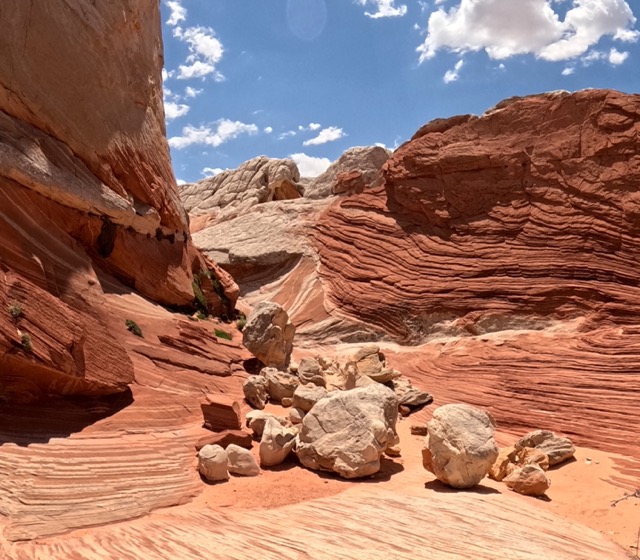
Rounded boulders on the Arizona desert floor, shaped by weathering over time.
4. Symmetry
Arizona spring wildflowers are a good place to start with symmetry.
Mexican poppies, brittlebush blooms, and lupine flowers are all built around a kind of balance that children notice naturally.
Rotate a poppy, and the flower keeps looking the same. Fold a lupine bloom along its center, and the two halves correspond. The math is already visible.
📕 You May Also Like: What Is a Line of Symmetry? A Kid-Friendly Guide
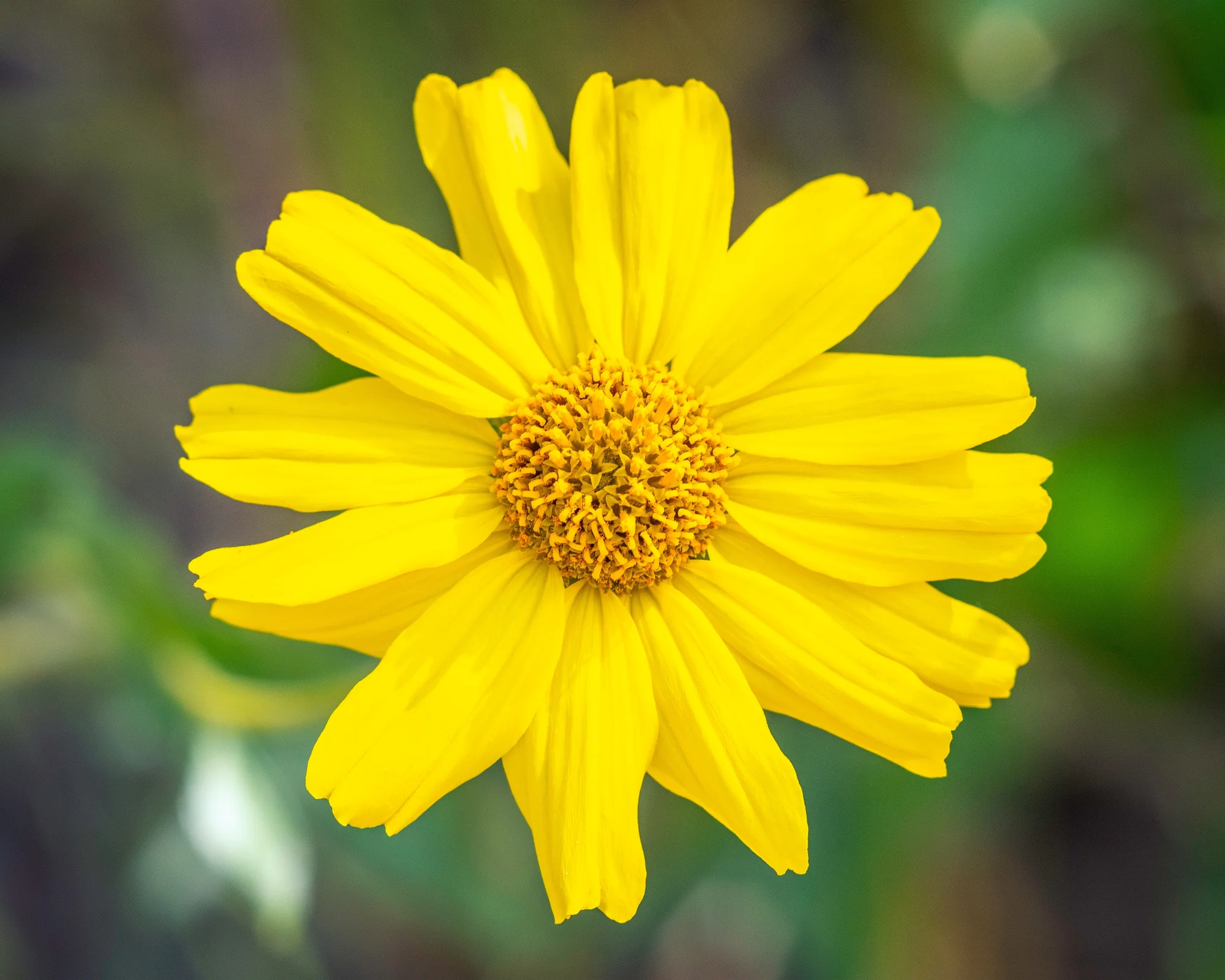
A brittlebush bloom with petals arranged symmetrically around a central point.
5. Angles
Most children first meet angles on a protractor. Arizona spring offers a less formal introduction.
Rocks in Sonoran Desert streambeds develop jagged edges through erosion, and a child with a good eye can look at two meeting rock faces and make a reasonable guess about whether the angle between them is acute or obtuse.
Ocotillo branches diverge from the base at wide angles, roughly 60 to 90 degrees, a natural illustration of intersecting lines that is hard to miss once you know to look for it.
📕 You May Also Like: Types of Angles: Acute, Right, Obtuse & Straight Explained
6. Spirals
Spirals bring together everything we have covered so far. Agave rosettes are the clearest example in the Arizona spring landscape: each leaf grows outward from the center at a consistent angle from the previous one, producing a spiral pattern that is visible from above and easy to trace with the eye.
Ground-level rosettes are accessible enough for children to crouch next to and count the arms turning in each direction. The pattern keeps showing up because the mathematics behind it never changes.
📕 You May Also Like: 9 Examples of the Golden Ratio in Nature + Definitions
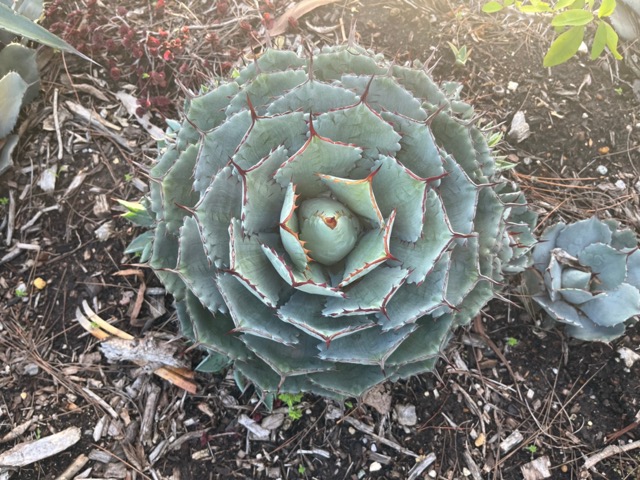
An agave rosette viewed from above, its leaves spiraling outward from the center in a precise, repeating pattern.
A Spring Geometry Scavenger Hunt for Arizona Families
A neighborhood walk, a desert trail, or a local park will all work for this. The challenges below are organized by grade band so you can focus on what is most relevant to your child. A sketch journal and a pencil are the only equipment needed, though a phone comes in handy for the older grades.
Grades K–2: Lines, Curves, and Shapes
Start simple and stay close to the ground. Young learners will find plenty to work with on any desert trail.
-
Find a saguaro and count the vertical ribs running up its side.
-
Crouch next to a prickly pear pad and sketch its oval outline in your child's journal.
-
Walk the trail and find one circle and one rectangle anywhere around you, in nature or in the built environment nearby.
Grades 3–4: Symmetry and Angles
This grade band is ready to look more closely and start making observations in their journal.
-
Find a wildflower and sketch it, then draw the lines of symmetry you can see.
-
Find two examples of parallel lines in the landscape and two lines that intersect.
-
If you come across a yucca in bloom, sketch the shape of the stalk and label the widest and narrowest points.
Grades 5–6: Angles and Spirals
Older students can bring a phone and start measuring, not just observing.
-
Use a phone app to estimate the angle at which an ocotillo branch diverges from the base.
-
Find a ground-level agave rosette, count the spiral arms turning clockwise then counterclockwise, and sketch what you find. See whether the two numbers are close to each other.

At Mathnasium, we build curious math thinkers by connecting what students learn to the world around them.
How Mathnasium Builds Creative Math Thinkers
Connecting math concepts to the real world is a big part of how we help students make sense of math at Mathnasium.
That connection to real life is built into the Mathnasium Method™, our proprietary teaching approach. This is not a one-size-fits-all system. It is designed to build a deep understanding of each concept through six core elements:
-
Personalized learning: Each student begins with a diagnostic assessment that helps us identify their strengths, potential knowledge gaps, and how they approach math overall. From there, we design a learning plan customized to their needs.
-
Teaching for understanding: We use natural, everyday language to explain math concepts, combined with verbal, visual, mental, tactile, and written techniques to help students truly make sense of what they are learning.
-
Caring, supportive tutors: Our specially trained tutors understand both the technical and emotional sides of teaching. They know how to encourage a student who is overwhelmed and how to challenge one who is ready to stretch their thinking.
-
Problem-solving and critical thinking: We allow time for productive struggle, then rejoin students to check and correct their process. This helps them learn to rely on their own thinking and understand both the how and the why behind each problem.
-
Singular focus on math: We are dedicated to math and math only, which allows us to go deeper into how students best learn, absorb, and retain math skills.
-
A confidence-building, fun environment: We often hear students say our sessions do not feel like lessons at all. That is because we incorporate game-based activities and plenty of encouragement to keep students motivated.
This approach delivers measurable growth and lasting mindset shifts:
Families in Anthem, AZ, and nearby communities trust the local team at Mathnasium of Anthem AZ to help their children build confidence and a deeper understanding of math.
If your child is looking to catch up, keep up, or get ahead in math, our team is happy to assist!
📅 Schedule a Free Assessment at Mathnasium of Anthem AZ
Mathnasium of Anthem AZ not your closest center?
📍 Find Mathnasium Learning Centers Near You


 (623) 551-7888