Imagine buying tickets to a game. Each ticket costs $8. If you buy 3 tickets, you can write 8 × 3, and the answer will always be 24. But before you know how many tickets you need, you can write 8n, where n stands for the number of tickets. The value now depends on what number n represents.
Before we know every number in a situation, a variable gives us a way to write the math. That idea is the starting point for understanding expressions.

What Is a Numerical Expression?
A numerical expression is a mathematical phrase made up of numbers and operations, such as addition, subtraction, multiplication, division, or exponents, that simplifies to one fixed value.
Sounds familiar?
You have worked with numerical expressions for years. The formal name may be new, but the idea is familiar.
Here are four examples, moving from straightforward to more involved:
-
8 + 3
-
15 − 6 × 2
-
(4 + 7) × 3
-
(4 + 7) × 3 − 1
A numerical expression can include several operations in the same problem. The answer depends on which operation we complete first, which is why the order of operations is so important. Let’s take the last example, (4 + 7) × 3 − 1 to see how it works:
(4 + 7) × 3 − 1
We solve the parentheses first
= 11 × 3 − 1
Multiplication next
= 33 − 1
Now we subtract
= 32
A numerical expression contains only numbers and operations, so it has one fixed value. In this example, if wesimplify it correctly, we should get the same answer: 32.
Now, we compare that with 3x + 4. The letter x changes the expression. We cannot find one fixed value until we know what x represents. That is the main difference between a numerical expression and an algebraic expression.
📕 You May Also Like: The Order of Operations in Math: A Kid-Friendly Guide
What Is an Algebraic Expression?
An algebraic expression uses at least one variable along with numbers and operations.
A variable is a symbol that stands for a number we do not know yet. For example, in the expression 3x+4, our variable is x. We often use x, but any letter can be used as a variable.
Here are four algebraic expressions that mirror the numerical examples we’ve seen earlier:
-
n + 3
-
15 − 6n
-
(4 + n) × 3
-
(4 + n) × 3 − 1
Each expression gives a different answer depending on the value of n. Algebraic expressions are useful precisely because of that flexibility: take the perimeter of a rectangle, for example, which can be written as 2l + 2w, where "l" is the length and "w" is the width.
The same expression works for any rectangle. This gives a general way to describe the relationship between length, width, and perimeter.
Both numerical expressions and algebraic expressions are expressions. The key difference is that a numerical expression uses only numbers, while an algebraic expression includes at least one variable.
Expressions vs. Equations: An Important Distinction
An expression is a math phrase, which uses a combination of numbers, variables, and operations with no equals sign. An equation, on the other hand, takes two expressions and connects them with an equals sign to show they have the same value.
Here is a clean pair using the same numbers:
The first example is an expression. It does not say that anything is equal to a specific value; it simply shows a value that changes depending on n. The second example is an equation. It says that 2n + 5 equals 11, so n must be 3.
Each one asks for a different kind of work. With an expression, we substitute a value for the variable and simplify. With an equation, we find the value that makes both sides equal.
Students sometimes try to solve an expression or simplify an equation, but each one asks for a different kind of work.
One more note: 7 + 5 = 12 is an equation, not a numerical expression. It contains an equals sign and makes a claim. You may not have thought of it that way before, but the label fits.
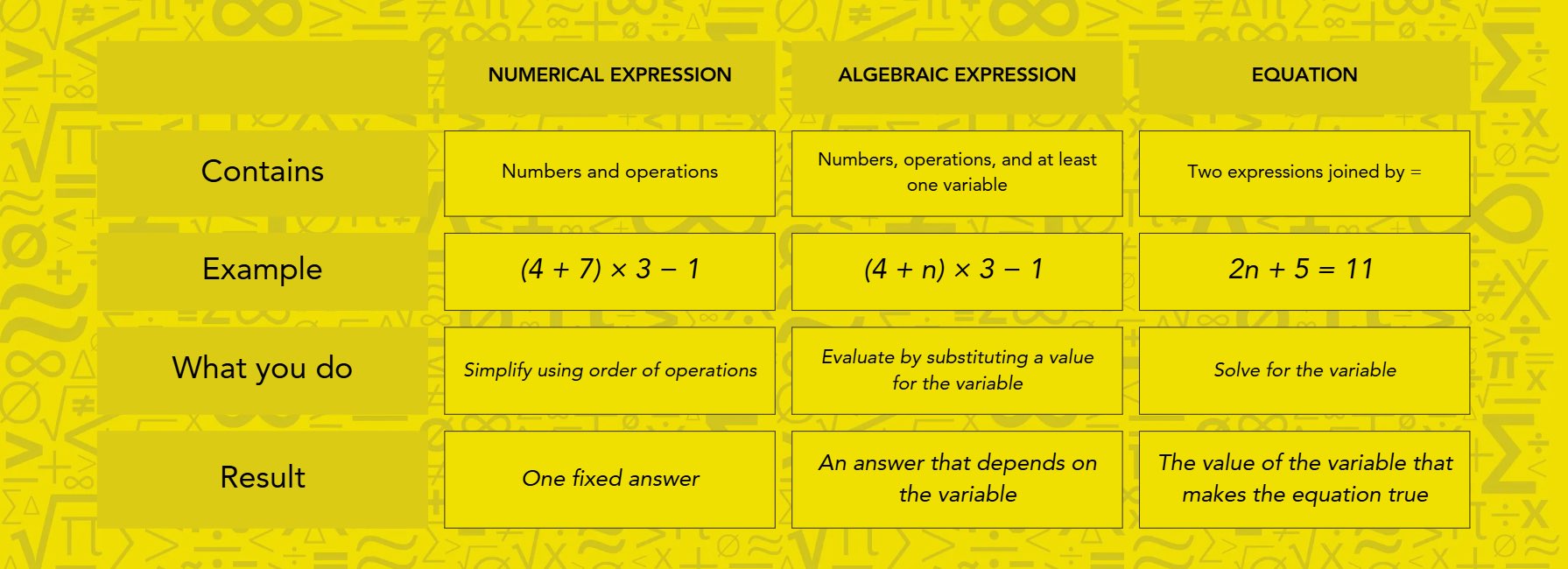
Here is how the three terms compare at a glance:
📕 You May Also Like: What Is an Expression in Math? A Beginner-Friendly Guide
Try It Yourself! Practice Working with Numerical and Algebraic Expressions
Practice what we learned, then scroll to the end to check your work. For each problem, decide whether it is a numerical expression, an algebraic expression, or an equation, then simplify or evaluate as instructed.
-
Simplify: (3 + 5) × 2 − 4
-
Evaluate (6 + n) × 2 − 4 for n = 2
-
Evaluate (6 + n) × 2 − 4 for n = 5
-
Is 4n + 3 = 19 an expression or an equation? What is the value of n?
-
Write an algebraic expression for: a number increased by 4, then multiplied by 3
-
Write a numerical expression that gives the same result as problem 5 when n = 2
How Numerical Expressions, Algebraic Expressions, and Equations Connect to Later Math
Once you fully understand the distinction between numerical expressions, algebraic expressions, and equations, you can easily move from basic calculations into algebraic thinking.
-
You will be ready for equations, functions, inequalities, and graphs because expressions lead into equations, equations lead into functions, and functions lead into graphing. Later, those same ideas support higher-level math.
-
Algebraic expressions also show up outside the classroom. We might write the cost of several tickets plus a service fee, the perimeter of a rectangle with unknown sides, or the distance traveled at a certain speed.
Understanding these distinctions can also help you feel more prepared for math assessments. We recommend pausing and reviewing before the math becomes more abstract.
📕 You May Also Like: Pre-Algebra Skills Behind Every Middle School Placement Test

Mathnasium tutors help children build the kind of steady, cumulative math practice that turns short-term understanding into long-term mastery.
How Mathnasium Can Help Truly Understand Numerical & Algebraic Expressions
Mathnasium is a math-only learning center that helps students learn and master any K-12 math class or topic, including numerical and algebraic expressions.
At Mathnasium, enrollment begins with a diagnostic assessment that helps us understand your child's current skill level and how they think about math. We use those insights to build a personalized learning plan tailored to exactly where they are and where they need to go.
These are the core components of the Mathnasium Method™, our proprietary teaching approach designed to develop deep mathematical understanding from the ground up.
To foster true mastery, our approach relies on:
-
Teaching for understanding: We explain math topics like numerical expressions, algebraic expressions, variables, and equations using clear language and multiple teaching techniques. Students learn what each concept means, how it works, and why it asks for a different kind of response.
-
Caring instruction: Our tutors are trained to meet students where they are. They know how to support students who feel confused by variables, abstract symbols, or the shift from arithmetic to algebraic thinking.
-
Independent problem-solving and critical thinking: During instruction, students have time to work through problems on their own, explain their thinking, and test whether they understand the concept beyond a familiar example.
-
Singular focus on math: Our program spans thousands of pages and has been continuously refined over the past 20 years. This focus allows us to take a deep dive into how students best absorb, understand, and retain mathematical concepts.
-
Fun and caring group environment: Our environment is designed to build confidence as well as skills. Students work in a caring, engaging setting where progress feels visible, and math starts to feel more manageable.
The result? Real, measurable progress.
-
94% of parents report improvement in their child’s math skills and understanding
-
93% of parents notice a more positive attitude toward math
-
90% of students see higher grades in school
Mathnasium operates over 1,100 learning centers across the US, bringing our proven approach close to your community.
For families in and around Anthem, Mathnasium of Anthem is a local center with experience helping students build the foundations that make algebra feel more manageable.
Whether your child is learning to tell numerical and algebraic expressions apart, working with variables for the first time, or preparing for middle school math assessments, our team is here to help.
📅 Schedule a Free Assessment at Mathnasium of Anthem
Not near Anthem?
📍 Find a Mathnasium Learning Center Near You
Answer Key
-
(3 + 5) × 2 − 4 = 8 × 2 − 4 = 16 − 4 = 12
-
(6 + 2) × 2 − 4 = 8 × 2 − 4 = 16 − 4 = 12
-
(6 + 5) × 2 − 4 = 11 × 2 − 4 = 22 − 4 = 18
-
It is an equation. n = 4
-
(n + 4) × 3
-
(2 + 4) × 3 = 6 × 3 = 18


 (623) 551-7888