About one in four students in the United States experiences significant math anxiety, according to the research by Ashcraft and Ridley (2005).
Math anxiety can block performance on its own, independently of skill level. Your child can blank on a concept they practiced the night before because of stress. This is different from disliking math or falling behind in class, and it responds to different strategies.
We’ll explain what math anxiety is and give you five coping strategies. We ordered them from the most immediate to the long-term habit-building ones.
The first two are for acute moments, like homework resistance or a test tomorrow. The last three address the patterns that keep anxiety going over time. Start wherever your situation calls for.

What Math Anxiety Is (and What It Isn’t)
Math anxiety is a stress response that activates brain areas linked to threat and discomfort. Students may feel overwhelmed simply from expecting a task, the research by Sian Beilock and colleagues showed.
We should separate math anxiety from ordinary math stress. Pressure around a hard test or a tricky homework set is normal. In small doses, it can help students feel alert and ready to try.
Research on stress reappraisal shows that students may perform better when they see those body signals as a sign that they can meet the challenge, rather than as proof that something is wrong.
The problem starts when that response stops being proportional to the task. If your child goes blank, avoids math, or becomes upset before a test, no matter how much they've prepared, that's a pattern that deserves a closer look.
Your child may also be missing an earlier skill. Math builds in layers, so one unclear concept can make the next topic feel harder.
With a shaky foundation in fractions, your child may hit the same wall later with ratios, algebra, and other connected topics. Seeing the same difficulty return in new topics can make math feel more stressful over time.
📕 You May Also Like: Building Math Success from a Strong Foundation
5 Ways to Help Your Child Work Through Math Anxiety
Every child's experience with math anxiety is a little different, and so is what helps. These strategies are based on research evidence and decades of classroom experience. Some you can use tonight; others take time to build into a habit. Start with what your child needs most.
1. Separate the Emotion from the Math
Your child cannot think clearly in the middle of a stress response. Before returning to the problem, acknowledge what they’re feeling. We suggest going with “I can see this is frustrating; let’s take a breath before we look at it again.”
Research published in Frontiers (2023) found that short reset breaks give the nervous system a moment to settle and make the next attempt more likely to succeed.
Once the moment has passed, you can return to work calmly without spending too much time on the frustration itself. Help your child experience math as something they can return to, not something they fled from.
2. Prepare for Tests Differently
If you are reading this the night before an exam, we offer putting the flashcards away. Last-minute drilling increases stress in children who are already anxious. A calm, predictable evening is more useful than a cramming session.
For the morning of the test, consider these two research-backed techniques.
-
You can guide your child through a short breathing exercise to help them feel calmer.
-
Or you can ask them to spend a few minutes writing down their worries. Frame it to your child as emptying the worry from their head, so there’s more room to think.
Beilock’s paper says that expressive writing can clear anxious thoughts from working memory before the task begins.
A few days before the exam, you can review the relevant math standards with your child to help them understand what to expect and where to focus. In our home state of Arizona, grade-level math expectations are set by the Arizona Mathematics Standards.
Find the standards applicable to your state, or better yet, your school district, and visit their official website to find the math standards applicable to your child's grade.

Mathnasium tutors use personalized learning plans and proven techniques to help students excel on their math tests.
3. Respond to Mistakes with Curiosity
Instead of correcting immediately, try asking a question: “Can you walk me through how you chose that step?” This shifts the conversation from verdict to reasoning.
Your child may start to feel anxious about math when mistakes seem like proof that they are “bad at it.” The way you respond to your child’s errors either reinforces that belief or challenges it.
Reframing mistakes as information instead of failure leaves less room for anxiety to get in the way of learning and improves students’ math performance, according to the research by Pizzie et al. (2020).
We recommend treating mistakes as useful clues rather than problems to fix, and your child will gradually start to do the same.
📕 You May Also Like: How Feedback Can Build (& Erode) Math Confidence
4. Change Where & When Math Happens
You can try doing math earlier in the evening before fatigue sets in, or in a different room. For older students who can work independently, a change of scenery can help them approach work with less tension.
This can be as simple as going to your nearby park or cafe.
Students in our home community of the Arcadia area, for example, can take short review sessions that don’t feel like homework in the Camelback corridor and nearby parks, like Herberger Park and Choila Park.
If math homework has become stressful at the same kitchen table every Tuesday evening, your child may feel anxious before the book is even open. As a certain setting can become linked to stress, a small change to the time or place can help break the pattern.
We also suggest spreading practice across several days to make math less overwhelming. Short, repeated sessions help your child become familiar with a concept before the pressure builds. Concentrated, last-minute sessions do the opposite.

Small changes to the learning environment can help your child overcome math anxiety.
5. Watch Your Own Math Language
Try to avoid phrases like “I was never a math person either” or “Math just isn’t our thing.” They confirm a belief that your child may already be forming.
Research by Maloney et al. (2015) in Psychological Science found that frequent homework help from math-anxious parents was linked to higher math anxiety in children and slower progress over the school year.
You don’t need to pretend to love math; neutral language is enough. Instead of saying, “I can’t do this either,” you can say, “Let’s figure it out together,” or “I’m not sure, but we can look at it.” This keeps the door open without forcing fake enthusiasm.
📕 You May Also Like: How Positive Math Talk Encourages a Growth Mindset at Home
What to Do If Math Anxiety Keeps Coming Back
Children who keep hitting the same wall, even after the anxiety eases, may be missing an earlier skill. A calm home environment can reduce pressure, but it cannot replace a concept your child has not fully learned yet.
Your child will make lasting progress as long as we address both the math anxiety and the knowledge gaps underneath it. The 2023 meta-analysis in the Journal of Child and Family Studies confirms that a combined approach works better than focusing on only one side.
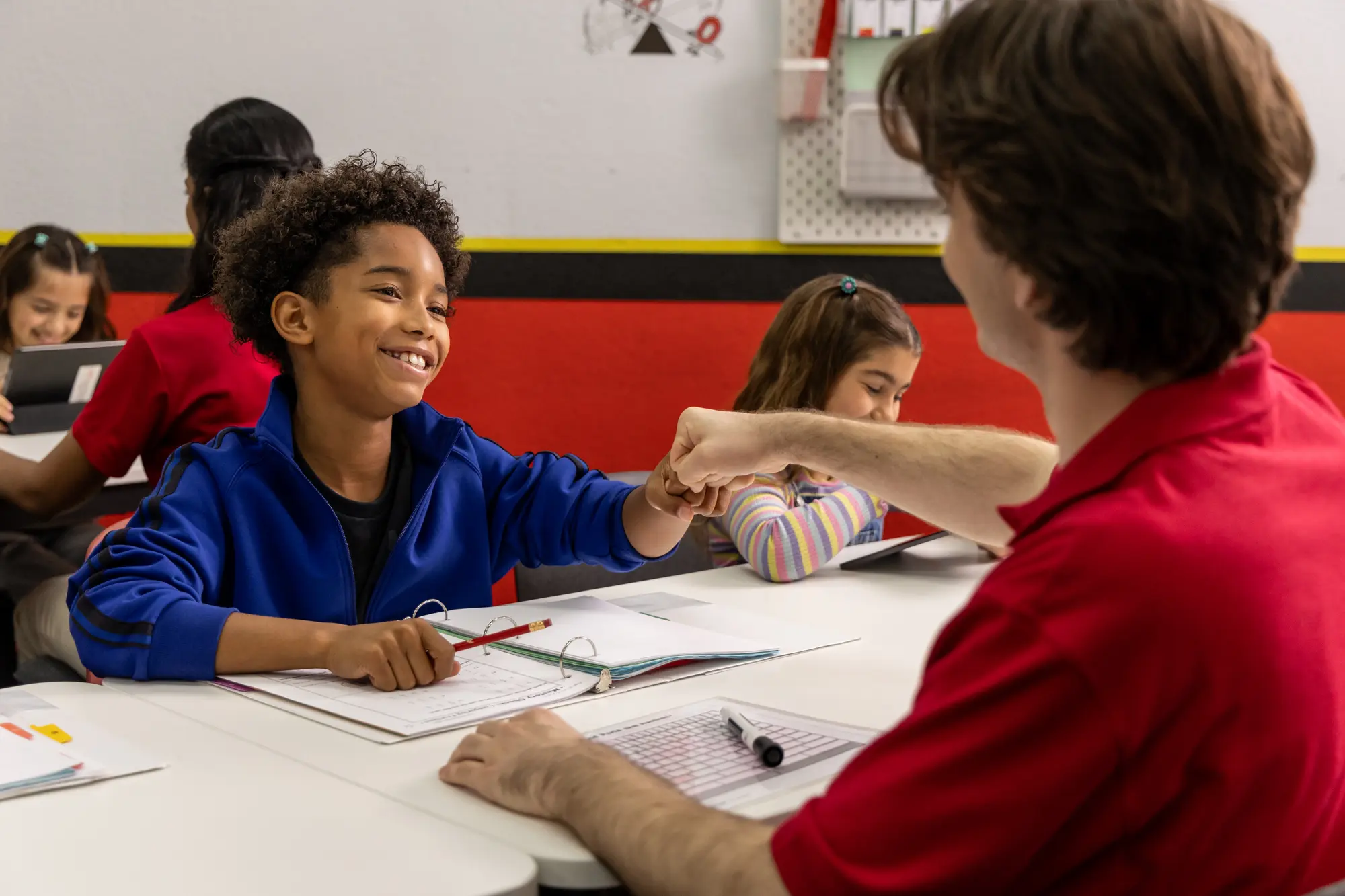
Mathnasium is a math-only learning center for students of all skill levels.
How Mathnasium Helps
At Mathnasium, we are a math-only learning center that helps students rebuild their relationship with math by working on both sides of the anxiety-gap cycle.
Every student begins with a diagnostic assessment that identifies exactly where knowledge gaps are creating repeated difficulty. From there, we build a personalized learning plan that fills those gaps step by step, so your child stops hitting the same walls and starts experiencing consistent progress.
Our specially trained tutors work with students in a caring and fun group environment, bringing patience and skill to the moments where confidence is most fragile.
Our results reflect what becomes possible when the approach fits the student:
-
93% of parents report their child’s improved attitude toward math after attending Mathnasium
-
94% of parents report an improvement in their child’s math skills and understanding
-
90% of students saw an improvement in their school grades
For families in and around Arcadia, Mathnasium of Arcadia is a trusted local center with experience helping students move from avoidance to confidence, session by session.
📅 Schedule a Free Diagnostic Assessment at Mathnasium of Arcadia
Not near Arcadia?
📍 Find a Mathnasium Learning Center Near You


 (602) 957-4500
 (602) 957-4500