Most of us remember learning multiplication facts with good ol' flashcards. Some probably still have a set tucked away in a drawer, ready to pass down.
Flashcards have earned their rightful place in the math toolkit. When the concept of multiplication is already in place, flashcards do what they do best: build automaticity through repetition. As a standalone method, though, they have limits.
Flashcards build recall, but recall alone is fragile: it doesn't develop the flexible, conceptual understanding of multiplication that modern math standards require.
So what are the alternatives? That's what our tutors are here to walk you through. Read on for six strategies to build multiplication fact fluency that goes beyond the flashcard.

1. Start With Skip Counting
If your learner is in second or third grade, this is where we'd suggest starting. And if they're older but their facts still feel shaky, this is worth revisiting too, because the foundation matters at any age.
Most children discover multiplication through skip counting before anyone tells them that's what they're doing.
Counting by fives while jumping rope, or by tens while clapping, is multiplication in disguise. The rhythm of these activities builds an intuitive feel for equal groups before multiplication symbols ever appear.
Start with the friendliest sequences and build gradually:
-
First: 2s, 5s, and 10s
-
Then: 3s, 4s, and 9s
Encourage your child to make it physical. Clapping once per number, stepping, or tapping a beat gives their memory two entry points instead of one: the number and the movement arrive together, and that pairing is hard to forget.
Once they get the hang of it, try asking, "If you count by 5s and do 7 claps, what number do you land on?"
That single question bridges skip counting directly into multiplication thinking, without any formal instruction.
📕 You May Also Like: Skip Counting: The Bridge Between Counting and Multiplication
2. Connect Multiplication to Repeated Addition and Equal Groups
Multiplication makes most sense when it grows out of something your child already knows how to do. Addition is that bridge.
When we say 3×4, what we really mean is three equal groups of four: 4+4+4.
The multiplication symbol is just a shorthand for something far more concrete. The language we use around this makes a difference. Instead of "three times four," try:
-
"Three groups of four"
-
"Four, three times"
Both phrases give children something to picture rather than just a string of symbols to manipulate.
And if they can't quite picture it mentally, reach for something tangible, such as coins, blocks, or even paper clips.
Ask your child to physically build the groups, three piles of four, and count the total themselves. Handing them the answer skips the very step that makes multiplication feel meaningful.
And as the equal groups idea starts to land, try exploring 6×0 together. Six groups of nothing. The answer becomes obvious the moment they try to build it, and that kind of understanding sits in a completely different place than a memorized fact.
📕 You May Also Like: How to Use Math Manipulatives Effectively at Home
3. Use Arrays and Visual Models
Grouping objects by hand gives children a feel for what multiplication means. The next step is getting that same idea down on paper, where they can see the whole picture at once.
An array is a rectangular arrangement of rows and columns.
Take 4×3: drawn out as 4 rows of 3 dots, the total of 12 becomes immediately visible without counting from one.
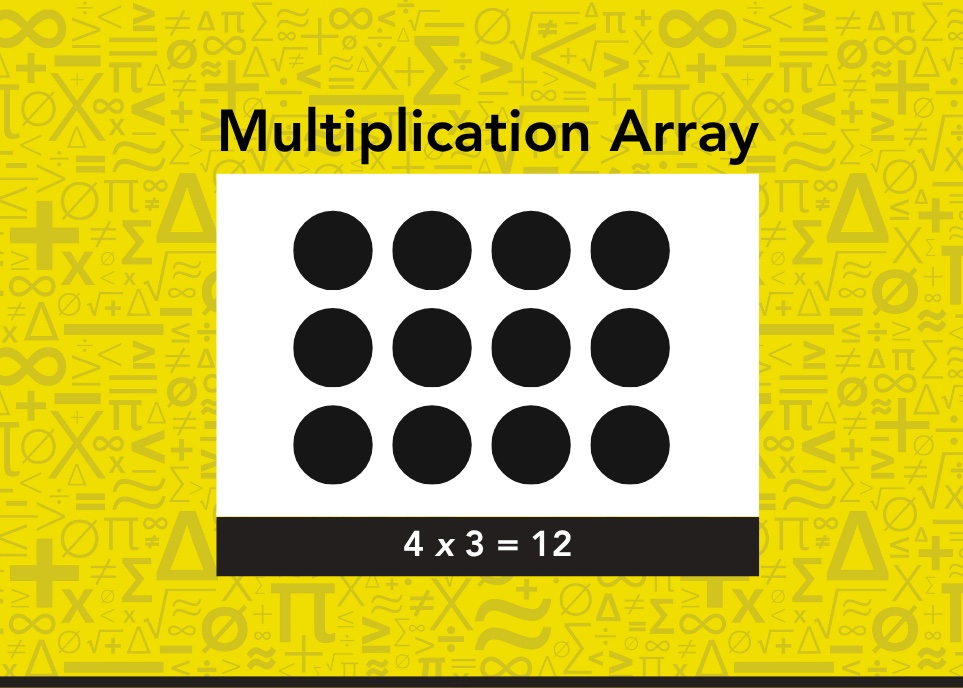
Egg cartons, chocolate bars, and theater seats are all arrays. Pointing them out as you come across them in daily life gives multiplication a context that feels natural.
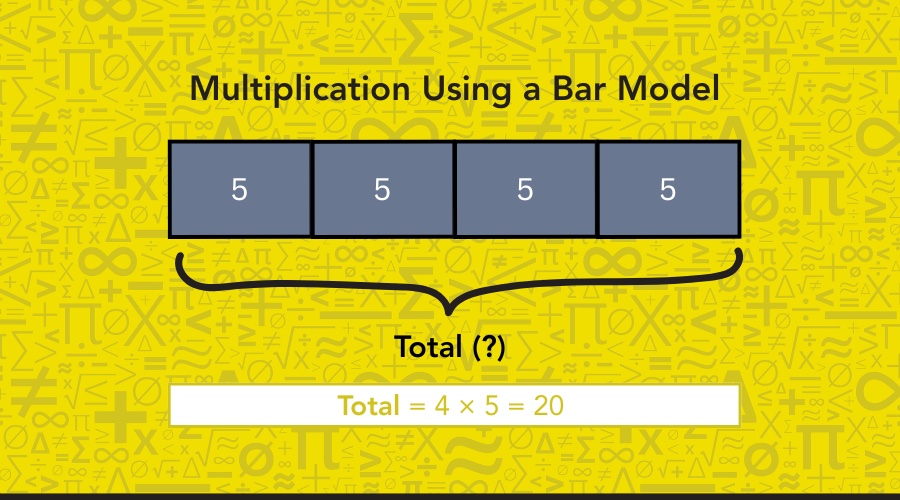
Beyond arrays, bar models, and number lines open up further ways of seeing the same idea.
Working out 4×5? Draw a bar divided into four equal sections and write five inside each one. Your child can see the total sitting right there in front of them, no flashcards required.
4. Learn One Fact, Get One Free
The full 12×12 multiplication chart can feel overwhelming at first glance. One hundred and forty-four facts is a lot to ask of any child. But before your young learner starts memorizing, tell them this: every fact has a twin.
What do we mean by that?
-
Knowing 3 × 8 = 24 means automatically knowing 8 × 3 = 24
-
Knowing 6 × 9 = 54 means automatically knowing 9 × 6 = 54
-
And so on, all the way through the chart
After you account for all those turn-around pairs alongside the 12 square numbers, like 3 × 3 or 7 × 7, the number of unique facts your child actually needs to learn drops to 78. Fewer than half.
If you don’t want this to sound like a strict rule, make it visible.
Draw 4 rows of 3 dots, then rotate the paper. Now it's 3 rows of 4. The dots haven't changed, only the orientation has, and the total is still 12. Trust us, it lands every time.
5. Start With Confidence-Building Facts
In school, children are introduced to multiplication by starting at 1 × 1 and working across the table in order.
The problem with that approach is that it mixes easy and hard facts from the start, and early frustration has a way of coloring everything that follows.
A more effective sequence starts with the facts that follow patterns clear enough to work out rather than memorize:
-
0s: Any number times 0 is 0. Always.
-
1s: Any number times 1 is itself.
-
2s: These are doubles, and most children already know their doubles from addition.
-
5s: The answer always ends in 0 or 5.
-
10s: Just add a zero.
-
11s: Up to 9 × 11, the digit simply repeats.
By the time these six families of facts feel comfortable, your child has already covered a substantial portion of the chart. And what remains, the 3s, 4s, 6s, 7s, 8s, and 9s, no longer feels out of reach. They come to it having already proven to themselves that they can do this.
📕 You May Also Like: 5 Proven Tactics to Promote a Math Growth Mindset
6. Build New Facts From Known Ones
By this point, your child has the friendly facts under their belt. What's left are the 3s, 4s, 6s, 7s, 8s, and 9s, and every single one of them can be worked out from something your child already knows.
The near-tens strategy for 9s
The 9s feel hard until you see them as one group less than the 10s.
-
To work out 9 × 6, start with 10 × 6 = 60, then subtract one group of 6. The answer is 54.
-
Try it with 9 × 8: 10 × 8 = 80, subtract one group of 8, and you land on 72.
This works for every fact in the 9s table, and once your child sees the pattern, they rarely forget it.
Doubling for 4s and 8s
The 4s are just the 2s doubled.
-
If your child knows 2 × 7 = 14, then 4×7 is simply 14 doubled: 28.
-
The 8s work the same way off the 4s. If 4 × 6 = 24, then 8 × 6 is 24 doubled: 48.
Two whole families of facts, unlocked from ones they already have.
Doubling for 3s
The 3s can be approached through doubling too. To work out 3×8, double 8 to get 16, then add one more group of 8: 24. It takes a moment longer than simple recall, but that reasoning is exactly what builds fluency that holds up under pressure.
Adding One Group for 6s and 7s
The 6s and 7s are where children tend to feel most stuck, and understandably so. Encourage your child to step off a known fact.
-
If they know 5 × 7 = 35, then 6 × 7 is just one more group of 7: 35 + 7 = 42.
-
The same logic applies across the 6s: 5 × 6 = 30, so 6 × 6 = 30 + 6 = 36. With a little practice, this becomes second nature.
Don’t think of these strategies as workarounds. If a student works out 7 × 8 by reasoning "I know 7 × 7 = 49, so I add one more 7 to get 56," they understand multiplication in a way that serves them well beyond the times table.
📕 You May Also Like: 7 Creative Kid-Friendly Techniques to Learn Division

Mathnasium uses personalized learning plans and interactive techniques to help students master any math skill.
How Mathnasium Helps Students Master Any Math Skill
Mathnasium is a math-only learning center empowering students of all skill levels to excel in math.
When students turn to us for math support, whether that means (re)building foundational skills like multiplication or tackling more advanced topics like algebra, we go far beyond repetitive drills and rote memorization.
Our goal is for every student to develop a true understanding of the concepts they are working with so they can apply what they learn with confidence.
That idea sits at the heart of our proprietary teaching approach, the Mathnasium Method™.
To help students build a deep understanding of math, our method includes:
-
Personalized learning plans: Each student begins with a diagnostic assessment that reveals their strengths, gaps, and how they think through problems. Using these insights, we build a customized plan that meets them exactly where they are.
-
Teaching for understanding: Our instructors use everyday language and face-to-face instruction, supported by a mix of verbal, visual, mental, tactile, and written techniques. This helps students truly make sense of the math concepts they are learning.
-
Caring tutors: Our tutors are skilled in both content and connection. They know how to support students who are struggling and challenge those who are ready for more.
-
Problem-solving and critical thinking: Each session includes time for students to work independently before reviewing with their tutor. We teach both the how and the why, helping students build the reasoning and problem-solving tools they’ll use in math and beyond.
-
Singular focus on math: We specialize in math and math only. Our proprietary curriculum is built from thousands of thoughtfully developed pages, continually refined to reflect how students absorb, learn, and retain math best.
-
An engaging, fun environment: Parents often tell us Mathnasium sessions don’t feel like lessons. That’s intentional. We use game-based activities, small wins, and reward systems to keep students engaged and proud of their progress.
This approach brings measurable results.
-
94% of parents report an improvement in their child’s math skills and understanding
-
93% of parents report improved attitude toward math after attending Mathnasium
-
90% of students saw an improvement in their school grades
With over 1,100 Mathnasium centers nationwide, families across the U.S. trust us to help their children succeed in math.
For families in and near the Arcadia neighborhood of Phoenix, AZ, Mathnasium of Arcadia provides personalized learning plans, interactive instruction, and a proven path to math mastery.
If your child is looking to catch up, keep up, or get ahead in math, our team is happy to help!
Ready to get started?
📅 Schedule a Free Diagnostic Assessment at Mathnasium of Arcadia
Not near Phoenix?
📍 Find a Mathnasium Learning Center Near You


 (602) 957-4500
 (602) 957-4500