If your child struggles to follow math lessons, work through problems independently, or understand concepts they’ve practiced before, it can be difficult to know where to step in. Should you review an earlier skill, try a different explanation, or ask their teacher for guidance?
The first step is to understand where they need support. An earlier skill may need attention, a new concept may not yet make sense, or unfamiliar mathematical language may make a question difficult to interpret.
You do not need to recreate the classroom at your kitchen table. We are the education specialists at Mathnasium of Buffalo Grove, and in this guide, we share seven practical tips to help you support your child at home, along with local resources for Buffalo Grove parents.

1. Find Out Where Your Child Needs Help
Before you add more practice, ask your child to show you a recent math assignment and point to the first place they felt unsure. Start with one problem so you can see exactly where they need guidance.
Here are a few simple questions you can ask:
-
What is this question asking you to find?
-
Show me how you would start.
-
If they have already written an answer, ask them to explain the step they feel least sure about.
At Mathnasium, we help students reason through the how and why behind their work rather than copy a sequence of steps. At home, give your child time to talk through their thinking before correcting an answer. Try to notice what they can explain and where they need guidance.
For example, a student adding fractions may know they need a common denominator but struggle to write equivalent fractions. That gives you a more useful question to bring to the teacher than “Can we have extra fraction worksheets?”
Save the example and note what your child found confusing. “My child knows how to begin but gets stuck at this step” gives their teacher or tutor a specific starting point for a closer look.
📕 You May Also Like: How to Add and Subtract Fractions with Like Denominators
2. Keep Math Practice Consistent and Manageable
Set aside manageable periods for practice across the week rather than saving all the review for one long session. Give your child a clear focus for each session, such as the skill you identified together in their recent schoolwork.
In a 2025 meta-analysis, Murray and colleagues found that students benefited more from math practice spread across separate sessions than from practice concentrated into one session. The findings support returning to material on different occasions, rather than prescribing one ideal session length for every child.
We recommend starting with a routine that fits around your child’s homework and other commitments. For example, you could set aside 15-20 minutes on Monday, Wednesday, and Friday to revisit equivalent fractions.
Choose a few relevant problems before you begin so the session has a clear endpoint. At the next practice session, briefly revisit the same skill before moving on. Keep the focus on what your child understands, rather than how many questions they complete.

3. Help Your Child Approach Math With Confidence
Pay attention to how you respond after a difficult problem. Instead of labeling your child “good at math” or asking them to “try harder,” recognize a specific action they took. You could say:
-
You checked your answer and noticed the fractions weren’t equivalent.
-
You asked for an explanation of the step you didn’t understand.
-
You tried a different approach after the first one didn’t work.
In a 1998 study, Mueller and Dweck found that fifth graders praised for effort responded to setbacks with greater persistence than those praised for intelligence. The findings suggest a reason to avoid labels such as “you’re good at math” and instead acknowledge the work your child puts into a difficult task.
In practice, you should keep encouragement specific and honest. You do not need to praise every attempt or pretend an incorrect answer is correct. Acknowledge a useful strategy, then leave room to discuss what still needs work.
If your child says, “I’m awful at math,” try a response such as:
-
This topic is difficult for you right now. Let’s look at the part you understand first.
-
You don’t have to understand it all yet. Show me which part feels confusing.
-
You worked out the first step on your own. Let’s see what you need help with next.
If frustration builds, acknowledge it without rushing to insist that the problem is easy. “I can see this is frustrating” leaves space for your child to ask for help without having to defend how they feel.
📕 You May Also Like: How Feedback Can Build (& Erode) Math Confidence
4. Use Objects and Visuals to Explain Math Concepts
If a written calculation leaves your child confused, try representing the idea with objects or a visual model. Ask your child to show how the objects or parts of the model match the numbers in the calculation.
At Mathnasium, our tutors use visual and hands-on techniques alongside verbal explanations and written work. We help students understand the reasoning behind a concept before moving toward a formula or procedure.
For example, if your student is struggling with equivalent fractions, take two equal-length paper strips:
-
Divide the first strip into two equal parts and shade one.
-
Divide the second into four equal parts and shade two.
-
Line up the strips and ask, “What do you notice about the shaded amounts?”
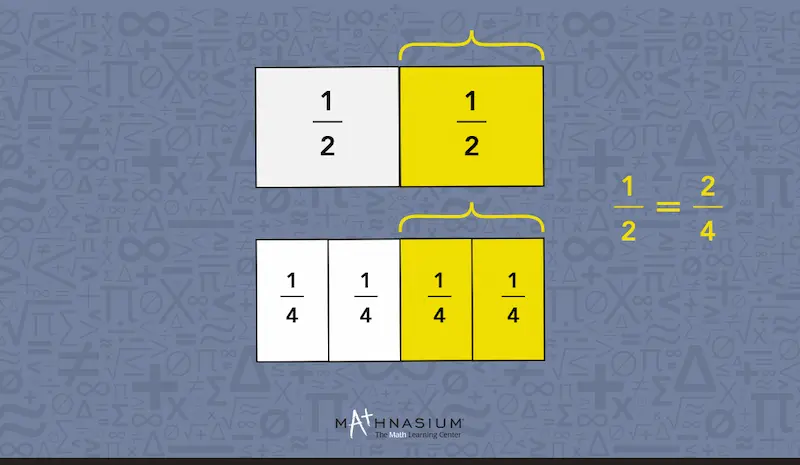
The shaded portions are the same length, even though the strips have different numbers of sections. Write \(\Large\frac{1}{2} = \Large\frac{2}{4}\) beside them and ask your child to explain how the strips show that equality.
If they need more support with multiplication, arrange 24 counters or buttons into four rows of six. Ask your child to describe the arrangement, then write 4 × 6 = 24.

Next, rearrange the same objects into six rows of four. Ask, “Has the total changed? What has changed about the arrangement?” Write 6 × 4 = 24 beside the first equation. The objects show why changing the order of the factors gives the same product.
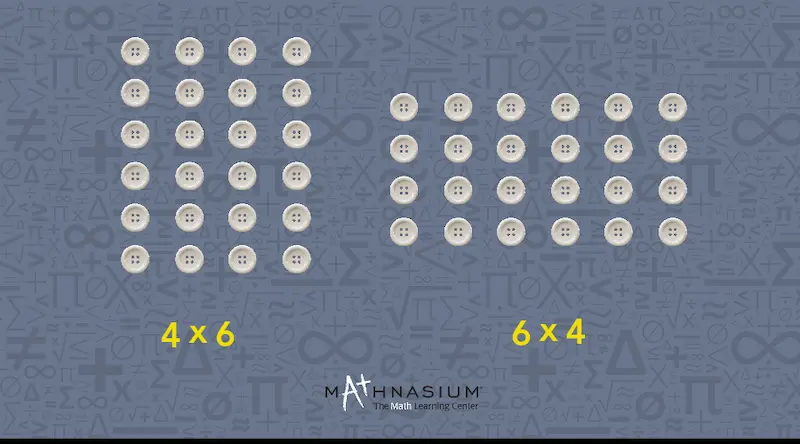
After exploring an example together, invite your child to make a model for a similar problem and write the matching calculation. Ask them to explain how each number connects to their model.
📕 You May Also Like: 5 Ways to Use Diagrams and Drawings for Math Problems
5. Connect Home Support With Classroom Learning
In its guidance for schools, the Education Endowment Foundation recommends that schools give parents practical ways to support learning at home and encourage two-way communication between parents and teachers.
In practice, if your child struggles with a certain math topic, ask their teacher what the class is working on and how they’re learning it. Share a specific example, such as a homework problem your child found confusing, to help the teacher understand where they need support.
Here are a few questions you might ask:
-
Which skill would be most useful to practice at home?
-
What language, visual models, or steps are students using in class?
-
Is there a sample problem we can use as a guide?
Use the teacher’s advice on what to practice and how to approach it to keep home practice connected to classroom learning. For example:
-
If your child uses arrays to represent multiplication, ask them to draw one for a familiar problem and explain how the rows and columns match the numbers.
-
If your child uses visual models to add fractions with different denominators, ask them to show how the model helps them find equal-sized parts before they add.
-
If your student works on algebraic equations, ask them to walk you through a classroom example and explain why each step keeps both sides equal.

A focused conversation with the teacher can turn ‘my child is stuck’ into a specific skill to work on next.
6. Explore Local Math Support Resources in Buffalo Grove
Local libraries offer online resources for math homework help and extra practice. Check these options and their library-card requirements:
Your child’s school may offer targeted support for the math they learn in class. Local options include:
-
Kildeer Countryside School District 96 offers math interventions during the school year. Its summer support program provides free small-group math practice for eligible students by invitation, if staff are available.
-
Stevenson High School provides drop-in math help from certified tutors and peer tutors through its learning centers. It also offers small-group support through Guided Study Math and Mentor Math, with placement based on school recommendations.
Ask your child’s teacher or counselor which school-based options fit their needs. Check the linked resource pages for current access details, eligibility, and availability.
7. Consider Structured Math Support If Struggles Persist
If help at home and free resources still haven’t resolved your child’s math difficulties, that’s okay. It doesn’t diminish your best efforts. Your child may need more time, a different explanation, or support that focuses on skills they haven’t yet mastered.
Structured math support can give your child a clear path forward, with:
-
A regular schedule that makes room for steady practice.
-
Specific goals based on the skills they need to develop.
-
Guidance when a problem or concept feels confusing.
-
Time to revisit earlier concepts before moving to harder material.
-
Encouragement that helps them feel comfortable with questions and mistakes.
At Mathnasium of Buffalo Grove, we help students sharpen their understanding of math through personalized learning plans. Whether your child needs to revisit foundational skills or work through current challenges, our instructors meet them where they are and help them build toward what comes next.

At Mathnasium, we meet each student exactly where they are and help them reach their academic goals one step at a time.
How Mathnasium of Buffalo Grove Helps Students Succeed in Math
Mathnasium of Buffalo Grove is a math-only learning center dedicated to helping K-12 students learn and master math.
We proudly serve students in Buffalo Grove, Arlington Heights, Palatine, Hawthorn Woods, and Vernon Hills, whether they need to revisit earlier concepts, strengthen current skills, or prepare for more challenging work. If your child has trouble keeping up in class, we start with what they understand and identify where they need help next.
We personalize every student’s learning through the Mathnasium Method™, our proprietary teaching approach. It adjusts to each student’s math journey, meeting them where they are, not where their grade-level says they should be, and guiding them forward at their own pace.
Each student starts their Mathnasium journey with a diagnostic assessment. This helps us identify what your child already understands, which skills need attention, and where instruction should begin.
With those insights, we create a personalized learning plan tailored specifically to your child’s needs, goals, and academic pace.
From there, our specially trained tutors guide your child through the plan, with face-to-face instruction and support as they work through unfamiliar or challenging concepts.
We teach math for understanding. This means we strip out heavy jargon, use natural language to explain concepts, and rely on a mix of verbal, visual, mental, tactile, and written techniques. We adapt to different learning styles and ensure every concept truly makes sense.
We build dedicated time for independent work into every session, which encourages students to trust their own logic. When our instructors step in, we explain the how and why behind every method. That helps students develop problem-solving skills and critical thinking for their math class and beyond.
Fun is an integral part of our approach. We build game-based math activities into learning so students stay engaged while putting in the effort. As they earn rewards, it keeps them excited and shows them just how far their effort can take them.
The results speak for themselves:
-
94% of parents report an improvement in their child's math skills and understanding
-
93% of parents report their child's improved attitude toward math after attending Mathnasium
-
90% of students saw an improvement in their school grades
If your child struggles to keep up with math, scheduling a free diagnostic assessment is a great first step. Our team at Mathnasium of Buffalo Grove can help you understand where they need support and create a personalized learning plan for what comes next.
Ready to get started?
📅 Schedule a Free Assessment at Mathnasium of Buffalo Grove
Not near Buffalo Grove?
📍 Find a Mathnasium Learning Center Near You


 (847) 777-1772
 (847) 777-1772