Many kids think of geometry as a list of shapes, formulas, and proofs to memorize. When class time centers on procedures, it's easy to forget that geometry also helps us solve everyday problems.
So, if you’ve ever asked, “When will I ever use this?”, the answer might be closer to home than you think.
Today, our Mathnasium tutors explore five familiar situations and show how geometry skills may help us solve practical problems.

1. How Much Fencing Does a Garden Need?
Say we're putting a fence around a rectangular garden. Before we go out and buy materials, we need to know how much fencing will reach all the way around it.
The distance around the garden... does that ring any bells from math class? Yes, we're talking about perimeter!
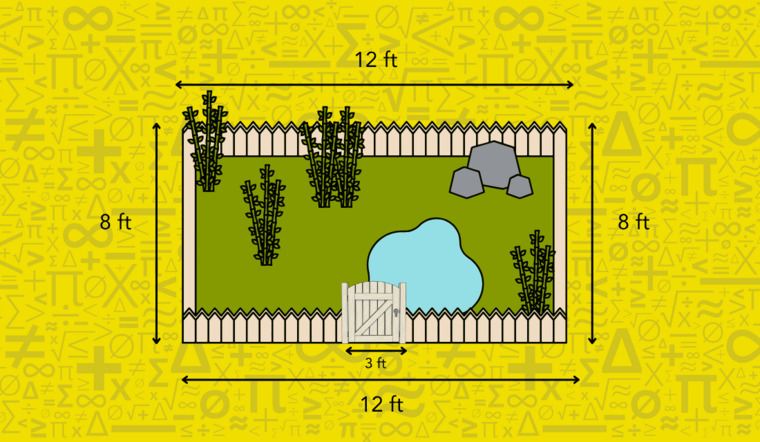
To find the perimeter, we will add the lengths of all four sides.
Suppose our garden measures 12 feet long and 8 feet wide. In a rectangle, opposite sides have equal lengths. That gives us two 12-foot sides and two 8-foot sides.
12 + 8 + 12 + 8 = 40 feet
We need 40 feet of fencing to enclose the whole garden.
If we add a gate, its width replaces part of the fence. We subtract that measurement from the total. For a 3-foot gate, we'd buy 37 feet of fencing.

2. How Much Flooring Does a Room Need?
We've picked out new flooring for a room, and the next question is how many boxes to bring home. The room's area answers it.
Area measures the surface inside a shape, which is exactly the space the flooring will cover. The tape measure shows the room is 15 feet long and 11 feet wide.
Now picture the floor covered in squares, each 1 foot by 1 foot. We’d have 15 rows with 11 squares in each row. We don't need to count every square, because multiplying the rows by the squares in each row gives us the total.
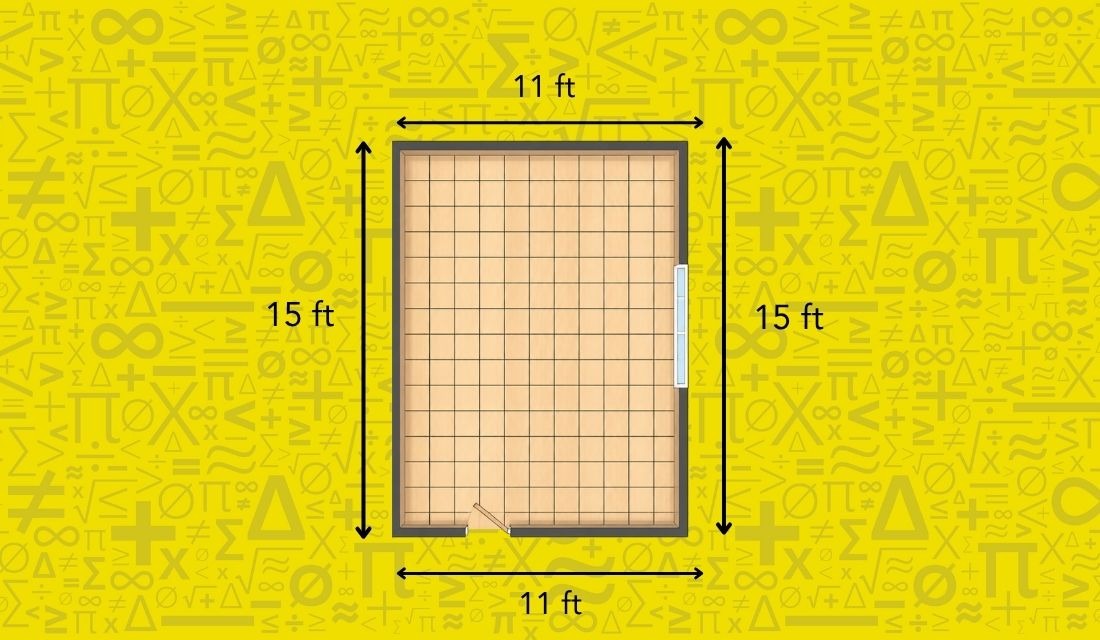
15 × 11 = 165 square feet
Each square equals 1 square foot, so 165 squares cover the whole floor.
Back to the boxes. If each box covers 15 square feet, divide the floor area by that amount.
165 ÷ 15 = 11 boxes
Eleven boxes cover the measured floor area. Cuts around doorways, corners, and cabinets create some waste, so plan to buy a little extra!
📕 You May Also Like: What Is Area in Math?
3. How Much Soil Fills a Garden Bed?
To know how much soil a garden bed holds, we find its volume. Volume measures the space inside the bed using length, width, and depth. Once we know it, we know how many bags to buy.
Why not use the area? The area only measures a flat surface, like the bottom of the bed. Soil goes deeper than that. It fills the bed from the bottom up, so we need one more measurement: depth.
Let's say our bed is 6 feet long and 3 feet wide on the inside. We want to fill it 1 foot deep.
Now let's picture the space filled with cubes, each 1 foot on every side. Six cubes fit along the length. Three fit across the width. That's 18 cubes in one layer! Since the soil is 1 foot deep, one layer fills the whole bed.
6 × 3 × 1 = 18 cubic feet
Each cube equals 1 cubic foot, so our bed holds 18 cubic feet of soil.
Time to shop! Soil bags usually list how much they hold in cubic feet. If each bag holds 2 cubic feet, we divide our total by 2.
18 ÷ 2 = 9 bags
Before we head to the store, two quick tips will keep our count accurate. We measure the inside of the bed because the walls take up space. We also use the depth we plan to fill, not the full height of the walls.
📕 You May Also Like: What Is Volume in Math? A Kid-Friendly Guide
 The same steps work for any rectangular bed, so all we need is a tape measure and three numbers.
4. What Angles Make a Picture Frame?
Now we want to make a frame whose corners join neatly. To see how, take a closer look at the corner of a rectangular picture frame. Notice the diagonal seam where the two pieces meet?
The corner itself is a right angle, so it measures 90°. Both pieces have to fill that 90° corner together.
Now let's look at the seam. When the frame's sides are the same width, the seam splits the corner into two equal angles. So how many degrees does each piece get?
We divide 90° into two equal parts.
90° ÷ 2 = 45°
There's our answer! The end of each piece forms a 45° angle. When two of them meet, they make the 90° corner.
Now let's check the other three corners. Can you spot the same pair of 45° angles?
Every corner works the same way. As long as the sides are the same width, each corner splits into two equal angles, and the pieces fit together neatly.
📕 You May Also Like: Is Your Student Ready for Their Geometry Class? [+Quiz]
 If the two angles add up to more or less than the corner's angle, the pieces won't meet cleanly, and a gap will open at the seam.
5. Can We Plan a Room Without Moving Furniture?
Your bedroom could use a new layout, but moving the bed every time we try one sounds like a lot of work. Here's an easier way. Draw the room on paper, make paper cutouts of the furniture, and move the cutouts around instead!
How do we make sure something that fits on paper will also fit in the room?
The answer is scale! Every measurement in the drawing follows the same rule. For our drawing, 1 inch stands for 2 feet.
Let's start with the room. It measures 12 feet by 10 feet. Every 2 feet becomes 1 inch, so we divide each measurement by 2.
12 ÷ 2 = 6 inches
10 ÷ 2 = 5 inches
On paper, the room becomes a rectangle 6 inches by 5 inches.
Next up is the bed, which measures 6 feet by 3 feet. The same rule applies.
6 ÷ 2 = 3 inches
3 ÷ 2 = 1.5 inches
The bed's paper cutout measures 3 inches by 1.5 inches.
Notice that the room and the bed use the same scale. We didn't shrink the bed just to squeeze it into the drawing. So if the cutout fits, the real bed fits too!
Let's slide the cutouts around and compare arrangements. Does anything block the doorway? Is there enough room to walk? We'll draw the door's swing as well, so we can see the space it needs when it opens.
And if we change our minds next month, the drawing and cutouts are ready for another try.
📕 You May Also Like: Geometric Transformations – Definitions, Types, Examples, and Quiz
 Mathnasium's specially trained tutors combine hands-on activities with visual, verbal, and written techniques to help students understand geometry.
How Mathnasium Helps Students Master Geometry (And Any Other Math Concept)
Mathnasium is a math-only learning center dedicated to helping K–12 students of all skill levels excel in math.
Whether students are just beginning to learn geometry or working through more advanced concepts, our specially trained geometry tutors help them connect what they learn to logical reasoning and real-world applications.
To do that, we use the Mathnasium Method™, our proprietary teaching approach, which is designed around each student's needs and learning style. Our approach includes:
-
Assessment and Personalized Learning Plans: Each student begins their Mathnasium journey with a diagnostic assessment that identifies skill level, knowledge gaps, learning goals, and learning style. From those findings, we build a personalized learning plan tailored to their goals.
-
Teaching for Understanding: Our specially trained tutors use natural language and a mix of verbal, visual, mental, tactile, and written techniques so each concept lands before we move forward.
-
Problem-Solving and Critical Thinking: We give students time to work through problems independently. When we do step in, we explain both the how and the why behind each answer, so students build problem-solving and critical thinking skills.
-
An Engaging and Fun Learning Environment: Sessions include games, earned rewards, and consistent celebration of progress. Students build confidence alongside fluency, and many develop a more positive relationship with math over time.
The impact extends beyond the classroom:
-
94% of parents report an improvement in their child's math skills and understanding
-
93% of parents report their child's improved attitude toward math after attending Mathnasium
-
90% of students saw an improvement in their school grades
With over 1,100 learning centers across North America, there is likely a Mathnasium close to you.
For families in and around Cave Creek, Mathnasium of Cave Creek is a trusted local center with a proven record of building confident math thinkers.
If geometry or any other math concept is giving your child trouble, our team is ready to help.
📅 Schedule a Free Assessment at Mathnasium of Cave Creek
Not near Cave Creek?
📍 Find a Mathnasium Learning Center Near You


 (602) 313-0901
 (602) 313-0901