As a Cave Creek-based learning center, we often hear from parents concerned about how their child is handling the transition toward middle school math. They may remember a confident 4th grader who earned good grades, then notice that by 6th grade, math starts to feel much harder.
Between 4th and 6th grade, Arizona's math standards ask students to do more with the skills they already have, from fractions and decimals to more abstract ideas and multi-step reasoning. So, your learner's earlier knowledge gaps that were easy to miss when math was more familiar get exposed.
Today, our education specialist will break down
-
what changes in math from 4th to 6th grade,
-
how to spot that your learner starts falling behind in math before a report card shows a problem,
-
what you can do to ease the transition.
How Math Changes in Arizona from 4th to 6th Grade
In Cave Creek Unified School District (CCUSD), your child follows Arizona Math Standards throughout elementary school, with a K–5 math program that builds procedures, conceptual understanding, mathematical reasoning, and problem-solving.
By 6th grade, they are working with Arizona's Grade 6 standards, which ask them to use those earlier skills in more advanced ways.
Let's look at how math expectations change from 4th through 6th grade, according to Arizona Math Standards.
The standards show what students are expected to learn, but the bigger change is in how they are expected to think about math. Here’s what that progression looks like in practice:
|
Grade
|
What changes
|
What it might look like
|
| 4th Grade |
Students extend arithmetic and begin to explain how and why different methods work. They also begin working with unknown quantities and looking for patterns. |
Your child may solve 348 × 6 correctly while developing a fuller understanding of multiplicative comparison, or work with fractions while building a solid sense of fraction size and equivalence. |
| 5th Grade |
Fifth grade acts as a bridge year. Your learner starts using familiar skills in more demanding ways and prepares for the greater abstraction of middle school math. |
In 4th grade, your child may explain why \(\Large\frac{3}{10}\) = \(\Large\frac{30}{100}\). In 5th grade, they use the same idea of equivalent fractions to solve problems such as \(\Large\frac{2}{3}\) + \(\Large\frac{1}{4}\) by rewriting both fractions with a common denominator first. |
| 6th Grade |
Middle schoolers begin working with relationships between quantities, multiple representations, unknown values, and more abstract reasoning. |
A 4th-grade problem might read, “There are 3 bags of 6 apples. How many apples are there in total?” By 6th grade, it may ask, “For every 3 apples, there are 6 oranges. Write a relationship, a table, a graph, and an equation.” |
This means, by 6th grade, math asks your student to connect several representations of the same idea and reason about how quantities relate.
6th grade is not a full algebra course, but it draws heavily on earlier work with patterns, unknowns, fractions, and place value. So if middle school math suddenly feels harder, that may be because your child now needs to apply several skills at the same time, even if they understand each one on its own.

How to Spot Math Struggles as Your Child Moves Toward Middle School
Your learner may start having difficulty with the transition to middle school math long before their report card reflects it. The earlier you notice those signs, the sooner you can give them the support they need.
At Mathnasium, we use a diagnostic assessment to look beyond grades and identify the specific knowledge gaps that may be holding your child back.
You can take a similar approach at home with a few simple checks, similar to what we use during an assessment.
1. Ask your child to explain their reasoning
After your student solves a problem and lands on a right answer, ask them to walk you through their reasoning. If they can’t walk you through their reasoning, they may be relying more on memorized steps than on a solid grasp of the concept.
That workaround can go unnoticed for years, until a new problem requires them to understand the idea behind the procedure. From Grades 4 through 6, math keeps revisiting familiar concepts in less familiar problems, so your learner needs enough command of an idea to use it in a new situation.
Self-explanation can do more than reveal how your child is thinking. According to a study by Wong et al. (2002), students taught to explain their reasoning improved their problem-solving performance.
Simply put, by asking your child to explain their reasoning, you can both see how well they grasp the idea and give them another chance to work through it more deeply.
For example, your learner correctly solves \(\Large\frac{3}{4}\) + \(\Large\frac{1}{4}\), ask them:
-
“How did you land on the answer?”
-
“Why does the denominator stay the same?”
Listen to whether their explanation matches the calculation. If they hesitate once, that does not automatically point to a gap. Try a few low-pressure questions across familiar problems and listen to how they explain their thinking.
📕 You May Also Like: Verbal vs. Written Math Reasoning: Why Writing Is Harder
2. Notice whether a foundational skill is used easily or still takes effort
Procedural fluency is as important as conceptual understanding. Your student needs both a clear sense of when, why, and how a method works and enough fluency to use it accurately and efficiently.
We can see this idea supported in research by Rittle-Johnson et al. (2015), which concludes that conceptual and procedural knowledge support one another and should be developed together, rather than presenting one as a substitute for the other.
When basic procedures become more automatic, your child can devote more mental effort to the more complex reasoning and problem-solving that middle school math requires.
To check your child’s fluency, pick a foundational skill your child should have down cold, like multiplication facts or basic fraction equivalents, and watch how they produce the answer:
-
Do they answer close to instantly?
-
Or, do they pause to recompute or visibly work it out each time? In this case, extra practice can help prevent it from slowing your child down in more complex problems later.
📕 You May Also Like: What Math Fluency Really Looks Like at Every Stage
3. Check their fraction understanding
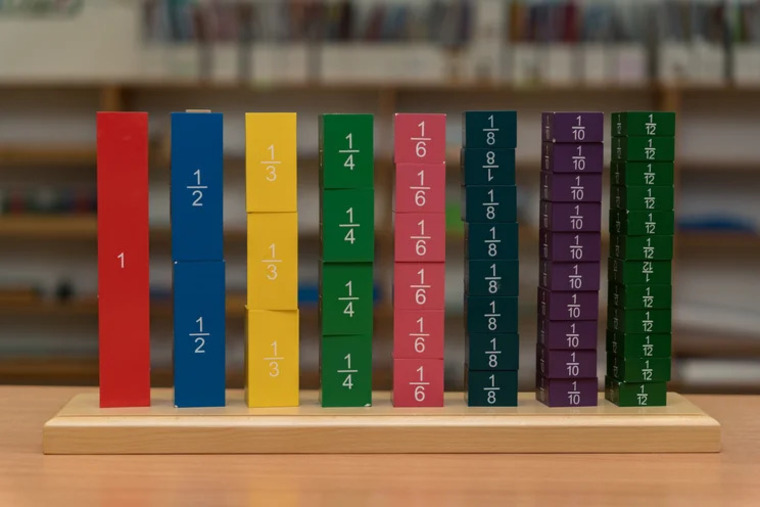
We recommend paying extra attention to fractions because your student will use them in both 5th-grade fraction operations and 6th-grade topics such as ratios, rates, percentages, rational numbers, and fraction division.
This aligns with research by Siegler et al., which found that elementary students’ knowledge of fractions and division predicted their later algebra knowledge and overall high school math achievement.
In a related IES practice guide, Siegler also emphasizes that students need to understand fractions as numbers, use number lines to represent them, and connect fractions with decimals and percentages.
To get a sense of how securely your learner understands fractions, try these quick checks:
-
Compare two fractions. Ask which is greater, \(\Large\frac{3}{8}\) or \(\Large\frac{3}{5}\), and have your child explain why. In case, they choose \(\Large\frac{3}{8}\) because “8 is bigger,” they may be applying whole-number reasoning to fractions instead of thinking about fraction size.
-
Connect different forms of the same value. Ask whether \(\Large\frac{1}{2}\), 0.5, and 50% belong at the same point on a number line. This can help you see whether your child recognizes the relationship between fractions, decimals, and percentages.
📕 You May Also Like: 7 Tips to Help Your Child Build Solid Fraction Understanding
4. Watch how they handle multi-step word problems
Under Arizona Grade 6 standards, your child is expected to solve real-world ratio problems using tables, diagrams, graphs, and equations and coordinate several quantities and steps within the same problem.
So by middle school, make sure that your learner can:
Take a closer look at their problem-solving skills with this example:
-
Give your learner an unfamiliar problem without obvious signal words, such as: “A trail map uses 1 inch for every 2 miles. Two locations are 7.5 inches apart on the map. How far apart are they?”
-
Ask them to sketch or explain the situation before they calculate, then talk through each step as they work.
-
Watch for patterns such as jumping straight into calculations before identifying what the quantities mean, losing track of units, abandoning a plan after a small error, or switching operations without being able to explain why.
📕 You May Also Like: A 4-Step Method for Solving Word Problems + Examples
 Fraction skills in elementary school support later work with ratios, rates, percentages, rational numbers, and algebra.
How to Help Your Child Through the 4th-to-6th-Grade Math Transition
To make the transition from Grade 4 to Grade 6 smoother for your learner, you can use these strategies. They draw on research and our own insights from work with students at Mathnasium of Cave Creek.
A. Use multiple representations to build true understanding
Encourage your child to show the same math idea in more than one way:
-
with a drawing
-
number line
-
table
-
equation
-
words
-
real-life example
This helps them move beyond memorizing a procedure and understand what the numbers and symbols represent.
The Institute of Education Sciences (IES) practice guide by John Woodward et al also recommends using visual representations to help students connect math ideas and notation.
When your child solves 3 × 8 = 24, ask them to show the same idea another way. They might draw three groups of eight, or make equal jumps on a number line. Each representation should connect back to the same relationship.
Repeat this every once in a while with homework problems to help your learner see quantities and relationships behind numbers.
📕 You May Also Like: How Multiple Representations Improve Understanding of Math
B. Build speed on facts your child already knows
If your child still has to stop and work out a foundational skill, such as a multiplication fact or a basic fraction equivalent, that can make 6th-grade problems harder to manage. Fluent recall of basic facts can free up working memory for more complex problem-solving.
In particular, fluency with multiplication facts is linked to performance on multiplication application tasks, as Lin and Kubina reported in their 2005 study.
Keep practice brief and targeted. Choose a small set of facts your child understands but does not yet recall efficiently, and spend a few minutes reviewing them regularly. This could be a quick multiplication round during the drive to Cave Creek Regional Park or a short fraction-equivalence quiz before dinner.
C. Prepare your learner for the fractions-to-ratio transition
Fractions and ratios are closely related, but they describe relationships in different ways. With fractions, we usually compare a part with a whole; with a ratio, we can compare one part with another part or with the whole.
By 6th grade, your child begins working more formally with ratio language and unit rates, so the transition is easier if they can build on what they already know about fractions.
You can practice this with something familiar, such as a sports statistic. Say your child is a Cactus Shadows sports fan; turn a few facts into a score-style challenge: when a basketball player makes 9 out of 12 shots, ask them to describe the result in two ways:
Then ask, “What changed when we switched from a fraction to a ratio?” and “What stayed the same?”
This way, your student will learn to move comfortably between different ways of describing the same quantities before ratio work becomes a bigger part of 6th-grade math.
D. Develop multi-step thinking
Multi-step problem-solving becomes easier with a consistent routine. Instead of saving it for difficult problems, use the same four questions during regular homework:
At first, model the routine out loud on one problem. Then gradually let your child take over more of the questions until they can use the routine on their own. With enough repetition, your child can start using the routine automatically whenever a problem feels unfamiliar.
E. Encourage math independence
During this transition through grades 4-6, the way you help with homework can shape how independently your child approaches harder math. Try to support their thinking without taking over the problem or turning homework into a test of how well they are doing.
A 2023 meta-analysis by Jiang et al. found that parent support was most positively linked to math achievement when it encouraged greater student autonomy.
At Mathnasium of Cave Creek, our tutors build that independence with guiding questions instead of supplying answers. You can use the same approach at home. Rather than saying, “Let me show you how,” try:
-
“What is the question asking you to compare?”
-
“Would a drawing, table, or number line help you find a first step?”
Then give your child room to make the next move.
📕 You May Also Like: How to Foster a Child’s Math Independence by High School
 Mathnasium tutors guide students to explain their reasoning, choose strategies, and check their work, building independence for middle school math.
How Mathnasium of Cave Creek Helps Students Prepare for the Middle School Transition (and Beyond)
Mathnasium of Cave Creek is a math-only learning center dedicated to helping K–12 students of all skill levels excel in math. In our tutoring work, we help students build the foundations they need for the shift from 4th- and 5th-grade math into the more abstract, multi-step work of 6th grade and beyond.
Through the Mathnasium Method™, our proprietary teaching approach, we meet students where they are and guide them forward step by step.
Each student begins with a diagnostic assessment that helps us understand their current skill level, knowledge gaps, goals, and how they think and feel about math. For students approaching middle school, that may include fraction understanding, working across different representations, calculation fluency, and multi-step reasoning.
Using these insights, we create a personalized learning plan focused on the skills the student needs most, rather than simply reviewing the previous grade. That may mean reinforcing an earlier foundation, preparing for new 6th-grade concepts, or giving a student more challenge before the transition.
Our specially trained tutors follow the plan closely and provide live, face-to-face instruction in a caring and fun group environment. They use mental, verbal, visual, tactile, and written techniques to help students make sense of new concepts and connect them to what they already know.
Students also get room to think through problems before tutors step in. Our tutors guide them to explain their reasoning, choose an effective strategy, and check whether an answer makes sense. This helps students build the problem-solving skills and math independence that become increasingly important in middle school.
Fun is part of the approach, too. We use game-based activities, rewards, and consistent encouragement to help students stay engaged as they refresh earlier skills and prepare for the work ahead.
Families see the difference:
-
94% of parents report an improvement in their child's math skills and understanding
-
93% of parents report their child's improved attitude toward math after attending Mathnasium
-
90% of students saw an improvement in their school grades
Whether your child needs to catch up, keep up, or get ahead before middle school, a free diagnostic assessment is a great place to start. Using what we learn, we create a personalized learning plan focused on the skills they need next.
📅 Schedule a Free Assessment at Mathnasium of Cave Creek
Not near Cave Creek?
📍 Find a Mathnasium Learning Center Near You


 (602) 313-0901
 (602) 313-0901