Some of the best math moments we see happen outside the classroom. A concept that resisted every worksheet suddenly makes sense the moment it connects to something concrete.
Research by educator Jo Boaler shows that encountering math in meaningful, real-world contexts leads to far more reliable skill transfer than practicing the same procedures in the abstract.
The grocery store is one of the richest math environments families have access to. A budget is a firm constraint. A unit price comparison has a right answer that determines what goes in the cart. Getting the total wrong has a consequence.
The numbers mean something, and that changes how children engage with them.
Today, we walk you through a structured budget challenge for three age groups: early elementary, upper elementary, and middle school, each with its own math focus and challenge design. The same errand, three different math experiences.
Why the Grocery Store Works as a Math Environment
Children encounter math skills first on a worksheet, such as addition, decimals, unit rates, percentages, estimation, etc. The grocery store puts every one of them to work in the same trip, with actual stakes attached.
NCTM's standards emphasize that students learn math more deeply when they connect procedures to real-world contexts rather than practicing them in isolation. The grocery store is one of the most natural places that connection happens.
Each task in the store maps to a specific math skill:
-
Prices and totals: addition, subtraction, and decimal arithmetic
-
Unit pricing: division and ratio reasoning
-
Sale items and discounts: percentage calculation
-
Staying within a budget: estimation and basic optimization
These are the same skills school math introduces through word problems that ask children to imagine exactly what a grocery store presents concretely. A child calculating the unit price to decide which yogurt is the better deal has a reason to care about the answer.
📕 You May Also Like: How Do We Measure Rainfall? A Fun DIY Guide
The Budget Challenge at Each Stage
Our tutors designed this challenge around the three key stages of math development in grades 1–8. Each stage comes with a specific math focus, a concrete challenge structure, and examples of what the math looks like in practice.
1. Early Elementary, Grades 1–3: Counting, Comparing, and Adding Up in the Grocery Store
Children in grades 1–3 are building fluency with addition, subtraction, and basic number sense. The grocery store gives them a concrete place to practice all three at once.
Give your child a small, fixed budget of five to ten dollars and a short list of three to four items to find. They need to:
If the total goes over, they need to decide which item to put back.
Keep the numbers manageable at this stage. Items priced in whole dollars or simple decimals, like $1.99 or $2.50, are more useful than items with complex pricing. You should aim for fluency with addition and comparison.
This challenge develops several foundational skills:
-
Addition with decimals in a context where the answer matters
-
The concept of a budget as a firm constraint
-
Basic comparison reasoning: Is this item more or less expensive than that one?
For families in Denver neighborhoods like Congress Park and Park Hill, where weekend farmers' markets and neighborhood grocery runs are part of the routine, this challenge fits naturally into trips you are already making.
📕 You May Also Like: How to Build Decimal Sense Using Money
2. Upper Elementary, Grades 4–5: Estimation, Unit Price, and Multiplication in the World Around Us
Children in grades 4–5 are ready to move beyond totaling a list. They can handle multi-step reasoning, and the grocery store gives them a natural place to practice it.
-
Give your child a budget of fifteen to twenty dollars and a less prescriptive task: find the best value among three options in a single category, such as cereal, pasta, or juice.
-
They need to calculate the unit price for each option, price per ounce, price per serving, or price per item in a multipack, and identify which is the best deal.
-
Add an estimation layer before they start calculating. Ask them to predict which option will be cheapest per unit, then check that estimate against their calculation.
This challenge develops several skills that carry directly into middle school math:
-
Division with decimals in a meaningful context
-
Unit rate reasoning, which maps directly onto ratio and proportional thinking in grade 6
-
Estimation as a mathematical habit rather than a procedural step
Most Denver-area grocery stores, including Cherry Creek's Whole Foods and King Soopers locations, display unit prices directly on shelf tags.
Show your child where to find that information, then ask them to verify it by calculating it themselves. The discrepancy between their calculation and the shelf tag, when it appears, is itself a useful math conversation.
📕 You May Also Like: 5 Ways to Help Your Child Build Estimation Skills
3. Middle School, Grades 6–8: Percentages, Discounts, and Budget Optimization During Shopping
Students in grades 6–8 are ready for a challenge with true complexity. This version of the activity asks them to plan, calculate, and make decisions under competing constraints.
-
Give your child a realistic weekly grocery budget for a single meal: enough ingredients to cook one dinner for the family. Their job is to plan the meal, find the ingredients, and stay within the budget.
-
Take it further with a percentage challenge. Ask them to find two or three items on sale, calculate the actual discount in dollars, and factor those savings into their running total.
-
Then, add an optimization question: If they come in under budget, what is the most they could spend on one optional item and still stay within the limit?
This challenge develops skills that appear directly on state assessments like the Colorado Measures of Academic Success (CMAS):
-
Percentage reasoning with actual stakes attached
-
Multi-step problem solving across competing constraints
-
Early financial literacy: understanding that a 20% discount on a $4.99 item produces a specific dollar saving
These are precisely the applied reasoning skills that students find most difficult when their math experience has been primarily procedural. The grocery store makes them concrete and immediate.
📕 You May Also Like: How to Teach Kids Money Skills with Math
How to Make the Challenge an Effective Learning Experience
The way you run this challenge matters as much as the challenge itself. Three principles make the difference between an errand with math in the background and an experience that actually builds skills.
-
Let the outcome land. If your child goes over budget, let them put an item back. If their estimate is wrong, let them recalculate. The actual outcome is what makes the math meaningful, and removing it turns the challenge into a performance.
-
Ask questions instead of correcting. If your child makes an error, try asking 'How did you get that?' before offering the right answer. This is the same approach Mathnasium tutors use: guiding students toward their own understanding rather than handing them a solution. Your child will learn more by finding their own mistakes than by being corrected. This aligns with Jo Boaler's research showing that students guided to discover answers retain concepts far longer than those simply given solutions.
-
Keep the debrief short. After the trip, one or two questions are enough. "Which item was the best value?" or "Did anything surprise you?" A long debrief after a successful challenge can feel like more homework. A short conversation keeps the experience positive and gives them a reason to do it again.
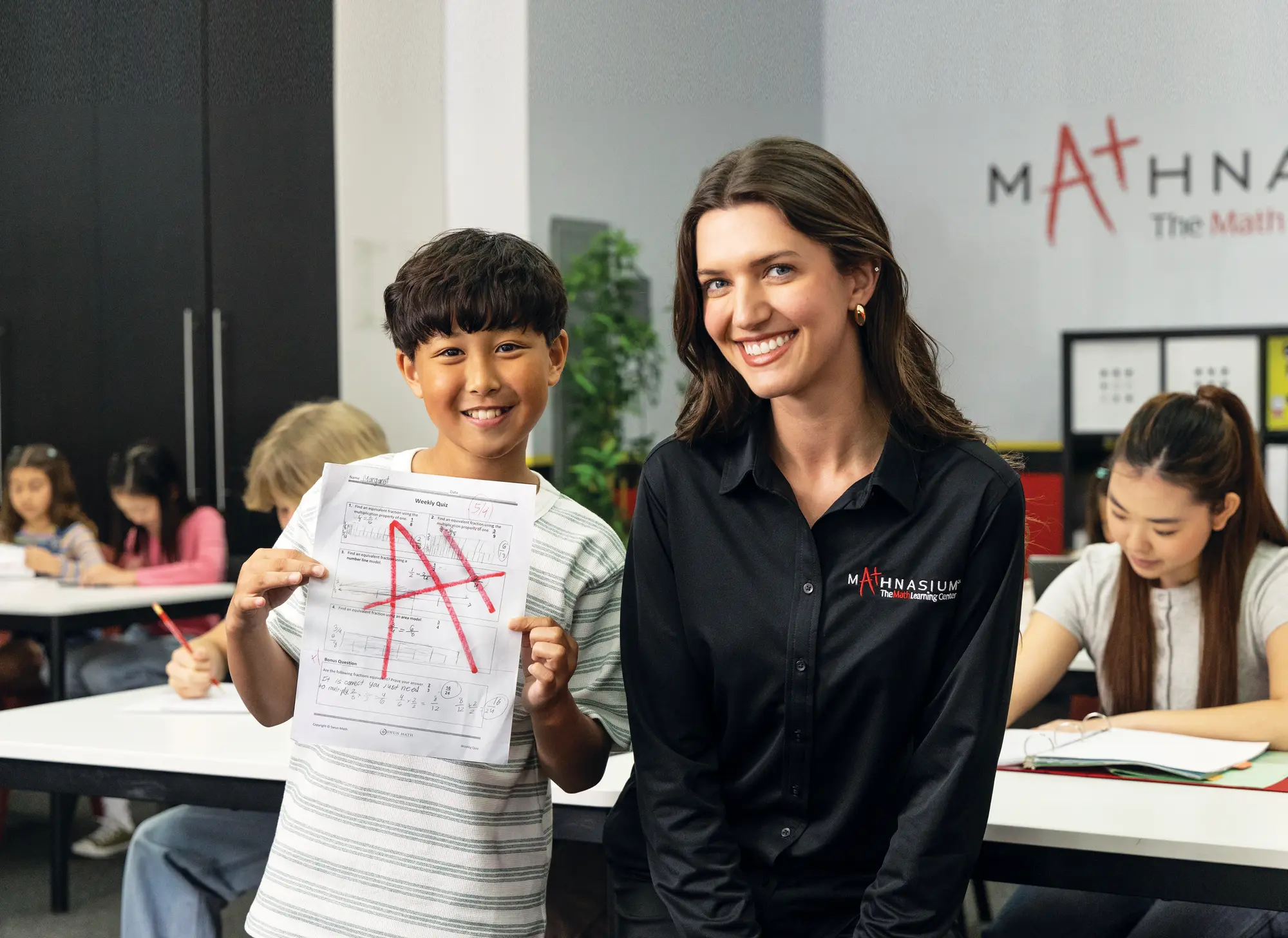
Mathnasium tutors build on the math skills children develop in everyday life, turning real-world intuition into lasting classroom confidence.
How Mathnasium Builds on the Math Your Child Already Knows
Mathnasium is a math-only learning center helping K-12 students of all skill levels learn and master math.
When students come to us for math support, using real-world connections and meaningful challenges is one of the tools we reach for to make math make sense. This is all part of a broader teaching approach we call the Mathnasium Method™.
Designed around each student's individual needs, our time-tested approach does more than fill gaps or help students reach a specific math goal. It transforms how they think and feel about math.
Here is how it works:
-
Diagnostic assessment: Each student begins with a relaxed interaction that helps us identify their current skills, knowledge gaps, and how they naturally think about math. Nothing is assumed.
-
Personalized learning plan: From those insights, we build a plan tailored to their needs and goals, so instruction starts at the right place and moves forward with purpose.
-
Face-to-face instruction in a warm setting: Our specially trained tutors follow the plan closely, teaching math in a supportive and engaging environment where students feel comfortable asking questions and working through challenges.
-
Teaching for understanding: We use plain, everyday language to explain concepts and draw on a mix of verbal, visual, mental, tactile, and written techniques so students can see the math from different angles and truly make sense of it.
-
Problem-solving and critical thinking: We give students room to work through challenges on their own, then step in to guide their reasoning. We always teach both the how and the why, building the independent thinking skills students carry into math and beyond.
-
Fun: Sessions are often game-based, students earn rewards along the way, and every bit of progress gets celebrated. Confidence grows with each session.
And the results speak for themselves:
-
93% of parents report a more positive attitude toward math after attending Mathnasium
-
94% of parents report an improvement in their child's math skills and understanding
-
90% of students saw an improvement in their school grades
With over 1,100 centers, Mathnasium brings top-rated instruction close to your home.
For families across Cherry Creek, Congress Park, Park Hill, City Park, Capitol Hill, Montclair, and Wash Park, Mathnasium of Cherry Creek is a trusted local center with years of experience helping students excel in math.
Our community recognizes our dedication to student success, honoring us with over 100 five-star Google reviews.
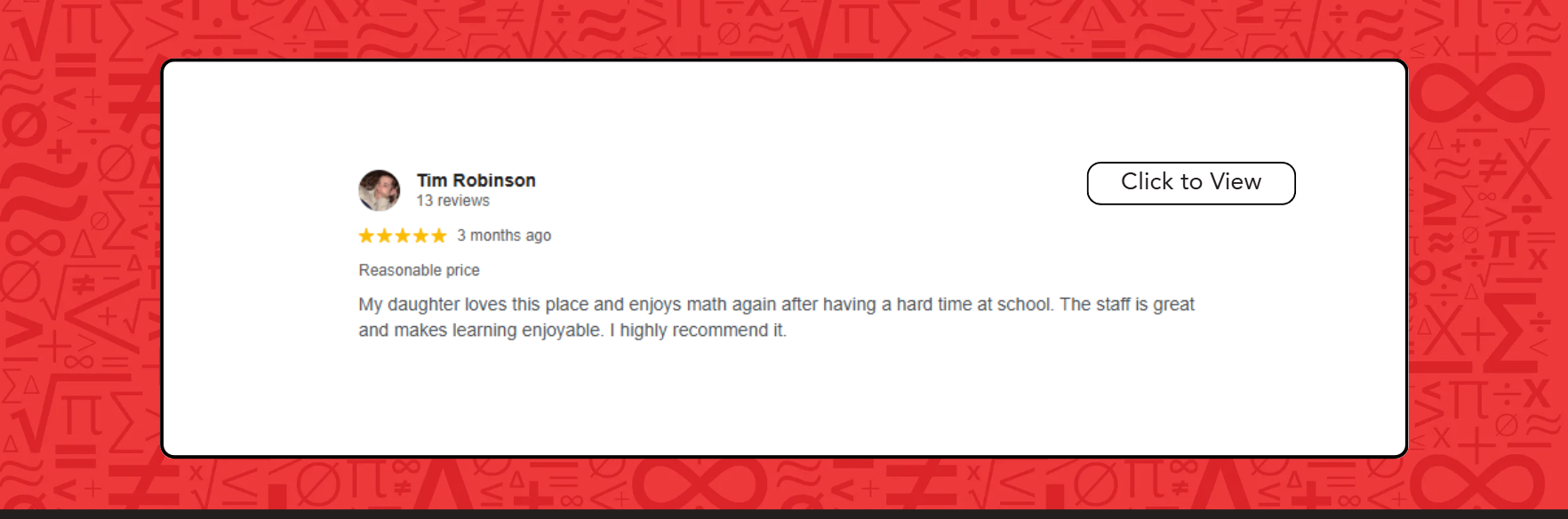
Here’s what one parent had to say about Mathnasium of Cherry Creek:
Whether your child is looking to catch up, keep up, or get ahead, our team is ready to assist.
📅 Schedule a Free Assessment at Mathnasium of Cherry Creek
Not near Cherry Creek?
📍 Find a Mathnasium Learning Center Near You


 (303) 333-6284
 (303) 333-6284