Cherry Creek School District math follows a structured path from pre-kindergarten through 12th grade, built around the Colorado Academic Standards and three curriculum programs that change as students move through school.
Our education specialists at Mathnasium of Cherry Creek explain how the CCSD math curriculum is organized at each stage, what your child is working on at each level, and how we can support them along the way.
How Cherry Creek School District Math Is Organized
Cherry Creek School District (CCSD) teaches math using the Colorado Academic Standards in Mathematics, the statewide standards that define what students should know and be able to do at each grade level.
To help students meet those standards, the district uses different curriculum programs at different school levels:
-
Elementary school (Pre-K–5): Cherry Creek elementary schools use Bridges in Mathematics as the core curriculum, along with ST Math as a visual supplemental program.
-
Middle school and early high school: Cherry Creek uses Open Up Resources (OUR) for math in grades 6 through Geometry, including Algebra 1.
-
Later high school: Students continue into courses such as Algebra 2, Precalculus, and Statistics, depending on their school and pathway.
Although the programs differ by school level, they share a common instructional approach. Across the district, math instruction emphasizes:
That way, students build understanding rather than only memorizing steps.
Here’s an overview of what each grade band covers and what to expect as your child moves through it.
1. Elementary (Pre-K–5)
Under the Colorado Academic Standards, each elementary grade focuses on a few big math ideas that build on one another. In Cherry Creek classrooms, those ideas show up through Bridges in Mathematics and ST Math activities.
-
Kindergarten: This is where young learners start to make sense of what numbers really mean. They learn to count, compare, and show quantities up to at least 20, using fingers, counters, and pictures instead of just writing numerals. Along the way, they try simple addition and subtraction stories with small numbers and get to know basic shapes and measurement words like longer and shorter or heavier and lighter.
-
Grade 1: First grade turns those early skills into more confident problem solving. Students work toward fluency with addition and subtraction within 20 and begin to see how counting connects directly to these operations. They discover that two‑digit numbers are built from tens and ones, explore early place‑value ideas, and use math to talk about length, time (hours and half‑hours), and simple data shown in picture and bar graphs.
-
Grade 2: In second grade, the numbers get bigger, and the problems get richer. Students extend addition and subtraction to 100 using tens and ones, and tackle word problems that may take more than one step to solve. They dig deeper into measurement with length, time, and money, learn about equal groups as a stepping stone to multiplication, and sort and describe shapes by their sides and angles.
-
Grade 3: Third grade is where multiplication and division really come into focus. Students connect these operations to equal groups, arrays, and area, so the facts mean more than just answers on a page. They begin formal work with fractions as numbers on the number line (like \(\Large\frac{1}{2}\) or \(\Large\frac{3}{4}\)), solve one‑ and two‑step word problems using all four operations, and build a more solid sense of area, perimeter, and geometric shapes.
-
Grade 4: Students work with multi‑digit whole‑number operations, including more complex multiplication and division, and extend their fraction work to comparing, adding, and subtracting fractions with like denominators. They understand factors and multiples, begin working with decimal notation (especially in connection to money and measurement), and explore angles and symmetry.
-
Grade 5: Students consolidate fluency with operations on whole numbers and decimals, and learn to add and subtract fractions with unlike denominators using equivalent fractions. They multiply and divide fractions in simple situations, interpret numerical expressions, and use place value to read, write, and compare large whole numbers and decimals to thousandths. In geometry and data, they work with volume, classify more complex shapes, explore coordinate grids in the first quadrant, and analyze line plots and other graphs.
📕 You May Also Like: How Number Lines Improve Math Understanding (Grades 1-5)

By the end of 5th grade, students should be able to work fluently with fractions and decimals, tackle multi-step problems with confidence, and explain their thinking clearly.
2. Middle School (6–8)
Middle school is where your child’s number sense turns into full‑strength algebra and geometry. Each year adds new ideas, but they’re all built on the foundation laid in elementary school.
-
Grade 6: Sixth grade is the bridge between arithmetic and algebra. Students work deeply with ratios and unit rates, using tables, diagrams, and real‑world contexts to compare quantities. They start writing and solving simple equations and inequalities, reason with negative numbers on number lines, and connect area, surface area, and volume to shapes they can see and draw. Along the way, they summarize data sets and learn to describe variability, not just “the average.”
-
Grade 7: In seventh grade, proportional thinking ramps up. Students analyze proportional relationships in tables, graphs, and equations, and use them to solve multi‑step word problems (like tax, tips, and discounts). They solve more complex linear equations with variables on both sides, continue working with negative numbers and rational numbers, and use geometry to study angles, triangles, and three‑dimensional figures. They also deepen their statistics work by looking at samples, populations, and informal ideas of probability.
-
Grade 8: Eighth grade is often called “prealgebra,” and it sets the stage for high school success. Students focus on linear functions and systems of equations, learning to connect equations, tables, and graphs and to interpret slope and intercepts in context. They study the Pythagorean Theorem and use it to reason about distance in the coordinate plane, explore transformations like translations and rotations, and begin to see patterns in exponents that lead into high school algebra. In data and statistics, they work with two‑variable data and think more carefully about association and trends.
📕 You May Also Like: 4 Key Middle School Math Skills For High School Success
3. High School (9–12)
High school ties Cherry Creek's math sequence together, leading toward college readiness.
-
Algebra 1 (typically Grade 9): Algebra 1 turns patterns into full algebraic language. Students work with linear equations and inequalities, systems of equations, and functions, learning to move comfortably among equations, tables, and graphs. They study slope and intercepts to model real‑world situations, work with exponents and simple quadratic expressions, and interpret rate of change and features of graphs in context. This is the year when strong equation sense and comfort with variables become essential.
-
Geometry (typically Grade 9 or 10): Geometry moves the focus from numbers to shapes and reasoning. Students study congruence and similarity, work with triangles, circles, and polygons, and use proofs (often in both informal and formal forms) to show why certain relationships must hold. They apply the Pythagorean Theorem and distance and midpoint formulas in the coordinate plane, calculate area, surface area, and volume for a variety of figures, and learn to connect algebraic skills with geometric diagrams and transformations.
-
Algebra 2 (typically Grade 10 or 11): Algebra 2 extends algebra into more complex territory. Students analyze and compare different types of functions, including quadratic, polynomial, exponential, and sometimes rational or logarithmic functions. They work with more advanced equations and inequalities, including those involving complex numbers, and study how transformations (shifts, stretches, reflections) change graphs. This is also a key year for building comfort with sequences, series, and modeling situations that grow or decay over time.
-
Precalculus, Statistics, and other advanced courses (typically Grades 11–12): In later high school, students choose courses that fit their goals. Precalculus deepens work with trigonometric functions, higher‑degree functions, and analytic geometry, laying the groundwork for college calculus. Statistics focuses on data collection, representation, and interpretation, including ideas like correlation, regression, sampling, and inference, so students can make sense of data in everyday life and in science and social science courses.
📕 You May Also Like: Functions vs. Equations: What Is the Difference?

Mathnasium tutors build on what Cherry Creek students are already learning, one session at a time.
How Mathnasium of Cherry Creek Supports Students Through the CCSD Curriculum
Mathnasium is a math-only learning center dedicated to helping K–12 students of all skill levels excel in math.
Mathnasium of Cherry Creek works with students across the Cherry Creek School District and can align our instruction to follow CCSD curriculum points when needed.
The math standards in Colorado focus on helping students build strong conceptual understanding, use visual models, solve problems in meaningful contexts, and explain their thinking clearly.
That same focus sits at the core of the Mathnasium Method™, our proprietary teaching approach, which is built to develop deep understanding and flexible, confident problem-solving skills rather than rote memorization.
Each child's Mathnasium journey begins with a diagnostic assessment that identifies their current skills, strengths, and knowledge gaps, whether that's fraction reasoning from elementary school or algebraic pacing from Algebra 1.
From there, we build a personalized learning plan tailored to their needs and goals, so instruction targets exactly what they're ready to work on next.
Our specially trained tutors deliver face-to-face instruction in a caring and fun group environment, both in-center and online, using verbal, visual, mental, tactile, and written techniques, the same kind of varied approach Bridges and Open Up Resources already use in their classroom.
Rather than handing over the answer, tutors guide students through each step, helping them build the reasoning skills they'll rely on across every math class they take.
Sessions run in a small-group setting with encouragement built in, so students build confidence alongside their skills, one win at a time.
The results speak for themselves:
-
94% of parents report an improvement in their child’s math skills and understanding
-
93% of parents report their child’s improved attitude toward math after attending Mathnasium
-
90% of students saw an improvement in their school grades
With over 1,100 centers, Mathnasium brings top-rated instruction close to your home.
For families in the Denver area, Mathnasium of Cherry Creek brings that same approach to your community, with specially trained tutors who understand both the Colorado Academic Standards and the students sitting in front of them.
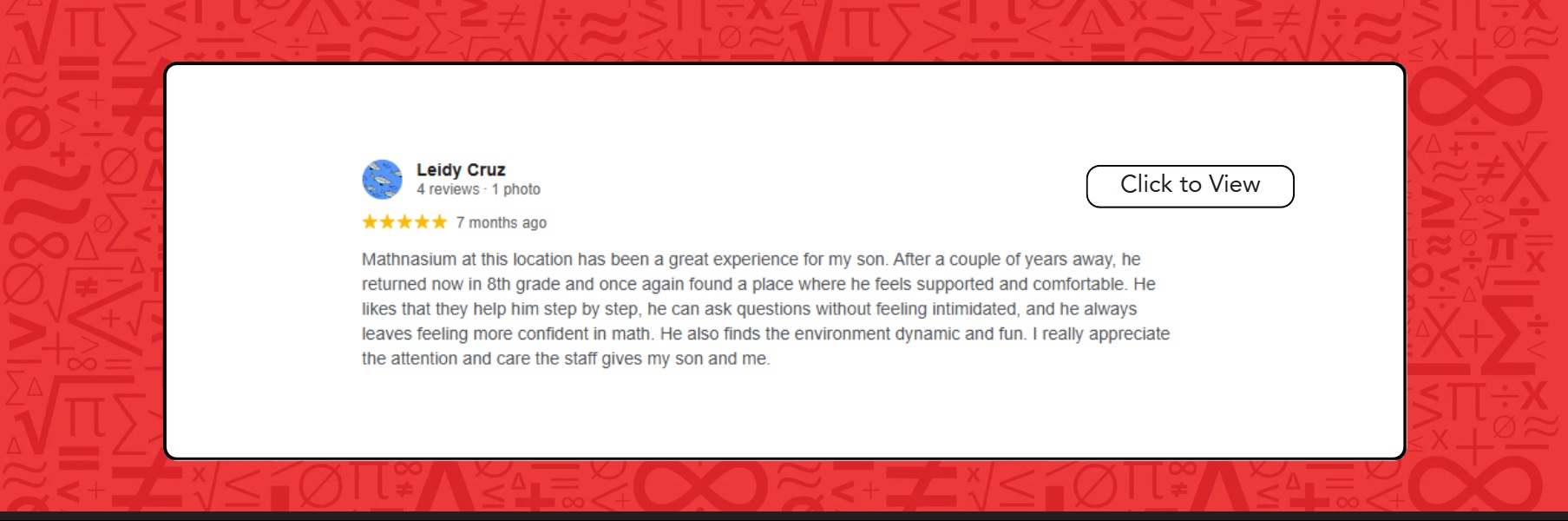
Our community recognizes our dedication to student success, honoring us with over 100 five-star Google reviews.
Here’s what one parent had to say about Mathnasium of Cherry Creek.
Whether your child is looking to catch up, keep up, or get ahead, our team is ready to assist.
📅 Schedule a Free Assessment at Mathnasium of Cherry Creek
Not near Cherry Creek?
📍 Find a Mathnasium Learning Center Near You


 (303) 333-6284
 (303) 333-6284