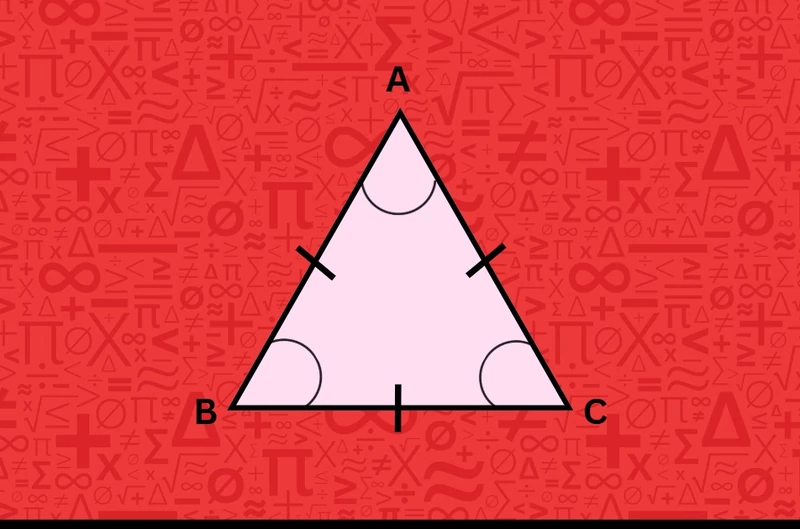
An equilateral triangle is the most symmetrical of all triangles: three equal sides, three equal angles, one central point where everything meets. You'll find this shape in yield signs, or honeycomb cells.
Today, Mathnasium tutors will break down the properties, angles, formulas, and special features you need to know to master equilateral triangles.

What Is an Equilateral Triangle?
An equilateral triangle is a polygon with three equal sides, three equal angles, and perfect symmetry.
If one side measures s, all three sides measure s. The angles follow the same rule: the three interior angles add up to 180°, split evenly into three equal parts of 60° each. Because no angle reaches 90°, an equilateral triangle is always an acute triangle.
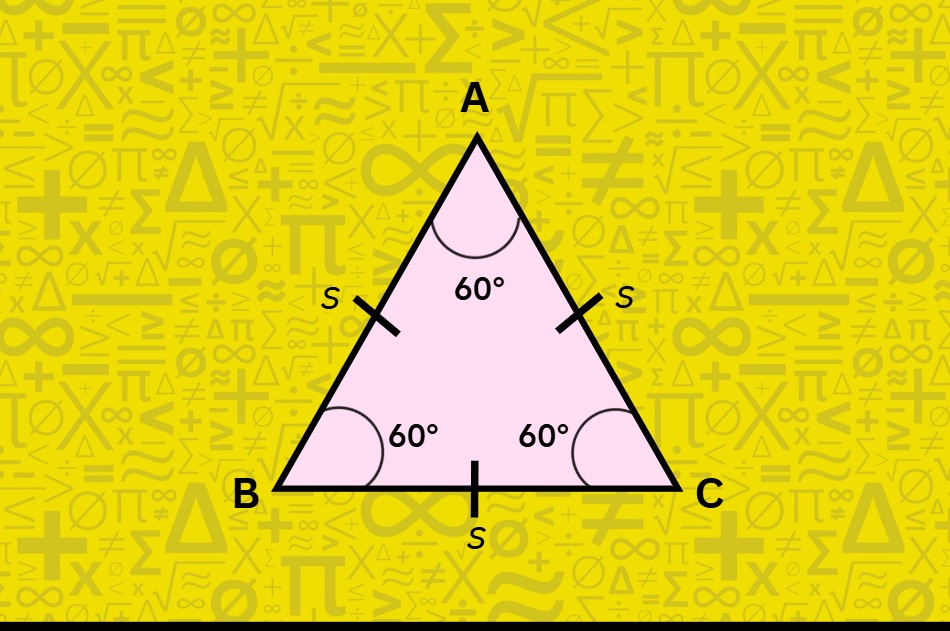
Each exterior angle, the angle formed by extending one side beyond the triangle, measures 120° (180° − 60°). All three exterior angles together add up to 360°.
That combination of equal sides, equal angles, and consistent angle relationships is what makes the equilateral triangle unique among all triangle types.
In a scalene or isosceles triangle, sides and angles vary. Here, everything is fixed. Once you know one side length, you can calculate every other measurement the triangle has, its height, its area, and the circles that fit around and inside it.
📕 You May Also Like: Types of Angles: Acute, Right, Obtuse & Straight Explained
What Makes Equilateral Triangles Unique Among Triangles?
Equilateral triangles have several features that set them apart from every other triangle, and most of them follow directly from the shape’s balance.
1. Three Lines of Symmetry
An equilateral triangle has three lines of symmetry. Each one runs from a vertex to the midpoint of the opposite side. If we fold the triangle along any of these lines, the two halves match perfectly.
The altitude, median, angle bisector, and perpendicular bisector all fall on a unified line that serves as a perfect mirror or fold line.
📕 You May Also Like: What is a Line of Symmetry?
2. The 30-60-90 Split
What happens when we draw the altitude of an equilateral triangle? It splits the shape cleanly down the middle into two identical right triangles. Let’s look at what happens to the angles:
-
The 60° angle at the top is cut in half, becoming 30°
-
The 60° angle at the base stays at 60°
-
The altitude meets the base at 90°
Each half is a 30-60-90 triangle. This comes up directly in the height formula, which we cover in the next section.
3. All Four Centers Coincide
In most triangles, four geometric centers exist at different points. In an equilateral triangle, all four land on the exact same central point:
-
Centroid: The point where the three medians meet
-
Orthocenter: The point where the three altitudes meet
-
Circumcenter: The center of the circle that passes through all three vertices
-
Incenter: The center of the circle inscribed within the triangle
How to Calculate Perimeter, Height, and Area of an Equilateral Triangle
Once we know the side length of an equilateral triangle, we can calculate everything else: perimeter, height, area, and both circle radii.
1. Perimeter
All three sides of an equilateral triangle are equal. If each one measures s, what is the simplest way to find the total distance around the triangle? We just add all three sides, s + s + s, which we can write as:
P = 3s
2. Height
To find the height, recall the 30-60-90 split from the previous section. Drawing the altitude divides the base in half, creating a right triangle with hypotenuse s and base \(\Large\frac{s}{2}\).
Applying the Pythagorean theorem (a2 + b2 = c2):
h2 + (\(\Large\frac{s}{2}\))2= s2
h2 = s2 − \(\Large\frac{s^2}{4}\)
h2 = \(\Large\frac{3s^2}{4}\)
h = \(\Large\frac{s\sqrt{3}}{2}\)
Knowing how this formula is derived means we can reconstruct it on a test rather than relying on memory alone.
3. Area
We already know the base is s and the height is \(\Large\frac{s\sqrt{3}}{2}\).
How do we find the area of any triangle?
We take half the base times the height. This is because a triangle is half of a rectangle whose sides match the base and height.
A = \(\Large\frac{1}{2}\) × base × height
A = \(\Large\frac{1}{2}\) × s × \(\Large\frac{s\sqrt{3}}{2}\)
A = \(\Large\frac{s^2\sqrt{3}}{2}\)
📕 You May Also Like: How to Calculate the Area of Triangles - A Beginner's Guide
4. Circumradius and Inradius
The circumradius R is the radius of the circle that passes through all three vertices:
R = \(\Large\frac{s\sqrt{3}}{3}\)
The inradius r is the radius of the circle that fits inside the triangle:
r = \(\Large\frac{s\sqrt{3}}{6}\)
Both radii connect back to the height formula. R equals \(\Large\frac{2}{3}\) of the total altitude, and r equals \(\Large\frac{1}{3}\) . This leads to one of the more elegant results in triangle geometry: R = 2r. The outer circle's radius is always exactly double the inner circle's radius.

At Mathnasium, students learn to derive formulas step by step, so they can reconstruct them independently on a test.
How Mathnasium Can Help Your Student Master Equilateral Triangles
Mathnasium is a math-only learning center that helps K–12 students of all skill levels truly understand geometry, not just memorize formulas.
Every student's journey begins with a diagnostic assessment. For geometry topics like equilateral triangles, this helps our specially trained tutors spot the foundational gaps that tend to get in the way: angle relationships, triangle classification, the Pythagorean theorem, or basic proof reasoning. From there, we build a personalized learning plan that targets exactly what each student needs, introducing concepts step by step so understanding builds naturally.
Our tutors use the Mathnasium Method™, a proprietary teaching approach that combines verbal, visual, tactile, and written techniques. For geometry specifically, that means students don't just work through abstract symbols on a page; they work with diagrams, talk through relationships, and develop the spatial reasoning that makes geometric thinking click.
The proof is in the numbers:
-
94% of parents report an improvement in their child's math skills and understanding
-
93% of parents report a more positive attitude toward math after attending Mathnasium
-
90% of students saw an improvement in their school grades
Whether your child needs to catch up, keep up, or get ahead in geometry, our team at Mathnasium of Collegeville is ready to help.
🗓️Schedule a Free Assessment at Mathnasium of Collegeville
Not near Collegeville?
📍Find a Mathnasium Learning Center near you.


 (484) 973-6889