By the time algebra arrives, students have spent years adding, subtracting, multiplying, and dividing. Then suddenly there are letters in the equations, and a whole new vocabulary to go with them.
One of the first things algebra asks you to do is simplify expressions, and that's where combining like terms comes in. It can look confusing at first, but once we know what to look for, it's one of the more straightforward skills in algebra.
Today, we'll walk through what like terms are, how to recognize them, and the step-by-step process for combining them with confidence.

What Are Like Terms?
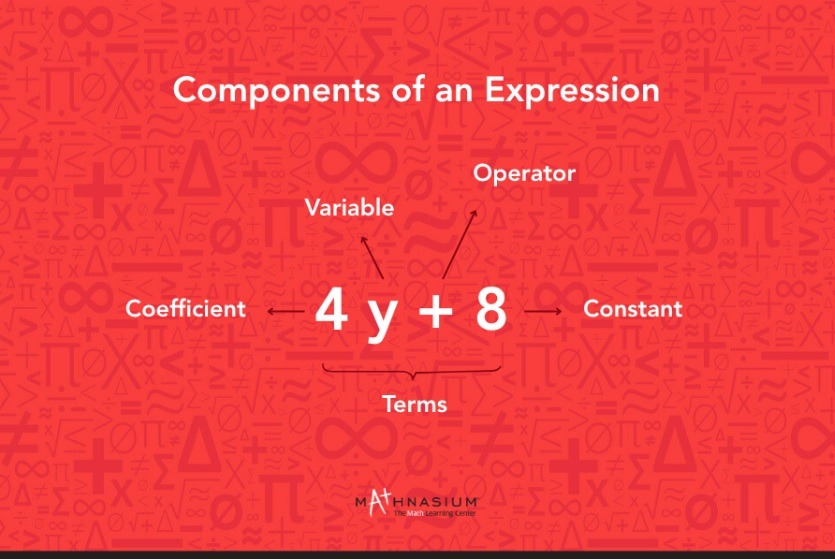
Like terms are terms in an algebraic expression that share the same variable and the same exponent or are both constants. Because they represent the same quantity, we can combine them into a single term.
At Mathnasium, we always build from the concrete before moving to the abstract. So let's start with something familiar to illustrate the concept.
Imagine a basket holding 3 apples, 2 bananas, 4 more apples, and 1 more banana. We naturally combine the apples with the apples and the bananas with the bananas:
Apples and bananas stay separate simply because they are different objects.
In algebra, we follow the same logic. Instead of fruit, we have terms: numbers, variables, or a mix of both. The expression 3a + 2b + 4a + b + 5 works on the same principle; we sort by type before we combine:
-
3a and 4a are like terms; they both belong to the a family → 7a
-
2b and b are like terms; they both belong to the b family → 3b
-
5 is a constant; it has no variable attached, so it stays on its own → 5
The simplified expression is 7a + 3b + 5.
There’s one important detail to keep in mind: b means 1b. The coefficient 1 is invisible, but it's always there. Our tutors always point this out early because it prevents confusion later when the invisible coefficient of 1 matters most.
Students typically encounter combining like terms in Grade 6 or Grade 7, when simplification becomes a larger part of prealgebra instruction.
📕 You May Also Like: What Is an Expression in Math? A Beginner-Friendly Guide
The Two Rules for Identifying Like Terms
To spot like terms, we check two things:
Constants, plain numbers with no variable, are always like terms with each other, no matter what the numbers are.
An exponent tells us how many times a variable multiplies by itself, which means x and x² are not like terms even though they share the same letter.
Our tutors like to say sort before you simplify. Group all the variable terms together first, then group the constants. It makes the combining step much harder to go wrong.
Let's check a few pairs to see if they're like terms or not:
|
Expression Pieces
|
Are They Like Terms?
|
|
5x and 3x
|
Yes. Same variable, same exponent.
|
|
7 and 12
|
Yes. Both are constants with no variable attached.
|
| 4x and 4y |
No. Different variables. The coefficients match, but the variables do not.
|
|
2x2 and 8x
|
No. Same variable but different exponents. x2 and x are not the same family.
|
|
3ab and 9ba
|
Yes. Order does not matter in multiplication. ab and ba represent the same variable part.
|
Now that we know how to spot like terms, we can start combining them.
📕 You May Also Like: What Is an Exponent? A Complete, Beginner-Friendly Guide
How to Combine Like Terms: Simplifying Step by Step
When we combine like terms, we add or subtract their coefficients to simplify the expression. Let's see how that works in practice through three levels of complexity.
Level 1: Just the Basics
The first example shows us how to combine like terms when only one variable family is present.
Let's simplify: 6x + 4 + 2x + 9
Step 1: Identify and group the like terms. Variable terms together, constants together.
(6x + 2x) + (4 + 9)
Step 2: Add the coefficients of the x terms and add the constants.
(8x) + (13)
Our result is 8x + 13.
Note that 8x and 13 cannot combine further because 8 has a variable and 13 does not.
Level 2: Mixing Variables and Subtraction
The next step is learning how subtraction affects the way we group and combine like terms.
Now let's work through: 9m + 7n - 3m + 2n
Step 1: Identify and group the like terms. The sign in front of a term belongs to that term, so the minus sign stays with 3m.
(9m - 3m) + (7n + 2n)
Step 2: Add or subtract within each group.
(6m) + (9n)
So, the final result is 6m + 9n.
When our tutors see a subtraction in a like terms problem, we always remind students to circle the sign in front of each term before grouping. The sign is part of the term, not a separator between terms.
Level 3: The Exponent Trap
Another challenge is to recognize that exponents create different variable families, even when the same letter appears in every term.
Consider the expression: 5x² + 3x + 4x² - x + 8
Step 1: Identify and group the like terms. Three families are present here: the x² terms, the x terms, and the constant. A variable standing alone, like -x, has an invisible coefficient of 1. So -x means -1x.
(5x² + 4x²) + (3x - 1x) + 8
Step 2: Add or subtract within each group.
(9x²) + (2x) + 8
In this case, we end up with: 9x² + 2x + 8.
Even though three terms remain, we fully simplified this expression since no remaining terms are like terms.
📕 You May Also Like: How to Solve Basic Equations — A Parent and Student Guide
3 Mistakes Students Make When Combining Like Terms
From our experience working with students, we often see three recurring mistakes when students first learn to combine like terms.
1. Dropping the Sign That Belongs to a Term
Signs are part of terms, so we keep them attached when we group and combine like terms.
In 8x + 5 - 3x, the minus sign belongs to the 3x. If a student overlooks that sign when combining like terms, they may add the coefficients instead of subtracting them.
2. Adding the Exponents Instead of the Coefficients
Coefficients and exponents play different roles, and mixing them up can change the meaning of an expression.
When simplifying 2x + 3x, students sometimes write 5x². Coefficients tell us how many variable terms we have.
-
Wrong: 2x + 3x = 5x²
-
Correct: 2x + 3x = 5x
3. Combining Different Variables as if They Were the Same Family
Different variable families stay separate, even when the coefficients look easy to combine.
In 4x + 3y, x and y are different variables representing different quantities, so we cannot combine them.
📕 You May Also Like: What Repeated Math Errors Reveal About Your Student’s Thinking
Let’s Practice Combining Like Terms
Our tutors put together four problems that use the same skills from examples we worked through. Go through each one on paper, then check your answers at the end of the article.
-
7x + 5 + 3x + 2
-
12a + 8b - 4a - 5b
-
4x² + 6x - 2x² + x
-
Pro Level: 8 + 5y + 3x - 2 + y - 2x
Take your time with the pro level. It has three different families of terms to sort before combining.
FAQs About Combining Like Terms
Let's clear up a few common questions that come up when students begin combining like terms.
1. Can a Plain Number Be a Like Term With Another Plain Number?
Yes. All constants belong to the same family. In 4x + 7 + 2, the 7 and 2 are like terms and combine to make 9, giving 4x + 9.
2. Does the Order of Terms in the Final Answer Matter?
The value does not change regardless of order, because addition is commutative. Standard convention places variable terms first in descending order of exponent, with constants at the end. So 5x + 3 is preferred over 3 + 5x.
3. Can an Expression Have More Than Two Like Terms?
Yes. In 2x + 5x + 3x, all three terms are like terms and combine to give 10x. There is no limit to how many like terms an expression can contain.
📕 You May Also Like: 4 Tips to Help Your Student Get Better in Algebra This Year

At Mathnasium, learning is designed to make challenging concepts more approachable and easier to understand.
How Mathnasium Helps Students Make Sense of Any Math Concept
Mathnasium is a math-only learning center dedicated to helping K-12 students of all skill levels excel in math.
Whether students are looking to rebuild foundations in number sense and algebraic thinking, improve their fluency with algebraic expressions, or take on a challenge above their school curriculum, we can support them.
Our proprietary teaching approach, the Mathnasium Method™, is designed around each student's needs and learning style.
To help students build a deep understanding of any math concept, including algebraic expressions, our approach includes:
-
Assessment and Personalized Learning Plans: Each student starts with a diagnostic assessment that identifies current skills, strengths, and gaps. From those findings, we build a personalized learning plan tailored to their goals, whether that means strengthening foundational skills, improving problem-solving abilities, or preparing for more advanced math.
-
Teaching for Understanding: Our specially trained tutors use natural language and a mix of verbal, visual, mental, tactile, and written techniques so each concept lands before we move forward.
-
Problem-Solving and Critical Thinking: We allow time for students to work through problems on their own. That productive struggle helps them learn to trust their own reasoning. When we do step in, we explain both the how and the why behind each answer, so students build problem-solving and critical thinking skills they can use in math and beyond.
-
An Engaging and Fun Learning Environment: Sessions include games, earned rewards, and consistent celebration of progress. Students build confidence alongside fluency, and many develop a more positive relationship with math over time.
The results speak for themselves:
-
94% of parents report improvement in their child's math skills and understanding
-
93% of parents report an improved attitude toward math after attending Mathnasium
-
90% of students saw improvement in their school grades
With over 1,100 learning centers across North America, there is likely a Mathnasium close to you.
Families across Collegeville and nearby areas, including Phoenixville, Royersford, Trappe, Limerick, Eagleville, Skippack, and Harleysville, trust Mathnasium of Collegeville to help their children build real math confidence at every level.
If combining like terms or any other math concept is giving your child trouble, our team is ready to help.
📅 Schedule a Free Assessment at Mathnasium of Collegeville
Not near Collegeville?
📍 Find a Mathnasium Learning Center Near You
Pssst! Check Your Answers Here
If you've given our challenges a try, see how you did below.
-
10x + 7: grouped as (7x + 3x) + (5 + 2)
-
8a + 3b: grouped as (12a - 4a) + (8b - 5b)
-
2x² + 7x: grouped as (4x² - 2x²) + (6x + 1x). The invisible coefficient of 1 applies to the lone x term.
-
x + 6y + 6: grouped as (3x - 2x) + (5y + 1y) + (8 - 2). The invisible coefficient of 1 applies to both the lone y term and the resulting x term.


 (484) 973-6889