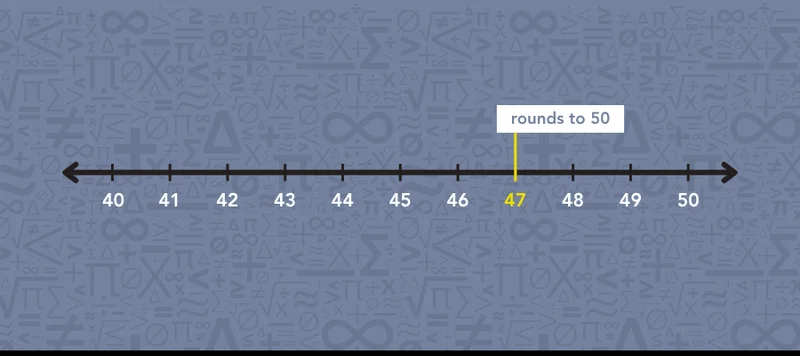
If a book has 291 pages, we might just say "about 300 pages." If a car ride takes 47 minutes, we can say "about 50."
These rounded numbers are cleaner and a lot easier to work with, and the action we are doing is simply called rounding.
We use it when we want to estimate costs, speed up mental math, describe approximate amounts, or simplify complex calculations.
Today, Mathnasium tutors guide you through how to round whole numbers and decimals using place value step by step with solved examples and visuals, practice problems, and FAQs.

What Is Rounding in Math?
Rounding (you might also hear it called rounding-off) is a type of estimation where we express a number to the nearest place value.
Simply put, rounding lets us change a number to the one that's close by but much easier to work with.
Let’s look at a few examples:
Here is what rounding looks like on a number line stretched out from 40 to 50:
Now just imagine how much easier our job becomes when the numbers become thousands, millions, and beyond.
In many situations, rounding serves as a handy shortcut when we want to:
-
Estimate costs: We can add up prices in our heads at the grocery store before reaching the register.
-
Speed up mental math: Working with round numbers like 10, 50, or 100 makes calculations faster and simpler.
-
Describe approximate amounts: People often use rounded numbers when telling someone about crowd sizes, distances, or time.
-
Check math work: After we solve a multi-step problem, a quick rounded estimate tells us whether our exact answer makes sense.

How to Round Whole Numbers
We can round whole numbers to the nearest 10, 100, 1,000, and beyond. For these numbers, the process works the same way each time. The only thing that changes is the place value we are rounding to. Let’s look at a few examples together.
A. Rounding Whole Numbers to Nearest Ten
To round a number to the nearest ten, we first look at the digit in the ones place (the rightmost digit). Then, we ask ourselves if the digit in the ones place is closer to the ten before it or the ten after. So, there can be only two outcomes:
-
If the ones digit is 5 or more, the number is closer to the next ten, so we round the number up.
-
If the ones digit is 4 or less, the number is closer to the lower ten, and we round it down.
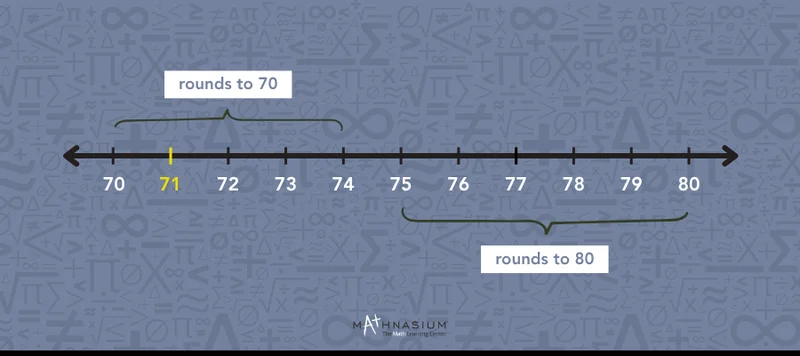
Let’s put this thinking to work with the number 71.
The ones digit is 1, which is less than 5. That tells us 71 is closer to 70 than to 80. So, it rounds down to 70.
B. Rounding Whole Numbers to Nearest Hundred
If we want to round a whole number to the nearest hundred, we focus on the value of the tens digit (second digit from the right). Then, we ask if the digit in the tens place is closer to the hundred before it or the hundred after.
-
If the number has a tens digit of 5 or more, then it's closer to the next hundred, and we round up.
-
If the tens digit is 4 or less, then it's closer to the hundred before it, and we round down.
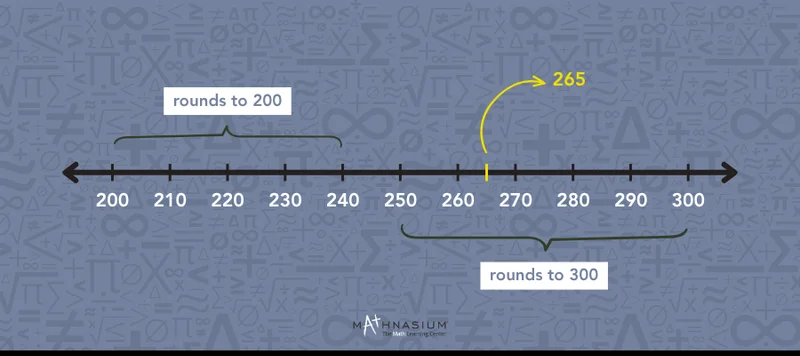
Let’s see how this works with 265.
What’s the tens digit we are working with here? It’s 6. Since 6 is more than 5, we can tell that 265 is closer to the next hundred (300) than to the previous one (200). So, it rounds up to 300.
C. Rounding Whole Numbers to Nearest Thousand
When we want to round a whole number to its nearest thousand, we focus on the value of the hundreds digit (the third digit from the right). We need to find out if the digit in the hundreds place is closer to the thousand before it or the thousand after. There are two scenarios in front of us:
-
If a number has a hundreds digit of 5 or more, it sits closer to the next thousand, so we round up.
-
If the hundreds digit is 4 or less, it sits closer to the thousand before it, so we round down.
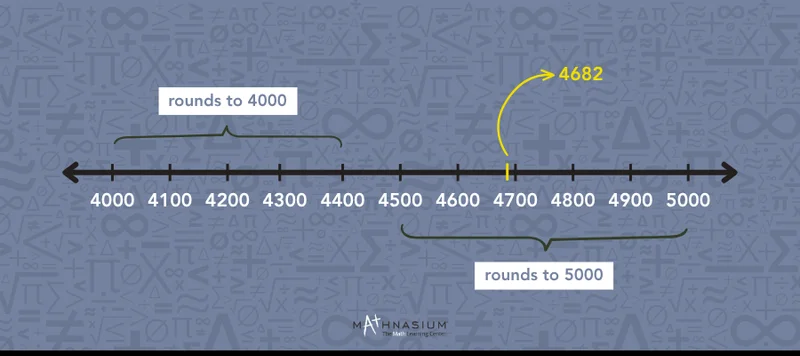
Let’s round 4,682 to the nearest thousand and see how this works.
The thousands digit here is 4, and the neighbor directly to the right in the hundreds place is 6. Since 6 is 5 or more, 4,682 is closer to the next thousand (5,000) than to the previous one (4,000). So, we round our number to the nearest thousand, which is 5,000.
How to Round Decimals
Just like whole numbers, we can round decimals, too. We can round them either to the nearest whole number or to a place after the decimal point, like the nearest tenth, hundredth, and beyond.
Let’s take a look at how rounding decimals works.
A. Rounding Decimals to the Nearest Whole Number
When we round a decimal to the nearest whole number, we are rounding to the ones place. We find out whether the number stays at the same whole number or goes up to the next one.
To do that, we look at the digit in the tenths place (the first digit after the decimal point). Then, we ask if the digit in the tenths place is closer to the whole number before it or the one after it. There are two outcomes that we can have:
-
If the tenths digit is 5 or more, we round up to the next whole number.
-
If the tenths digit is 4 or less, we round down and keep the whole number part the same.
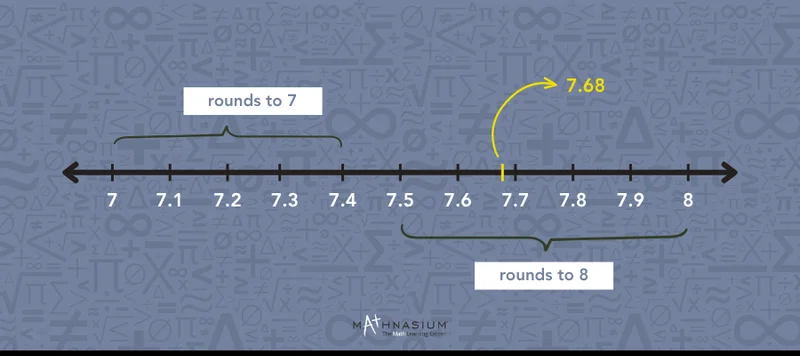
Let’s put the process to work with 7.68 and round it to the nearest whole number.
First, we need to find the tenths digit. That’s the 6 right after the decimal. Since 6 is greater than 5, we round the decimal up to 8.
B. Rounding Decimals to the Nearest Tenth
To round a decimal to the nearest tenth, we need to figure out what the tenths digit will become. That’s the first digit after the decimal point.
To figure that out, we first look at the digit in the hundredths place (the second digit after the decimal).
Then, we ask whether the digit in the hundredths place is closer to the tenth before it or the one after it.
-
If the hundredths digit is 5 or more, we round up.
-
If it’s 4 or less, we round down.
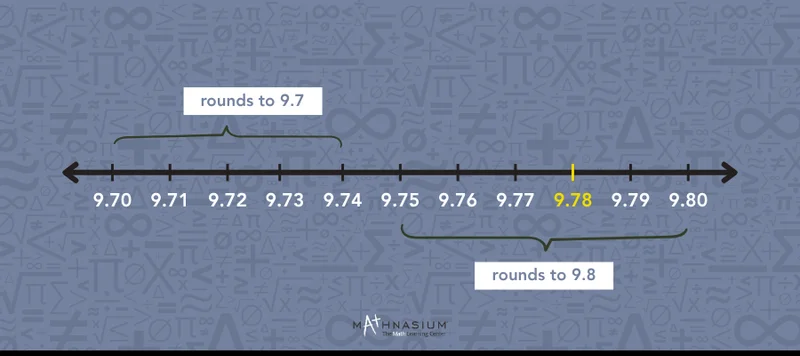
Let’s see what happens with 9.78.
First, we identify the digits. The tenths digit is 7. The hundredths digit is 8. Then, we focus on the 8. Since 8 is more than 5, we round 7 up to 8.
So 9.78 rounded to the nearest tenth is 9.8.
C. Rounding Decimals to the Nearest Hundredth
If we need to round a decimal number to its nearest hundredth, we need to figure out what the hundredths digit (second digit after the decimal point) will become.
How do we figure that out? We do that by looking at the digit in the thousandths place (the third digit after the decimal).
Then, we need to see if the digit in the thousandths place is closer to the hundredth before it or the one after it.
-
If the thousandths digit is 5 or more, we round it up.
-
If it’s 4 or less, we round it down.
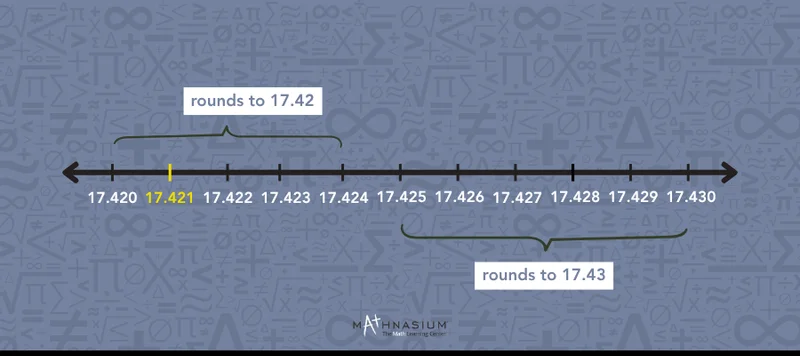
Let’s try that with 17.421.
The hundredths digit is 2. The thousandths digit is 1. Since 1 is less than 5, we round down. So, 17.421 rounded to the nearest hundredth is 17.42.
📕 You May Also Like: Rounding Decimals: Nearest Tenth, Hundredth, and Thousandth
Practice Time! Check Your Knowledge of Rounding Numbers
Now that we covered how to round both whole numbers and decimals, give these practice challenges a try and check the answers at the bottom of this guide.
-
Round 43 to the nearest ten.
-
Round 286 to the nearest hundred.
-
Round 7,349 to the nearest thousand.
-
Round 95 to the nearest ten.
-
Round 1,451 to the nearest hundred.
-
Round 8.3 to the nearest whole number.
-
Round 5.74 to the nearest tenth.
-
Round 9.268 to the nearest hundredth.
📕 You May Also Like: How Estimation and Rounding Support Number Sense in Math
FAQs About Rounding Numbers
Here are the questions about rounding we usually get from students at Mathnasium of Denver Highland.
1. How Far Can We Round a Decimal?
We can round a decimal to any place value, like the nearest whole number, tenth, hundredth, thousandth, and even beyond. The place we round to depends on what the problem asks for or how precise we want our answer to be.
For example, the decimal 4.58674 can be rounded to:
-
5 to the nearest whole number
-
4.6 to the nearest tenth
-
4.59 to the nearest hundredth
-
4.587 to the nearest thousandth
Beyond the thousandths place, we can also round decimals to the nearest ten-thousandth and even smaller place values.
2. What If the Digit We Are Rounding to Is 0?
As 0 has a place value, just like any other digit, we round the number the same way we normally would. Let’s illustrate that with a few examples:
-
3.09 rounded to the nearest tenth is 3.1. The digit in the tenths place is 0. If we look at the digit in the hundredths place (9), it is 5 or more, so we round the tenths digit up to 1.
-
8.02 rounded to the nearest tenth is 8.0. The digit in the tenths place is 0. Since the digit in the hundredths place (2) is 4 or less, the tenths digit stays 0.
-
12.006 rounded to the nearest hundredth is 12.01. The focus digit in the hundredths place is 0. If we look at the digit in the thousandths place (6), we see that it is 5 or more, so we round the hundredths digit up to 1.
📕 You May Also Like: Why Zero Is So Hard for Young Math Learners to Understand
3. Why Does 5 Mean Rounding Up If the Digit is Right in the Middle?
When a digit is 5, the number sits exactly halfway between two rounded options. For instance, 45 is the same distance from 40 as it is from 50.
To keep this simple, standard math uses the round-half-up rule that says when a number is precisely at the midpoint, we always round to the larger value. Here are a few more examples of how we can round a number when we are dealing with 5:
-
As 105 sits right between 100 and 110, we round up to 110.
-
12.5 is halfway between 12 and 13, so it rounds up to 13.
-
3.25 falls midway between 3.2 and 3.3, so we can round up to 3.3.

At Mathnasium, our tutors break down how rounding in math works into simple steps by using everyday language to help students see the logic behind the numbers.
How Mathnasium Helps Students Master Rounding Numbers (and Any Other Math Skill)
Mathnasium is a math-only learning center that helps K-12 students catch up, keep up, and get ahead in math.
Whether your student needs to rebuild foundational skills, master specific math topics like rounding numbers, or is looking for additional challenges, Mathnasium offers a personalized path forward.
To provide that support, we use the Mathnasium Method™, our proprietary teaching approach, to meet students where they are and guide them forward step by step.
Each student starts their Mathnasium journey with a diagnostic assessment that helps us identify their current skills, knowledge gaps, and learning goals. With those insights, we build a personalized learning plan tailored to their needs and pace.
Our specially trained tutors follow the plan closely and provide live, face-to-face instruction in a caring and fun group environment. We use mental, verbal, visual, tactile, and written techniques so math concepts can land. For example, these techniques help them see the logic behind numbers.
If students get stuck on any math concepts such as rounding whole numbers, decimals, or both, we break them down into manageable steps and teach both the how and the why behind the process.
As time goes on, students learn to do the same independently. They walk out of our centers with the problem-solving skills and critical thinking tools they can use in the math classroom and beyond.
Fun is an important part of how we work. Sessions often include game-based and hands-on activities that keep students engaged and make learning more enjoyable. Students earn rewards along the way, and we celebrate every bit of progress, so confidence grows alongside mastery.
The results speak for themselves:
-
94% of parents report an improvement in their child's math skills and understanding
-
93% of parents report their child's improved attitude toward math
-
90% of students saw an improvement in their school grades
With over 1,100 learning centers, Mathnasium brings top-rated math instruction close to your community.
For families in and around Denver, Mathnasium of Denver Highland is a trusted local center with years of experience helping students build the math skills and confidence they need to succeed at every grade level.
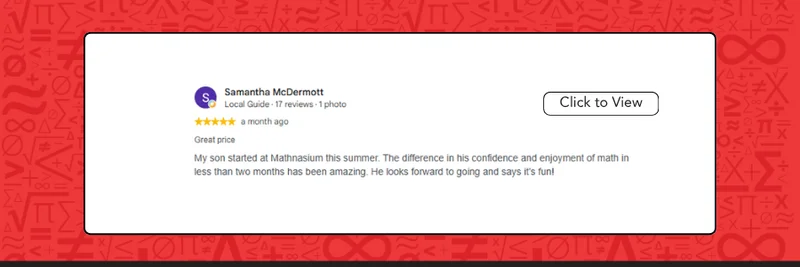
Here’s what one Denver parent shared about their experience with Mathnasium:
Ready to take the first step? Schedule a free assessment, and we’ll use that to create a personalized learning plan tailored to your child.
📅 Schedule a Free Assessment at Mathnasium of Denver Highland
Not located near Denver?
📍 Find a Mathnasium Learning Center Near You
Psst! Check Your Answers Here
If you’ve given our practice challenges a try, here are the answers:
-
40
-
300
-
7,000
-
100
-
1,500
-
8
-
5.7
-
9.27
How did you do?


 (720) 524-4763
 (720) 524-4763