In math, getting the right answer isn’t always enough. Sometimes, we also need to explain why it’s right.
Add two even numbers: 2 + 4 = 6, or 8 + 10 = 18. Both answers are even. But will that happen every time, no matter which two even numbers we choose? That’s where a mathematical proof comes in.
In this guide, we’ll use simple examples to explore how proofs work, then look at their role in geometry with no formal proof-writing experience needed.
What Is a Mathematical Proof?
In math, a proof is a logical explanation that uses facts we already know to show why a mathematical statement must be true. Every step in a proof needs support, and it may follow from:
-
A definition,
-
A condition in the problem,
-
A fact we already know, or
-
An earlier step in the reasoning.
Think of a detective explaining a conclusion. It’s not enough to point to a clue. The detective needs to connect the evidence to the conclusion. A mathematical proof also connects the dots, using definitions and known facts to show why a statement must be true.
Let’s consider a simple claim which says that the sum of two even whole numbers is always even. We can check an example:
4 + 6 = 10
The calculation supports the claim for those two numbers, but it does not prove the claim. There are infinitely many pairs of even whole numbers. A few examples show that the statement works for those particular numbers, while a proof explains why it works for every pair covered by the claim.
To build a proof, we start with the definition of an even whole number and consider any two numbers that fit that definition. We then use logical steps to show that their sum must also be even.
Next, we’ll follow two math proofs in plain language. Each proof explains why a claim holds for every case it describes, rather than for only the numbers in one calculation.

Simple Examples of Mathematical Proofs
To understand why a claim is true in every case it describes beyond a single calculation, we’ll follow two proofs in plain language. We do not need algebraic formulas or a formal proof format to follow the reasoning.
Example 1: Two Even Whole Numbers Add to an Even Number
Let’s start with the claim that says the sum of two even whole numbers is always even. We can arrange one even whole number into pairs with no item left over. For example, 6 makes three pairs:
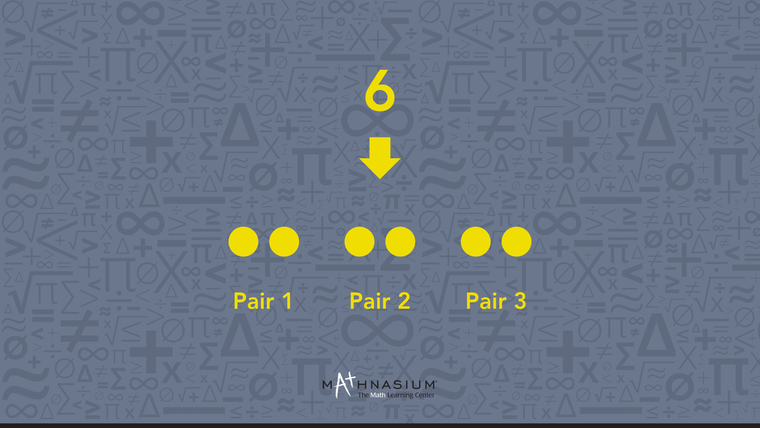
Now imagine two groups of objects, each containing an even number of objects. Each group can be arranged entirely into pairs. For instance, 6 objects make 3 pairs, and 8 objects make 4 pairs.
Adding the numbers means we combine the groups. In our example, the 3 pairs and 4 pairs become 7 complete pairs, with no object left over.
The same thing happens regardless of how many pairs we start with. When we combine two groups of complete pairs, we still leave complete pairs. The total is therefore even, which proves that the sum of any two even whole numbers is even.
📕 You May Also Like: Is Zero Even or Odd? The Surprising Answer
Example 2: Two Odd Whole Numbers Add to an Even Number
In this example, the claim says that the sum of two odd whole numbers is even. We can arrange odd whole numbers in pairs with one item left over. For example, 7 makes three pairs and one unpaired item:
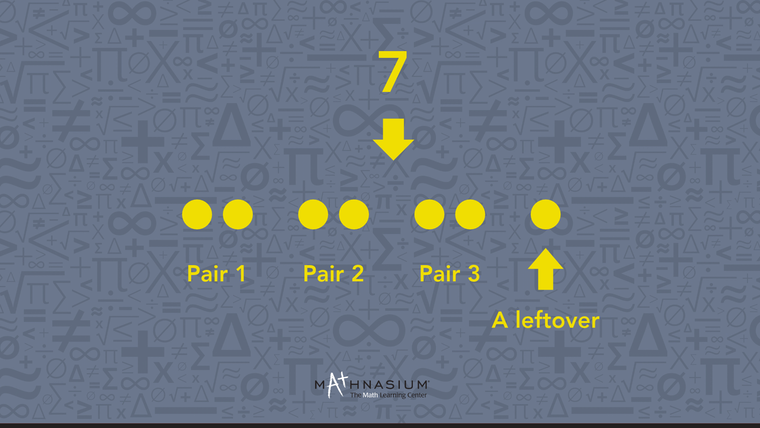
As with even numbers, we can start with any two odd whole numbers. Each group has complete pairs and one unpaired item. When we combine the groups, the two unpaired items join to make one more pair. Every item now belongs to a pair. The total has no item left over, so it is even.
Again, the argument applies to any two odd whole numbers. Each odd whole number leaves one item unpaired, and two unpaired items always make a pair.
Both proofs follow in the same pattern. They:
The first proof combines pairs that already exist. The second proof shows how two leftover items create an additional pair.
📕 You May Also Like: What Makes a Number Odd or Even? A Simple Guide
What Are Geometric Proofs?
Geometric proofs are logical explanations that establish facts about shapes, lines, and angles. While we changed the focus from numbers to figures, the process stays the same. We begin with facts we know and show why a conclusion follows, and here’s one simple example that shows it.
Example: A Triangle’s Angles Add to 180 Degrees
The interior angles of every triangle add up to 180 degrees. To understand why, let’s look at a visual in which a line goes through the triangle’s top vertex and is parallel to its opposite side.
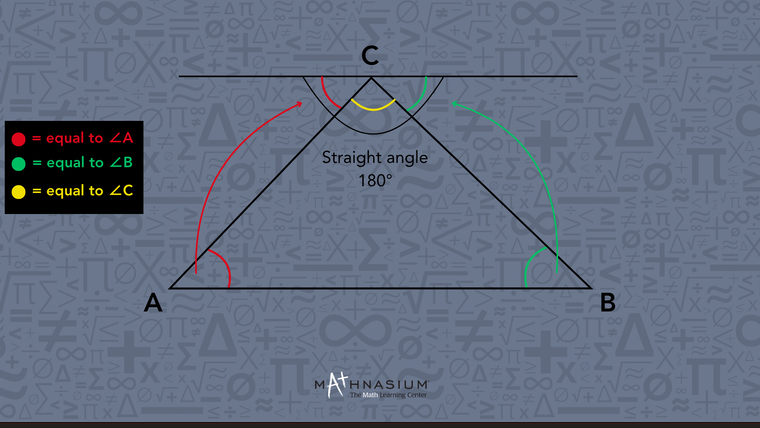
Since the line through C is parallel to AB, the red angle at C equals the triangle’s bottom-left angle, and the green angle at C equals its bottom-right angle. These are called alternate interior angles. Together with the triangle’s yellow angle at C, they form a straight angle.
A straight angle measures 180 degrees. Since the three angles on the line match the triangle’s three interior angles, the interior angles of the triangle also add up to 180 degrees.
The diagram helps us see which angles match, but measuring the drawing does not prove the result. A triangle can be drawn inaccurately, and its angle measurements may be slightly off.
The proof comes from the parallel-line angle relationships and the fact that a straight angle measures 180 degrees. Those facts apply to every triangle, rather than the one shown here.
How Students Learn Mathematical Proofs
Students do not usually learn mathematical proof all at once, as their ability to explain an answer develops over time. In the United States, Common Core reflects that general progression, though the exact timing can vary from one school to another.
1. Elementary School: Explaining Why
In elementary school, students often explain their thinking with objects, drawings, and basic mathematical facts. They might use counters, groups, or pictures to show why an answer makes sense.
The paired-dot examples from earlier show how a simple representation can explain why a mathematical relationship holds, instead of only showing an answer.
2. Middle School: Following General Arguments
By middle school, the work often moves toward broader mathematical claims and more general explanations. Students may be asked to:
Common Core grade 8 includes explaining a proof of the Pythagorean theorem, which shows that proof-related reasoning becomes more explicit before high school geometry.
📕 You May Also Like: How Playing with Patterns Boosts Your Child’s Math Skills
3. High School: More Systematic Proof-Writing
In high school, geometry often gives students more systematic experience with proof. That is where they are more likely to justify statements about lines, angles, and shapes in an organized way, like the triangle-angle example we used earlier. Still, schools do not all introduce that work on the same schedule, so it is better to think in terms of a general pattern than a fixed grade-by-grade rule.
Learning proofs is not a sudden jump into a completely different kind of mathematics. It grows out of something students already practice: explaining why an answer makes sense. As students move through school, those explanations become more precise and more carefully connected.
 At Mathnasium, we guide students through concepts like mathematical proofs in a supportive environment one step at a time.
How Mathnasium Helps Students Master Any Math Concept
Mathnasium is a math-only learning center that helps K-12 students catch up, keep up, and get ahead in math.
Mathematical proof asks students to explain why a statement is true, not just find an answer. At Mathnasium, we help students build that habit by connecting the steps they follow to the ideas behind them and guiding them to explain their own reasoning.
This focus on understanding is central to the Mathnasium Method™, our proprietary teaching approach. It helps students build a foundation they can draw on when they encounter formal proofs.
Each student starts their Mathnasium journey with a diagnostic assessment that helps us identify their current skills, knowledge gaps, and learning goals. With those insights, we build a personalized learning plan tailored to their needs and pace.
Our specially trained tutors follow the plan closely and provide live, face-to-face instruction in a caring and fun group environment. We use mental, verbal, visual, tactile, and written techniques so any math concept can land.
If students get stuck on these two concepts, we break them down into manageable steps and teach both the how and the why behind them.
As time goes on, students learn to do the same independently. They walk out of our centers with problem-solving skills and critical thinking tools they can use in the math classroom and beyond.
Fun is an important part of how we work. Sessions often include game-based and hands-on activities that keep students engaged and make learning more enjoyable. Students earn rewards along the way, and we celebrate every bit of progress, so confidence grows alongside mastery.
The results speak for themselves:
-
94% of parents report an improvement in their child's math skills and understanding
-
93% of parents report their child's improved attitude toward math after attending Mathnasium
-
90% of students saw an improvement in their school grades
With over 1,200 active learning centers, Mathnasium brings top-rated math instruction close to your community.
For families in and near Glen Cove, Mathnasium of Glen Cove is a trusted local center with years of experience helping students excel in math.
Whether your child needs to catch up, keep up, or get ahead, a free diagnostic assessment is a good place to begin. What we learn helps us create a personalized learning plan that builds the understanding your child needs to approach unfamiliar math concepts with confidence.
📅 Schedule a Free Assessment at Mathnasium of Glen Cove
Not near Glen Cove?
📍 Find a Mathnasium Learning Center Near You


 (516) 759-6284
 (516) 455-1665