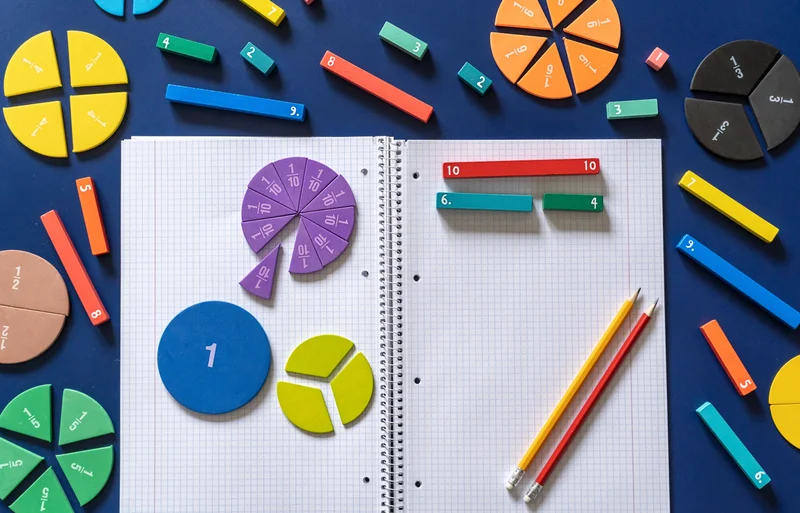
Flip-and-multiply is a great shortcut that helps us divide fractions quickly and easily. However, to use a shortcut well, it helps to understand why it works! Many students pick up the rule early and practice it on worksheet after worksheet without ever getting to see what's actually happening behind the scenes.
Today, our team is breaking down the math behind each step so you can move past just memorizing rules and build true fraction fluency.

What Does It Mean to Divide by a Fraction?
Dividing by a fraction means finding out how many times that fraction fits into a given amount. It asks the same question as whole-number division: “How many of these are inside of that?” The only difference is that the number we’re counting can be a fraction instead of a whole number.
Let's refresh our memory on how it works with whole numbers. If we have 6 cookies and want to know how many groups of 2 that makes, we divide:
6 ÷ 2 = 3.
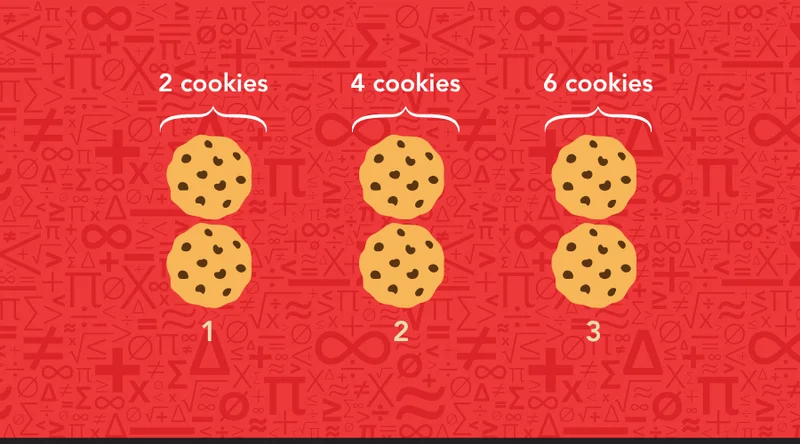
The exact same question works with fractions. Let's try it with a simple kitchen problem.
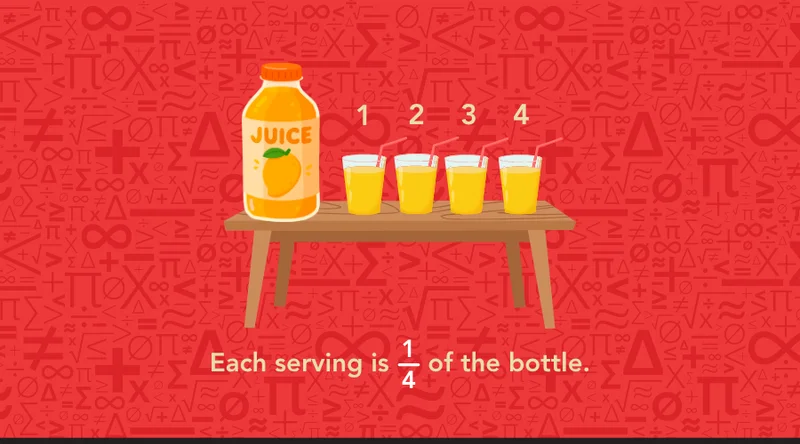
Say we have 1 bottle of juice, and each serving uses a quarter of the bottle, or \(\Large\frac{1}{4}\). How many servings can we make?
We can answer this simply by counting.
-
The first \(\Large\frac{1}{4}\) is one serving.
-
The second \(\Large\frac{1}{4}\) is another serving.
-
Keep going, and we use up the whole bottle after exactly 4 servings.
That means the answer is 4.
Now, let's write that same situation as a math expression.
1 ÷ \(\Large\frac{1}{4}\) = 4
So why did our answer come out bigger than the amount we started with?
When we divide a number by a fraction smaller than 1, our answer actually gets bigger. This happens because division is just asking, "How many of these pieces fit into our starting amount?"
Dividing by a fraction means we are measuring with tiny pieces. Because the pieces are so small, it takes more of them to fill up what we started with. That is why our final count grows.
This feels backward at first because we are used to whole numbers, where division makes things smaller. But once we picture the tiny pieces, a bigger answer makes perfect sense.

How to Divide Fractions: The Flip-and-Multiply Method
This method tells us exactly what it does by its name. When we divide fractions with it, we flip the second fraction, our divisor, and then multiply.
Let's check that against our juice bottle example. We already found that 1 ÷ \(\Large\frac{1}{4}\) = 4 by counting servings. Here, 1 is our dividend, and \(\Large\frac{1}{4}\) is our divisor. Now, let’s see what happens when we flip the divisor.
Flipping \(\Large\frac{1}{4}\) means swapping its numerator and denominator, which gives us \(\Large\frac{4}{1}\), or simply 4. This flipped fraction has a name. It's called the reciprocal.
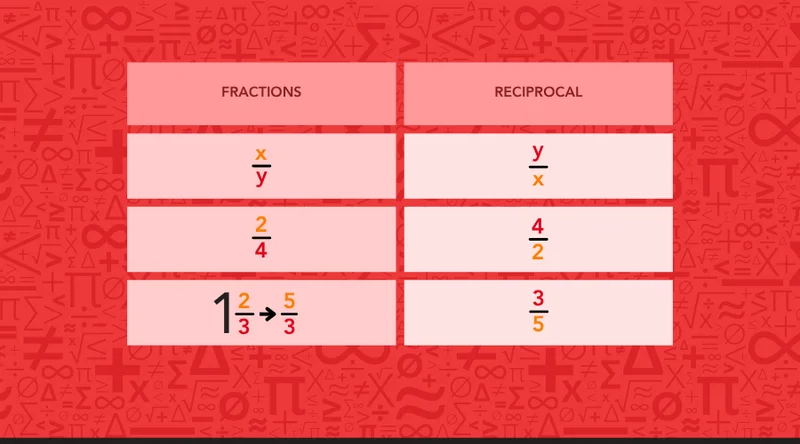
So instead of dividing by \(\Large\frac{1}{4}\), let's multiply by its reciprocal, 4:
1 × 4 = 4
We land on 4 again, the same answer as before.
Here's the process in four steps:
-
Write the dividend as a fraction. If it's already a fraction, keep it as is.
-
Flip the divisor to find its reciprocal, and change the division sign to a multiplication sign.
-
Multiply fractions straight across.
-
Simplify, if needed.
Let's put these steps to work with three examples, each a little different from the last.
📕 You May Also Like: Types of Fractions—A Comprehensive, Beginner-Friendly Guide
Example 1: Fraction ÷ Fraction
Here's our first problem \(\Large\frac{3}{4}\) ÷ \(\Large\frac{5}{6}\).
Step 1: Write the dividend as a fraction.
\(\Large\frac{3}{4}\) is already a fraction, so we keep it as is:
\(\Large\frac{3}{4}\) ÷ \(\Large\frac{5}{6}\)
Step 2: Flip the divisor, \(\Large\frac{5}{6}\), to get its reciprocal.
Swapping the numerator and denominator gives us \(\Large\frac{6}{5}\). We also change the division sign to a multiplication sign.
\(\Large\frac{3}{4}\) × \(\Large\frac{6}{5}\)
Step 3: Multiply straight across.
We multiply the numerators together and the denominators together:
-
Numerators: 3 × 6 = 18
-
Denominators: 4 × 5 = 20
\(\Large\frac{3}{4}\) × \(\Large\frac{6}{5}\) = \(\Large\frac{18}{20}\)
Step 4: Simplify.
Both 18 and 20 share a common factor of 2, so we divide both by 2:
And we get \(\Large\frac{9}{10}\).
Example 2: Whole Number ÷ Fraction
Now let's try 3 ÷ \(\Large\frac{2}{7}\).
Step 1: Write the dividend as a fraction.
A whole number always sits over 1, so we rewrite 3 as \(\Large\frac{3}{1}\).
\(\Large\frac{3}{1}\) ÷ \(\Large\frac{2}{7}\)
Step 2: We flip the divisor, \(\Large\frac{2}{7}\), to find its reciprocal.
When we swap its numerator and denominator, we get \(\Large\frac{7}{2}\). This also means our division sign becomes a multiplication sign:
\(\Large\frac{3}{1}\) × \(\Large\frac{7}{2}\)
Step 3: Multiply straight across.
We multiply the numerators together and the denominators together:
-
Numerators: 3 × 7 = 21
-
Denominators: 1 × 2 = 2
This gives us \(\Large\frac{21}{2}\).
Step 4: Simplify.
Since 21 and 2 share no common factor, \(\Large\frac{21}{2}\) is already in its simplest form as an improper fraction.
We can also write \(\Large\frac{21}{2}\) as a mixed number. We divide the numerator by the denominator: 21 ÷ 2 = 10, with a remainder of 1. That means our whole number is 10, and the leftover 1 goes back over the 2, giving us \(10\Large\frac{1}{2}\).
Example 3: Mixed Number ÷ Fraction
For our last example, let's tackle \(2\Large\frac{2}{5}\) ÷ \(\Large\frac{2}{3}\).
Step 1: Write the dividend as a fraction.
Since \(2\Large\frac{2}{5}\) is a mixed number, we convert it into an improper fraction first.
We multiply the whole number by the denominator, 2 × 5 = 10, then add the numerator, 10 + 2 = 12, and keep the same denominator to get: \(\Large\frac{12}{5}\)
Now we write our problem as:
\(\Large\frac{12}{5}\) ÷ \(\Large\frac{2}{3}\)
Step 2: We flip the divisor next to \(\Large\frac{3}{2}\) and switch the division sign to multiplication:
\(\Large\frac{12}{5}\) × \(\Large\frac{3}{2}\).
Step 3: Multiply straight across:
Numerators: 12 × 3 = 36
Denominators: 5 × 2 = 10
This gives us \(\Large\frac{36}{10}\).
Step 4: Simplify if we can.
Both 36 and 10 share a common factor of 2, so we divide both by 2 to get \(\Large\frac{18}{5}\).
Now, we can turn \(\Large\frac{18}{5}\) into a mixed number by dividing 18 by 5. That gives us 3, with 3 left over. Our whole number is 3, and the leftover 3 goes back over the 5, giving us \(3\Large\frac{3}{5}\).
📕 You May Also Like: A Simple Guide to Mixed Numbers and Improper Fractions
Common Mistakes When Flipping and Multiplying Fractions
Our Mathnasium tutors see the same few mix-ups whenever students learn to flip and multiply fractions.
Most of these mistakes come from rushing through the steps rather than misunderstanding the concept itself. A quick check at each step catches them before they turn into a wrong answer.
Here are the most common ones, what they look like in practice, and how to catch them.
|
Mistake
|
What It Looks Like
|
How to Catch It
|
|
The wrong fraction gets flipped.
|
\(\Large\frac{3}{4}\) ÷ \(\Large\frac{1}{2}\) becomes \(\Large\frac{4}{3}\) × \(\Large\frac{1}{2}\) instead of \(\Large\frac{3}{4}\) × \(\Large\frac{2}{1}\).
|
The fraction written first, right after the ÷ sign, always stays the same. Only the second fraction, the divisor, gets flipped.
|
|
Whole numbers and mixed numbers stay unconverted.
|
3 ÷ \(\Large\frac{1}{4}\) gets flipped and multiplied without first rewriting 3 as \(\Large\frac{3}{1}\)
|
Before we flip anything, we check that both numbers are already written as fractions.
|
|
The sign doesn't switch.
|
\(\Large\frac{3}{4}\) ÷ \(\Large\frac{2}{1}\) instead of \(\Large\frac{3}{4}\) × \(\Large\frac{2}{1}\) after the divisor is flipped.
|
The flip and the sign switch happen together, in the same step. A flipped divisor with no change from ÷ to × leaves the operation incorrect.
|
📕 You May Also Like: 7 Tips to Help Your Child Build Solid Fraction Understanding
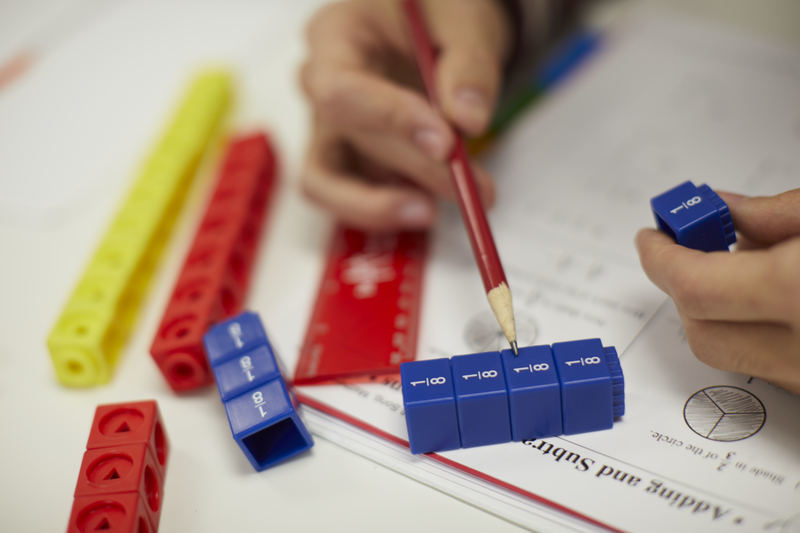
Mathnasium tutors use hands-on examples and clear reasoning to help students make sense of dividing fractions, one step at a time.
Practice: Divide These Fractions
Our tutors put together six problems using the flip-and-multiply method. Solve each one, simplifying your answer where needed.
-
\(\Large\frac{1}{2}\) ÷ \(\Large\frac{1}{4}\)
-
2 ÷ \(\Large\frac{1}{3}\)
-
\(1\Large\frac{3}{5}\) ÷ \(\Large\frac{4}{5}\)
-
\(\Large\frac{5}{6}\) ÷ \(\Large\frac{2}{3}\)
-
4 ÷ \(\Large\frac{2}{5}\)
-
\(2\Large\frac{1}{4}\) ÷ \(\Large\frac{1}{2}\)
Check the answers at the bottom of the guide.
How Mathnasium Helps Students Master Fractions (and Beyond)
Mathnasium is a math-only learning center serving K–12 students, focused on building confident, independent math thinkers through personalized instruction and targeted support.
Students come to us at different points in their fraction journey. Some are just getting comfortable with fraction basics, while others are ready to tackle operations like dividing fractions. Wherever a student is starting from, we build a path forward from that exact point.
We do this through the Mathnasium Method™, our proprietary teaching approach built around personalized learning and proven instructional techniques.
Here's what that looks like in practice:
-
Diagnostic Assessment and Personalized Learning Plans. Each student begins with a diagnostic assessment that identifies both visible skill gaps and the reasoning patterns behind them. From that starting point, we build a personalized learning plan tailored to their needs and goals, helping them build lasting math mastery at a pace that works for them.
-
Teaching for Understanding. Our specially trained tutors use plain, everyday language and a mix of verbal, visual, mental, tactile, and written techniques so concepts like dividing fractions land in a way that makes sense to each student.
-
Problem-Solving and Critical Thinking. Our tutors know when to offer support and when to let a student work through a problem on their own. That balance is what builds lasting independence.
-
An Engaging and Fun Learning Environment. Sessions are designed to keep students motivated and enjoying the process. We celebrate every bit of progress, and that consistent recognition builds confidence with each session. Over time, students develop a more positive relationship with math and greater confidence in their own abilities.
The results reflect that approach:
-
94% of parents report improvement in their child's math skills and understanding
-
93% of parents report an improved attitude toward math after attending Mathnasium
-
90% of students saw improvement in their school grades
We operate over 1,100 centers across North America, bringing our proven approach to communities everywhere.
Families across Highland Park and University Park, TX, can visit Mathnasium of Highland Park, a trusted local center with a proven record of building confident math thinkers.
Whether your student is looking to catch up, keep up, or get ahead in math, our local team is happy to help!
📅 Schedule a Free Assessment at Mathnasium of Highland Park
Not near Highland Park?
📍 Find a Mathnasium Learning Center Near You
Pssst! Check Your Answers Here
If you've given our practice problems a go, check your results here.
-
\(\Large\frac{1}{2}\) ÷ \(\Large\frac{1}{4}\) → \(\Large\frac{1}{2}\) × \(\Large\frac{4}{1}\) = \(\Large\frac{4}{2}\), which simplifies to 2
-
2 ÷ \(\Large\frac{1}{3}\) → \(\Large\frac{2}{1}\) × \(\Large\frac{3}{1}\) = \(\Large\frac{6}{1}\), which simplifies to 6
-
\(1\Large\frac{3}{5}\) ÷ \(\Large\frac{4}{5}\) → \(\Large\frac{8}{5}\) ÷ \(\Large\frac{4}{5}\) → \(\Large\frac{8}{5}\) × \(\Large\frac{5}{4}\) = \(\Large\frac{40}{20}\), which simplifies to 2
-
\(\Large\frac{5}{6}\) ÷ \(\Large\frac{2}{3}\) → \(\Large\frac{5}{6}\) × \(\Large\frac{3}{2}\) = \(\Large\frac{15}{12}\), which simplifies to \(1\Large\frac{1}{4}\)
-
4 ÷ \(\Large\frac{2}{5}\) → \(\Large\frac{4}{1}\) × \(\Large\frac{5}{2}\) = \(\Large\frac{20}{2}\), which simplifies to 10
-
\(2\Large\frac{1}{4}\) ÷ \(\Large\frac{1}{2}\) → \(\Large\frac{9}{4}\) ÷ \(\Large\frac{1}{2}\) → \(\Large\frac{9}{4}\) × \(\Large\frac{2}{1}\) = \(\Large\frac{18}{4}\), which simplifies to \(4\Large\frac{2}{4}\) (or \(4\Large\frac{1}{2}\))
How did you do?


 (972) 393-6284