Students usually encounter mixed numbers and improper fractions around 4th grade, and by 5th grade, switching between the two forms becomes an important part of fraction operations.
Based on our experience, many students understand the basic idea at first, but struggle to convert between the two forms consistently once fraction work becomes more advanced.
Our tutors at Mathnasium put together this simple guide to help students grasp both forms visually and procedurally, and see how they connect.

What Is a Mixed Number?
A mixed number combines a whole number and a fraction into a single value. The whole number and the fraction sit side by side, representing one quantity together. In \(3\Large\frac{1}{2}\), for example, 3 is the whole part, and \(\Large\frac{1}{2}\) is the fraction part.
Mixed numbers appear in everyday situations that students may already recognize:
-
A walk that covers \(2\Large\frac{1}{2}\) miles
-
A pencil that is \(6\Large\frac{1}{2}\) inches long
-
A movie that runs for \(1\Large\frac{3}{4}\) hour
The whole number tells how many complete groups there are, and the fraction tells what is left over.
📕 You May Also Like: What Is a Mixed Number? A Complete & Kid-Friendly Guide
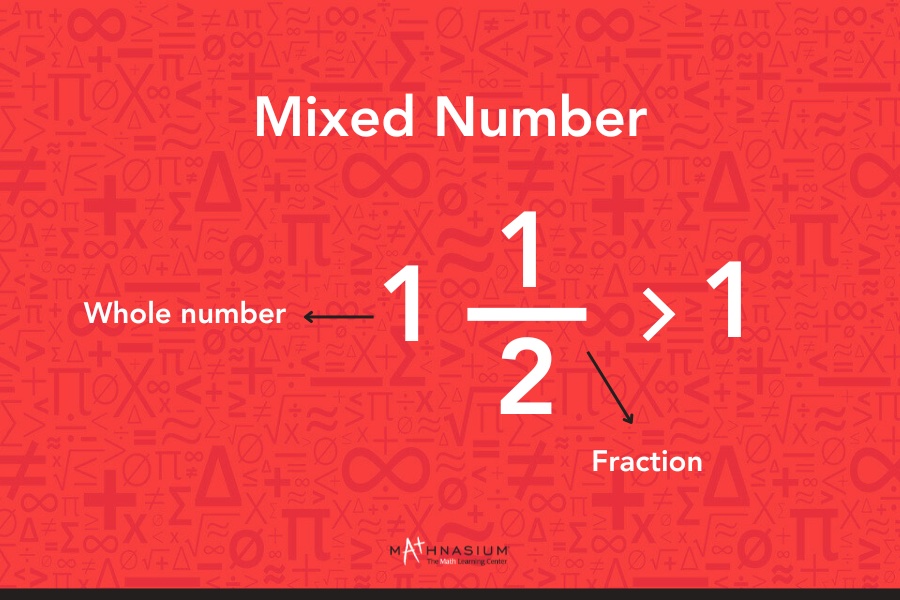
A mixed number combines a whole number with a fraction, showing a value greater than one in a form that is often easier to picture and interpret.
What Is an Improper Fraction?
An improper fraction represents a value greater than one whole using only a numerator and denominator.
The numerator, the top number, is greater than or equal to the denominator, the bottom number.
In \(\Large\frac{7}{2}\), for example, 7 is larger than 2, which signals that this fraction is worth more than one whole.
Similarly, if the numerator and denominator are the same, like \(\Large\frac{4}{4}\), the fraction is equal to exactly 1 whole.
Students usually encounter improper fractions in several specific situations:
Improper fractions are usually easier to work with during calculations, particularly in multiplication and division.
📕 You May Also Like: How to Divide Whole Numbers by Fractions - A Simple Guide
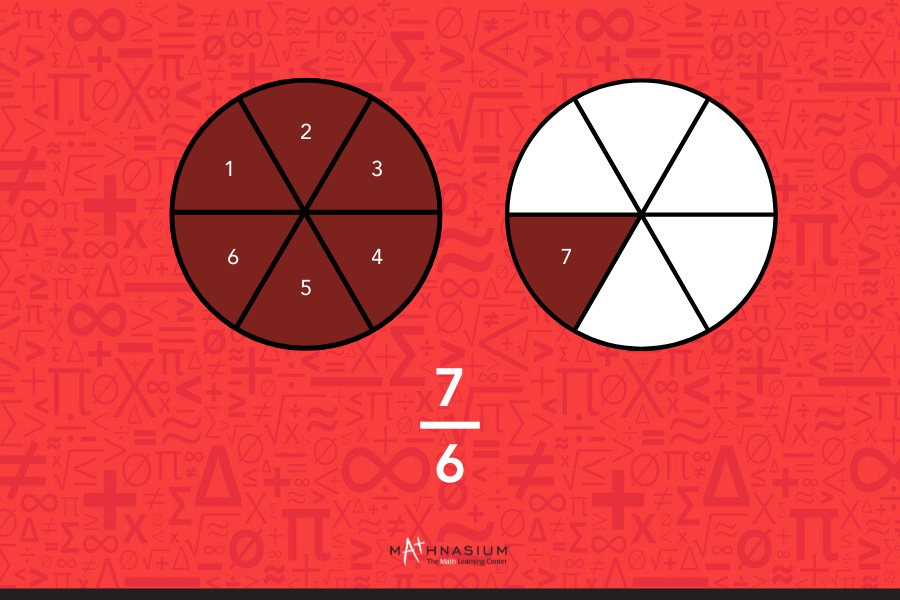
Seven slices with six in each whole means one full circle and one extra slice in the next circle. That is what \(\Large\frac{7}{6}\) represents visually.
Two Methods for Converting Between Forms: Visual and Procedural
Two methods work together to make fraction conversion land, one visual and one procedural:
-
Visual method: uses pictures or real-world examples to show why the conversion works before students begin following the specific steps
-
Procedural method: gives students a clear sequence of steps they can follow once the visual idea makes sense
Students who understand the reasoning behind the steps are far less likely to mix them up when converting under the pressure of a test or timed assignment.
The combination of visual understanding and procedural fluency also makes later fraction operations, especially addition, subtraction, multiplication, and division with mixed numbers, much easier to manage.
📕 You May Also Like: How to Compare Fractions? A Kid-Friendly Guide
How to Convert an Improper Fraction to a Mixed Number
An improper fraction converts to a mixed number by finding how many whole groups fit inside it and what remains.
We can use a visual and a step-by-step procedural method to convert \(\Large\frac{11}{4}\) into a mixed number.
1. Visual method
Imagine a pizza party where every pizza is cut into 4 equal slices. After a party, 11 slices remain, which gives us \(\Large\frac{11}{4}\).
To find the mixed number, we group the slices back into whole pizzas:
That gives 2 whole pizzas and 3 slices remaining, which is \(2\Large\frac{3}{4}\).
The denominator stays 4 because the size of each slice never changed.
2. Procedural method
The procedural method solves the same conversion using division. We divide to find how many whole groups fit inside the fraction and how many pieces remain.
-
Divide the numerator by the denominator: 11 ÷ 4 = 2 remainder 3
-
The quotient becomes the whole number: 2
-
The remainder becomes the new numerator: 3
-
The denominator stays the same: 4
-
Result: \(2\Large\frac{3}{4}\)
Both \(2\Large\frac{3}{4}\) and \(\Large\frac{11}{4}\) represent the same value written in two different forms. The next section shows how we can reverse this process.
📕 You May Also Like: How to Reduce Fractions - A Kid-Friendly Guide
How to Convert a Mixed Number to an Improper Fraction
A mixed number converts to an improper fraction by expressing every part (whole and fraction) as a single count of equal pieces.
We will use both a visual and a procedural method to convert \(2\Large\frac{3}{4}\) back into an improper fraction.
1. Visual method
The same pizza example works in reverse. We start with \(2\Large\frac{3}{4}\) pizzas, and every pizza is still cut into 4 equal slices.
-
The first whole pizza gives 4 slices
-
The second whole pizza gives 4 slices
-
The remaining piece gives 3 slices
-
Total: 4 + 4 + 3 = 11 slices
All slices are fourths, so the result is \(\Large\frac{11}{4}\).
2. Procedural method
The procedural method reaches the same result using multiplication and addition.
-
Multiply the whole number by the denominator: 2 × 4 = 8
-
Add the numerator: 8 + 3 = 11
-
Place the result over the original denominator: \(\Large\frac{11}{4}\)
-
Final result: \(\Large\frac{11}{4}\)
\(\Large\frac{11}{4}\) converts back to \(2\Large\frac{3}{4}\), which is exactly where we started in the previous section.
📕 You May Also Like: How to Convert Mixed Numbers to Improper Fractions (& Vice Versa)
Where This Conversion Skill Shows Up in 4th and 5th Grade Math
Fraction conversion is a tool that 4th and 5th-graders use across several areas of the curriculum. Here are the three most immediate places where it matters:
-
Adding and subtracting mixed numbers: converting to improper fractions first makes the calculation cleaner and avoids errors with borrowing
-
Multiplying fractions in 5th grade: improper fractions are easier to work with than mixed numbers when multiplying
-
Word problems: answers often need to be expressed as mixed numbers because they are easier to interpret in context, for example, \(2\Large\frac{3}{4}\) hours rather than \(\Large\frac{11}{4}\) hours
The visual and procedural methods in this guide give your child the foundation needed for later fraction operations, measurement problems, and introductory algebra work.
Once students can move confidently between mixed numbers and improper fractions, they are much better prepared for the more complex fraction skills that appear throughout upper elementary and middle school math.
📕 You May Also Like: Multiplying and Dividing Fractions: The Why Behind the How
Your Turn: Practice Converting Between Forms
The following problems give students a chance to practice switching between mixed numbers and improper fractions independently.
Convert each improper fraction into a mixed number:
-
\(\Large\frac{9}{4}\)
-
\(\Large\frac{13}{5}\)
-
\(\Large\frac{17}{6}\)
Convert each mixed number into an improper fraction:
-
\(3\Large\frac{1}{2}\)
-
\(4\Large\frac{3}{4}\)
When you’re done converting, check your answers at the bottom of our guide.

At Mathnasium, our tutors work through fraction problems step by step so students can see how the whole number, numerator, and denominator work together, rather than treating conversion like a memorized rule.
How Mathnasium Helps Students Master Fractions
Mathnasium is a math-only learning center dedicated to helping K-12 students build strong math skills and confidence.
Many students who come to us need extra support with fractions, especially when they begin switching between mixed numbers and improper fractions during more advanced fraction work.
Our tutors focus on helping students understand what the numbers represent and why each conversion step works rather than memorizing rules mechanically.
We build that understanding through the Mathnasium Method™, our proprietary teaching approach that teaches math in a way that makes sense to each student.
Our tutors use visual, verbal, written, tactile, and mental teaching techniques, so students can build fraction fluency through multiple forms of learning and practice.
When needed, we can align your child’s instruction with state learning standards like the New York State Education Department Next Generation Mathematics Learning Standards so the skills they practice at Mathnasium connect directly to what their teacher expects in class.
The results speak for themselves:
-
94% of parents report improvement in their child's math skills and understanding
-
93% of parents report an improved attitude toward math after attending Mathnasium
-
90% of students saw improvement in their school grades
With over 1,100 learning centers across North America, there is likely a Mathnasium close to you.
Families across Massapequa Park, Massapequa, Seaford, and Bar Harbor trust Mathnasium of Massapequa Park to help their children build real fraction fluency and confidence at every grade level.
If your child is working through mixed numbers and improper fractions and needs more targeted support, our team is ready to help.
📅 Schedule a Free Assessment at Mathnasium of Massapequa Park
Not near Massapequa Park?
📍 Find a Mathnasium Learning Center Near You
Pssst! Check Your Answers Here
If you gave our conversion challenges a try, check your answers below:
-
\(\Large\frac{9}{4}\) = \(2\Large\frac{1}{4}\)
-
\(\Large\frac{13}{5}\) = \(2\Large\frac{3}{5}\)
-
\(\Large\frac{17}{6}\) = \(2\Large\frac{5}{6}\)
-
\(3\Large\frac{1}{2}\) = \(\Large\frac{7}{2}\)
-
\(4\Large\frac{3}{4}\) = \(\Large\frac{19}{4}\)


 (516) 550-9031
 (516) 203-7501