Roman numerals were invented more than two thousand years ago, long before smartphones, electricity, or even the number zero. Yet we still see them in many places, from Super Bowl titles and movie sequels to clock faces and building cornerstones.
Why has such an old number system lasted this long? Roman numerals are no longer used for everyday math, but they have not disappeared entirely.
Today, we’ll learn how to read Roman numerals wherever they appear and understand why this two-thousand-year-old system is still around today.

A Quick Review: How Roman Numerals Work
Before we go looking for Roman numerals in the wild, let’s make sure we can read them. The whole system is built from seven symbols:
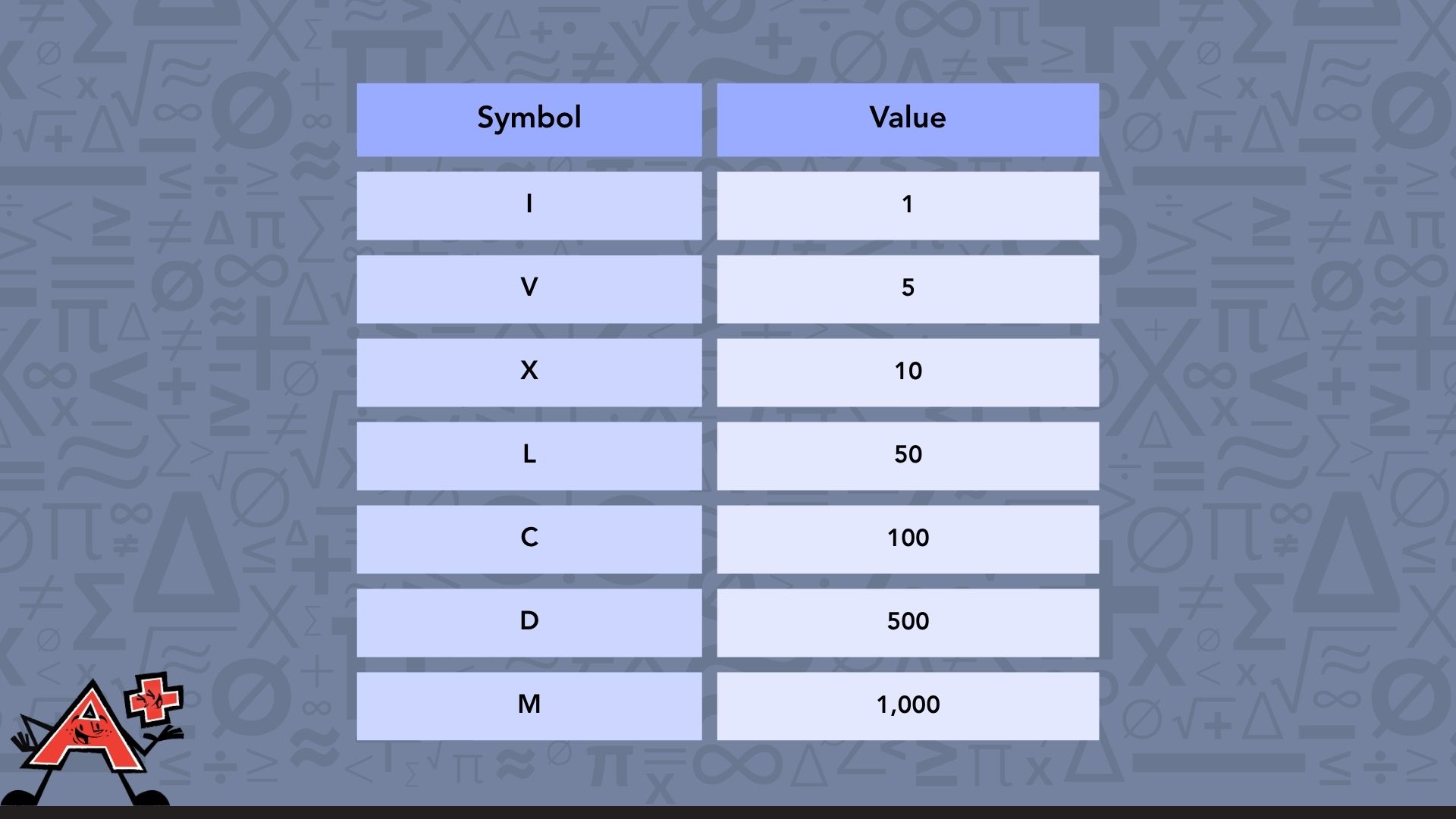
Every Roman numeral is made from some combination of these seven symbols.
Most of the time, to understand a Roman numeral, we need to read left to right and just add if the symbols are equal or go from bigger to smaller.
-
III is 1 + 1 + 1 = 3.
-
XII is 10 + 1 + 1 = 12.
-
LX is 50 + 10 = 60.
But in some cases, when a smaller symbol comes right before a larger one, we subtract the smaller one from the bigger number. IV isn’t 1 + 5 = 6, it’s 5 − 1 = 4.
-
IX is 10 − 1 = 9.
-
XL is 50 − 10 = 40.
-
CM is 1000 − 100 = 900.
Without this shortcut, we’d have to write IIII for 4 and VIIII for 9, and things would quickly get messy. The subtraction hack keeps Roman numerals compact and readable.
As long as we understand these two ideas, add when going from big to small, subtract when a smaller symbol sits right before a bigger one, we can read almost any Roman numeral we’ll see in real life. Let’s go find some.
📕 You May Also Like: The History of Roman Numerals & Why They Still Matter
Roman Numerals in Big Sports Events
Sports events love Roman numerals. When a championship has been happening for many years, each event needs to feel like part of a bigger story rather than just one game or one season.
They help create the feeling that the event is official, important, and part of a long tradition. Here are two of the biggest examples.
1. The Super Bowl: America's Most-Watched Roman Numeral
The Super Bowl is probably the most-watched Roman numeral in America every year. Millions of people see it on screen, on merchandise, and on every sports broadcast. Super Bowl LX, played in February 2026, is the most recent example: LX is 60: L (50) + X (10).
The NFL officially introduced Roman numerals on the field in 1971, starting with Super Bowl V.
But why did the NFL need to change the numbering in the first place? Roman numerals make the event feel more special, but there is a simpler reason, too.
As we know, the football season starts in one year, but the Super Bowl is played in January or February of the next year. That creates a naming problem. Do we call it by the season year or the game year?
Super Bowl LIX, for example, was the championship of the 2024 NFL season, but it was played in February 2025. Neither '2024' nor '2025' feels quite right on its own.
Roman numerals solve the problem neatly. They label the game itself rather than the calendar year. Let’s try decoding a few past Super Bowls:
-
Super Bowl XLVIII, what year does that translate to? X = 10, L = 50, as X comes before L, we subtract: L (50) – X (10) = 40. VIII: V (5) + III (3) = 8, so that’s Super Bowl 48.
-
Super Bowl LVI. L (50), VI is V (5) + I (1) = 6. Super Bowl 56.
-
Super Bowl XXXIX. XXX is X (10) + X (10) + X (10) = 30, IX is X (10) – I (1) = 9. Super Bowl 39.
There is one famous exception. The NFL used regular numbers for Super Bowl 50 instead of writing it as Super Bowl L. Why? A single letter did not look solid enough for the game’s logos, merchandise, and branding. The next year, the NFL went back to Roman numerals with Super Bowl LI.
2. Olympics: How Roman Numerals Connect More Than 100 Years of History
The Super Bowl isn't the only major sporting event that uses Roman numerals. The Olympic Games do too. Every Olympics has an official number, and it's always written in Roman numerals. The Olympic Games in Paris were officially called the Games of the XXXIII Olympiad. Let's decode it:
-
XXX is X (10) + X (10) + X (10) = 30
-
III is I (1) + I (1) + I (1) = 3
-
XXXIII = 30 + 3 = 33
The XXXIII Olympiad in France was the 33rd Summer Olympics. The tradition goes back to the very first modern Olympics in Athens in 1896, the I Olympiad. The count keeps each Summer Games connected from the first to the most recent, in one unbroken sequence.
The Roman numerals feel especially fitting for the Olympics because they make the Games feel historic, official, and part of a tradition that stretches back more than a century.
Movie Sequels: Hollywood’s Love of Roman Numerals
We can spot Roman numerals in movie sequel titles. You may have seen them in Rocky II, The Godfather Part II, or Star Wars Episode IV.
Hollywood has used Roman numerals for decades because they make a sequel feel a little more important, classic, or connected to a bigger story.
Think about the difference between Star Wars Episode 7 and Star Wars Episode VII. The regular number is easier to read, but the Roman numeral makes the title feel more dramatic, like the movie is part of a long-running series with history behind it.
Newer movie series tend to use regular numbers or subtitles instead. Roman numerals can take a little longer to read on a poster, and they can make a movie feel more formal than the filmmakers want. So instead of something like Despicable Me IV, a studio will choose Despicable Me 4 or give the sequel its own subtitle.
Now, we’ll decode a few movie titles:
-
Rocky III uses III, which means 3. That tells us it is the third movie in the series.
-
Star Wars: Episode IX — The Rise of Skywalker. I comes before X, so we do X − I = 10 − 1 = 9. Episode IX is Episode 9.
-
Star Wars Episode IV. I comes before V, so we go V (5) – I (1) = 4. Episode IV is Episode 4. This one is especially interesting because this Star Wars movie came out first and initially had no episode number at all. It was simply called Star Wars. The “Episode IV” part was added later when the director decided the story was part of a much bigger saga.
The broader point is this: when filmmakers choose Roman numerals for a title, they’re borrowing the sense of history and significance that comes with them. The same number feels different when written as IV versus 4.
📕 You May Also Like: 8 Simple Ways to Make Math Fun at Home
Clock Faces: A Classic Place to Spot Roman Numerals
Today, we use digital clocks, phones, or smartwatches to tell the time, which typically use regular numbers. But on older clock faces, especially in museums, castles, old buildings, or on fancy decorative clocks, the numbers are sometimes written in Roman numerals.
If you come across such a traditional clock face with a Roman numeral design, there’s a good chance one of the numbers will look slightly wrong.

One famous example of such a clock with Roman numerals is the clock above the entrance to Grand Central Terminal in New York City. And one number looks quite surprising. 4 is written as IIII instead of IV, as in standard Roman numerals.
Is it a mistake? Not exactly. One common explanation, accepted by most historians, is that clockmakers used IIII because it looked more balanced on the clock face, especially across from VIII.
But one legend suggests another interesting reason. In Latin, Jupiter, the king of the Roman gods, was written as IVPITER. Since IV looked like the beginning of his name, some people believe that clockmakers avoided IV and used IIII instead.
Whether the Jupiter story is true or not, the IIII tradition has lasted for centuries. It is a good example of how Roman numerals were not used only for math. They were also shaped by history, design, and the beliefs of the people using them.
📕 You May Also Like: How Different Languages Count: A Simple & Fun Guide
Where Else Can We Spot Roman Numerals
Here’s a quick tour of some less obvious but interesting places where Roman numerals still appear:
A. Roman Numerals on Historic Buildings
Many older buildings have their construction year carved above the entrance or on a cornerstone. One of the most famous examples is the Washington Square Arch in New York City. It has MDCCLXXXIX carved on it. Let's decode it step by step:
-
M = 1 000
-
D = 500
-
CC is C (100) + C (100) = 200
-
LXXX is L (50) + X (10) + X (10) + X (10) = 80
-
IX: I (1) comes before X (10), so we subtract. X (10) − I (1) = 9
-
MDCCLXXXIX = 1,000 + 500 + 200 + 80 + 9 = 1 789
The Roman numerals carved into the Arch mark 1789, the year George Washington was inaugurated as the first President of the United States. Decoding Roman numerals on buildings is one of the most interesting math challenges because they almost always use both addition and subtraction together.
B. Roman Numerals in the Titles of Monarchs and Popes
Roman numerals also appear in the names of kings, queens, and popes. You may have seen names like Queen Elizabeth II, Pope John Paul II, or King Charles III. The Roman numeral helps us tell rulers with the same name apart. It shows whether that person was the first, second, third, or another later ruler with that name.
Queen Elizabeth II was the second British monarch named Elizabeth. King Charles III is the third British king named Charles. Pope John Paul II was the second pope to take that name.
Without Roman numerals, history would get confusing very quickly. For example, England had eight kings named Henry. Try keeping track of those without a number.
C. Roman Numerals in WrestleMania
WrestleMania (WWE) is another big sports event that regularly used Roman numerals in its logos most notably between 1998 and 2014. After 2014, the WWE almost completely dropped Roman numerals from the logos. But they made a big return for WrestleMania XL, held in Philadelphia in 2024.
The X comes before the L, so we subtract 10 from 50: 50 − 10 = 40. It is the same subtraction pattern we see in numerals like IV for 4 and IX for 9.
As a Roman numeral, XL means 40, but we can also recognize XL from clothing tags, where it means extra-large. So WrestleMania XL works in two ways at once. It marks the fortieth event, and it also looks like a title saying the show is extra large.
D. The iPhone X: A Roman Numeral in Your Pocket
Another Roman numeral we have seen and even held in our hands is X, from the iPhone X. When Apple released the iPhone X in 2017, the X stood for 10, marking the iPhone’s tenth anniversary. Many people read it as “iPhone Ex.” like the letter X, but Apple officially called it the iPhone Ten.
Apple went from the iPhone 8 straight to the iPhone X, skipping 9. So the Roman numeral was not only a version number. It also made the phone feel like a bigger milestone. The number 10 already feels important, but X looked cleaner and sharper on a product name.
Apple continued the idea with the iPhone XS and iPhone XR, where X still meant 10. Then the company returned to regular numbers with the iPhone 11.
The Roman numeral moment did not last long, but it shows once again that people use Roman numerals when they want to mark something as significant or memorable.
Why We Don’t Use Roman Numerals for Everyday Math
If Roman numerals have been around for so long, why don’t we use them for everyday math? The honest answer is that they are just hard to calculate with.
Roman numerals do not have a symbol for zero. They also do not use place value the way our number system does. In our system, the 2 in 20 is different from the 2 in 200 because of where it sits. Roman numerals do not work that way.
They can also make simple math feel much harder than it needs to be. Try adding XLVII and LXXXIX. That is the same as 47 + 89, but the Roman numeral version is much harder to line up and solve on paper.
That is why the Hindu-Arabic numeral system eventually became the main system for math in Europe. It gave people zero, place value, and a much easier way to add, subtract, multiply, and divide. So Roman numerals are not great for everyday calculation. But that is also why they survived in a different role.
Once people stopped depending on Roman numerals for math, they became useful as symbols. Today, they are symbols of history, tradition, and ceremony. That is why we still see them on old clocks, movie titles, royal names, and major sports events.

Mathnasium tutors make math come alive through games, visuals, and comparisons that ground math concepts.
How Mathnasium Makes Learning Numbers Fun
As a math-only learning center, Mathnasium helps K–12 students of all skill levels excel in math.
We’ve worked with thousands of students, and we know how to make math learning both enjoyable and productive.
Behind every program we offer is our proprietary teaching approach, the Mathnasium Method™. We don't just rely on rote drills but rather aim to help students truly understand what they're learning.
Each student begins with a diagnostic assessment that helps us understand what they know, how they think, and where they are ready to grow next. From there, we create a personalized learning plan tailored to their needs.
Our specially trained tutors explain math in clear, everyday language, using visual, verbal, tactile, and written techniques to help students make sense of math in a clear and engaging way. Students don’t just practice procedures; they learn to look for patterns and connect math to the world around them.
We give students space to work through challenges on their own, then rejoin them to check their reasoning. Instead of just giving them the answer, we help them understand the how and why. This helps them develop problem-solving skills and critical thinking tools they can use in math and life.
Many of our activities are hands-on or game-based. We use reward systems and consistent encouragement to keep students interested in the subject. And we celebrate progress because confidence grows with every win.
The result? True, measurable progress:
-
94% of parents report an improvement in their child’s math skills and understanding
-
93% of parents report their child’s improved attitude toward math after attending Mathnasium
-
90% of students saw an improvement in their school grades
Mathnasium operates over 1,100 learning centers across the U.S., bringing our proven approach close to your community.
For families in or near the Massapequa Park area, NY, Mathnasium of Massapequa Park is a trusted local center with years of experience transforming how students think and feel about math.
If your child is ready to build mathematical confidence, a free diagnostic assessment is the right place to start.
📅 Schedule a Free Assessment at Mathnasium of Massapequa Park
Not near Massapequa Park?
📍 Find a Mathnasium Learning Center Near You


 (516) 550-9031
 (516) 203-7501