Early childhood is a natural window for building math thinking. From our work with young learners at Mathnasium, we see that the foundation often comes from a few simple skills like counting, comparing groups, noticing patterns, and recognizing basic shapes.
These skills do not require workbooks, flashcards, or formal lessons at the kitchen table. You can build them through small, repeated moments with your child.
As a Long Island-based math learning center, our education specialists put together this guide to help you understand what New York kindergarten teachers look for and share simple ways to support early math thinking before the school year begins.
What Kindergarten Math Readiness Looks Like
According to New York's Prekindergarten Learning Standards, pre-K math readiness is about understanding numbers, quantities, patterns, and shapes in simple, hands-on ways. Your child does not need to solve written addition or subtraction problems.
A. Counting and Understanding Quantity
Your learner should be able to count a small group of objects by touching or pointing to each one while saying one number per item.
That one-to-one match is what turns counting from memorized recitation into early number sense. When your child says “one” for the first cracker, “two” for the second, and “three” for the third, they are learning that the final number tells how many objects are in the group.
📕 You May Also Like: What Is Number Sense & Why It Matters in Early Math Education
B. Comparing Groups and Amounts
As soon as your preschooler can count a group of objects, the next step is comparing two of them. They may look at two groups and tell which has more, which has fewer, or whether both groups have the same amount.
They do not need a formal explanation yet. At this stage, they are expected to notice quantity, size, and attributes, and describe them using everyday measurement language, such as bigger, smaller, longer, shorter, heavier, and lighter.
C. Noticing Patterns and Sorting Objects
Pattern recognition helps children see order and structure in math. In pre-K, this can mean noticing, copying, or extending simple repeating patterns. Your learner may notice a red-blue-red-blue bead pattern, clap a simple rhythm, or continue a repeating block pattern.
They also need to group objects by attributes such as shape, color, or size. This skill helps them notice what is alike, what is different, and how objects can belong together in a group.
D. Recognizing Shapes and Spatial Relationships
Your child should begin recognizing basic shapes such as circles, squares, rectangles, and triangles in different sizes and positions.
Make sure that they can spot shapes in the world around them, even when they look different from the neat examples on a worksheet. A triangle is still a triangle even when it is tall and skinny. A square is still a square, whether it is very small or large.
Plus, your learner should be able to use spatial words like above, below, inside, outside, next to, behind, and under. These words help them describe where objects are in relation to one another, which supports later geometry and problem-solving.
📕 You May Also Like: 7 Fun Preschool Math Activities to Try at Home
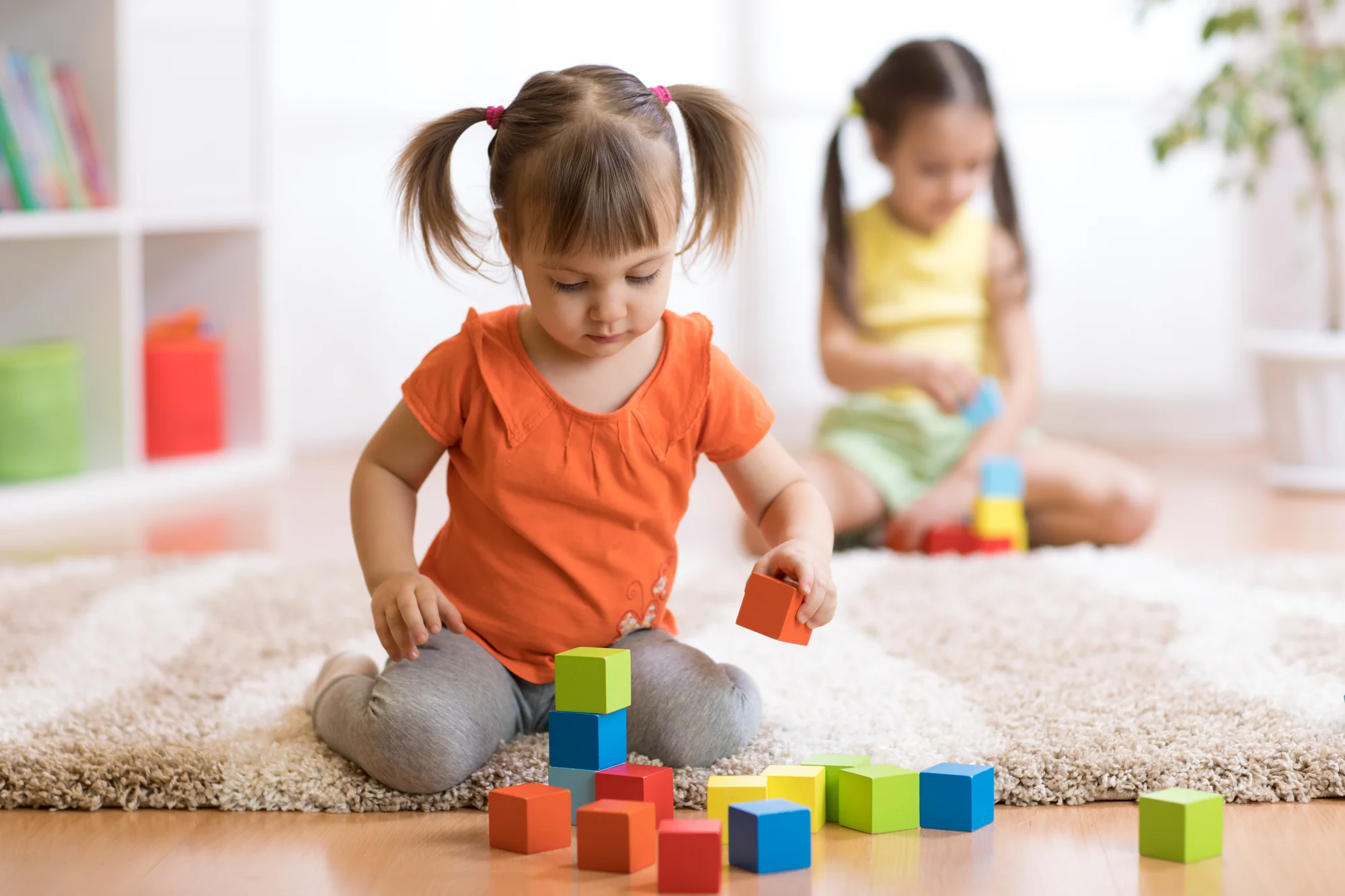
Pre-K math readiness begins with hands-on understanding of numbers, quantities, patterns, shapes, and spatial relationships.
How to Help Your Child Build Math Readiness Before Kindergarten
When you know what kindergarten teachers look for, you can focus on the skills that matter most before school begins.
These simple strategies connect directly to New York’s Prekindergarten Learning Standards and fit into everyday Long Island routines, from meals and errands to playtime, walks, and time at home.
Keep these activities short, frequent, and playful. From our experience, young children learn better through small moments repeated across the day, rather than through long sit-down lessons.
1. Turn Ordinary Moments Into Counting Practice
Research by Gunderson and Levine (2011) suggests that simple number talk at home is linked to stronger early number knowledge, which is why everyday moments like snack time and cleanup can be so effective.
Here are a few ways to work this in:
-
Counting steps out loud while walking up or down the stairs
-
Counting out plates, forks, or napkins while setting the table
-
Counting snacks, like crackers, grapes, or cereal pieces, before eating them
-
Counting toys out loud while putting them away at cleanup time
If you're commuting by Long Island Rail Road (LIRR), counting the stops or minutes until your station is another easy one to fold in, turning a wait most kids already find boring into a few minutes of counting practice.
None of this needs to look like math to work. Every time your child points to one object and says one number, they're practicing exactly the one-to-one correspondence kindergarten teachers are looking for.
2. Build Comparing Skills With Things Your Child Already Has
Your preschooler may understand “more” and “less” more easily when the groups are right in front of them.
With blocks, crackers, or toys, they can see the difference, touch each item, and talk through what they notice, an approach supported by a comprehensive review of research on the use of physical manipulatives in early learning by Byrne et al. (2023).
You can start with these simple activities:
-
Comparing two small piles of snacks and asking which has more
-
Comparing how many stuffed animals are on the bed versus the floor
-
Comparing portions at mealtime, like who has more grapes on their plate
When your family visits the South Shore, your child can count shells, rocks, or pebbles, then compare which group has more, fewer, or the same amount. You can use the same idea at a local park or pond by comparing how many ducks or geese you see today with how many you counted last time.
Your learner doesn't need to explain why one group is bigger, just build comfort with the language of comparison: more, less, the same. That vocabulary shows up in early kindergarten math instruction.
📕 You May Also Like: Greater Than and Less Than: A Simple Guide for Early Math
3. Notice and Extend Patterns During Everyday Routines
You do not need to create a special pattern activity from scratch. Your child can practice noticing patterns that are already part of the day, from alternating colors on a toy to repeated sounds in a song.
Try these simple activities:
-
Noticing a repeating pattern in a necklace, a bead bracelet, or a striped shirt
-
Clapping a simple rhythm together and asking your child to continue it
-
Setting the table in a repeating pattern, like fork-spoon-fork-spoon, and asking what comes next
-
Sorting laundry, toys, or shells by color, size, or shape
Long Island gives families plenty of ready-made pattern practice. Your learner can notice the alternating stripes on a Long Island Ducks jersey or the repeating pickets on a fence during a neighborhood walk, then name what repeats with you.
4. Make Shapes Part of Day-to-Day Conversation
Your child can build shape recognition as you name shapes during everyday routines. Verdine et al. (2014) connect this kind of everyday shape and spatial play with early math development.
Simple ways to practice:
-
Pointing out circles, squares, and triangles on street signs or packaging during a car ride
-
Naming the shape of a plate, a window, or a book while doing daily tasks together
-
Building simple shapes out of blocks, crackers, or pretzel sticks and naming them as you go
During a walk through Massapequa Park or a ride on the LIRR, your preschooler can spot shapes all around them. Storefront signs, windows, playground equipment, benches, doors, and train signs all count.
Kindergarten shape work asks children to recognize a shape even when it changes size, position, or setting. So objects in real life may help build that flexibility better than practicing from one flashcard image.
📕 You May Also Like: 3 Ways Early Spatial Skills Impact Long-Term Math Success
When to Consider Extra Support
Many pre-K children build early math readiness through everyday practice. But when certain skills keep feeling hard, more structured support can help you understand what your child needs next.
You may want to look more closely if your learner is still:
-
losing track when counting a small group of objects one at a time,
-
struggling to tell which of two groups has more,
-
having trouble naming a circle, square, or triangle even after plenty of exposure.
These differences are common at this age. They do not mean something is wrong, but they can help you see where your preschooler may need more practice, support, or time.
Some parents look for extra structure simply because they want a clearer path to follow. Your child may be developing right on track, but you may still want expert guidance on what to practice, how to practice it, and whether the right early skills are taking shape.
At Mathnasium, we begin by getting to know how your learner thinks about numbers, quantities, patterns, and shapes. Then we build on the math they are already meeting at home, through counting, comparing, sorting, noticing, and talking through ideas in a gentle, encouraging way.

Mathnasium tutors help young learners build the number sense and confidence they need to thrive in math.
How Mathnasium Supports Early Learners
Mathnasium is a math-only learning center dedicated to helping children build a solid math foundation from the start.
For pre-K and kindergarten-aged children, early math begins with counting, comparing, shapes, patterns, and the confidence to talk about what they notice. These early skills grow best when learning feels concrete, playful, and connected to how young children naturally explore the world.
That is where the Mathnasium Method™, our proprietary teaching approach, comes in. We do not rush children into memorized steps or formal procedures before they are ready. Instead, we meet each child where they are and help them build real understanding step by step.
Each child begins with a gentle, play-based diagnostic assessment. This relaxed interaction helps us understand what your child already knows, how they think, and where they are ready to grow next.
Using these insights, we create a personalized learning plan focused on the skills your child needs most, whether that means building one-to-one correspondence, recognizing shapes, or developing early problem-solving confidence.
Our specially trained early childhood tutors work with pre-K and kindergarten-aged children to build number sense through hands-on, playful instruction, similar in spirit to the activities discussed today.
We use a mix of interactive teaching techniques to match your child’s learning style.
Our sessions are fun, too. They include hands-on activities, guided questions, game-based learning, rewards, and consistent encouragement, so children stay engaged while building confidence. For early learners, that positive relationship with math is just as important as the skill practice itself.
The results speak for themselves:
-
94% of parents report an improvement in their child's math skills and understanding
-
93% of parents report their child's improved attitude toward math after attending Mathnasium
-
90% of students saw an improvement in their school grades
With over 1,100 learning centers across the U.S., Mathnasium brings personalized math support close to home.
Mathnasium of Massapequa Park is happy to support Long Island families getting ready for kindergarten and beyond, proudly serving Massapequa Park and nearby communities, including Massapequa, Seaford, and Amityville.
If your child is beginning their math journey and you want a clearer picture of where they stand, a free diagnostic assessment is a great place to start. Based on its results, we’ll create a personalized learning plan that helps your child build early math skills in a way that feels clear, playful, and encouraging.
📅 Schedule a Free Assessment at Mathnasium of Massapequa Park
Not located near Massapequa Park?
📍 Find a Mathnasium Learning Center Near You


 (516) 550-9031
 (516) 203-7501