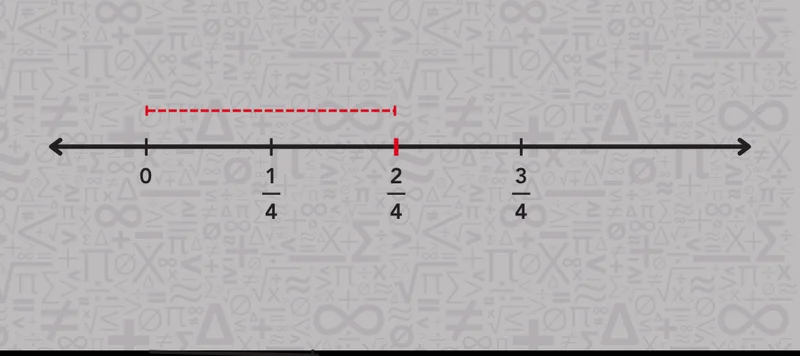
Placing a fraction on a number line is a skill 3rd graders learn as they meet fractions for the first time, and one 4th graders lean on again and again as fractions get compared, matched up, and eventually mixed with decimals.
A proper fraction, one smaller than a whole, like \(\Large\frac{1}{2}\) or \(\Large\frac{3}{4}\), always has exactly one spot on a number line. Finding that spot may trip kids up. Fraction circles feel familiar, right up until a worksheet swaps the pie for a line and asks for a single point instead.
Our seasoned Mathnasium tutors walk you through the same four-step method on more than one proper fraction, plus a few practice problems to check whether it's landed.

Why Do We Place Proper Fractions on a Number Line?
Every fraction is already made up of two numbers, a denominator and a numerator. The denominator tells us how many equal parts something is split into, and the numerator tells us how many of those parts we have.
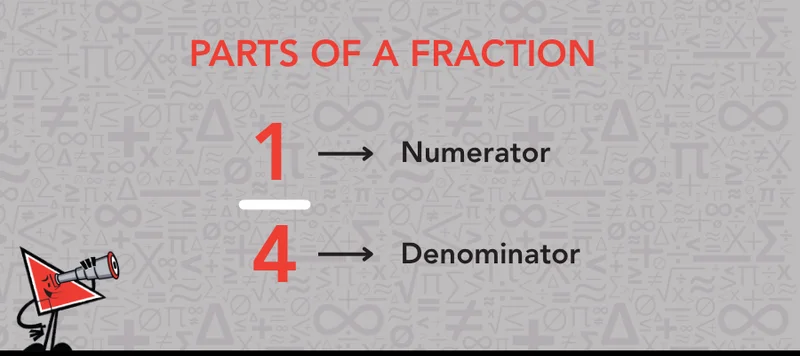
When we place a fraction on a number line, we use those same two numbers for the same jobs. The denominator tells us how many equal parts to divide the space into, and the numerator tells us how many of those parts to count.
Putting a fraction on a number line helps us:
-
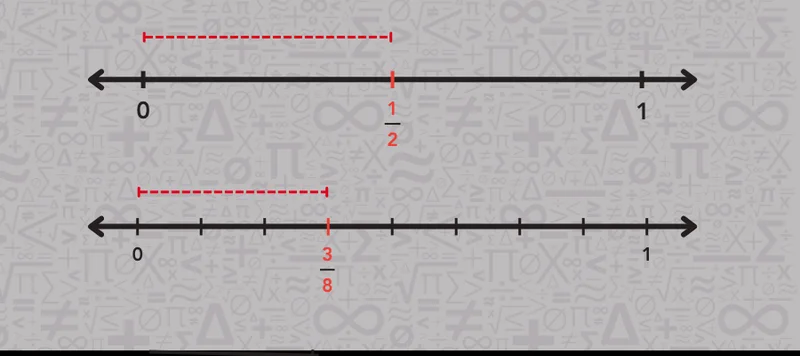
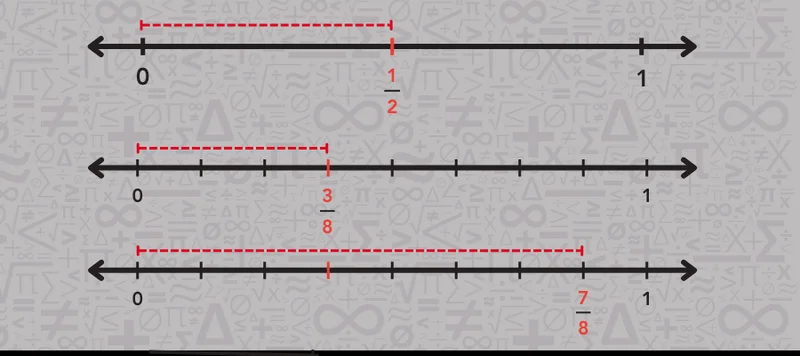
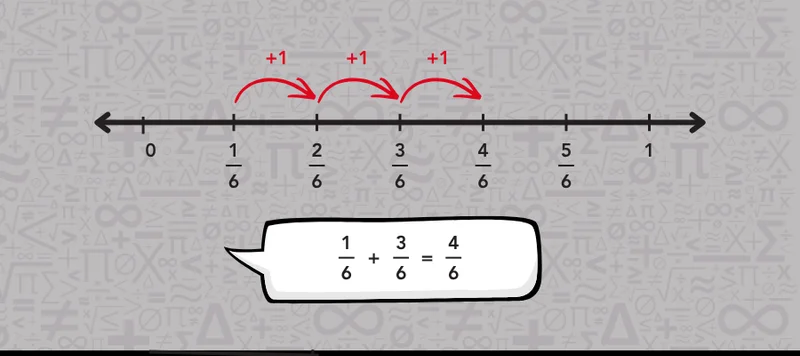
Compare and order. Lining up fractions like \(\Large\frac{3}{8}\), \(\Large\frac{1}{2}\), and \(\Large\frac{7}{8}\) on the same number line makes it easy to see which is smallest, which is largest, and how far apart they sit.
📕 You May Also Like: Benchmark Fractions: The Secret Weapon for Mental Math

How to Place a Proper Fraction on a Number Line, Step by Step
Every fraction lands on a number line through the same four moves, no matter which fraction we're using.
We'll walk through all four using \(\Large\frac{3}{4}\), placing it on a number line between 0 and 1.
Step 1: Check the Denominator
The denominator alone tells us how many equal parts to divide the space into.
-
In \(\Large\frac{3}{4}\), the denominator is 4.
-
That means dividing the distance between 0 and 1 into 4 equal parts.
This number is fixed the moment we see the fraction, before we draw anything.
Step 2: Divide the Line Into Equal Spaces
This is where most mistakes happen, so let's be exact. To divide the line into 4 equal parts, we don't draw 4 tick marks between 0 and 1. We draw 3.
Here's what that looks like between 0 and 1.
-
0 and 1 already mark the two ends.
-
We add 3 new marks in between.
-
That gives us 5 marks total, and those 5 marks create exactly 4 equal spaces.
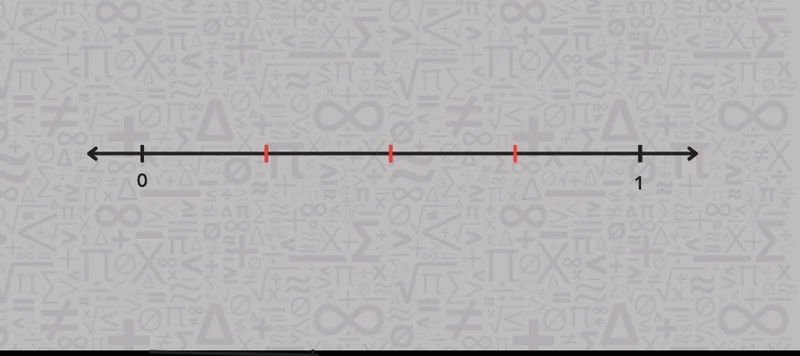
If we draw 4 tick marks instead of 3, we end up with 5 spaces, and every fraction we place after that lands in the wrong spot.
We can check our work by counting the gaps instead of the lines. For \(\Large\frac{3}{4}\), that count should equal 4.
Step 3: Count Over Using the Numerator
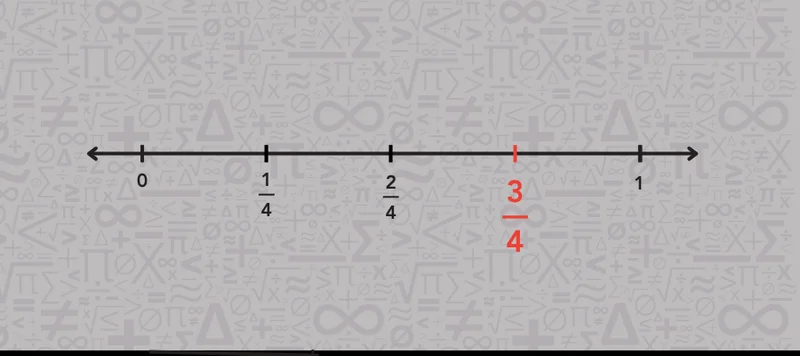
The numerator tells us how many of those equal spaces to count, starting at zero.
In \(\Large\frac{3}{4}\), the numerator is 3, so we count three spaces over from zero and land on the third mark. That mark is exactly where \(\Large\frac{3}{4}\) sits on the line.
Step 4: Mark and Label the Point
Before marking the point, it helps to count the spaces once more and confirm the total matches the denominator. We confirm the count holds, then draw the point directly on the line and label it \(\Large\frac{3}{4}\).
We now fast-check. Does the point sit before or after the halfway mark?
For \(\Large\frac{3}{4}\), the point sits past \(\Large\frac{1}{2}\), closer to 1, which matches what we'd expect from a fraction bigger than half.
Try It Again With a Different Fraction
The same four moves work on any fraction. Let's run through them again with \(\Large\frac{5}{6}\), a little faster this time.
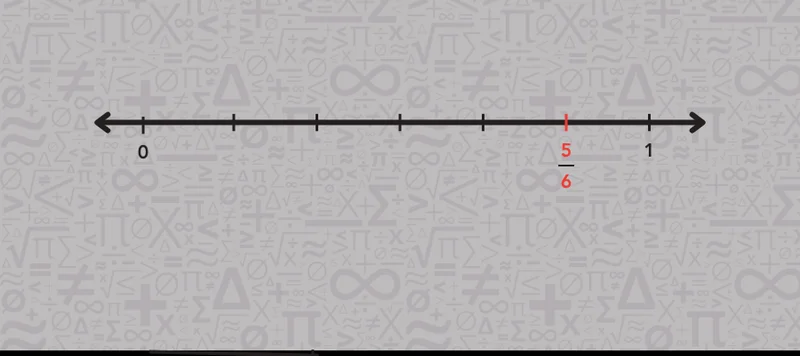
The denominator is 6, so the line splits into 6 equal spaces. That takes 5 new tick marks between 0 and 1, since those marks plus the two endpoints create 6 equal spaces.
The numerator is 5, so we count five spaces over from zero. That lands just shy of 1, since \(\Large\frac{5}{6}\) sits one space short of a whole.
A quick recount before marking the point confirms the spacing still holds, and the point goes exactly where it belongs, labeled \(\Large\frac{5}{6}\).
Mathnasium tutors encourage students to picture the number line as a ruler that divides into equal steps, showing point and distance instead of pie slices and portions. That shift carries students into decimals, negative numbers, and ratio work later on.
📕 You May Also Like: How to Use a Number Line: Positive and Negative Numbers
Over to You: Practice Placing Proper Fractions
Ready to try it? These 3 problems use proper fractions we haven't placed yet.
-
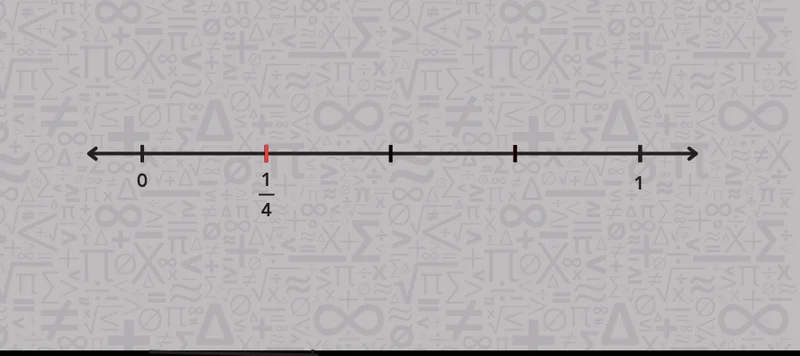
Place \(\Large\frac{1}{4}\) on a number line from 0 to 1.
-
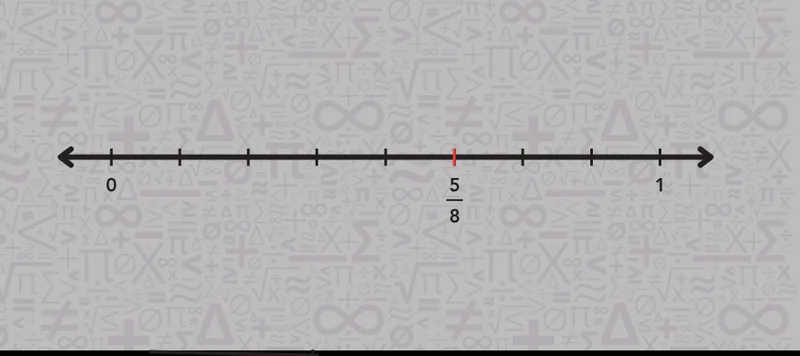
Place \(\Large\frac{5}{8}\) on a number line from 0 to 1.
-
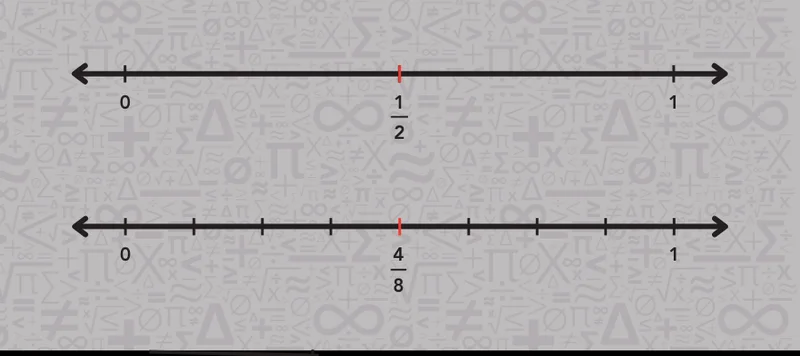
Place \(\Large\frac{1}{2}\) and \(\Large\frac{4}{8}\) on the same line, and see what you notice.
Check the answer key at the end of this guide.

At Mathnasium, we celebrate every fraction placed in exactly the right spot.
📕 You May Also Like: What Is a Fraction on a Number Line? A Complete Overview
How Mathnasium Helps Students Build Confidence with Concepts Like Fractions
Mathnasium is a math-only learning center dedicated to helping K-12 students of all skill levels excel in math.
Whether a student is placing their first fraction on a number line, working to build fluency with equal spaces and gaps, or preparing for the benchmark fraction-and-decimal work that builds on this skill in later grades, we can support them.
Our proprietary teaching approach, the Mathnasium Method™, is designed around each student's needs and learning style to help them learn and master math. Our approach includes:
-
Assessment and Personalized Learning Plans: Each student begins their Mathnasium journey with a diagnostic assessment that identifies their current skill level, learning goals, and learning style. From those findings, we build a personalized learning plan tailored to their goals, whether that means mastering fraction placement on a number line, building fluency with equivalence and comparison, or preparing for the decimal and negative-number work still ahead.
-
Teaching for Understanding: Our specially trained tutors use natural language and a mix of verbal, visual, mental, tactile, and written techniques so each concept lands before we move forward.
-
Problem-Solving and Critical Thinking: We give students time to work through problems independently. That productive struggle helps them learn to trust their own reasoning. When we do step in, we explain both the how and the why behind each answer, so students build problem-solving and critical thinking skills they can use in math and beyond.
-
An Engaging and Fun Learning Environment: Sessions include games, earned rewards, and consistent celebration of progress. Students build confidence alongside fluency, and many develop a more positive relationship with math over time.
The impact extends beyond the classroom:
-
94% of parents report an improvement in their child's math skills and understanding
-
93% of parents report their child's improved attitude toward math after attending Mathnasium
-
90% of students saw an improvement in their school grades
With over 1,100 learning centers across North America, there is likely a Mathnasium close to you.
Families across Keller and Southlake trust Mathnasium of Keller to help their children build lasting confidence in math. If fractions or any other math concept is giving your child trouble, our team is ready to help.
📅 Schedule a Free Assessment at Mathnasium of Keller
Not near Keller?
📍 Find a Mathnasium Learning Center Near You
Psssst! Check Your Answers Here
Here's how each practice problem breaks down.
1. \(\Large\frac{1}{4}\). Four equal spaces, three tick marks, and a point on the first mark, just past 0.
2. \(\Large\frac{5}{8}\). Eight equal spaces, seven tick marks, and a point five spaces over, just past the halfway mark.
3. \(\Large\frac{1}{2}\) and \(\Large\frac{4}{8}\). Splitting the line into eighths gives us marks for both. \(\Large\frac{1}{2}\) and \(\Large\frac{4}{8}\) land on the exact same point (the fourth of eight spaces) because \(\Large\frac{4}{8}\) reduces to \(\Large\frac{1}{2}\). Same location, two different names.


 (817) 732-6284