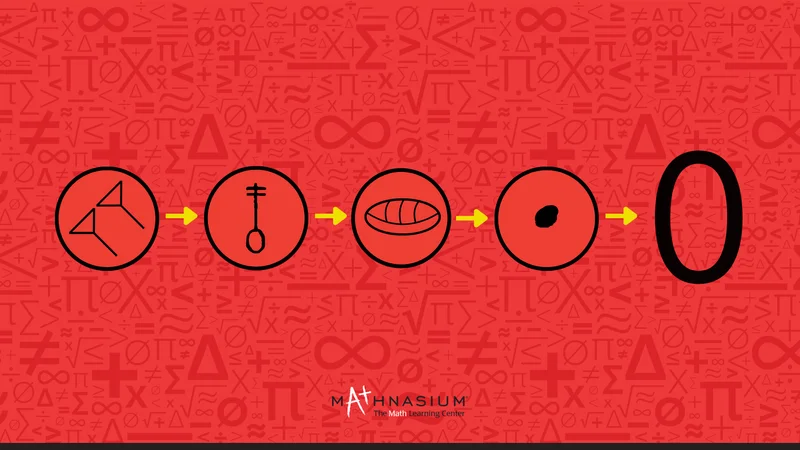
Zero is everywhere. It sits on our number line, anchors our calculations, and runs through every piece of digital technology we use. It is so familiar that we rarely stop to think about it.
But zero was not always there. For most of human history, it simply did not exist. Different civilizations counted, measured, and built empires without it. And when they finally started reaching for it, each one arrived at a different answer.
Today, our Mathnasium tutors trace that five-thousand-year journey, from the first attempts to mark an empty space to the moment zero became a number that changed mathematics forever.

What Is Zero?
Zero is both a number denoting the absence of quantity and a placeholder in positional number systems.
That definition, however, is only the beginning. What zero does sets it apart from every other number we work with.
Zero can be:
-
A number: It tells us that a quantity is empty. If we have three apples and eat all three, zero is what remains.
-
A placeholder: It tells us that a position in a number is empty. In the number 503, the zero tells us there are no tens. Remove it, and 503 becomes 53, a completely different number.
-
The center of the Number Line: It sits at the point where positive numbers and negative numbers meet, acting as the anchor that separates what lies to its right from what lies to its left.
-
Neither positive nor negative: It stands apart from all other numbers, claiming no sign of its own.
-
A point of Symmetry: Because it sits exactly in the middle, it creates balance. For every positive number, there is a negative counterpart on the other side. Add them together, and they always bring us back to zero.
Now let's see how zero behaves when we use it in calculations.
|
Operation
|
Rule
|
Example |
| Addition |
Adding zero leaves the number unchanged
|
15 + 0 = 15 |
|
Subtraction
|
Subtracting zero leaves the number unchanged
|
15 - 0 = 15 |
|
Multiplication
|
Multiplying by zero gives zero
|
15 × 0 = 0 |
|
Division
|
Dividing zero by any number gives zero
|
0 ÷ 15 = 0 |
Zero stands alone among all numbers in how it behaves across every operation. For such a small symbol, it carries a remarkable amount of mathematical weight.
So where did this unusual number come from, and why did it take humanity thousands of years to figure it out?
📕 You May Also Like: Why Zeros Are Challenging for Young Learners (And How You Can Help)
A History of Zero: From Empty Space to Number
Zero began as a simple mark for an empty position and evolved over five thousand years into a number with its own mathematical identity.
Our Mathnasium tutors will walk us through that journey, from the earliest civilizations that felt the need for a placeholder to the mathematician who first gave zero its rules.
1. Early Civilizations and the First Placeholder Symbols
Before zero became a number, several civilizations independently developed symbols to represent emptiness in their counting systems. We can trace that evolution across distinct cultures, each arriving at a different solution.
Mesopotamia (3000 BC – 300 BC)
The Sumerians were among the first to use a place-value number system, leaving empty spaces to indicate missing digits. Over time, those blank spaces created confusion.
Around 300 BC, the Babylonians formalized the first explicit placeholder symbol, a slanted double wedge pressed into clay, to mark empty positions clearly. The idea had evolved from an invisible gap into a visible mark, but it remained a scribal tool rather than a number.

Ancient Egyptians (2000 BC)
Ancient Egyptians built their number system additively, meaning they constructed numbers by combining symbols rather than arranging them by position.
Within that system, the hieroglyph nefer, meaning “beautiful” or “complete”, served a practical purpose. Scribes used it to represent a zero balance in bookkeeping records, and builders used it to mark baseline ground level in construction measurements.

Ancient Greeks (6th–4th century BC)
Greek mathematics made extraordinary advances in geometry and number theory. Their philosophical tradition, however, treated empty space as an impossibility, and that belief shaped Western mathematics for centuries, keeping zero outside the mainstream of mathematical thought.
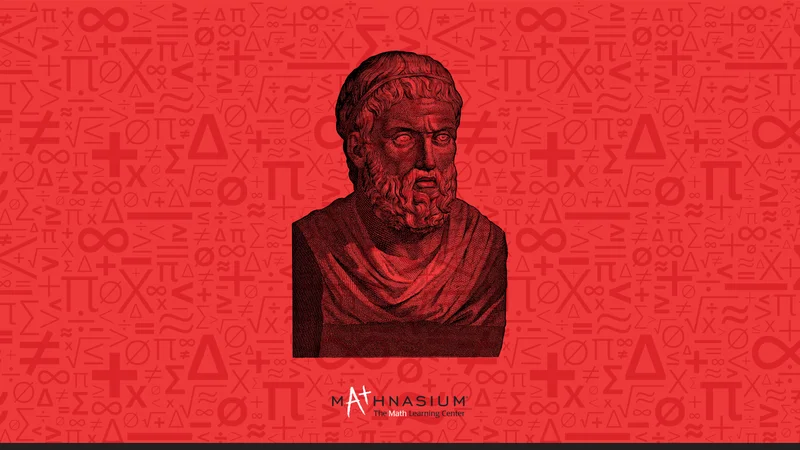
Aristotle argued that a void could not exist in nature, a position that discouraged Western mathematicians from developing a symbol for emptiness for generations.
Ancient Romans (7th century BC – 5th century AD)
The ancient Romans built their number system entirely on an additive arrangement of letters, meaning each symbol held a fixed value regardless of its position. Centuries later, medieval monks began using the Latin word nulla, meaning “none”, to fill empty spaces in their numerical charts.
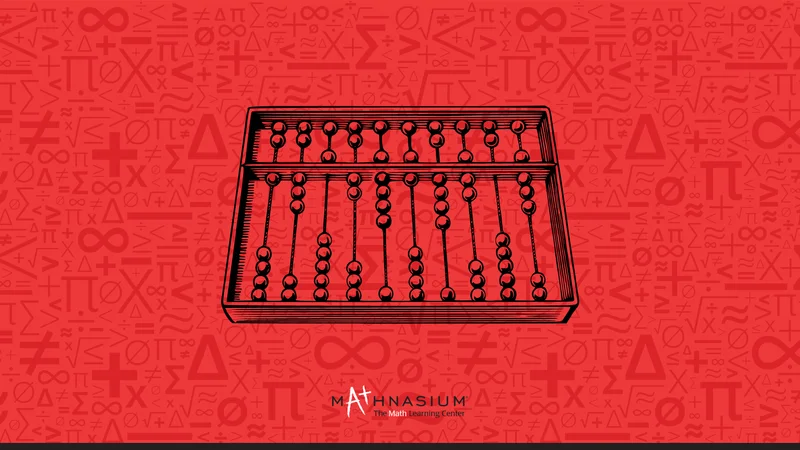
Calculations on paper were so cumbersome that Romans relied on physical counting boards with pebbles to do their arithmetic instead.
The Mayans (350 AD)
The Mayan civilization of Central America independently developed its own zero around 350 AD. For the Mayans, zero meant completion, the turning over of a full cycle.
We can think of it like a car odometer rolling from 99,999 back to 00,000. When it rolls over, it signals that everything has been counted and a new cycle is beginning.
The Mayan zero had a consistent symbol, a distinctive shell shape, and a permanent place in their calendar system. It filled gaps and marked transitions, serving as a placeholder rather than a number used in calculations.

2. India: Where Zero Became a Number
Zero became a true number in India in 628 AD, when the astronomer and mathematician Brahmagupta was the first to define how zero behaves in calculations and establish it as a number in its own right.
In India, zero was called shunya, a Sanskrit word meaning “void” or “empty”. The earliest physical symbol for shunya appeared as a dot in the 3rd or 4th century, and over time that dot opened into the circle we recognize today.
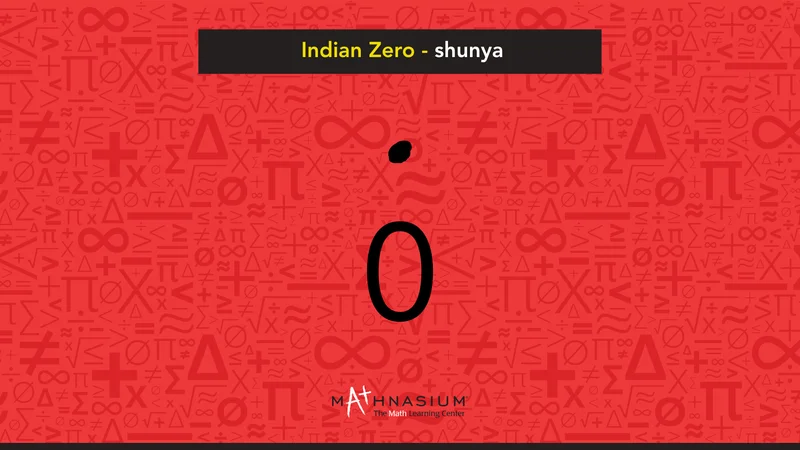
Brahmagupta was the first to define zero's mathematical behavior:
-
Zero added to any number leaves it unchanged
-
Zero subtracted from any number leaves it unchanged
-
Zero multiplied by any number gives zero
But he went further. By placing zero at the center of the number line, he created the concept of negative numbers. To explain it, he turned to money.
-
Fortunes: positive numbers, representing what we have
-
Debts: negative numbers, representing what we owe
-
Nowhere: zero, the neutral point between them
A debt of 5 and a fortune of 5 cancel each other out and bring us back to zero.
Brahmagupta's rules had one exception. He wrestled with division by zero, concluding that a number divided by zero equals zero.
Mathematics has since shown that dividing by zero is undefined.
📕 You May Also Like: Why Can’t You Divide by Zero? The Answer That Finally Makes Sense
3. How Zero Traveled From India
From India, zero began a journey that would take it across the world. Over the centuries that followed, scholars, merchants, and mathematicians carried it westward.
-
8th–9th centuries, Persia: Arab scholars encountered Indian mathematics and adopted the Hindu-Arabic numeral system, zero included. They developed the mathematical frameworks that would carry zero further westward.
-
9th century, Arabic texts: Zero appeared in Arabic mathematical texts, establishing it firmly in the Islamic scholarly tradition and opening it to mathematicians across the region.
-
1202, Liber Abaci: The Italian mathematician Leonardo Fibonacci published his book on calculation, demonstrating how practical the Hindu-Arabic numeral system was for business arithmetic. Zero had reached Spain earlier through Moorish trade routes, but Fibonacci's book brought it into everyday commercial use across Europe.
-
The Renaissance: By the Renaissance, the zero-based numeral system had gained widespread popularity across Europe, replacing Roman numerals in trade, science, and scholarship.
-
17th century, the invention of calculus: Newton and Leibniz independently developed calculus, a branch of mathematics built entirely on the concept of quantities approaching zero. Zero had grown into something larger, the foundation of an entirely new mathematical language.
📕 You May Also Like: Why We Use Base 10: The History of Our Number System
How Zero Changed Mathematics Forever
Zero gave mathematics the ability to express nothing and calculate with it. That sounds simple, but the consequences reached further than anyone who first scratched a placeholder into clay could have imagined.
Before zero, mathematics was largely a tool for counting and measuring things that existed. Zero expanded what mathematics could describe, and with each expansion, an entirely new branch of knowledge became possible.
-
Arithmetic: Zero made written calculation possible. By holding empty positions in a number, it gave every digit a precise location and value. Addition, subtraction, multiplication, and division on paper all depend on zero doing that job reliably.
-
Algebra: Algebra needed a way to express the absence of a quantity. Zero provided it, giving equations a fixed point to resolve to and opening up an entire branch of mathematics built around that idea.
-
Calculus: Calculus is the mathematics of things that change, and it works by imagining quantities getting smaller and smaller, approaching zero. That idea made it possible to calculate speed, predict motion, and measure growth in ways that had never been possible before.
-
Computing: Every piece of digital information, every image, every message, every calculation a computer performs reduces to sequences of ones and zeros. The binary system that runs the modern world was built on the number that took humanity thousands of years to imagine.

Mathnasium tutors help students see the story behind every math concept, building understanding that lasts well beyond any single lesson.
How Mathnasium Builds True Math Understanding
Mathnasium is a math-only learning center dedicated to helping K–12 students of all skill levels excel in math.
We work with students to make math clear, approachable, and connected to the skills they need next.
Our specially trained tutors use a proprietary teaching approach, the Mathnasium Method™, to meet students where they are and guide them toward math mastery, step by step.
Each student's Mathnasium journey starts with a diagnostic assessment, which lets us identify their current skills and knowledge gaps.
From there, we build a personalized learning plan that addresses those gaps step by step, using clear, example-led instruction at every stage.
Students work in a fun and caring group environment where they feel comfortable asking questions, making mistakes, and trying again. We teach math for understanding, using clear, everyday language and a combination of verbal, visual, mental, tactile, and written teaching techniques.
Our tutors give students room to think through a problem before stepping in. We know when to guide, when to ask a better question, and when to let the student work through the challenge. That balance helps build critical thinking and problem-solving skills, along with the lasting independence students need for higher-level math.
Our approach also includes game-based activities and plenty of rewards to keep students motivated and engaged.
The results speak for themselves:
-
94% of parents report an improvement in their child's math skills and understanding
-
93% of parents report their child's improved attitude toward math after attending Mathnasium
-
90% of students saw an improvement in their school grades
Mathnasium operates over 1,100 learning centers, bringing our top-rated approach close to your community.
For families in and around Keller, TX, Mathnasium of Keller is a trusted local center serving students across the Fort Worth metro area.
Whether your child is looking to catch up, keep up, or get ahead, our team is ready to help.
Ready to get started?
📅 Schedule a Free Assessment at Mathnasium of Keller
Not near Keller?
📍 Find a Mathnasium Learning Center Near You


 (817) 732-6284