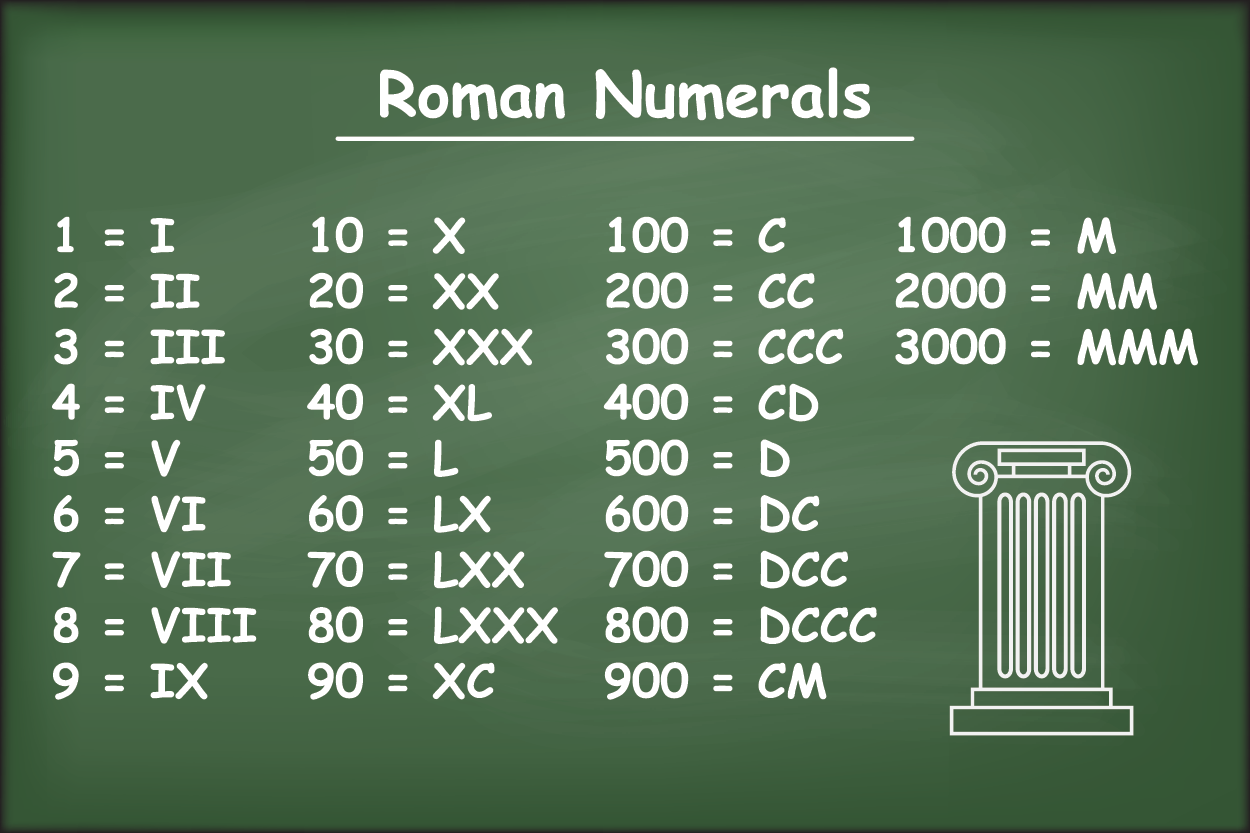
Roman numerals are one of the oldest number systems still in use today, and students learn them as part of number sense. The system follows different rules from the numerals we use in everyday math.
Our tutors at Mathnasium put together this guide as both a quick reference and a learning tool. Students will find the full chart from 1 to 100, the three rules that make the system readable, and worked examples for some of the trickiest Roman numerals.

What Are Roman Numerals?
Roman numerals are a number system developed in ancient Rome that uses seven letters to represent values instead of digits. Each letter represents a fixed value, and different combinations create larger numbers.
Here are the seven symbols we need to know:
| Symbol |
Value |
Memory Hook |
| I |
1 |
One finger held up |
| V |
5 |
Two fingers spread into a V shape |
| X |
10 |
Two hands crossed |
| L |
50 |
Half of C (100 ÷ 2 = 50) |
| C |
100 |
Latin: centum (hundred) |
| D |
500 |
Half of M (1,000 ÷ 2 = 500) |
| M |
1,000 |
Latin: mille (thousand) |
The Roman system uses no place value and no zero, which makes it different from the Hindu-Arabic system we use today. Let's take a closer look at what that means.
📕 You May Also Like: How to Read & Write Large Numbers: Millions, Billions, & Beyond
Why Roman Numerals Have No Zero
Roman numerals developed before mathematicians created the concept of zero as a number. Later writers sometimes used the Latin word nulla, meaning "none," to indicate an empty value, but zero was not part of the original Roman numeral system.
Unlike our modern number system, Roman numerals do not rely on place value. In our Hindu-Arabic system, a digit changes value depending on its position. The 3 in 30 represents three tens, while the 3 in 300 represents three hundreds.
Roman numerals work differently. Each symbol represents the same amount no matter where it appears, which makes the system useful for labeling and ordering, but far less practical for calculation.
📕 You May Also Like: Why Zeros Are Challenging for Young Learners (And How You Can Help)
The Three Rules Behind Every Roman Numeral
Every Roman numeral follows three rules that determine how symbols combine to represent a value.
Here’s how each rule works in practice.
1. The Additive Rule
The additive rule adds symbol values together when a smaller symbol follows a larger one. In other words, XV equals 15 because V (5) comes after X (10), so we add 10 + 5.
Here are a few more examples:
-
VI = 5 + 1 = 6
-
XI = 10 + 1 = 11
-
LX = 50 + 10 = 60
2. The Subtractive Rule
The subtractive rule subtracts one value from another when a smaller symbol appears before a larger one. For example, IV equals 4 because I (1) comes before V (5), so we subtract 1 from 5.
The rule applies only to six valid pairs:
-
I before V and X → IV = 4, IX = 9
-
X before L and C → XL = 40, XC = 90
-
C before D and M → CD = 400, CM = 900
A common mistake here is to assume any smaller symbol can subtract from any larger one.
For example, a student might write IC for 99, since I (1) before C (100) seems to follow the same logic. But IC is not a valid Roman numeral; subtraction only works with the six pairs listed above. The correct way to write 99 is XCIX (90 + 9).
3. The Repetition Rule
Roman numeral symbols cannot repeat more than three times in a row.
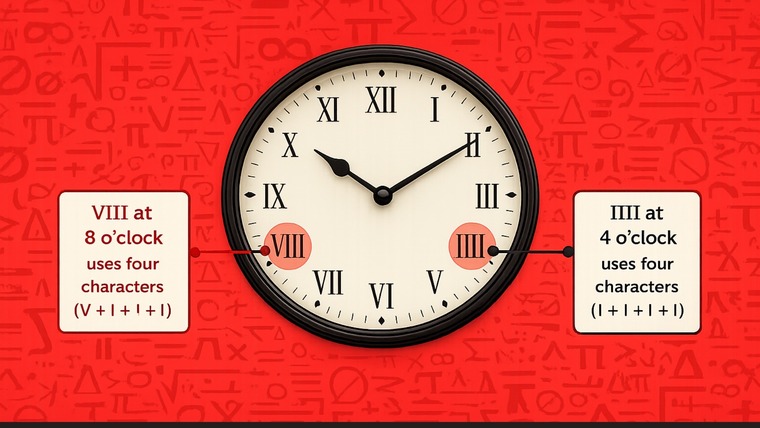
Many analog clock faces use IIII instead of IV, which is a deliberate historical exception. Clockmakers used IIII because it creates visual symmetry opposite VIII on the other side of the dial, so it is not a rules error.
📕 You May Also Like: What Is Number Sense & Why It Matters in Early Math Education
How to Read and Write Roman Numerals
Now let's put the three rules together and see how they help us read and write Roman numerals. We'll show you a few examples that may seem challenging at first:
-
14 = XIV → subtractive pair (IV)
IV = 4 because I comes before V → 10 + 4 = 14
-
29 = XXIX → repetition + subtractive pair (XX + IX)
XX = 20, and IX = 9 because I comes before X → 20 + 9 = 29
-
44 = XLIV → two subtractive pairs (XL + IV)
XL = 40 because X comes before L, and IV = 4 because I comes before V → 40 + 4 = 44
-
68 = LXVIII → additive rule + repetition rule (LX + VIII)
LX = 60 because L (50) and X (10) add together, and VIII = 8 because V (5) is followed by three I's (1 + 1 + 1) → 60 + 8 = 68
📕 You May Also Like: The History of Roman Numerals & Why They Still Matter
Roman Numerals Chart 1 to 100
We've organized the Roman numeral chart from 1 to 100 into three tables, so it's easier to spot the patterns behind the system.
The first table introduces the numbers from 1 to 20, where I, V, and X demonstrate all three rules in action.
| Number |
Roman Numeral |
| 1 |
I |
| 2 |
II |
| 3 |
III |
| 4 |
IV |
| 5 |
V |
| 6 |
VI |
| 7 |
VII |
| 8 |
VIII |
| 9 |
IX |
| 10 |
X |
| 11 |
XI |
| 12 |
XII |
| 13 |
XIII |
| 14 |
XIV |
| 15 |
XV |
| 16 |
XVI |
| 17 |
XVII |
| 18 |
XVIII |
| 19 |
XIX |
| 20 |
XX |
The second table covers the numbers from 21 to 50, where longer numeral combinations become more common, and the subtractive rule appears in larger values. The 40s introduce XL, where X (10) comes before L (50) to represent 40.
| Number |
Roman Numeral |
| 21 |
XXI |
| 22 |
XXII |
| 23 |
XXIII |
| 24 |
XXIV |
| 25 |
XXV |
| 26 |
XXVI |
| 27 |
XXVII |
| 28 |
XXVIII |
| 29 |
XXIX |
| 30 |
XXX |
| 31 |
XXXI |
| 32 |
XXXII |
| 33 |
XXXIII |
| 34 |
XXXIV |
| 35 |
XXXV |
| 36 |
XXXVI |
| 37 |
XXXVII |
| 38 |
XXXVIII |
| 39 |
XXXIX |
| 40 |
XL |
| 41 |
XLI |
| 42 |
XLII |
| 43 |
XLIII |
| 44 |
XLIV |
| 45 |
XLV |
| 46 |
XLVI |
| 47 |
XLVII |
| 48 |
XLVIII |
| 49 |
XLIX |
| 50 |
L |
The third table covers the numbers from 51 to 100, where L, C, and larger numeral combinations become part of the system. The 90s introduce XC, where X (10) comes before C (100) to represent 90.
| Number |
Roman Numeral |
| 51 |
LI |
| 52 |
LII |
| 53 |
LIII |
| 54 |
LIV |
| 55 |
LV |
| 56 |
LVI |
| 57 |
LVII |
| 58 |
LVIII |
| 59 |
LIX |
| 60 |
LX |
| 61 |
LXI |
| 62 |
LXII |
| 63 |
LXIII |
| 64 |
LXIV |
| 65 |
LXV |
| 66 |
LXVI |
| 67 |
LXVII |
| 68 |
LXVIII |
| 69 |
LXIX |
| 70 |
LXX |
| 71 |
LXXI |
| 72 |
LXXII |
| 73 |
LXXIII |
| 74 |
LXXIV |
| 75 |
LXXV |
| 76 |
LXXVI |
| 77 |
LXXVII |
| 78 |
LXXVIII |
| 79 |
LXXIX |
| 80 |
LXXX |
| 81 |
LXXXI |
| 82 |
LXXXII |
| 83 |
LXXXIII |
| 84 |
LXXXIV |
| 85 |
LXXXV |
| 86 |
LXXXVI |
| 87 |
LXXXVII |
| 88 |
LXXXVIII |
| 89 |
LXXXIX |
| 90 |
XC |
| 91 |
XCI |
| 92 |
XCII |
| 93 |
XCIII |
| 94 |
XCIV |
| 95 |
XCV |
| 96 |
XCVI |
| 97 |
XCVII |
| 98 |
XCVIII |
| 99 |
XCIX |
| 100 |
C |
📕 You May Also Like: How to Use Math Anchor Charts to Support Learning at Home
Where We Can See Roman Numerals
Roman numerals show up in everyday life, which makes them useful to learn beyond a single classroom unit.
Here are a few examples where the system is still in use today:
-
Books and outlines: Prefaces, introductions, and chapter headings in many books use Roman numerals for page numbering. School outlines follow the same convention.
-
Films and pop culture: Movie sequels often use Roman numerals in their titles. Students who know the system can read them without stopping to decode the symbols.
-
Major sporting events: Several annual sporting events number their editions with Roman numerals. The Super Bowl is one of the best-known examples, and each championship game carries a Roman numeral instead of a standard number.
-
Buildings and monuments: Cornerstones, plaques, and memorial inscriptions often use Roman numerals to display dates.
📕 You May Also Like: Math for Life: Why Math Skills Matter Beyond School
 At Mathnasium, we help students develop strong mathematical foundations through reasoning, pattern recognition, and problem-solving.
How Mathnasium Helps Students Build Number Sense and Math Fluency
Mathnasium is a math-only learning center dedicated to helping K–12 students of all skill levels excel in math.
Students come to us at different points in their math journey. Some are building foundational number sense, while others are ready to explore patterns and enrichment topics like alternative number systems. The path forward is built around exactly where each student is.
We build that path through the Mathnasium Method™, our proprietary teaching approach. Here is how it works in practice:
-
Assessment and Personalized Learning Plans: Each student begins with a diagnostic assessment that identifies current skills, strengths, and knowledge gaps. From those findings, we build a personalized learning plan tailored to their goals. That process helps us identify the skills students need to strengthen their number sense and build greater fluency.
-
Teaching for Understanding: Our specially trained tutors use natural language and a mix of verbal, visual, mental, tactile, and written techniques so each concept lands before we move forward.
-
Problem-Solving and Critical Thinking: We allow time for productive struggle so students can rely on their own reasoning. When we step in, we make sure to show both the how and the why behind the answer. Over time, this helps students build their own problem-solving skills and critical thinking tools.
-
An Engaging and Fun Learning Environment: Sessions include games, earned rewards, and consistent celebration of progress. Students build confidence alongside fluency, and many develop a more positive relationship with math over time.
The impact shows up in the classroom and beyond:
-
94% of parents report improvement in their child's math skills and understanding
-
93% of parents report an improved attitude toward math after attending Mathnasium
-
90% of students saw improvement in their school grades
With over 1,100 learning centers across North America, there is likely a Mathnasium close to you.
Families across Meridian, Eagle, and Star trust Mathnasium of Meridian to help their children build real math confidence at every level.
If number sense or any other math concept is giving your child trouble, our team is ready to help.
📅 Schedule a Free Assessment at Mathnasium of Meridian
Not near Meridian?
📍 Find a Mathnasium Learning Center Near You


 (208) 888-0020
 (208) 888-0020