There is no right or wrong amount of involvement in your child's math education, and your instinct to sit down at the homework table to help is a good one.
Research consistently shows that parental involvement supports your child's achievement, engagement, and motivation across every stage of their education.
Math homework is where parental involvement often feels less clear. Even with the best intentions, it is easy to slip from guiding your child through the thinking to stepping in too quickly or unconsciously taking over the work entirely.
Our education specialists share six research-backed strategies that make homework feel more encouraging and far less stressful for everyone involved.

What Research Says About Helping Your Child With Math Homework
Research on parental involvement in homework reaches a clear conclusion. How you help your child with math homework matters more than how often you do it. The findings are specific and can help make the next homework session more effective.
Barger and colleagues analyzed 448 studies covering 480,830 families and found that parental involvement in your child's education is broadly positive across every stage of development, with one clear exception:
-
School event participation, conversations about school at home, and consistent encouragement all showed positive links to achievement, engagement, and motivation
-
Direct homework assistance showed a negative link to achievement, even while remaining positive for engagement
Xu and colleagues followed up with a study of 378,222 participants and found that different types of homework help lead to very different outcomes:
-
Autonomy support, where parents encourage children to work through problems independently, showed the strongest positive link to academic achievement
-
Controlling involvement, where parents take over problems or direct every step, showed a negative link to achievement that became more pronounced in middle and high school
Our experience working with students consistently shows that independence grows once your child learns to trust their own thinking process. Your child gradually moves from relying on help to approaching problems with confidence on their own. Mindful support at the homework table is what makes that shift possible over time.
📕 You May Also Like: When to Step Back: A Grade-by-Grade Guide to Building Math Homework Independence
6 Ways to Help With Math Homework Without Taking Over
Our education specialists share six strategies that keep your child working through the math homework while you stay close enough to support them without taking over:
1. Ask Questions Before Giving Answers
Questions are the most effective form of homework help your child can receive.
If your child is stuck on this fraction \(\Large\frac{3}{4}\) + \(\Large\frac{1}{2}\), instead of explaining the steps, try this:
-
Ask: "How many quarters fit in one half?"
-
Your child draws it out and sees that \(\Large\frac{1}{2}\) equals \(\Large\frac{2}{4}\)
-
From there, \(\Large\frac{3}{4}\) + \(\Large\frac{2}{4}\) = \(\Large\frac{5}{4}\), and they found it themselves
Your child's thinking just needs a nudge in the right direction, and a well-placed question does that far better than an explanation that takes the problem out of their hands entirely.
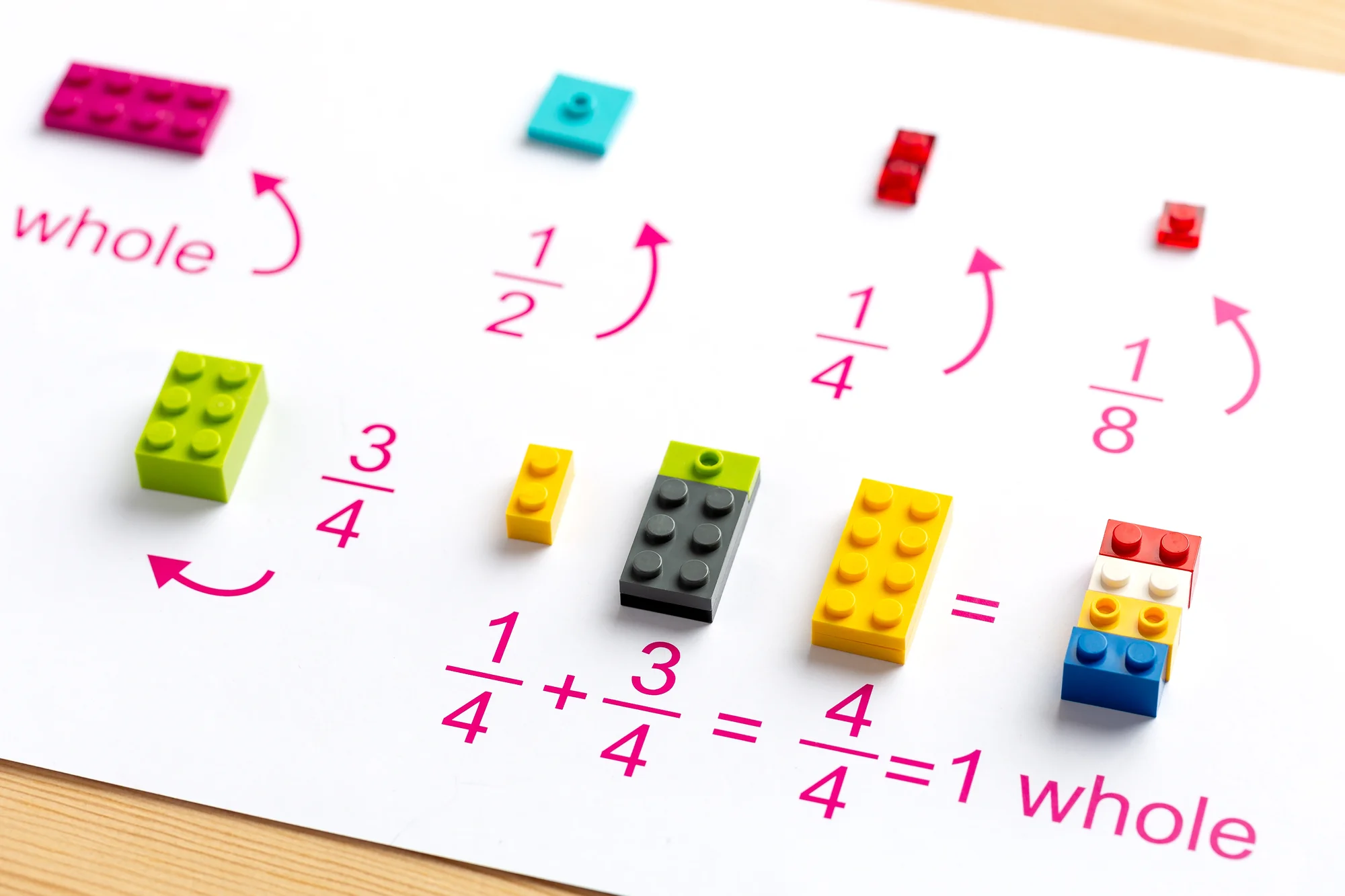
The right question turns a fraction problem your child couldn't start into one they solved themselves.
2. Let Your Child Talk Through the Problem First
Let your child explain their thinking first while you listen without interrupting or correcting.
If your child is doing subtraction 43 - 17, simply ask: "Can you walk me through what you are doing?" Your child will often catch their own mistake just by saying the steps out loud.
DiNapoli and Miller, cited in NWEA's guide to home math engagement, found that prompting your child to think through the math problem before solving it helped them re-engage when they got stuck. Your role here is to listen attentively rather than interfere directly.
3. Praise the Work Instead of the Result
Specific praise builds more confidence in your child than general praise. Instead of "You are so good at this," try naming exactly what your child did:
Park and colleagues found that children build more confidence and perform better in math tasks when effort, strategy, and persistence receive more attention than correct answers alone. What you state out loud often shapes what your child repeats.
4. Guide Your Child Toward the Answer
Your role at the homework table isn’t to solve the problem but to guide your child toward solving it themselves. The practical difference is between "Let me show you how to do this" and "What do you think the first step might be?" Your child does the mathematical thinking, and you stay close enough to redirect when needed.
Let’s say your child is stuck on 6 × 7. Instead of answering, try this:
Jiang and colleagues found that autonomy support showed the most positive link to math achievement. Your child learns more from finding the answer than from receiving it.
5. Keep the Homework Environment Calm
The atmosphere at the homework table shapes how your child experiences math far beyond that single session.
Maloney and colleagues found that when our own stress or anxiety around math enters homework time, our children begin to feel more anxious about math themselves. Children respond to the emotional environment around them, which is why calm support and lower pressure matter so much at the homework table.
For example, if your learner needs to solve a division problem like 84 ÷ 4 and you feel yourself tense up, try this:
-
Say: "Let's start small. What is 8 divided by 4?"
-
Your child answers 2
-
Ask: "So what do you think 80 divided by 4 might be?"
-
Your child works out the answer is 20, then adds the remaining 4 ÷ 4 = 1, arriving at 21 themselves
A calmer start to a harder problem makes the whole session feel more manageable for both of you.
6. Know When to Step Back Entirely
Your absence from a homework session can sometimes be the most effective form of support you can offer your child. The right moment to step back is when your child has the tools to work through a problem independently, but keeps looking to you for reassurance before trying.
Earlier research by Xu and colleagues also found that the frequency of parental involvement in homework was unrelated to achievement.
Consistent encouragement, brief check-ins, and signaling that you trust your child to work through difficulties independently are all forms of involvement that better support your child. Your decision to step back also becomes a form of trust that your child can feel.
📕 You May Also Like: 5 Ways to Check Math Homework Without Teaching It

At Mathnasium, every session is built around the same principle: your child thinks about the problem, and our tutors ask the questions that lead them to solutions.
How Mathnasium Builds Independent Math Thinkers
Your role at the homework table is already shaping your child into an independent math thinker.
When home support isn't producing the results you hoped for, or gaps keep resurfacing despite consistent practice, your child may benefit from a structured environment where their specific needs are diagnosed, progress is tracked, and instruction is tailored to exactly where they are. That is precisely what we offer at Mathnasium.
As a math-only learning center serving K-12 students, Mathnasium focuses on building confident, independent math thinkers through personalized instruction and targeted support.
Our tutors can support your child with homework, but the broader goal is to develop the skills and confidence your child needs to approach math independently over time.
To do that, we use the Mathnasium Method™, our proprietary teaching approach built around personalized learning and proven teaching techniques.
Here is what it looks like in practice:
-
Assessment and Personalized Learning Plans. Each student begins with a diagnostic assessment that pinpoints which skills are solid and which need attention. Every learning plan builds from that exact starting point.
-
Teaching for Understanding. Our specially trained tutors use natural language and a mix of verbal, visual, mental, and written techniques so concepts land in a way that makes sense to your child.
-
Problem-Solving and Critical Thinking. Our tutors know when to offer support and when to let your child push through on their own. That balance is what builds lasting independence.
-
An Engaging and Fun Learning Environment. Sessions are designed to keep your child motivated and enjoying the process. We celebrate every bit of progress, and that consistent recognition builds confidence with each session.
The results speak for themselves:
-
94% of parents report improvement in their child's math skills and understanding
-
93% of parents report an improved attitude toward math after attending Mathnasium
-
90% of students saw improvement in their school grades
With over 1,100 learning centers across North America, there is likely a Mathnasium close to you.
Families across Meridian, Eagle, and Star have trusted Mathnasium of Meridian to help their children build real math confidence and a more positive experience with math.
Whether your child is looking to catch up, keep up, or get ahead in math, our team is ready to assist!
📅 Schedule a Free Assessment at Mathnasium of Meridian
Not near Meridian?
📍 Find a Mathnasium Learning Center Near You


 (208) 888-0020
 (208) 888-0020