You’ve probably seen a math anchor chart before. You know, the colorful posters taped to classroom or bedroom walls, filled with math steps or strategy cues. They’re meant to help students stay on track.
But just hanging one up and hoping it sticks? That’s where things usually go sideways.
In truth, many anchor charts don’t work the way they’re supposed to. It’s not the idea that’s the problem. It’s how they’re made and how they’re used.
With that in mind, Mathnasium tutors explain what math charts should be, why many fall short, and how to build ones that actually support independent learning. We’ll also share a few ideas you can use at home to help your child organize their thinking and build lasting confidence in math.
What Is a Math Anchor Chart, Really?
A math anchor chart is a visual reference (usually a poster) that captures important math ideas in visuals and words.
It’s typically placed somewhere easy to see, like a classroom wall or study space at home, so students can refer back to it when they need help remembering a concept or solving a problem.
Imagine a student who’s still working on mastering long division. They might glance at an anchor chart that breaks the steps into a clear sequence—divide, multiply, subtract, bring down—and use it as a guide.
The real goal? To help students help themselves.
An efficient anchor chart keeps useful strategies in view so they can try, adjust if needed, and keep working, without waiting for someone to walk them through it.
📕 You May Also Like: How to Use Tally Marks to Count and Organize Data
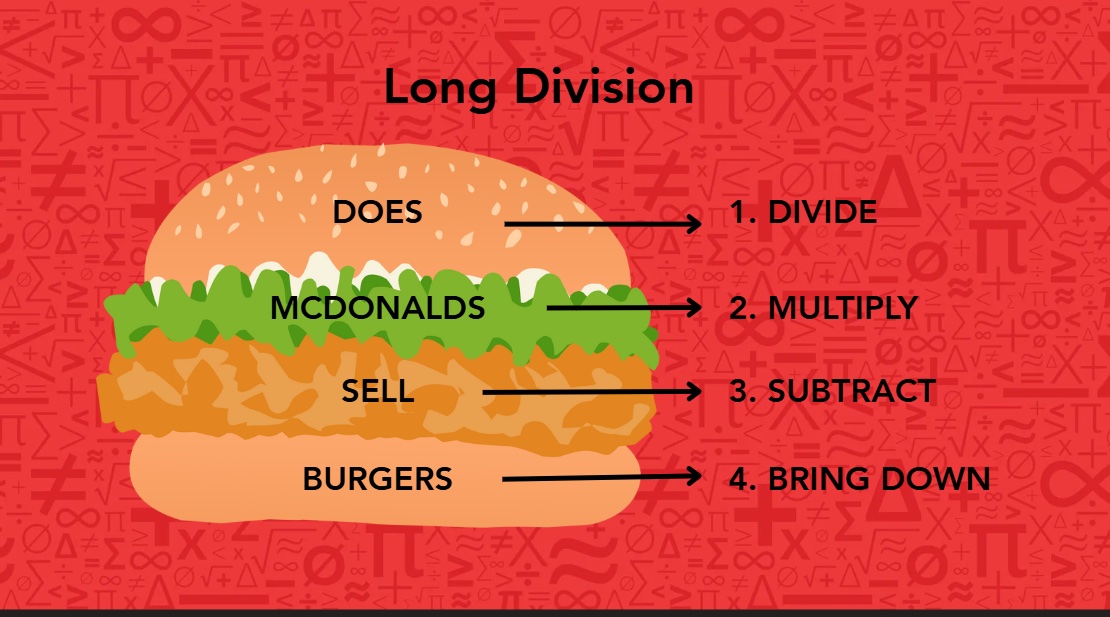
A fun anchor chart makes math steps easy to remember and hard to miss.
Why Some Anchor Charts Don’t Work
From teachers to students to parents, many have taken a shot at making math anchor charts. But they don’t always land.
They’re easy to overlook, easy to misread, and just as easy to forget, until they get pulled off the wall altogether.
The reasons vary, but here are a few common pain points we see that get in the way of anchor charts doing their job.
-
They’re too vague. For example, a chart might say “choose a strategy” or “solve and check”, phrases that sound helpful but don’t give students a clear next step. When they’re stuck, vague reminders don’t move them forward.
-
They’re overloaded. A single chart trying to explain fractions, then squeezes in visuals for pie models, bar diagrams, number lines, and side notes about mixed numbers, can actually create cognitive overload.
-
They’re poorly designed. Think small fonts, low-contrast colors, confusing visuals, or layouts that bury the most important parts. What young learner has the patience to sort through that?
-
Lack of student ownership. When a chart is pre-made, like purchased or copied from online, it may look polished, but students have no mental “hook” for the information. The most effective charts are built together, during the learning process, using the student’s own words and thinking.
-
Vocabulary barriers. If the language on the chart is too technical or abstract, students won’t connect with it.
📕 You May Also Like: How to Teach Math to Visual Learners
What Makes a Math Anchor Chart Actually Work?
If we know what doesn’t work, we’re already off to a good start.
To make a chart that actually helps, our tutors recommend a few simple guidelines:
-
Focus on one idea. Stick to a single skill or strategy. A chart about regrouping should only be about regrouping, not mixed in with rounding or estimation.
-
Use the student’s language. If your child typically says “carry the one,” use that. Charts don’t need fancy vocabulary to be effective. However, they do need to sound familiar.
-
Keep it clean and clear. Every part of the chart should have a purpose. If it feels crowded or confusing, take something off. White space is your friend.
-
Use color with intention. Choose colors that organize the chart in a helpful way, like showing steps in order or grouping related ideas. A well-placed color can draw attention to what matters most.
-
Build it with your child, not just for them. Talk it through together. Ask how they would explain the steps. Even drawing one small part themselves helps them remember it later.
-
Show them how to use it. Use the chart alongside your child during practice. Say things like, “Let’s check the first step together.” When students see the chart in action, they’re more likely to use it on their own later.
📕 You May Also Like: How to Use Math Manipulatives Effectively at Home
3 Anchor Chart Ideas That Support At-Home Math Learning
You don’t need fancy materials or perfect handwriting to make a helpful math anchor chart at home. A sheet of paper, a few markers, some tape, and the right idea can go a long way.
Here are five chart ideas that support learning at home and why they work.
1. Expanded Form Chart (Place Value)
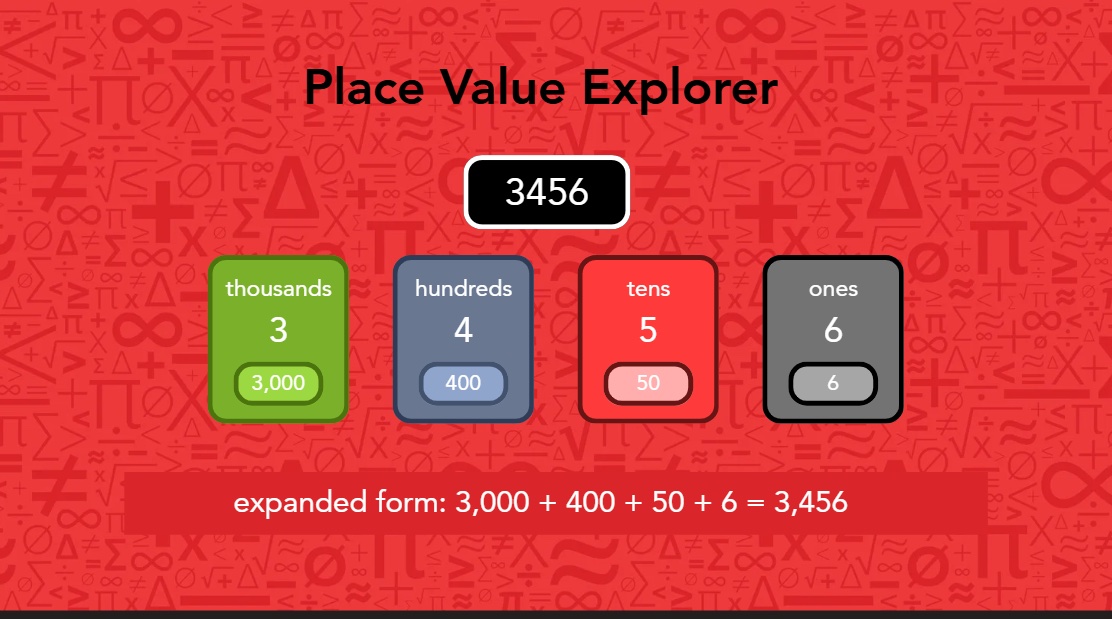
This chart breaks down the number 3,456 so students can clearly see how each digit connects to its value.
-
The full number is written at the top as a reference point.
-
Columns are labeled by place value: Thousands, Hundreds, Tens, Ones.
-
Each digit is placed under its label—3, 4, 5, 6.
-
Below each digit is its value: 3,000, 400, 50, 6.
-
At the bottom, the number is rebuilt in expanded form: 3,000 + 400 + 50 + 6 = 3,456
-
Color helps separate each place visually and makes it easier to follow.
Very simple, right? But that’s what makes it work. Students can see the structure of the number at a glance, and that visual makes it easier to remember and use later.
2. Order of Operations Chart
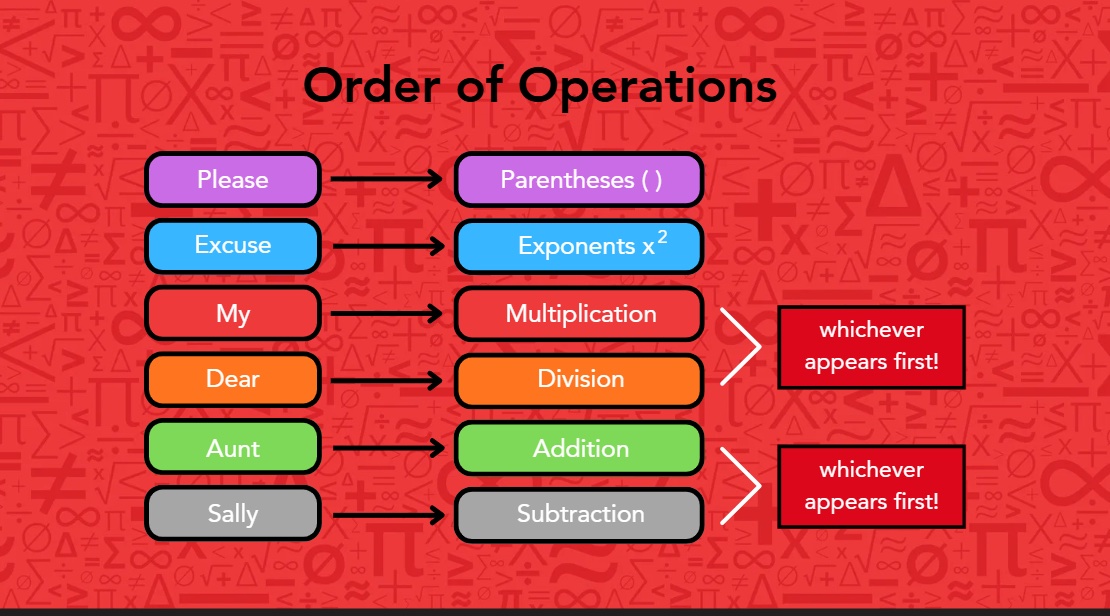
This one helps students remember the correct order of operations to follow when solving multi-step math problems. It’s built around the well-known mnemonic for PEMDAS that goes: “Please Excuse My Dear Aunt Sally” but it adds just enough structure to make the meaning stick.
The left side shows the memory trick: Please Excuse My Dear Aunt Sally.
Each word connects to a math operation.
-
Please -> Parentheses ( )
-
Excuse -> Exponents (², ³, etc.)
-
My -> Multiplication
-
Dear -> Division
-
Aunt -> Addition
-
Sally -> Subtraction
On the right, two red boxes clarify an important rule:
-
Multiplication and division are solved in order from left to right, whichever comes first.
-
Same goes for addition and subtraction.
And that’s it. No more guessing what goes first!
3. Area Model for Multiplication
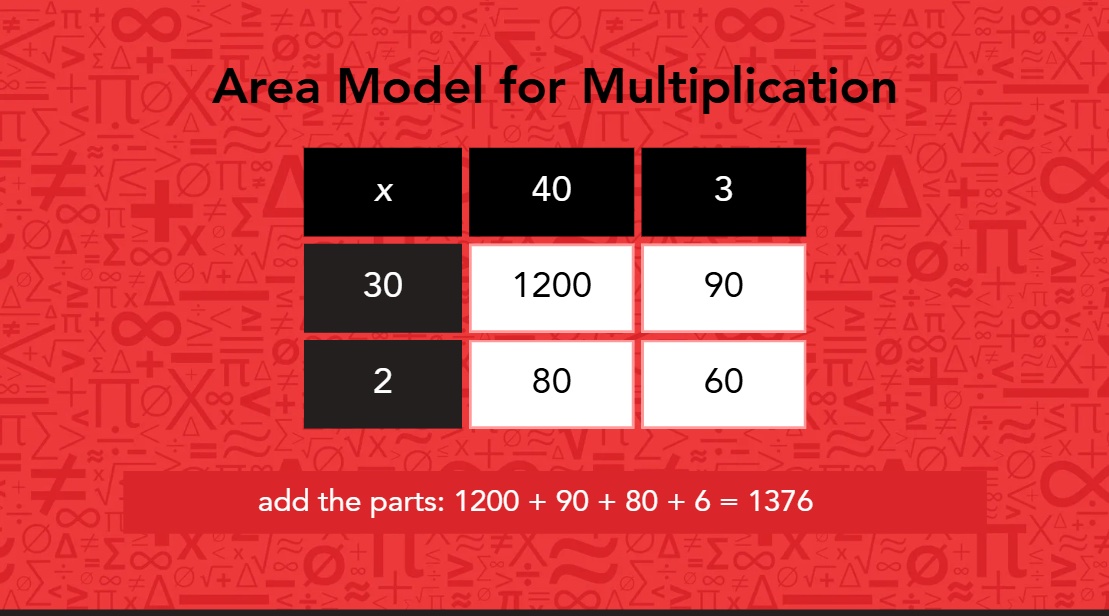
If your child struggles with multi-digit multiplication, this one’s a go-to. It sticks to one clear strategy, the area model or grid method, and shows exactly how to break a big problem into manageable pieces.
Even better, when they get the hang of this setup, they can use the same structure for tons of similar problems.
It has:
-
A simple grid that breaks numbers into place value parts
-
Color-coded boxes to keep partial products organized
-
Space to work without feeling cramped
-
A final step that pulls it all together with one clean total
One glance, and suddenly the steps make sense.
📕 You May Also Like: Why Kids Struggle With Multi-Digit Multiplication (and How to Fix It)

Mathnasium uses multi-sensory techniques, including visuals, to help students make sense of any math concept.
How Mathnasium Helps Students Master Any Math Concept
Charts like this are meant to do one thing well: take a big concept and give students a clear way in. They help decompress the clutter students often carry around a tricky topic, turning confusion into something they can work with. You’ll see anchor charts like this at many of our centers.
Of course, it’s just one tool in the toolshed.
At Mathnasium, it fits into a broader strategy we call the Mathnasium Method™, our proprietary approach designed to help students unlock their full math potential. It’s not about memorizing steps or grinding through drills. It’s focused on building flexible thinkers who truly understand how math works.
How does our approach support real mastery?
It relies on:
-
Personalized learning plans: Each student begins with a diagnostic assessment that reveals their strengths, gaps, and how they think through problems. Using these insights, we build a customized plan that meets them exactly where they are.
-
Teaching for understanding: Our instructors use everyday language and face-to-face instruction, supported by a mix of verbal, visual, mental, tactile, and written techniques. This helps students truly make sense of the math concepts they are learning.
-
Caring, trained instructors: Our tutors are skilled in both content and connection. They know how to support students who are struggling and challenge those who are ready for more.
-
Independent thinking and critical problem-solving: Each session includes time for students to work independently before reviewing with their instructor. We teach both the how and the why, helping students build the reasoning and problem-solving tools they’ll use in math and beyond.
-
Singular focus on math: We specialize in math and math only. Our curriculum is built from thousands of thoughtfully developed pages, continually refined to reflect how students absorb, learn, and retain math best.
-
A confidence-building, fun environment: Parents often tell us Mathnasium sessions don’t feel like lectures. We use game-based activities, small wins, and reward systems to keep students engaged and proud of their progress.
The results are real and measurable:
-
94% of parents report an improvement in their child’s math skills and understanding
-
93% of parents report improved attitude toward math after attending Mathnasium
-
90% of students saw an improvement in their school grades
With a network of over 1,100 learning centers across the U.S., Mathnasium brings top-rated tutors and our efficient approach close to your community.
For families located in or near Surprise, AZ, Mathnasium of Surprise is a trusted local center with a proven record of helping students excel in math.
If your child is looking to catch up, keep up, or get ahead in math, our team is happy to assist!
📅 Schedule a Free Diagnostic Assessment at Mathnasium of Surprise
Not near Surprise, AZ?
📍 Find a Mathnasium Learning Center Near You


 (623) 533-4503