Families in La Jolla exploring Algebra 2 courses may be looking for details about what the course covers, how students can prepare, and the available support options.
We provide personalized, face-to-face math instruction at Mathnasium of La Jolla to help students in La Jolla and nearby communities such as Torrey Pines and Bird Rock build their algebra skills and solid math foundations.
Today, we’ll provide an overview of the necessary foundations for Algebra 2, how the topics fit into the local curriculum, and the local learning resources families can explore.
Algebra 2 Curriculum Overview in La Jolla, California
Math instruction at La Jolla High School, part of San Diego Unified School District (SDUSD), follows California’s standards through an integrated math pathway. Students study Algebra 1, Geometry, and Algebra 2 across Integrated Math 1, 2, and 3 instead of taking separate courses.
Math pathways vary among schools in La Jolla and the surrounding area. While La Jolla High School follows an integrated math sequence, nearby schools such as Cathedral Catholic High School offer Algebra 2 as a separate course.
This guide focuses on Algebra 2 as a standalone course.
Families can consult their child’s school course guide for descriptions, prerequisites, and pathway information. For learning materials, assignments, and additional practice, ask the math teacher which textbook, online platforms, and support resources the class uses. Cathedral Catholic families can start with the school’s Curriculum & Programs page.
For La Jolla students taking a standalone Algebra 2 course, California’s Algebra 2 standards include:
-
Polynomial operations, factoring, zeros, and connections between equations and graphs.
-
Rational and radical expressions, equations, and functions, including identifying extraneous solutions.
-
Exponential and logarithmic functions, inverse functions, and transformations of graphs.
-
Complex numbers and quadratic equations with complex solutions.
-
Trigonometric functions, the unit circle, and models of repeating patterns.
-
Statistical inference, normal distributions, and evaluating conclusions from surveys, experiments, and observational studies.
-
Equations and graphs of circles and parabolas, including using completing the square to identify their features.
Students use these ideas to model changing quantities, describe repeating motion, and evaluate conclusions drawn from data. They also explain their reasoning, compare mathematical representations, and check whether their solutions make sense in context.
1. Polynomials, Rational Expressions, and Equations
Polynomials are expressions made up of terms with variables raised to non-negative whole-number exponents. Students use polynomial division and the Remainder Theorem to understand relationships between polynomials and their factors.
Rational expressions are ratios of polynomials, and students rewrite them to solve simple rational and radical equations. They also examine extraneous solutions: values produced during the solving process that don’t satisfy the original equation.
2. Functions, Graphs, and Inverse Relationships
Students work with polynomial, rational, radical, exponential, and logarithmic functions, connecting equations to tables and graphs. They interpret features such as intercepts, intervals of increase and decrease, and end behavior, and select functions that appropriately model a relationship.
Students also explore transformations and inverse functions. Transformations change a graph’s position or shape, while an inverse function reverses the original input-output relationship. California’s Algebra 2 standards include using graph intersections, tables, and technology to find approximate solutions to equations.
3. Exponents, Logarithms, and Complex Numbers
Algebra 2 builds on students’ understanding of exponents and roots. Students graph exponential and logarithmic functions, use logarithms to solve exponential equations, and apply logarithm properties to rewrite and simplify expressions.
Students also calculate with complex numbers, which have the form a + bi , where a and b are real numbers and the imaginary unit i is defined by i2 = -1. They add, subtract, and multiply complex numbers and solve quadratic equations with complex solutions.
California’s standards identify additional advanced content, including polynomial identities involving complex numbers and the Fundamental Theorem of Algebra. These expectations are marked with a plus sign to distinguish them from the course’s core standards.
4. Trigonometric Functions and Repeating Patterns
Students extend trigonometry beyond right triangles by using the unit circle and measuring angles in radians. They graph trigonometric functions and interpret features such as amplitude, period, and midline. They also prove and apply the Pythagorean identity, sin2 θ + cos2 = 1.
These functions help describe quantities that repeat in cycles. For example, a model of the form y = a sin(bx) + d, where b ≠ 0, can represent repeating motion. Its parameters determine the amplitude, period, and midline, helping students connect the graph to the situation being modeled.
5. Statistical Inference and Evaluating Evidence
Statistical inference involves using a sample to draw conclusions about a larger population. Algebra 2 students distinguish among sample surveys, experiments, and observational studies, and examine the role of randomization in each.
Students also use means and standard deviations to work with normal distributions, estimate population means or proportions, and develop margins of error through simulations. They compare treatments in randomized experiments and evaluate reports based on data.
Algebra 2 Foundations: What Should La Jolla Students Know to Prepare?
Preparation for Algebra 2-level work involves using earlier skills from Algebra 1 and Geometry. For students preparing for a standalone Algebra 2 course, the following review areas connect directly to California’s expectations.
1. Expressions, Equations, and Factoring
Polynomial and rational expressions build on the ability to combine like terms, apply the distributive property, and recognize equivalent forms. Factoring helps students connect an expression’s structure to the solutions of an equation and the zeros of a function.
For example, students should be able to explain why x2 + 5x + 6 = (x+2)(x+3) and use the factored form to solve x2 + 5x + 6 = 0.
2. Functions, Graphs, and Mathematical Notation
Students should be comfortable evaluating functions and connecting equations, tables, and graphs. These skills support later work with transformations, inverse functions, and interpreting features of more complicated graphs.
A useful review is to ask students to evaluate a function for a given input and explain the result. For f(x) = 2x + 3, they should understand that f(4) = 11 means an input of 4 produces an output of 11.
3. Exponents and Roots
Reviewing exponent rules and the relationship between powers and roots prepares students for radical functions, exponential equations, and logarithms.
For example, understanding why \(16^{\frac{1}{2}}\) = 4 connects fractional exponents to square roots. Similarly, 23 = 8 and log28 = 3 express the same relationship in different forms.
Algebra 2 Support Resources Available to La Jolla Students
Families can begin with school resources and public library tutoring, then consider personalized instruction when a student needs more sustained support.
-
La Jolla High School tutoring resources: Families should confirm current schedules and whether tutors are available for Integrated Math 3 or Algebra 2-level questions. The page also directs families to their school counselor for help discussing support options.
-
San Diego Public Library online tutoring: The library advertises free, live online tutoring, including K–12 math support in English and Spanish. These online services are a better fit for advanced high school questions than assuming the library’s in-person K–8 homework coaches cover Algebra 2.
-
Mathnasium of La Jolla: Our personalized algebra instruction supports students of all skill levels, both in-center and online. We help students strengthen foundational skills, understand current coursework, and work toward algebra mastery, whether they need to catch up, keep up, or get ahead.
Potential Funding for Algebra 2 Support Available to La Jolla Students
La Jolla families can explore the following resources for help with the cost of math support. Each program has its own eligibility requirements and application schedule, so families should check current details before applying.
-
Folds of Honor Children’s Fund: Eligible children of fallen or qualifying disabled military service members and first responders can receive up to $5,000 per academic year for approved educational expenses, including K–12 tutoring. Mathnasium of La Jolla may accept Folds of Honor scholarship funds. Parents should confirm with the center before enrolling.
-
Our Military Kids activity grants: Eligible children of deployed National Guard and Reserve members and qualifying combat-injured service members or veterans may receive grants for activities, including tutoring. Families should confirm current eligibility and grant limits before applying.
-
Public charter-school educational budgets: Families enrolled in participating charter schools, such as Pacific Coast Academy, may be able to use school funding for approved tutoring. Services require advance authorization, and families should confirm Mathnasium of La Jolla’s vendor status with their school. This funding is available to enrolled students, not all La Jolla residents.
FAQs About Algebra 2 in La Jolla
Families may have questions about course placement, graduation requirements, and the options available after advanced algebra. At La Jolla High School, these questions generally relate to Integrated Math 3 rather than a standalone Algebra 2 course.
1. What is the difference between Algebra 2 and Integrated Math?
Algebra 2 is a standalone course in the traditional Algebra 1–Geometry–Algebra 2 pathway. Integrated Math is a sequence that combines algebra, geometry, and statistics across several courses.
Many Algebra 2 topics appear in Integrated Math III, but the courses are not interchangeable because their content is organized differently.
Schools in the wider area use different pathways. For example, Cathedral Catholic High School in nearby Carmel Valley offers Algebra 2, while La Jolla High School lists Integrated Math 1, 2, and 3. Families should check their child’s school course guide to confirm the sequence they follow.
2. What should my child know before starting Algebra 2?
Students should be comfortable simplifying expressions, factoring quadratics, solving equations and systems, applying exponent rules, and interpreting functions and graphs.
Algebra 2 builds on these skills through more advanced work with polynomial, rational, radical, exponential, and logarithmic relationships.
Reviewing recent work with the teacher can help identify which skills need attention. For formal prerequisites, including required courses and minimum grades, you should consult the school’s current course guide.
3. What is the difference between regular and honors Algebra 2?
An honors designation generally indicates additional depth, challenge, or a faster pace, but the exact differences depend on the school. California’s Algebra 2 standards also identify additional advanced content with a plus sign, but this doesn’t establish one uniform honors course for every school.
Ask the school how its two courses differ in content, workload, and prerequisites instead of assuming that taking honors automatically allows a student to skip the next course.
4. Does Algebra 2 help meet University of California math admission requirements?
Yes, Algebra 2 can provide the advanced algebra component of the University of California’s math requirement. UC requires three years of qualifying college-preparatory mathematics covering elementary and advanced algebra and geometry. A fourth year is, however, strongly recommended.
Passing Algebra 2 alone does not satisfy the entire requirement. Families should confirm that the course is UC-approved and that their child’s complete sequence and grades meet admission requirements.
5. Which math course usually comes after Algebra 2?
Precalculus is a common next step for students preparing for calculus. Depending on their school’s offerings and prerequisites, students may also have options such as statistics or a separate trigonometry course. California’s framework allows schools to organize higher math coursework in different ways.
The appropriate choice depends on the student’s understanding, interests, and future plans. Ask the teacher or counselor which courses the student qualifies for and whether additional preparation would be helpful.
Students should confirm their next course using current counseling materials and teacher guidance.
 Mathnasium helps K-12 students prepare for algebra courses in a fun and supportive environment.
Algebra 2 Tutoring at Mathnasium of La Jolla
Mathnasium of La Jolla is a math-only learning center dedicated to helping K–12 students in local communities, including La Jolla, Torrey Pines, and Bird Rock.
We work with students of all skill levels and help them excel in algebra and beyond, whether they need to catch up, keep up, or get ahead.
To meet students where they are and guide them forward in algebra step by step, we use the Mathnasium Method™, our proprietary teaching approach.
Here’s how it works.
Each student begins their Mathnasium enrollment with a diagnostic assessment that helps us identify their current skills, areas for improvement, and how they think about algebra and math in general.
With these insights, we create a personalized algebra learning plan. For a student enrolled in Algebra 2, that may mean revisiting a foundational skill, developing a deeper understanding of current coursework, or exploring more advanced concepts when they’re ready for a greater challenge.
With the plan in place, our specially trained tutors follow it closely, providing face-to-face math instruction in a supportive setting. We use a mix of verbal, visual, mental, tactile, and written teaching techniques so students truly understand any Algebra 2 concept instead of relying on memorized procedures.
If a student struggles with an Algebra 2 concept, we break it down into manageable bits and show them both the how and the why behind the answer. In time, students gain their own problem-solving abilities and critical thinking tools they can rely on in their Algebra 2 course and beyond.
Fun is an integral part of the approach, as we use game-based activities, rewards, and consistent encouragement to keep students engaged as they revisit earlier skills and prepare for Algebra 2 and the math courses that follow it.
The results across Mathnasium centers speak for themselves:
-
94% of parents report an improvement in their child's math skills and understanding
-
93% of parents report their child's improved attitude toward math after attending Mathnasium
-
90% of students saw an improvement in their school grades
Mathnasium of La Jolla has also earned local recognition, receiving a Readers’ Choice Award from La Jolla Light and more than 100 Google reviews from families sharing their experiences with our center.
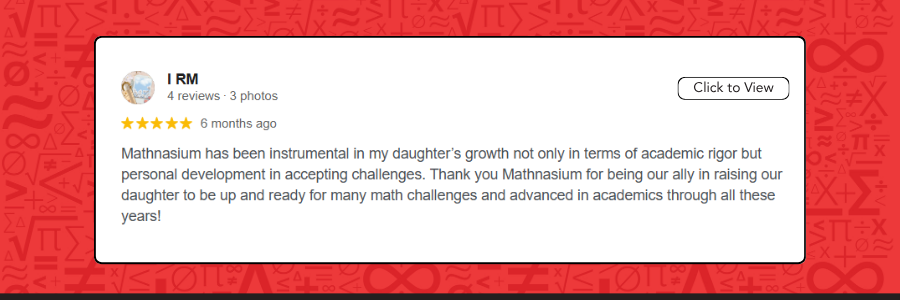
Here is what one parent had to say about their experience with Mathnasium.
If your child needs help with algebra foundations or current Algebra 2 coursework, a free diagnostic assessment is a great place to start. Using what we learn, we create a personalized learning plan focused on the skills your child needs next to prepare for the math ahead.
📅 Schedule a Free Assessment at Mathnasium of La Jolla
Not near La Jolla, San Diego?
📍 Find a Mathnasium Learning Center Near You


 (858) 291-8186
 (858) 291-8186