We've probably all divided up a group of things and ended up with a few left over, some extra cookies, one empty seat, or some spare change. In math class, we call that leftover amount a remainder.
The same remainder shows up in real life, but what we do with it depends on the situation.
Today, our Mathnasium tutors explain what a remainder is, how we find one, and why the same leftover number can mean something different depending on the situation.

What Is a Remainder in Division?
A remainder is the amount left over after we split a number into as many equal groups as we can.
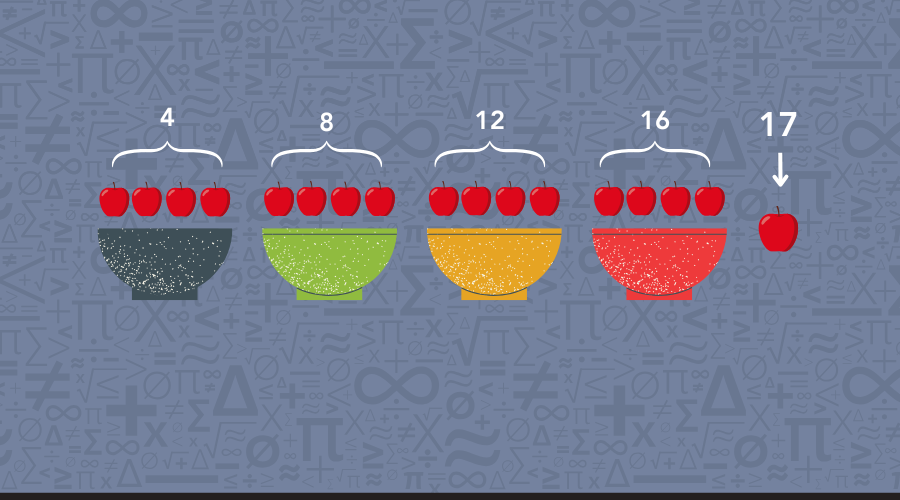
Let's look at an example. Suppose we have 17 apples and want to pack them evenly into baskets of 4.
-
We put 4 apples in the first basket (4 apples used).
-
We put 4 more in the second basket (8 apples used).
-
We put 4 more in the third basket (12 apples used).
-
We put 4 more in the fourth basket (16 apples used).
We've used 16 of our 17 apples. How many are left? Let's check. 17 − 16 = 1, so 1 apple is left over.
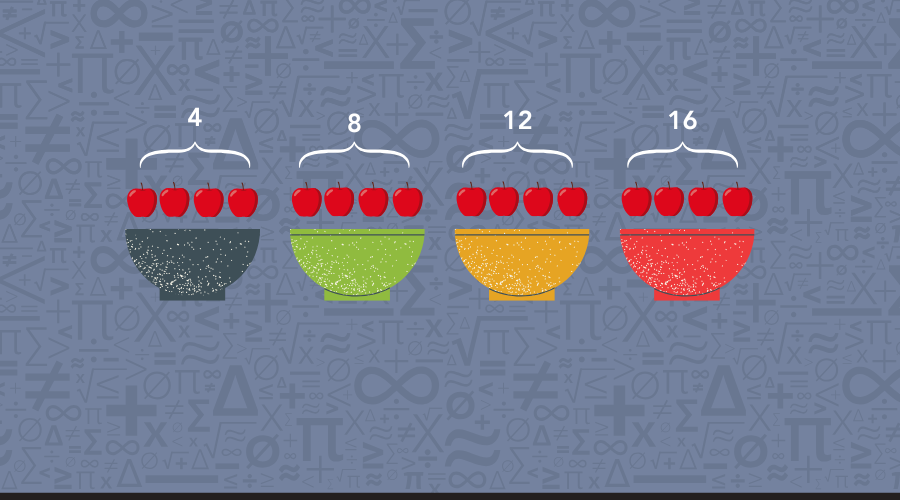
What if we only had 16 apples instead of 17? We could pack 4 full baskets of 4, using every apple, with nothing left over.
16 ÷ 4 = 4
A number that divides evenly has a remainder of 0!
But with our 17 apples, we have that 1 leftover apple. In math notation, we write this extra piece as:
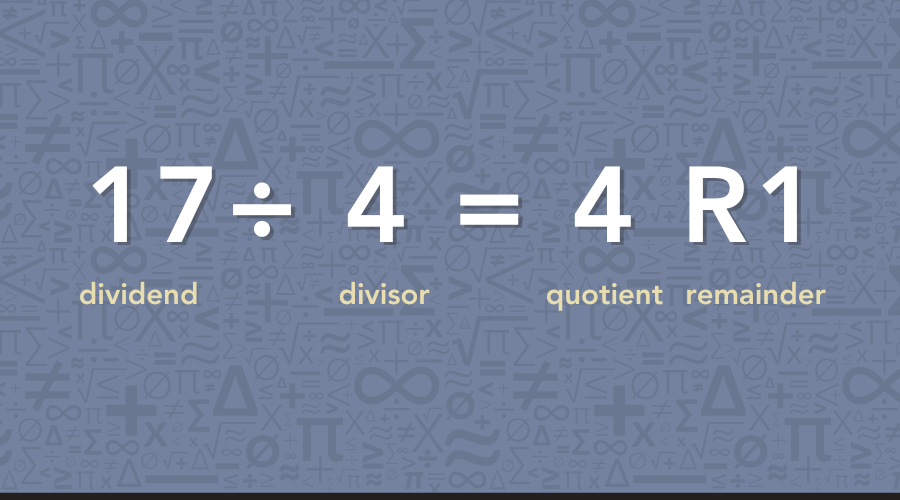
17 ÷ 4 = 4 R 1
Every division problem has four parts working together, and each one has its own name. Here's what they are, using our apple example to show what each one looks like:
-
Dividend: the total amount we're starting with. In our example, the dividend is 17, our full set of apples.
-
Divisor: the size of each equal group we're splitting into. The divisor is 4 here, since that's how many apples go in each basket.
-
Quotient: the number of full groups we're able to make. Our quotient is 4, since we filled 4 baskets.
-
Remainder: the leftover amount. Here, the remainder is 1, our single leftover apple.
📕 You May Also Like: 3 Ways to Help Your Child Finally Understand Division
How to Find a Remainder in Division (Step-by-Step Example)
We find a remainder in division by figuring out how close we can get to our total using equal groups, then checking what's left over.
Let's work through it step by step using 22 ÷ 5.
Step 1: Find the closest multiple.
Our divisor tells us that each group holds 5, so we count by 5s to see how close we can get to 22 without going over: 5, 10, 15, 20, 25.
25 is too big, since it goes past 22. The closest we can get without going over is 20, since 5 × 4 = 20. That makes our quotient 4.
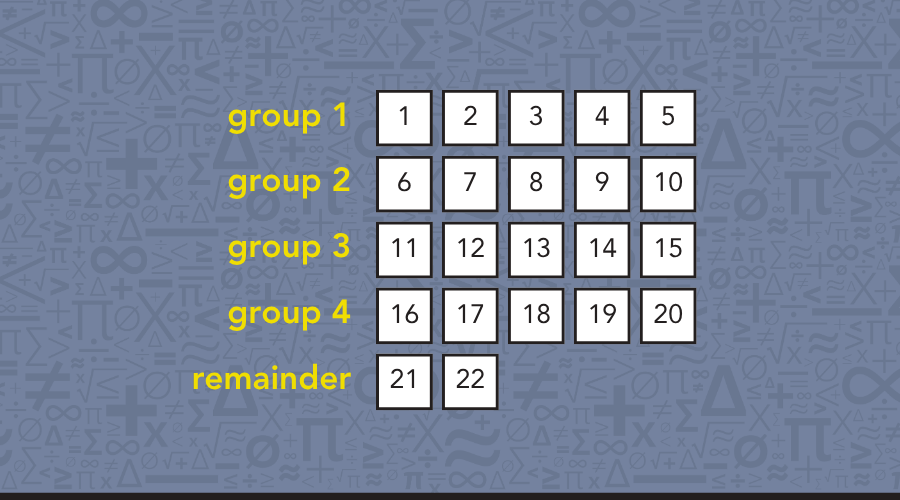
Step 2: Subtract the closest multiple from our starting number to find the leftover.
We take 20 (our closest multiple) away from our starting number, 22:
22 − 20 = 2
Step 3: Write the answer
We combine our quotient and our remainder to write:
22 ÷ 5 = 4 R2
Our remainder is 2.
Now that we've found it, could our remainder ever have been 5 or bigger? Let's check.
If we had 5 left over, that would mean one more full group of 5 was hiding in there the whole time, so we'd count it as a fifth group instead of a remainder.
That's why our remainder always ends up smaller than our divisor.
📕 You May Also Like: 3 Fun Ways to Practice Long Division without Worksheets
How Real-Life Situations Change What We Do with a Remainder
What we do with a remainder depends on the situation. After that same leftover number shows up in a real situation, the same division problem can lead to more than one correct next step.
Whenever we work with a remainder in real life, we lean on three general options:
-
Round it up
-
Drop it
-
Split it
Still, choosing the right path comes down to what we're actually trying to figure out.
Our Mathnasium tutors picked three situations that each treat a remainder in a different way. Let's go through them together!
1. How to Know When to Round Up a Remainder
We round up a remainder when the leftover items still require a full group, space, or container.
Standard mathematical rounding rules only bump a number up to the next digit if the value ends in .5 or higher. A real-life problem changes this rule. We add a whole extra unit the moment even one single person or item is left over.
Let’s see how this works using a grocery example. Suppose we have 20 eggs, and each carton holds a maximum of 6 eggs. We divide 20 by 6 to find the number of cartons we need:
20 ÷ 6 = 3 R 2
Three full cartons hold 18 eggs because 3 × 6 = 18. The calculation leaves 2 eggs left over because 20 - 18 = 2.
So what are we going to do with 2 leftover eggs?
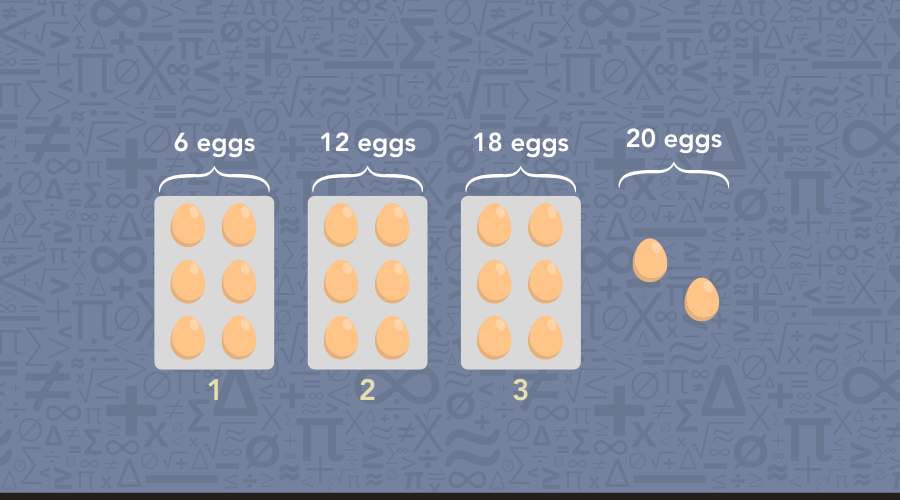
We must take one more carton to hold the remaining eggs, even though that final container stays mostly empty. We round up to give every egg a safe spot.
The necessity of a safe container pushes our calculation from 3 to a real-world answer of 4 cartons.
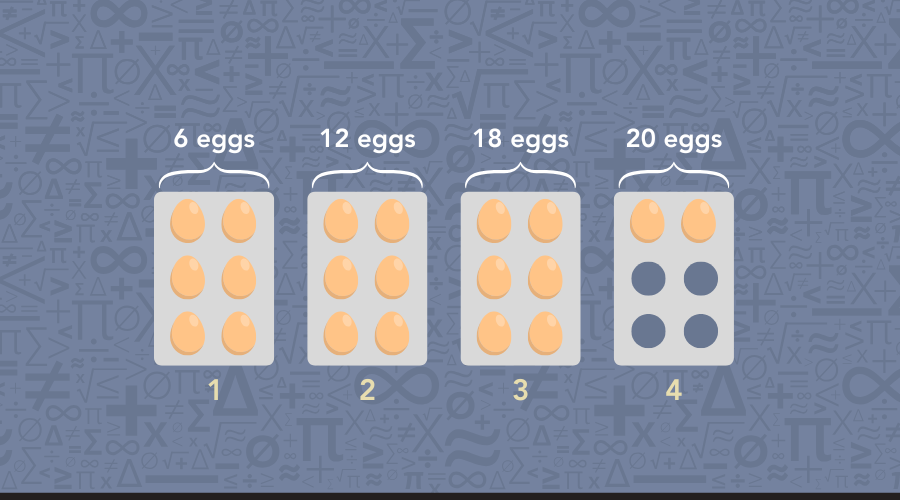
We round up the remainder in these situations:
-
Containers: Leftover items still require storage, such as our extra egg carton.
-
Transportation: Every extra passenger requires a seat, such as driving an extra car to transport two remaining friends.
-
Tables or Seating: Every guest requires a chair, which forces us to set up one additional table for the leftover guests.
2. How to Know When to Drop a Remainder
We drop a remainder when the leftover amount is too small to complete a full group, and the item cannot be broken into smaller pieces.
Suppose we have $25 to spend on books that cost $8 each. We divide $25 by $8 to find how many books we can buy:
25 ÷ 8 = 3 R 1
Buying 3 books costs $24 because 3 × $8 = $24. This purchase leaves us with a single dollar bill because $25 - $24 = $1.
So, what happens to that last dollar? It simply stays in our wallet. Since a new book costs $8, our single dollar cannot buy another one. Because we can only buy complete items, we walk away with exactly 3 books.
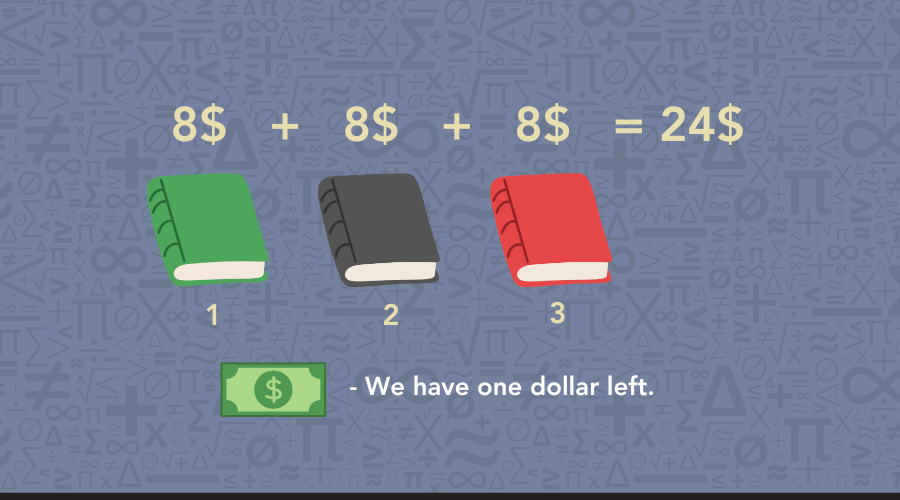
We drop the remainder in these situations:
-
Shopping: Leftover money is less than the price of one more full item.
-
Treats: A leftover item cannot be broken apart, such as an extra lollipop or a toy.
-
Matching Pairs: A remaining item cannot form a complete set, such as a single leftover sock.
3. How to Know When to Share a Remainder
We share a remainder by turning it into a fraction or decimal when the leftover resource can be broken down and divided equally.
Imagine 2 friends splitting 7 cookies. At first, this problem seems like the book or egg scenario because 7 does not divide evenly by 2. If we deal out the whole cookies evenly to start, the math looks like this:
7 ÷ 2 = 3 R 1
Giving 3 whole cookies to each of the 2 friends uses up 6 cookies because 3 × 2 = 6. This leaves 1 whole cookie untouched because 7 - 6 = 1.
The answer here is a bit different because food can be divided into parts. We can break that last remaining cookie into 2 equal pieces.
That means that each friend receives half of the final cookie, and we can split everything equally. Instead of writing 7 ÷ 2 = 3 R 1, we can write our answer as a fraction 3\(\Large\frac{1}{2}\) or as a decimal 3.5.
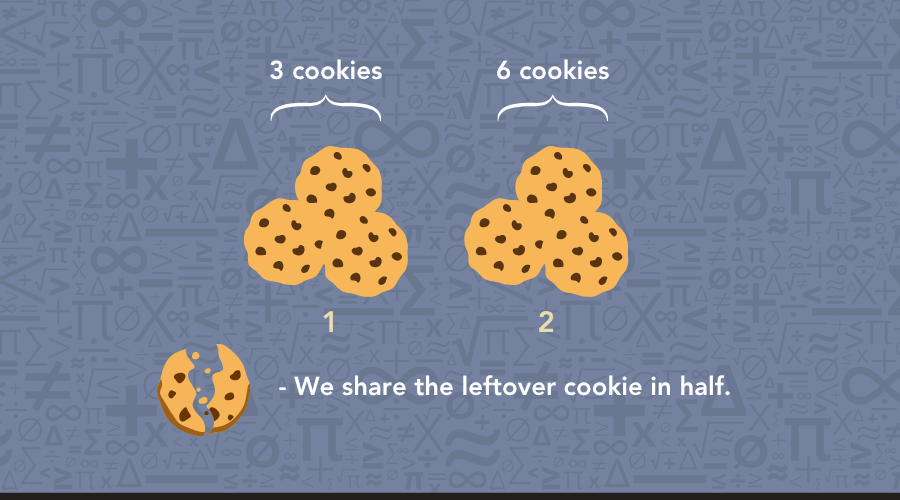
We share a remainder in these situations:
-
Food items: A leftover treat can be broken or sliced, such as cake, cookies, or fruit.
-
Cash pools: Shared money can be broken down into smaller units, such as splitting a $21 bill two ways into exact dollar and cent amounts.
-
Measurements: A remaining length can be cut, such as a piece of ribbon, wood, or string measured in inches.
📕 You May Also Like: 5 Ways to Help Your Child Build Flexible Thinking in Math
Try It Yourself: Round Up, Drop, or Share a Remainder?
For each problem below, divide first to find the remainder, then decide what happens to it. Do we round it up, drop it, or share it? Write your answer as a full sentence explaining your choice, not just a number.
-
A teacher has 29 students going on a field trip. Each van holds 8 students. How many vans does the teacher need?
-
A family has $34 to spend on tickets that cost $9 each. How many tickets can they buy?
-
Two cousins want to split 9 brownies evenly. How much does each cousin get?
You can check your answers at the end of this article.
 At Mathnasium, we help students understand what any math concept means, beyond just finding the answer.
How Mathnasium Helps Students Understand Division (and Any Other Math Concept)
Mathnasium is a math-only learning center dedicated to helping K-12 students of all abilities learn and master math.
A student might be just starting to divide, working through remainders for the first time, or moving on to fractions and decimals. Wherever they are in that progression, we meet them there and help them build true understanding.
We do this through the Mathnasium Method™, our proprietary teaching approach, built around what each student needs and how they learn best. Our approach includes:
-
Assessment and Personalized Learning Plans: Each student begins their Mathnasium journey with a diagnostic assessment that identifies their current skill level, learning style, and goals. From those insights, we build a personalized learning plan tailored to what they need next, whether that means strengthening division facts, building number sense, or moving on to fractions and decimals.
-
Teaching for Understanding: Our specially trained tutors use a mix of verbal, visual, mental, tactile, and written techniques so every concept makes sense before a student moves forward.
-
Problem-Solving and Critical Thinking: We give students room to work through problems on their own first. When we do step in, we explain both the how and the why behind each answer, so students build reasoning skills they can use far beyond a single math problem.
-
An Engaging and Fun Learning Environment: Sessions include games, earned rewards, and consistent recognition of progress, helping students build confidence alongside their skills.
The impact extends beyond the classroom:
-
94% of parents report an improvement in their child's math skills and understanding.
-
93% of parents report their child's improved attitude toward math after attending Mathnasium.
-
90% of students saw an improvement in their school grades.
With over 1,100 learning centers across North America, there is likely a Mathnasium close to you.
Our community recognizes that impact with 100+ glowing Google reviews and a Reader's Choice Award from La Jolla Light.
If remainders or any other math concept are giving a student trouble, our team is ready to help.
📅 Schedule a Free Diagnostic Assessment at Mathnasium of La Jolla
Not near La Jolla?
📍 Find a Mathnasium Learning Center Near You
Psst! Check Your Answers Here
How did you do? Let's find out together.
1. We divide 29 by 8, which gives 3 R 5. Since 5 students still need a seat, we round up. The teacher needs 4 vans.
2. We divide 34 by 9, which gives 3 R 7. Since $7 isn't enough for a fourth ticket, we drop the remainder. The family can buy 3 tickets.
3. We divide 9 by 2, which gives 4 R 1. Since the leftover brownie can still be cut, we share it in half. Each cousin gets 4\(\Large\frac{1}{2}\) brownies.


 (858) 291-8186
 (858) 291-8186