Your child will usually meet a perimeter in elementary school, and the concept can be more challenging than it first appears. From our work with students at Mathnasium, we see that much of the confusion around it starts with how perimeter is introduced.
Perimeter and area are usually taught close together, so the two can easily blur. And if your learner focuses on steps before they fully understand what perimeter measures, they may know what to do on one type of problem but get stuck as soon as the layout changes.
With that in mind, we’ve put together a simple guide to help parents support their students with the concept. We’ll explain what perimeter is, show how to find it for common shapes, and highlight the mistakes to avoid.

What Is Perimeter?
Perimeter is the total distance around the outside edge of a flat shape. We write it as P.
Imagine we walk around the edge of a playground. We start at the gate, follow the fence all the way around, and end back at the gate. The distance we walked is the playground’s perimeter. We didn’t cut across the grass or walk through the sandbox. We stayed on the outside edge the whole time.
We can try the same idea on paper. Let’s draw a triangle and place our pencil on one corner. We trace the first side, continue along the second and third sides, and stop once our pencil reaches the starting corner again. The length of that full path around the triangle is its perimeter.
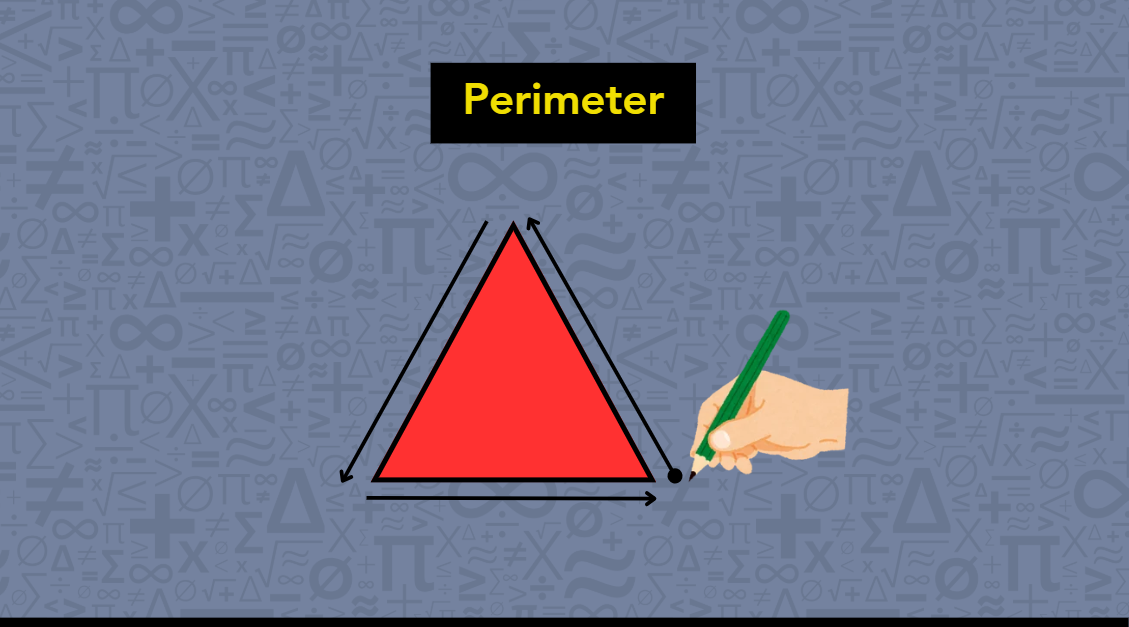
To help students see the concept in context, our tutors often connect perimeter to everyday situations during sessions. Here are a few we can spot at home or around town:
| Where we meet perimeter |
What we’re measuring |
| Fencing a backyard |
How much fence we need to go all the way around the yard. |
| Framing a picture |
How much frame material wraps around the edges. |
| Decorating a bulletin board |
How much border trim fits along the outside edge. |
| Running laps around a track or field |
How far we travel in one full loop. |
In each case, we follow the outside edge from start to finish. Next, we’ll turn that path into numbers and see how we calculate perimeter.

How to Find the Perimeter of Different Shapes
To find the perimeter of a shape, we add the lengths of all its outer sides. Each side gives us one part of the full distance around the shape.
For an accurate answer, we need to:
-
Count every side so we do not miss one
-
Find any missing side lengths using the information we already have
-
Add all the side lengths and keep the same unit in our answer
Let’s put this into practice and find the perimeter of the most common shapes.
A. Perimeter of a Triangle
We’ll start by calculating the perimeter of the triangle, whose sides measure 4, 5, and 6 inches.
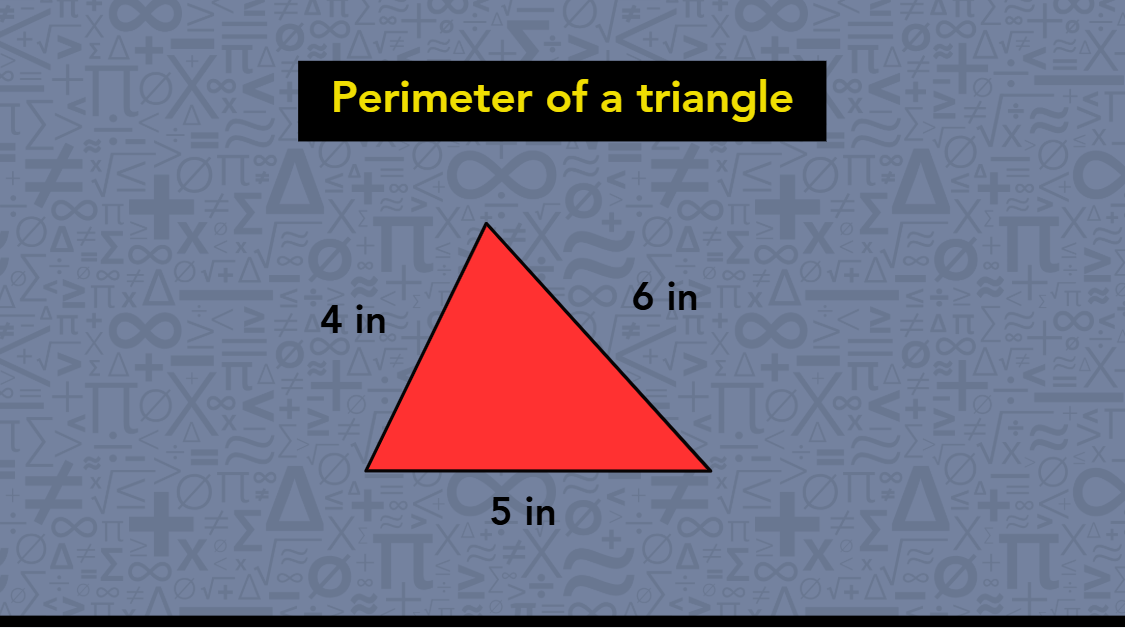
Our triangle has three sides, and all three lengths are already given, so we can go straight to adding them:
P = 4 + 5 + 6 = 15.
So the perimeter is 15 inches.
We can use the same idea for any triangle. If we call the three side lengths a, b, and c, we can write the perimeter formula as:
P = a + b + c.
📕 You May Also Like: Types of Triangles for Grades 4–8: A Complete Guide
B. Perimeter of a Rectangle
Now, let’s find the perimeter of a rectangle that is 5 inches long and 3 inches wide.
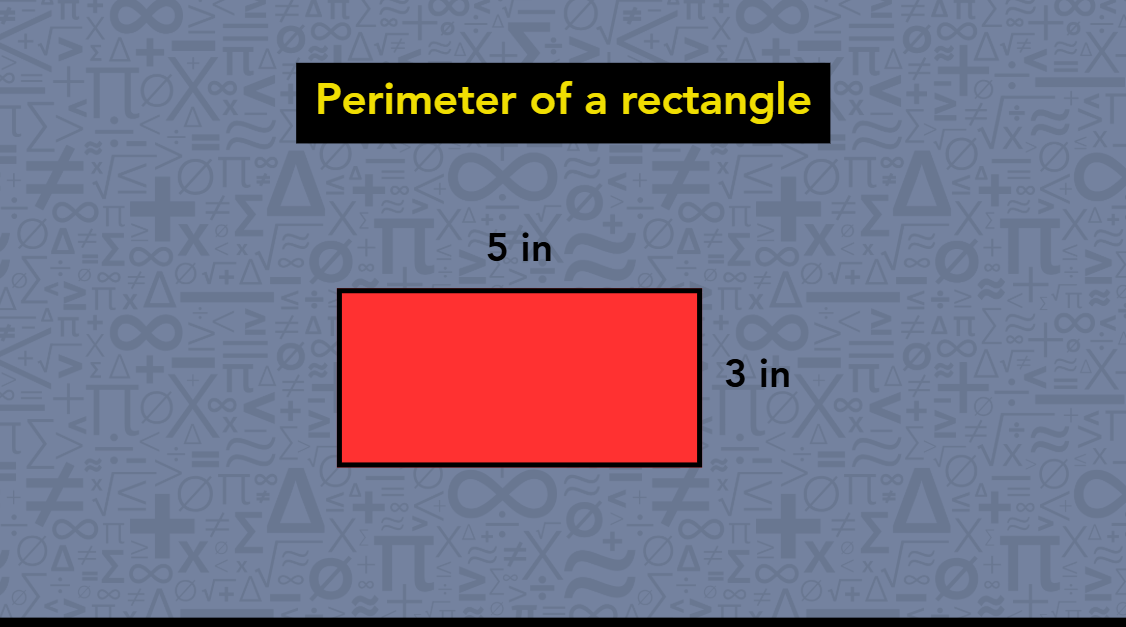
In a rectangle, opposite sides are equal. So if we know the length and the width, we can use that to fill in the two unlabeled sides.
Then, we add them:
P = 5 + 5 + 3 + 3 = 16.
This gives us a perimeter of 16 inches, and we keep the same unit in our answer.
There’s also a shorter way to get the same result. Since a rectangle has two equal lengths and two equal widths, we can add one length and one width, then double the total:
P = 2(5 + 3) = 16.
This shortcut works for any rectangle. If we use l for length and w for width, we can write:
P = 2(l + w).
We may also see:
P = 2l + 2w.
Both formulas mean the same thing. One doubles the sum of the length and width, while the other doubles each measurement separately before adding.
Whichever version we use, we need two lengths and two widths. If we add only one length and one width, we have measured only half of the rectangle’s perimeter.
C. Perimeter of a Square
Next, we’ll calculate the perimeter of a square with side lengths of 3 inches.
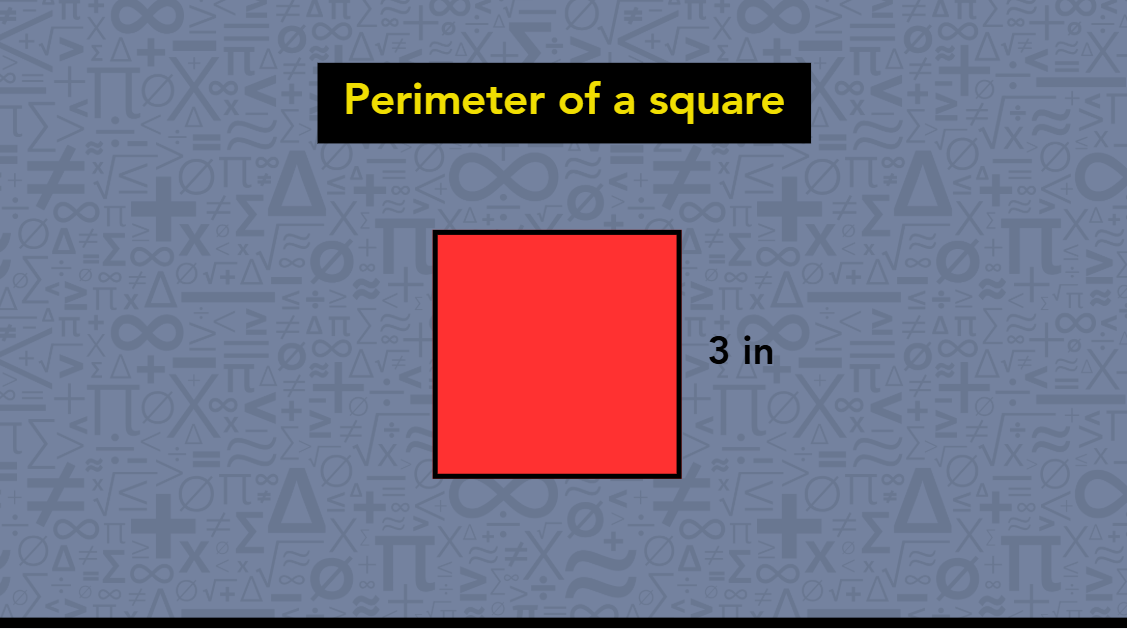
A square has four equal sides, so once we know one side is 3 inches, we know all four side lengths and can add them:
P = 3 + 3 + 3 + 3 = 12.
This means our perimeter is 12 inches. Because all four sides have the same length, instead of adding 3 four times, we can just multiply 3 by 4:
P = 3 × 4 = 12.
Let s stand for the length of one side, and we get the perimeter formula for any square:
P = 4s.
D. Perimeter of Other Polygons
A polygon is a flat, closed shape made of straight sides. Triangles, rectangles, and squares are all polygons. So are pentagons with 5 sides, hexagons with 6, and octagons with 8.
Polygons can be regular or irregular:
-
Regular polygons have all sides the same length, and all angles the same measure.
-
Irregular polygons have at least one side length or angle measure that is different.
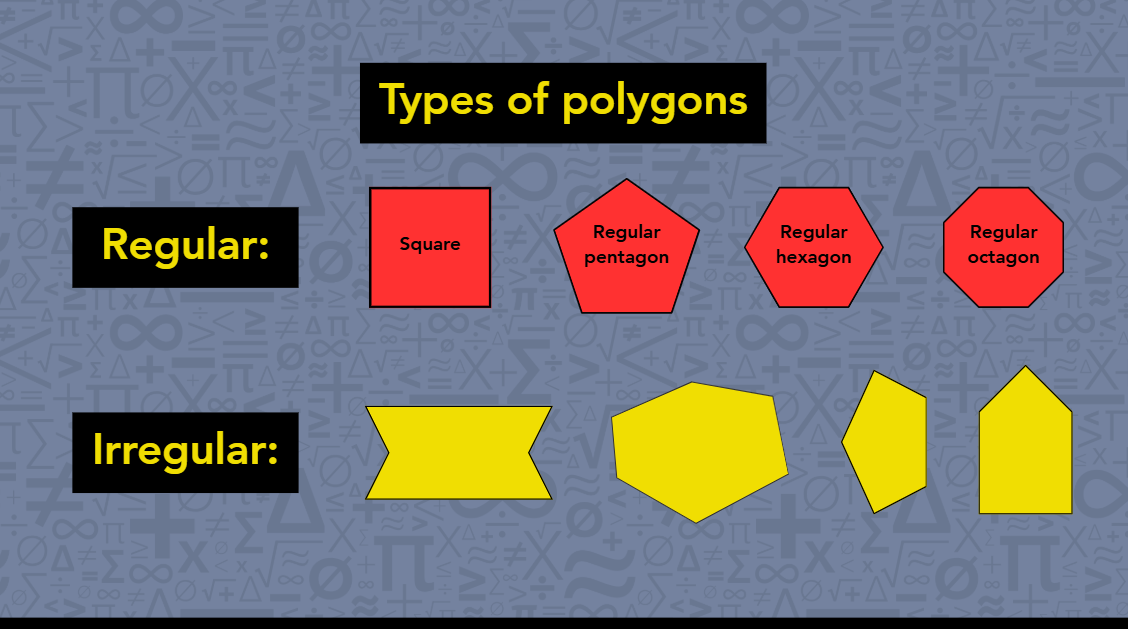
That difference tells us how to approach the perimeter:
-
For a regular polygon, once we know the length of one side, we know them all.
-
For an irregular polygon, we need to look at each side separately and work out any missing lengths before we add.
Let’s see how this works with this example. Say a regular pentagon has side lengths of 4 inches.
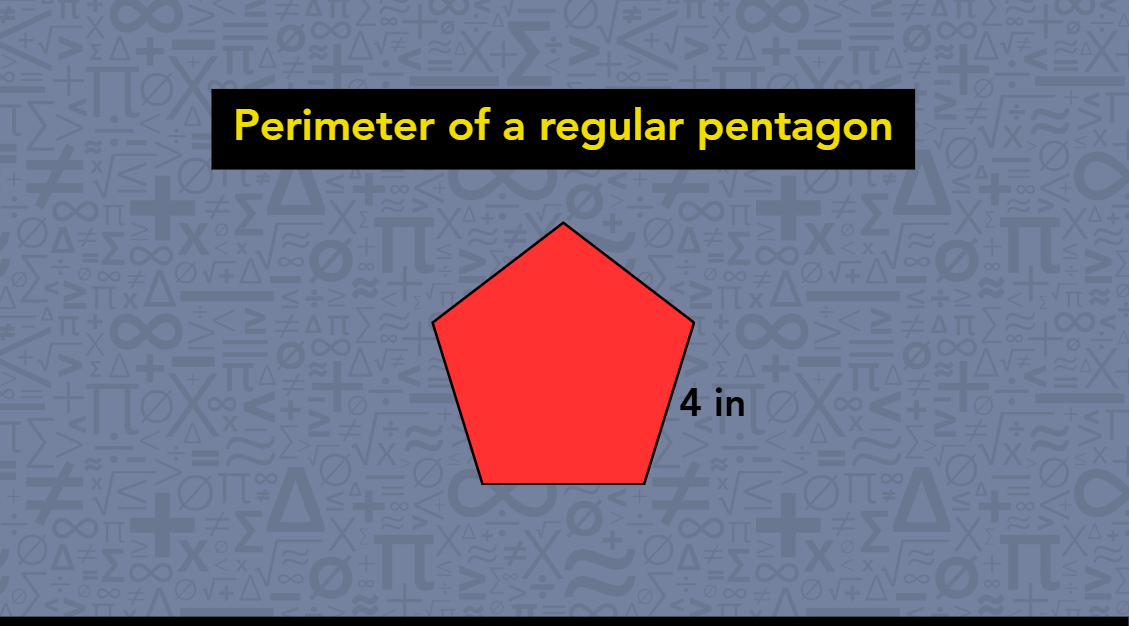
A pentagon has 5 sides, and as ours is regular all 5 of them are equal. We can add them one by one:
P = 4 + 4 + 4 + 4 + 4 = 20.
So the perimeter is 20 inches.
Because the same side length repeats 5 times, we can also multiply:
P = 5 × 4 = 20.
Take s for the length of one side, and the perimeter formula for a regular pentagon will look like this:
P = 5s.
Remember the perimeter formula for a square, which has 4 equal sides? It’s P = 4s. For a regular pentagon with 5 equal sides, it’s P = 5s. So, following the pattern, the perimeter formula for a regular hexagon with 6 equal sides is:
P = 6s.
We can extend this pattern to any regular polygon. If n stands for the number of sides and s stands for the length of one side, the perimeter formula for a regular polygon is:
P = ns.
Before using the shortcut, we need to make sure the polygon is actually regular. We can check the labels, matching tick marks, or the problem statement. If the sides are not all equal, we add each side length separately instead.
📕 You May Also Like: Regular vs. Irregular Polygons: What's the Difference?
Quick Reference: Perimeter Formulas for Common Shapes
For a quick reminder of the perimeter formulas for common shapes, our Mathnasium tutors put together this table.
| Shape |
Perimeter formula |
What the letters mean |
| Triangle |
P = a + b + c |
a, b, and c are the three side lengths. |
| Rectangle |
P = 2(l + w) |
l stands for length, w for width. |
| Square |
P = 4s |
s is the length of one side. |
| Regular polygon |
P = ns |
n stands for the number of sides, s for the length of one side. |
Common Mix-Ups to Avoid With Perimeter
Take a look at the perimeter mistakes our tutors see students make most often, along with tips for how to avoid them.
| What to watch for |
How we can catch it |
| Using multiplication for every shape |
Multiplication is a shortcut we can use when side lengths are equal or come in matching pairs. For other shapes, we add each side length. |
| Confusing perimeter and area |
Check what the problem is asking you to measure. Perimeter is the distance around the outside, while area is the space inside. |
| Missing one or more sides, especially in irregular shapes. |
Before we add, we can count the sides and number or highlight each one as we go. This way, we won’t accidentally miss any sides. |
| Mixing up units for perimeter |
Perimeter measures length, so we use units such as inches, feet, centimeters, or meters, not square units like cm2 or m2. We also keep our answer in the same unit given in the problem. |
If these mix-ups keep showing up in homework or quizzes, or any other geometry topic feels hard, our geometry tutors at Mathnasium of Manassas can help pinpoint where the confusion starts and work through it step by step.
📕 You May Also Like: Perimeter vs. Area: How to Teach the Difference at Home
Try Finding the Perimeter of This Shape!
Calculate the perimeter of this L-shaped garden bed. The bottom side measures 6 feet, the left side 5 feet, the top side 3 feet, and the short right side 2 feet. The two inner sides both measure 3 feet.
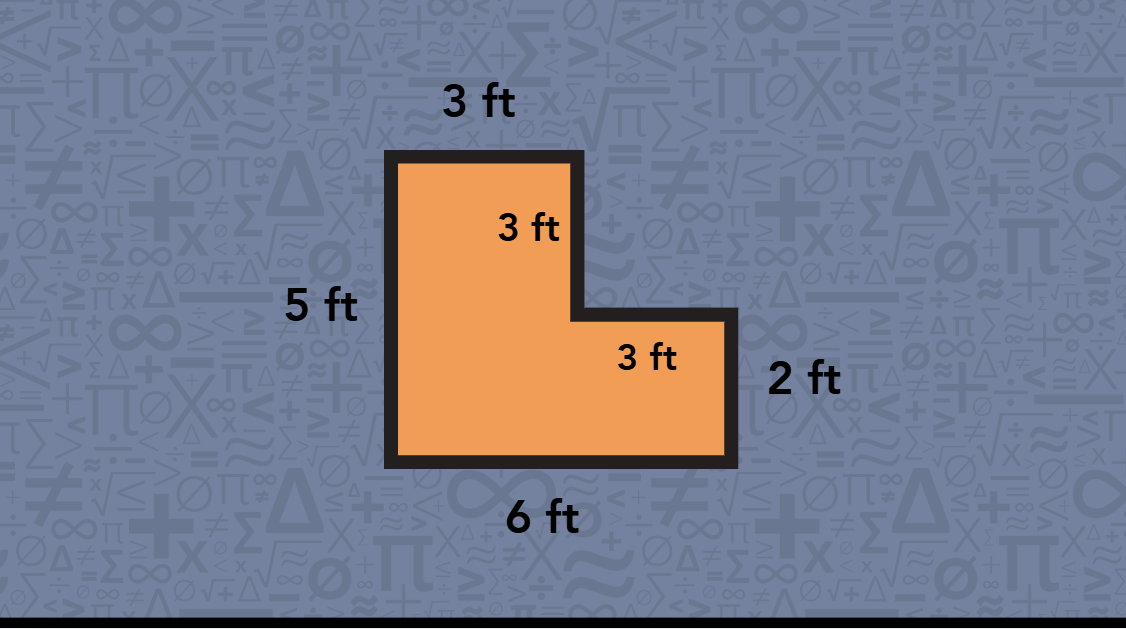
You can check your answer at the bottom of the page.
📕 You May Also Like: Why Math Practice Matters & What Happens When Kids Skip It
 Mathnasium tutors use hands-on activities and real-life examples to help students develop a deeper understanding of math concepts, such as perimeter, before they use a formula.
How Mathnasium Helps Students With Perimeters (and Any Other Math Topic)
Mathnasium is a math-only learning center dedicated to helping K–12 students of all skill levels excel in math.
In our tutoring work, we see that math makes more sense when ideas connect instead of feeling like separate rules to memorize. That’s why, with concepts like perimeter, we make sure learners truly grasp what the measurement means first. Only then, we introduce the formula, which becomes a way to express that idea.
To help students build that kind of understanding, we use the Mathnasium Method™, our proprietary teaching approach, which is designed to meet students where they are and guide them forward step by step.
Each student begins with a diagnostic assessment that helps us understand their current skill level, knowledge gaps, goals, and how they think and feel about math.
Using these insights, we create a personalized learning plan focused on the skills the student needs most, whether that means reinforcing measurement, improving addition fluency, identifying the outside edge of a shape, or preparing for area and more advanced geometry.
Our specially trained tutors follow the plan closely and provide live, face-to-face instruction in a caring and fun group environment. They use mental, verbal, visual, tactile, and written techniques to help concepts make sense. With perimeter, students might trace the boundary of a shape, measure real objects, compare diagrams, or explain why each side must be included.
Students also get room to think through problems before tutors step in. Instead of simply giving the answer or formula, our tutors guide them through the reasoning behind each step. This builds critical thinking, problem-solving skills, and greater independence in math.
Fun is part of the approach, too. We use hands-on and game-based activities, rewards, and consistent encouragement to keep students engaged as they work with different shapes and measurement challenges.
The results? True, measurable progress:
-
94% of parents report an improvement in their child's math skills and understanding
-
93% of parents report their child's improved attitude toward math after attending Mathnasium
-
90% of students saw an improvement in their school grades
With over 1,100 learning centers across North America, there is likely a Mathnasium close to you.
For families in and near Manassas, VA, Mathnasium of Manassas brings that same approach close to home, with specially trained tutors who help students make sense of perimeter, measurement, and the geometry skills that build from them.
If your child finds perimeter or any other math topic hard, a free diagnostic assessment is a great place to start. Using what we learn, we create a personalized learning plan that helps your child strengthen the skills they need next.
📅 Schedule a Free Assessment at Mathnasium of Manassas
Not near Manassas?
📍 Find a Mathnasium Learning Center Near You
Check Your Answers Here!
Ready to see how you did? Here is the answer to the practice problem above:
The answer is 22 feet. We are finding the perimeter of an irregular L-shaped polygon with six sides. We know all the side lengths, so we can add them: 6 + 5 + 3 + 3 + 3 + 2 = 22. So the perimeter of our garden bed is 22 feet.


 (571) 428-2323