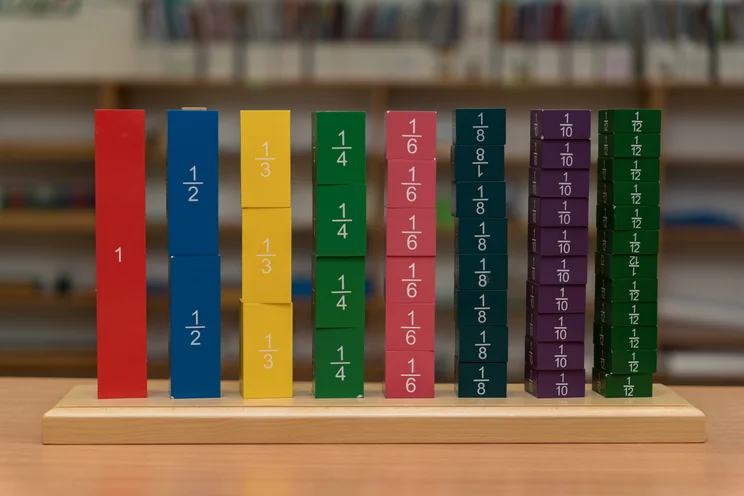
Fraction comparison is a skill we often support our students with at Mathnasium. It starts in 3rd grade and continues through 5th grade, adding new layers along the way. As our knowledge of fractions grows, our methods for comparing them do, too.
If we only nail down one or two strategies, we're missing out on simpler shortcuts. However, when we know the four most important ones, we head into any problem feeling so much more confident!
With that in mind, our Mathnasium tutors will show you four fraction comparison strategies through worked examples, and provide practice problems to try at the end.

What Does It Mean to Compare Fractions?
To compare fractions well, we first need a clear picture of what a fraction is and what it means for one fraction to be greater than the other.
What Is a Fraction?
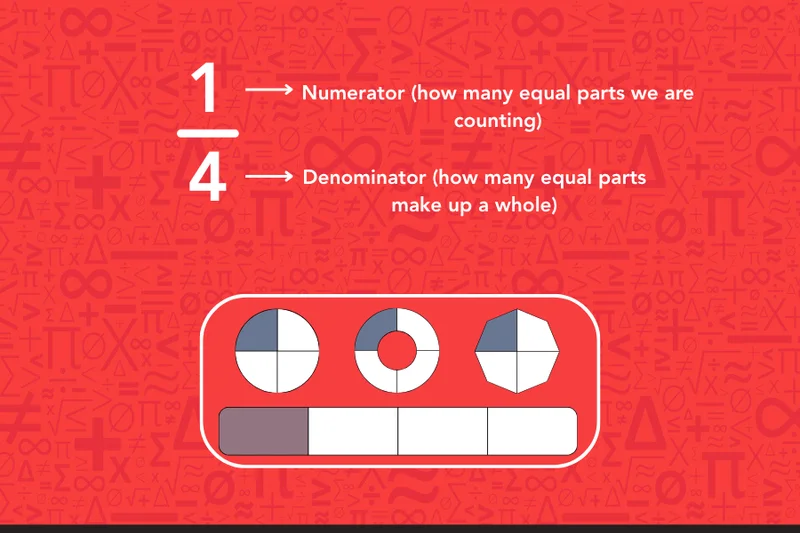
A fraction is a way of showing a part of a whole. When something is split into equal parts, a fraction tells us how many of those parts we have, written as one number over another.
The denominator on the bottom shows how many equal parts make up the whole. The numerator on top shows how many of those parts we are counting.
📕 You May Also Like: Types of Fractions - Your Comprehensive, Beginner-Friendly Guide
The Logic Behind Fraction Comparison
At its core, comparing fractions comes down to two things: the size of the pieces and how many pieces we have.
When denominators or numerators match, comparison is quick. When neither matches, we use visual or numerical tools to bring them to a common scale.

Four Methods for Comparing Fractions
We use different methods based on what the fractions look like. Sometimes we may easily find the solution using the denominator or benchmark fractions, and at other times we might find it more suitable to use a number line.
1. How to Compare Fractions Using a Common Denominator
When two fractions share the same denominator, we compare the numerators directly. The fraction with the greater numerator is greater.
We can take a look at \(\Large\frac{3}{7}\) and \(\Large\frac{5}{7}\). Since the denominators match, we compare 3 and 5. 5 is greater, so \(\Large\frac{5}{7}\) is the greater fraction.
When the denominators differ like in \(\Large\frac{2}{3}\) and \(\Large\frac{3}{4}\), and we need to find a common denominator, we can break the process into steps so it’s easy to follow.
Step 1: Find a Common Denominator
To make the piece size match, find a number that both denominators divide into evenly. A reliable way to do this is by multiplying the two denominators together.
For \(\Large\frac{2}{3}\) and \(\Large\frac{3}{4}\): 3 × 4 = 12
Our common denominator is 12.
Step 2: Convert to Equivalent Fractions
Multiply the top (numerator) and bottom (denominator) of each fraction by the factor needed to get our new denominator of 12.
For \(\Large\frac{2}{3}\) multiply top and bottom by 4:
\(\Large\frac{2×4}{3×4}\) = \(\Large\frac{8}{12}\)
For \(\Large\frac{3}{4}\), multiply top and bottom by 3:
\(\Large\frac{3×3}{4×3}\) = \(\Large\frac{9}{12}\)
Step 3: Compare the Numerators
Now that both fraction share the same piece size (12ths), we can compare the top number directly:
9 > 8 which means \(\Large\frac{9}{12}\) > \(\Large\frac{8}{12}\)
so, \(\Large\frac{3}{4}\) > \(\Large\frac{2}{3}\).
📕 You May Also Like: How to Multiply a Fraction By a Whole Number: A Step-by-Step Guide
2. How to Compare Fractions With a Common Numerator
When two fractions share the same numerator, the fraction with the smaller denominator is greater. A smaller denominator means the whole is divided into fewer, but larger pieces.
For example, if we compare \(\Large\frac{3}{5}\) and \(\Large\frac{3}{8}\), we notice that the numerators match at 3. Because 5 is smaller than 8, each \(\Large\frac{1}{5}\) piece is larger than a \(\Large\frac{1}{8}\) piece, meaning 3 larger pieces beat 3 smaller pieces.
While we only use this strategy when top numbers match, it is one of the fastest mental math methods to have in our toolkit!
3. How to Compare Fractions Using Benchmark Fractions
Benchmark fractions are the most common reference points (0, \(\Large\frac{1}{2}\) and 1), which we can use to compare fractions simply and with minimal calculation.
The most useful benchmark is \(\Large\frac{1}{2}\), and it is often the first one we check fractions against.
To check if a fraction is greater or less than \(\Large\frac{1}{2}\), we compare its numerator to half of its denominator:
-
If the numerator is less than half the denominator, the fraction is under \(\Large\frac{1}{2}\).
-
If the numerator is greater than half the denominator, the fraction is over \(\Large\frac{1}{2}\).
Let's compare \(\Large\frac{3}{8}\) and \(\Large\frac{5}{7}\).
-
Half of 8 is 4, and 3 is less than 4, so \(\Large\frac{3}{8}\) is below \(\Large\frac{1}{2}\).
-
For \(\Large\frac{5}{7}\), half of 7 is 3.5, and 5 is greater than 3.5, which means \(\Large\frac{5}{7}\) is above \(\Large\frac{1}{2}\).
Because \(\Large\frac{3}{8}\) is below \(\Large\frac{1}{2}\) and \(\Large\frac{5}{7}\) is above \(\Large\frac{1}{2}\), we know that \(\Large\frac{5}{7}\) > \(\Large\frac{3}{8}\).
This is another quick mental math method we can use if we need to order a list of fractions, but don’t have enough time to find common denominators for all of them.
This is the principle, but if you want to see how to use benchmark fractions to compare numbers with this method, check out our full walkthrough.
4. How to Compare Fractions With the Help of a Number Line
A number line gives us a visual way to compare fractions, which makes this method a great choice for visual learners. Here, the fraction that sits further to the right, closer to 1, is the greater one.
We can split this process into five manageable steps:
-
Draw two number lines of equal length, both running from 0 to 1.
-
Divide the first number line into equal parts based on the denominator of the first fraction.
-
Divide the second number line into equal parts based on the second fraction’s denominator.
-
Plot each fraction on the corresponding number line.
-
Figure out which one sits further to the right, and you’ve found the greater fraction!
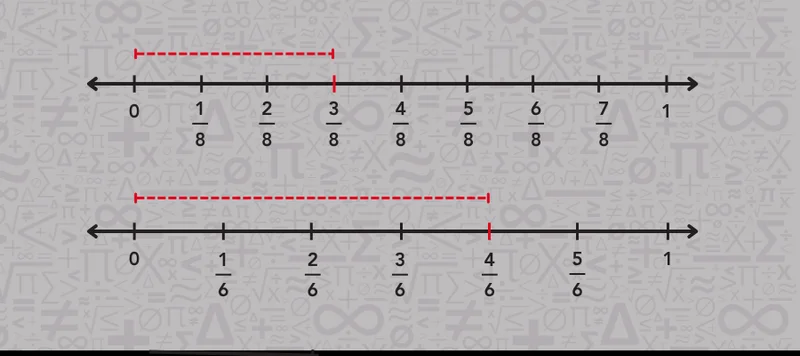
Let's compare \(\Large\frac{3}{8}\) and \(\Large\frac{4}{6}\). Start the process by dividing the first number line into 8 equal parts and mark \(\Large\frac{3}{8}\). Then divide the second into 6 equal parts and mark \(\Large\frac{4}{6}\). Since \(\Large\frac{4}{6}\) is closer to 1 than \(\Large\frac{3}{8}\), \(\Large\frac{4}{6}\) > \(\Large\frac{3}{8}\).
📕 You May Also Like: What Is a Fraction On a Number Line: A Complete Overview
It’s Your Turn to Practice!
It’s time for you to put each method to work with one practice problem per method. You can check your answers at the end.
Problem 1: Use the common denominator method to compare \(\Large\frac{3}{5}\) and \(\Large\frac{7}{10}\). Which fraction is greater?
Problem 2: Look at \(\Large\frac{4}{6}\) and \(\Large\frac{4}{9}\). Use the common numerator method to figure out which fraction is bigger.
Problem 3: Can you find out which is greater, \(\Large\frac{2}{9}\) or \(\Large\frac{4}{7}\), by checking them against a benchmark fraction?
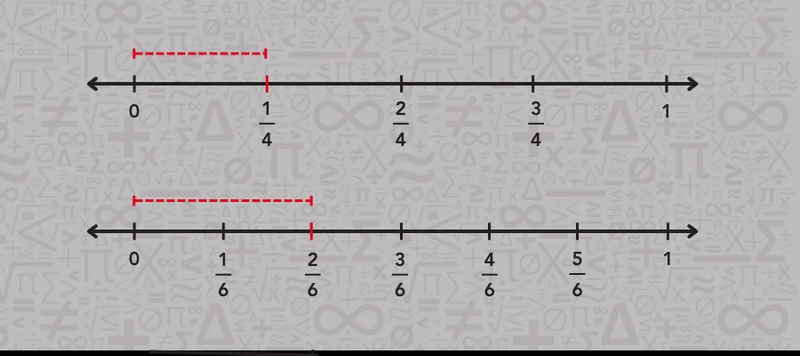
Problem 4: Place \(\Large\frac{1}{4}\) and \(\Large\frac{2}{6}\) on a number line. Which fraction is greater?

Mathnasium tutors use personalized learning plans to help students master fractions, and any other math concept.
How Mathnasium Helps Students Master Any Math Concept
Mathnasium is a math-only learning center with over 1,100 locations across the U.S., dedicated to helping K–12 students catch up, keep up, and get ahead in math.
To help students build a deep understanding of how math works, including specific math concepts like fractions, we use our proprietary teaching approach, the Mathnasium Method™, which is designed around each student’s needs and learning style.
Every student begins their journey with a diagnostic assessment that helps us identify their current skills and knowledge gaps. From there, we build a personalized learning plan adapted to their goals.
Our primary goal is to teach for understanding. Our specially trained tutors use natural language and a mix of verbal, visual, mental, tactile, and written techniques and always make sure students truly understand every concept they’re learning.
Although our tutors are always there to help, we encourage students to first try to tackle problems on their own. When we do step in, we teach both the how and the why behind the answer. This way, they start to develop problem-solving and critical thinking skills they can use in math and beyond.
All sessions are meant to be engaging and fun, full of interesting games and earned rewards. We help students develop a more positive relationship with math, which in turn builds their confidence.
Families who work with us see real results:
-
94% of parents report an improvement in their child's math skills and understanding
-
93% of parents report their child's improved attitude toward math after attending Mathnasium
-
90% of students saw an improvement in their school grades
If you live in or near McKinney, Mathnasium of McKinney tutors work with students from local school districts, including McKinney ISD, Melissa ISD, Princeton ISD, Allen ISD, Frisco ISD, and Prosper ISD.
Ready to get started?
📅 Schedule a Free Assessment at Mathnasium of McKinney
Not near McKinney, TX?
📍 Find a Mathnasium Learning Center Near You
Check Your Answers
Here is how the four practice problems turn out.
Problem 1: \(\Large\frac{3}{5}\) < \(\Large\frac{7}{10}\)
Problem 2: \(\Large\frac{4}{9}\) < \(\Large\frac{4}{6}\)
Problem 3: \(\Large\frac{2}{9}\) < \(\Large\frac{4}{7}\)
Problem 4: \(\Large\frac{2}{6}\) > \(\Large\frac{1}{4}\)


 (972) 784-4141