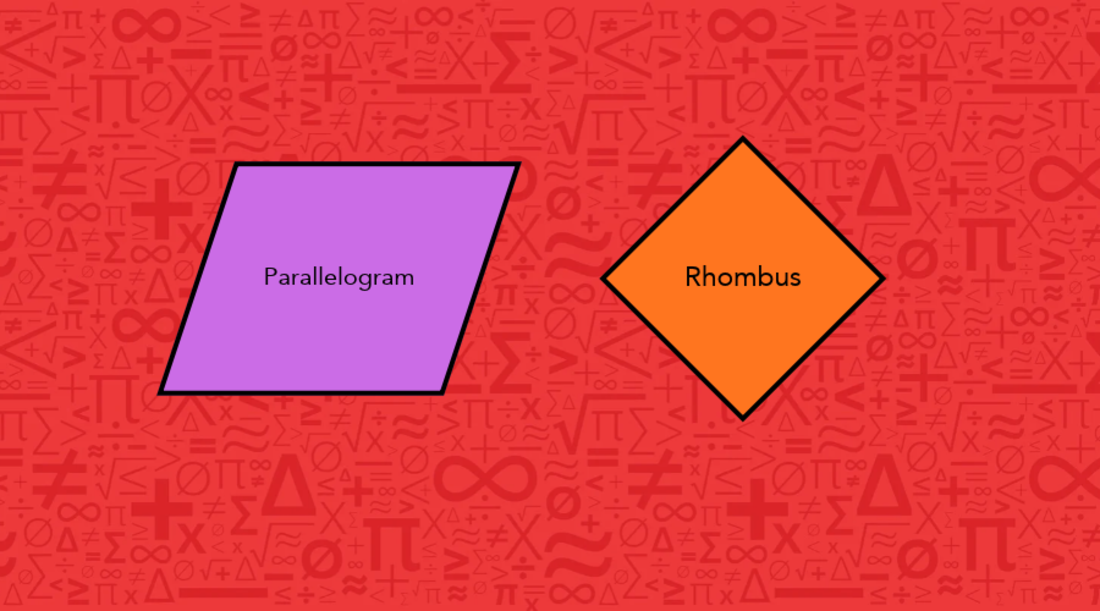
When students first learn that a rhombus is a type of parallelogram, they often assume the two terms mean the exact same thing. But that’s a classic geometry trap.
While every rhombus is a parallelogram, not every parallelogram is a rhombus.
To help clear up the confusion, the Mathnasium team put together this guide breaking down the definitions of both shapes, their main differences, and practical tips for telling them apart.

What Makes a Shape a Parallelogram
A parallelogram is a four-sided shape (we call these quadrilaterals) where both pairs of opposite sides are parallel.
What does this mean? It means the top and bottom sides, as well as the left and right sides, run side by side and never cross. These opposite sides are also equal in length, and opposite angles are equal too.
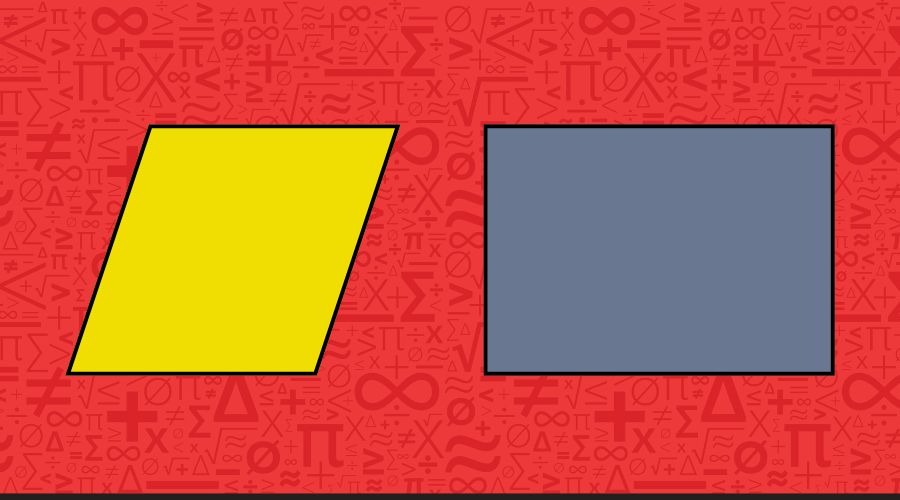
We can confirm that a shape is a parallelogram by checking a few properties:
-
Opposite sides are parallel: The top and bottom edges run side by side without touching, and so do the left and right edges.
-
Opposite sides match in length: The side across from any edge is always the exact same length.
-
Opposite angles match: The corners directly across from each other are equal in size.
-
Neighboring angles add up to 180°: Any two angles right next to each other along a side form a straight line when put together ( 180°).
-
Diagonals cut each other in half: If you draw lines connecting opposite corners, they cross at a center point that splits both lines into two equal pieces.
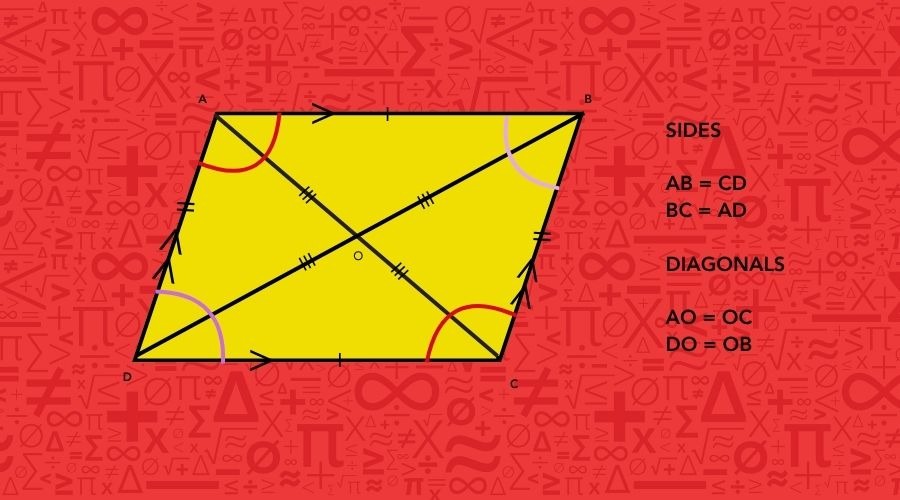
A diagonal is a line that connects two corners of a shape that aren't already next to each other, cutting across the middle instead of running along an edge.
In a parallelogram, drawing both diagonals always cuts them into two equal halves right where they cross. The angle where they meet can be wide, narrow, or a right angle.
📕 You May Also Like: How to Use Origami to Teach Geometry - Kid-Friendly Guide

What Makes a Shape a Rhombus
A rhombus is a parallelogram where all four sides are equal in length.
We often know this shape by a different name first, widely known as the "diamond". We can see it, for example, on a deck of cards, or a kite in the sky is usually a rhombus.
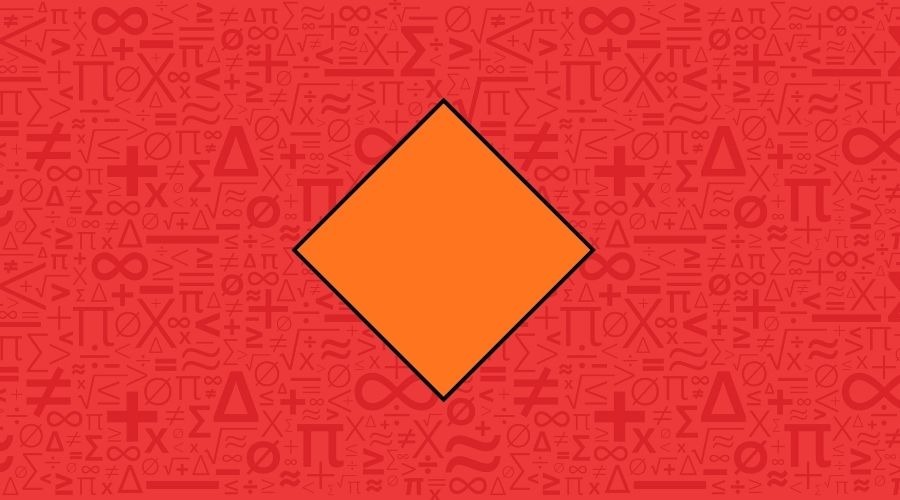
Because a rhombus is a type of parallelogram, it keeps every property of a parallelogram, plus a few extras!
The shared properties of a rhombus and a parallelogram are:
-
Opposite sides are parallel: Top and bottom stay parallel, as do left and right.
-
Opposite angles match: Corners across from each other are equal.
-
Diagonals bisect each other: Lines connecting opposite corners cut each other in half where they cross.
Special, rhombus-only properties are:
-
All four sides are equal: Every single side is the exact same length.
-
Diagonals cross at right angles: The diagonals form a perfect 90° angle in the middle.
-
Diagonals split corner angles in half: Each diagonal cuts its starting and ending corner angles into two equal pieces.
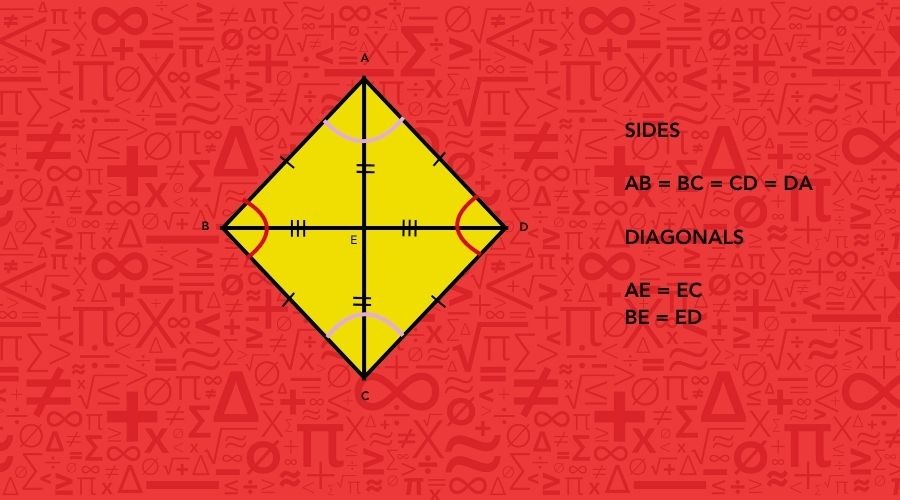
Neither of these has to be true in a regular parallelogram, but in a rhombus, they always are.
📕 You May Also Like: Types of Angles: How to Identify Straight, Right, Acute, and Obtuse Angles?
Rhombus vs. Parallelogram: The Main Differences
Rhombuses and parallelograms differ in three properties: side lengths, diagonal angles, and angle bisection.
|
Rhombus |
Parallelogram |
| Side lengths |
All four sides are the same length. |
Requires only opposite sides to match, so two sides can run longer than the other two. |
| Diagonals |
Diagonals always cross at a right angle. |
Diagonals cross at whatever angle the shape happens to lean toward. |
| Angle bisection |
Diagonals cut each corner angle exactly in half. |
Diagonals don't necessarily split the angles at all. |
A rhombus always checks off all three of these boxes, so it always counts as a parallelogram too.
But a regular parallelogram doesn't automatically get to call itself a rhombus. It only earns that name once its sides and diagonals meet these extra conditions. That's why the rule only works one way.
📕 You May Also Like: Regular vs. Irregular Polygons: What's the Difference?
How Students Can Tell Rhombus and Parallelogram Apart
When looking at shapes on a math test, appearances can be deceiving. A standard parallelogram can be tilted to look like a diamond, while a rhombus sitting flat might just look like a square.
To classify parallelograms and rhombuses correctly, we recommend this simple 2-step check:
-
Check the Side Lengths: Grab a ruler or look at the given side measurements. If all four sides are equal, it's a rhombus (which is also a special type of parallelogram!). If only the opposite pairs match, it's a standard parallelogram.
-
Check the Diagonals: If the test gives you interior lines instead of side lengths, look where they cross in the middle. If the diagonals meet at a 90° right angle (a square corner), you're looking at a rhombus.
📕 You May Also Like: What Is a Line of Symmetry? A Kid-Friendly Guide
 Mathnasium instructors bring a caring and fun group environment to every session, so students feel comfortable asking questions and helping each other along the way.
How Mathnasium Helps Students Master Any Geometry Concept
Mathnasium is a math-only learning center dedicated to helping K-12 students of all skill levels excel in math.
Many students come to us to better understand shapes like parallelograms and rhombuses. Whether your student needs support (re)building foundational math skills, keeping up with the demands of their geometry curriculum, or taking on math challenges beyond their school level, we can support them.
We support students through our proprietary teaching approach, the Mathnasium Method™, designed around individual students’ needs and learning styles.
Our proven approach includes:
-
Personalized learning: Every student begins with a diagnostic assessment that identifies their skill level, knowledge gaps, learning goals, and learning style. From there, we build a personalized learning plan around exactly what they need.
-
Teaching for understanding: We explain concepts in plain, everyday language, using verbal, visual, mental, tactile, and written techniques so students grasp the math behind every procedure.
-
Caring, specially trained instructors: Our instructors handle both the technical and emotional sides of teaching, rebuilding confidence on a hard day and offering a bigger challenge when it's time to move ahead.
-
Independent problem-solving and critical thinking: We give students time to work through problems on their own, then step in to teach the how and the why, building skills they carry beyond the session.
-
A supportive, fun environment: Sessions feel nothing like a lecture, by design. Game-based activities, earned rewards, and steady celebration of progress keep students engaged and confident.
The results speak for themselves:
-
94% of parents report an improvement in their child's math skills and understanding
-
93% of parents report their child's improved attitude toward math after attending Mathnasium
-
90% of students saw an improvement in their school grades
With over 1,100 centers across North America, Mathnasium brings this approach close to home.
Families in and around Mechanicsville can visit us at Mathnasium of Mechanicsville. Our local team has a proven track record of helping students build strong, confident math skills. Whether your child needs support with geometric shapes or any other foundational concept, our team is here to guide them.
📅 Schedule a Free Assessment at Mathnasium of Mechanicsville
Not near Mechanicsville?
📍 Find a Mathnasium Learning Center Near You


 (804) 559-0550