Whether we are estimating a grocery total or working through elementary math homework, rounding serves as a practical arithmetic skill. It allows us to trade precise, complex numbers for simple ones ending in zero.
Today, our Mathnasium tutors explain what rounding means, walk through the core "next door" rounding rule step by step, and show how to round any whole number to the nearest ten, hundred, or thousand.

What Does Rounding a Number Mean?
Rounding, also called rounding off, is a way of expressing a number as a nearby value that's easier to work with. We swap the exact number for one that ends in zero.
That might mean the nearest ten, the nearest hundred, or the nearest thousand, depending on the problem. We do this to make numbers simpler to estimate or calculate in everyday situations, like totaling a grocery bill or guessing how far a road trip will be.
For example:
-
A shirt priced at $47 rounds to $50.
-
A road trip of 382 miles rounds to 400 miles.
-
A stadium crowd of 6,150 people rounds to 6,000 people.
Notice something?
Every rounded number ends in one or more zeros. That's the whole point of rounding. We trade a precise but clunky number for a close one that's easier to hold in our heads.

So, How Do We Round a Whole Number?
We can round a whole number in three simple steps:
-
First, we find the place value we're rounding to.
-
Then, we check the digit sitting immediately next to it.
-
Finally, we decide whether the digit we're rounding stays the same or goes up by one.
Every digit in a number sits in its own place. From right to left, we have the ones place, then the tens place, then the hundreds place, then the thousands place, and so on.
Before we can round anything, we need to find the exact place we're rounding to. Let's look at a few numbers and find specific places within them.
-
In 384, the 3 sits in the hundreds place, the 8 sits in the tens place, and the 4 sits in the ones place.
-
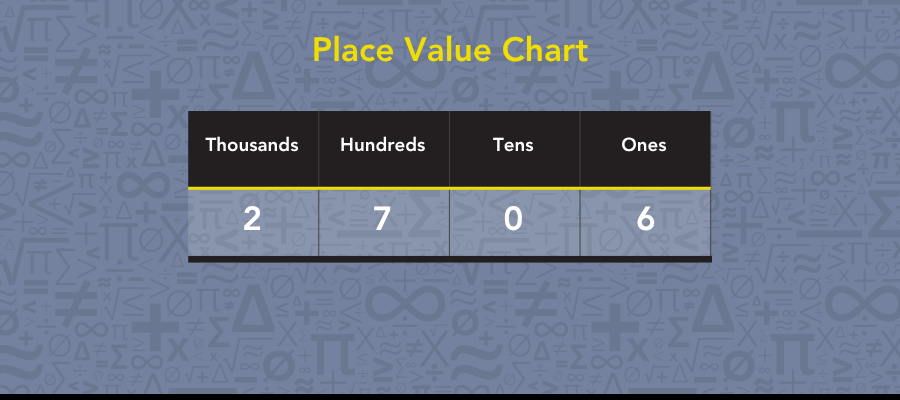
In 2,706, the 2 sits in the thousands place, the 7 sits in the hundreds place, the 0 sits in the tens place, and the 6 sits in the ones place.
-
In 19, the 1 sits in the tens place, and the 9 sits in the ones place.
After we find the place we're rounding to, the next step is checking the digit sitting immediately to its right.
We call this the "next door" digit, since it's the one neighbor whose value decides what happens to the digit we're rounding.
-
If it's 0–4, the number we're rounding to stays the same.
-
If it's 5–9, the number we're rounding goes up by one.
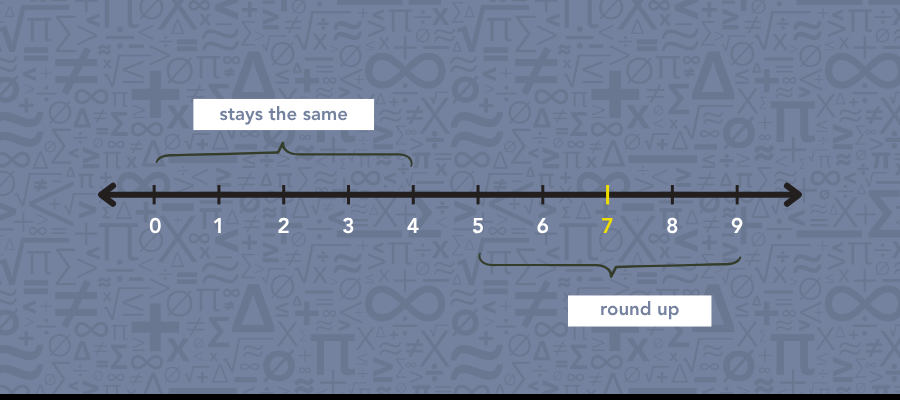
Either way, every digit to the right of the place we're rounding to turns into a zero. The rule never changes. Only the digit we're standing next to does.
Let's round some numbers and see this rounding method in action!
📕 You May Also Like: Do We Round Up or Down at 5? The Rounding Rule Explained
Rounding to the Nearest Ten
We round to the nearest ten by finding the tens place and checking the digit next door.
Let's round 67 to the nearest ten.
Step 1: Find the Tens Place
In 67, here's where each digit sits:
Since we're rounding to the nearest ten, the 6 is the digit we're rounding.
Step 2: Check the Next Door Digit
We look at the digit sitting immediately to the right of the tens place.
In 67, that's the ones digit, 7.
Step 3: Round the Number
So, does the 7 next door push the tens digit up, or leave it alone?
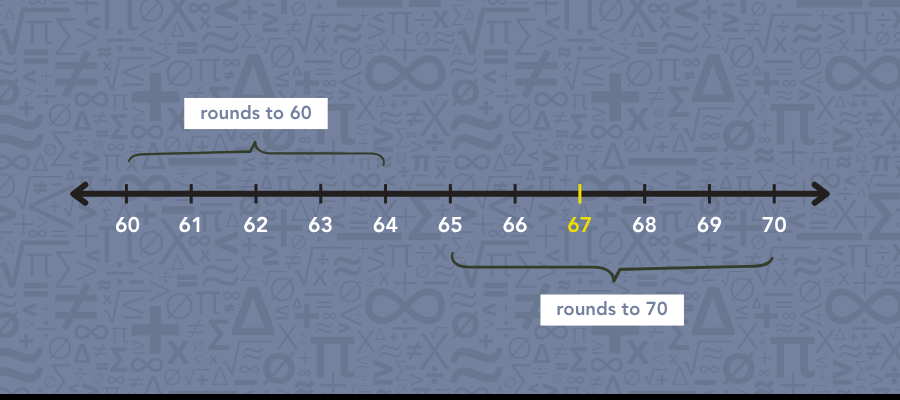
Since 7 falls in the 5–9 range, the digit we're rounding goes up by one, and everything after it turns to zero.
67 -> 70
📕 You May Also Like: Rounding Numbers in Math – A Kid-Friendly Guide
Rounding to the Nearest Hundred
We round to the nearest hundred the same way we round to the nearest ten. The only difference is which place we're checking.
Take 950, and let's round it to the nearest hundred.
Step 1: Find the Hundreds Place
We can break down 950 by its place value:
-
9 sits in the hundreds place.
-
5 sits in the tens place.
-
0 sits in the ones place.
We're rounding to the nearest hundred, so the 9 is our target digit.
Step 2: Check the Next Door Digit
The digit immediately to the right of the hundreds place is the one we check next.
Here, that's the tens digit, 5.
Step 3: Round the Number
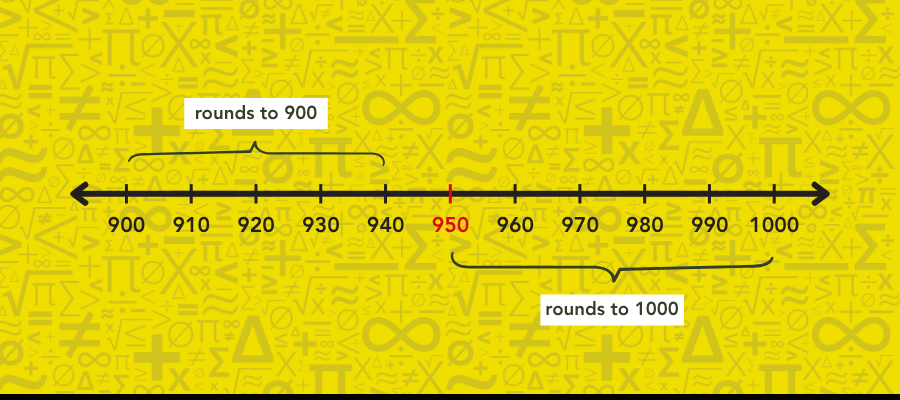
The tens digit, 5, falls in the 5–9 range. That means the hundreds digit, 9, goes up by one.
But 9 plus 1 doesn't leave a single digit; it actually rolls over to 10. That means that our hundreds digit becomes 0, and that extra 1 carries into the thousands place.
950 1,000
We call this regrouping. It is the same process we use whenever a digit adds up to 10 or more in any addition problem.
📕 You May Also Like: How to Round Decimals: Nearest Tenth, Hundredth, and Thousandth
Rounding to the Nearest Thousand
We round to the nearest thousand the same way we round to the nearest ten and the nearest hundred. Only the place we're checking changes.
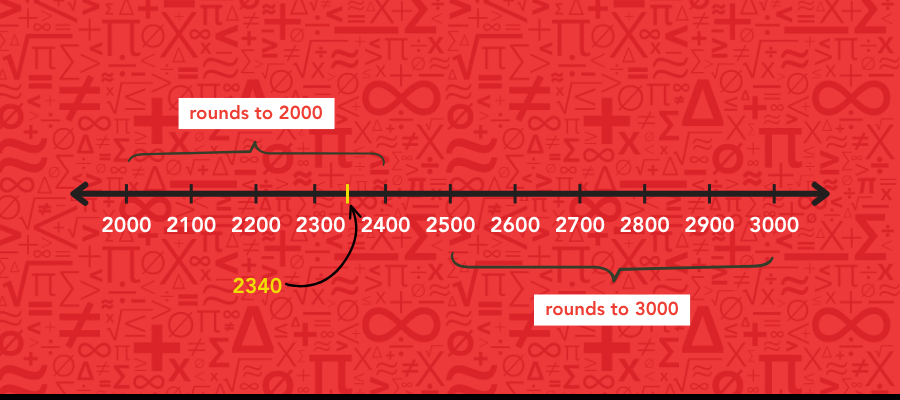
Let's work with 2,340 this time, rounding it to the nearest thousand.
Step 1: Find the Thousands Place
Here's how 2,340 breaks down by place value:
-
2 sits in the thousands place.
-
3 sits in the hundreds place.
-
4 sits in the tens place.
-
0 sits in the ones place.
The thousands digit, 2, is our target for this round.
Step 2: Check the Next Door Digit
Next, we look one place to the right of the thousands place. Here that’s number 3.
Step 3: Round the Number
3 sits in the 0–4 range, so the thousands digit holds steady at 2, and every digit after it turns to zero.
2,340 -> 2,000
📕 You May Also Like: How Estimation and Rounding Support Number Sense in Math
Quiz: How Well Do You Know Rounding to the Nearest Ten, Hundred, and Thousand?
Our tutors put together six questions covering everything we walked through today. Read each question and choose the best answer.
Question 1: In the number 526, which digit sits in the tens place?
- 5
- 2
- 6
Question 2: When we round to the nearest ten, which digit do we check?
- The digit two places to the right
- The digit immediately to the right of the tens place
- The first digit in the number
Question 3: Round 84 to the nearest ten.
- 80
- 90
- 100
Question 4: Round 650 to the nearest hundred.
- 600
- 700
- 750
Question 5: Round 3,240 to the nearest thousand.
- 3,200
- 3,000
- 4,000
Question 6: What happens when the digit we're rounding is a 9, and the next door digit is 5–9?
- The 9 stays the same
- The 9 rolls over to 0, and the extra 1 carries into the next place
- We ignore the next-door digit entirely
Check your results at the bottom of the guide.
 Our tutors guide students through rounding and place value with the same personalized, hands-on approach we bring to every math topic.
How Mathnasium Helps Students Master Rounding and Number Sense
Mathnasium is a math-only learning center for K–12 students, built around personalized instruction and targeted support that helps kids become confident, independent math thinkers.
Our tutors guide students through everything from foundational place value rules to more advanced rounding applications. We make sure every child leaves our center with a complete understanding of the topic.
We do this through the Mathnasium Method™, our proprietary teaching approach built around personalized learning and proven instructional techniques.
Here's what that looks like in practice:
-
Diagnostic Assessment and Personalized Learning Plans: Each student begins with a diagnostic assessment that identifies both visible skill gaps and the reasoning patterns behind them. From that starting point, we build a personalized learning plan tailored to their needs and goals, helping them build lasting math mastery at a pace that works for them.
-
Teaching for Understanding: Our specially trained tutors use plain, everyday language and a mix of verbal, visual, mental, tactile, and written techniques so concepts like place value and regrouping land in a way that makes sense to each student.
-
Problem-Solving and Critical Thinking: Our tutors know when to offer support and when to let a student work through a problem on their own. That balance is what builds lasting independence.
-
An Engaging and Fun Learning Environment: Sessions are designed to keep students motivated and enjoying the process. We celebrate every bit of progress, and that consistent recognition builds confidence with each session. Over time, students develop a more positive relationship with math and greater confidence in their own abilities.
Families see the impact of that approach firsthand:
-
94% of parents report improvement in their child's math skills and understanding
-
93% of parents report an improved attitude toward math after attending Mathnasium
-
90% of students saw improvement in their school grades
With over 1,100 centers across North America, there's likely a Mathnasium near you.
For families in and around Mechanicsville, VA, Mathnasium of Mechanicsville is a trusted local center with years of experience helping students build lasting confidence in math.
Whether your student is looking to catch up, keep up, or get ahead in math, our local team is happy to help!
📅 Schedule a Free Diagnostic Assessment at Mathnasium of Mechanicsville
Not near Mechanicsville?
📍 Find a Mathnasium Learning Center Near You
Pssst! Check Your Answers Here
If you've given our quiz a try, check your results here.
Question 1: b)
Question 2: b)
Question 3: a)
Question 4: a)
Question 5: b)
Question 6: b)


 (804) 559-0550