Early math foundations give students the tools and mental flexibility they need to move confidently through math down the road.
We find that one efficient way to build those foundations is through fact families.
Keep reading to learn more about what a fact family is, how the four equations relate to one another, and why that relationship can help build number sense and confidence in early elementary math. We'll also cover simple ways to practice fact families at home, so the concept feels just as familiar there as it does on a classroom worksheet.

What Is a Fact Family in Math?
A fact family is a set of equations built from the same three numbers, connected by a pair of operations that undo each other. Addition and subtraction make up one such pair (the one we’re covering in this article), and multiplication and division make up another.
Take 3, 4, and 7. We call 3 and 4 the "parts" and 7 the "whole," since the two parts combine to make it.
With the parts and the whole in place, we already have all four equations in the family:
-
The two addition equations. 3 + 4 = 7 and 4 + 3 = 7, since the parts can combine in either order and still add up to the same whole.
-
The two subtraction equations. 7 − 3 = 4 and 7 − 4 = 3, since we can remove either part from the whole and still find the other.
Most teachers introduce a triangle, sometimes called a fact family house, to show this relationship. The whole sits in the top corner, and the two parts sit in the two corners below it.
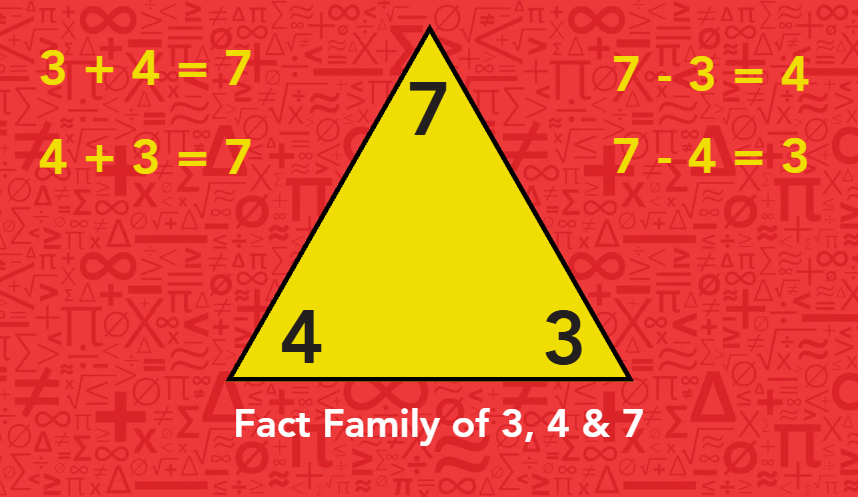
This shape works well because no single number carries more weight than the others. Cover any one corner, and the remaining two numbers tell us exactly what belongs there.
Fact families with addition and subtraction typically show up in Grade 1 and Grade 2 classrooms. By Grade 3, this same parts-and-whole thinking carries over to multiplication and division.
📕 You May Also Like: What Are Double Facts in Math? A Complete Overview
How Do the Four Equations in a Fact Family Connect?
Let's test the parts-and-whole idea with a new set of numbers, 5, 4, and 9.
Say we know 5 + 4 = 9. What does that tell us about 9 − 4? We don't need to count backward or start over to find out. We already know it's 5, since the same three numbers connect all four equations.
That's the value of a fact family. We only need to know one equation, and the other three come with it.
Here's how the four equations build on each other:
-
Start with the parts. 5 and 4 are the two smaller numbers in this family.
-
Add them to find the whole. 5 + 4 = 9.
-
Reverse the order. 4 + 5 = 9 works the same way, since addition doesn't care which part comes first.
-
Subtract each part from the whole. 9 − 5 = 4 and 9 − 4 = 5, moving in the opposite direction, back toward the parts we started with.
With 5, 4, and 9 as one family, a single relationship does the work of four separate facts.
📕 You May Also Like: 5 Easy Steps to Help Your Child Build Math Fact Fluency
Why Fact Families Build Number Sense and Math Confidence
Fact families can support understanding and may help some students build number sense and math confidence because they replace four separate memorized facts with one flexible relationship.
Instead of holding onto four unconnected pieces of information, we hold onto one idea. The parts and the whole belong together, and we can move between them in either direction.
Here's what that flexibility gives us:
-
Fewer facts to memorize. A fact family turns four separate equations into one relationship, so there's a single idea to hold onto instead of four.
-
Faster mental math. We move between addition and subtraction without pausing to recalculate, since the two operations were never separate to begin with.
-
A way back when a fact slips our mind. If one equation is momentarily forgotten, the other three in the family help us reconstruct it, so a gap in memory doesn't stall the work.
We see this most clearly next to flashcard memorization. Flashcards ask us to recall one fact at a time, with no sense of how it connects to anything else. Fact families ask us to understand how numbers hold together, which builds a sturdier kind of knowing.
With that flexibility in place, we can start practicing fact families in everyday moments at home.
📕 You May Also Like: How to Nurture Confident Math Thinkers, Not Just Answer-Getters
How to Practice Fact Families at Home
We can practice fact families at home with a few simple materials, including a deck of cards, a set of dominoes, or just paper and a pencil.
Here are three ways to try it together:
-
The fact family triangle. Draw a triangle with the whole in the top corner and the two parts in the corners below it. Cover one number at a time and ask your child to find the missing number using the other two.
-
Dominoes or playing cards. Draw two cards, or flip over a domino, and add the two numbers to find the whole. Then write out all four equations for that set.
-
The missing-number game. Give your child one equation from a family, say 5 + 3 = 8, and ask them to supply the other three.
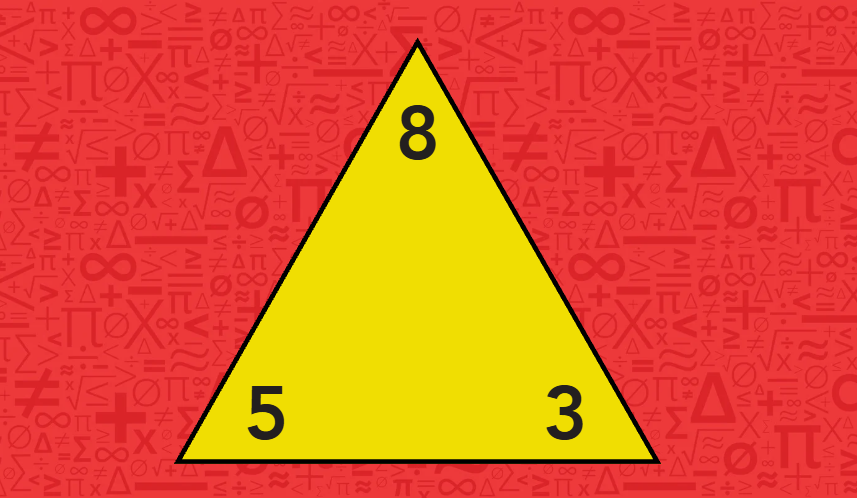
When kids practice fact families, one of the most important checks for understanding is whether they can move in both directions, not just recite one equation correctly. Check to see if your child answers 8 − 5 just as quickly as 5 + 3 = 8. If they hesitate on the subtraction side, the family hasn't fully connected yet.
We turn a memorized fact into an understood one by practicing the subtraction side just as often as the addition side.
Once your child can move confidently in both directions, they're ready to build a few fact families of their own.
📕 You May Also Like: How to Use Math Manipulatives Effectively at Home: A Parent's Guide
Your Turn: Build Three Fact Families
Let's put what we've learned to work. For each set of three numbers below, figure out which number is the whole and which two are the parts, then write all four equations, both addition equations and both subtraction equations.
-
Write all four equations for 4, 6, and 10.
-
Write all four equations for 6, 7, and 13.
-
Write all four equations for 2, 9, and 11.
Once you've written all four equations for each set, compare your work with the answer key at the end of this guide.
 A Mathnasium instructor helps a student see how numbers fit together, one fact family at a time.
How Mathnasium Builds Number Sense and Lasting Math Confidence
Mathnasium is a math-only learning center dedicated to helping K–12 students of all skill levels excel in math.
Whether children are building early number sense, strengthening fact fluency, or preparing for more advanced operations, we can support them.
Our proprietary teaching approach, the Mathnasium Method™, is designed around each student's needs and learning style to help them learn and master math.
Our approach includes:
-
Assessment and Personalized Learning Plans: Every student begins with a diagnostic assessment that identifies their current skill level, learning goals, and learning style. We build a personalized learning plan from those insights.
-
Teaching for Understanding: Our specially trained instructors use verbal, visual, mental, tactile, and written techniques so each concept lands before we move forward.
-
Problem-Solving and Critical Thinking: We give students time to work through problems on their own first. Whether they're rebuilding a forgotten fact from the other three in its family or working through something new, we step in to explain both the how and the why, so they build reasoning skills that carry well beyond one worksheet.
-
An Engaging and Fun Learning Environment: Sessions include games and consistent celebration of progress, so students build confidence alongside skill.
The impact extends beyond the worksheet:
-
94% of parents report an improvement in their child's math skills and understanding
-
93% of parents report their child's improved attitude toward math after attending Mathnasium
-
90% of students saw an improvement in their school grades
With over 1,100 learning centers across North America, there's likely a Mathnasium close to you.
Families across Midlothian and Chesterfield trust Mathnasium of Midlothian to help their children build number sense and lasting confidence in math.
If your child is looking to catch up, keep up, or get ahead in math, our local team is ready to help.
📅 Schedule a Free Assessment at Mathnasium of Midlothian
Not near Midlothian?
📍 Find a Mathnasium Learning Center Near You
Psst! Check Your Answers Here
How did you do? Let's compare notes.
For 4, 6, and 10: The whole is 10, and the parts are 4 and 6.
-
4 + 6 = 10
-
6 + 4 = 10
-
10 - 4 = 6
-
10 - 6 = 4
2. For 6, 7, and 13: The whole is 13, and the parts are 6 and 7.
-
6 + 7 = 13
-
7 + 6 = 13
-
13 − 6 = 7
-
13 − 7 = 6
3. For 2, 9, and 11: The whole is 11, and the parts are 2 and 9.
-
2 + 9 = 11
-
9 + 2 = 11
-
11 − 2 = 9
-
11 − 9 = 2


 (804) 378-2211