At Mathnasium, we like to say that math is a skill that helps us make sense of everyday decisions. Rounding is a perfect example of that in action. Students often first learn rounding in 3rd or 4th grade, and that same skill shows up again when we start working with money and need to round to the nearest cent.
Today, our instructors will walk you through why we round to the nearest cent, how to do it step by step, and give you a chance to practice on your own.

Quick Review: What Is Rounding in Math?
Rounding means replacing a number with a nearby value that is easier to work with. We can round to the nearest ten, hundred, whole number, or decimal place, like the hundredths place when working with money.
Here’s how we reason through it:
-
Look at the digit to the right of the place we're rounding to.
-
If it is 0–4, the rounding digit stays the same.
-
If it is 5–9, the rounding digit goes up by one.
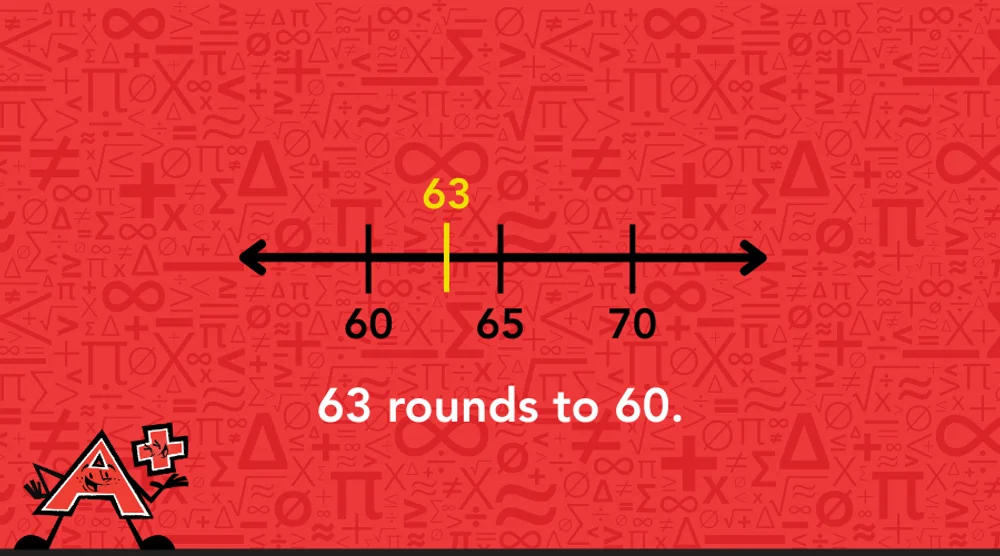
Take 63 rounded to the nearest ten. The digit to the right of the tens place is 3; that's 0–4, so 63 rounds down to 60.
Now a decimal: 4.67 rounded to the nearest tenth. The digit to the right of the tenths place is 7; that's 5–9, so 4.67 rounds up to 4.7.
📕 You May Also Like: Rounding Numbers in Math – A Kid-Friendly Guide
Why Do We Round to the Nearest Cent?
We round to the nearest cent because money is always expressed with exactly two decimal places. For example, we'll often see $4.99 or $12.50 on a price tag, never $4.9874 or $12.5031.
Those two decimal places represent cents. We know there are 100 cents in a dollar, which means cents live in the hundredths place, and that's where we stop when writing money.
However, we won't always find numbers that neat. Calculators often give us longer decimals in everyday situations, like:
-
Splitting a lunch bill three ways: $5.987
-
Working out 15% off a $14.99 item: $12.7415
-
Dividing a $10 prize equally among three friends: $3.3333...
These numbers don't make sense as a money amount, and that's exactly where rounding helps.
📕 You May Also Like: How Estimation and Rounding Support Number Sense in Math
How to Round to the Nearest Cent
When we round to the nearest cent, we round to the hundredths place or the second digit to the right of the decimal point. That's as far as we go with money.
To make this clearer, let's work through an example step by step.
Say we want to round $7.843 to the nearest cent.
Step 1: Find the cents (hundredths) place
In $7.843, the 4 is in the hundredths place. That's the digit we're rounding to.
Step 2: Look at the digit to the right
The digit in the thousandths place is 3. Since 3 is 0–4, the cents stay the same.
Step 3: Write the final amount
We drop everything past the hundredths place and write the answer with exactly two decimal places.
$7.843 → $7.84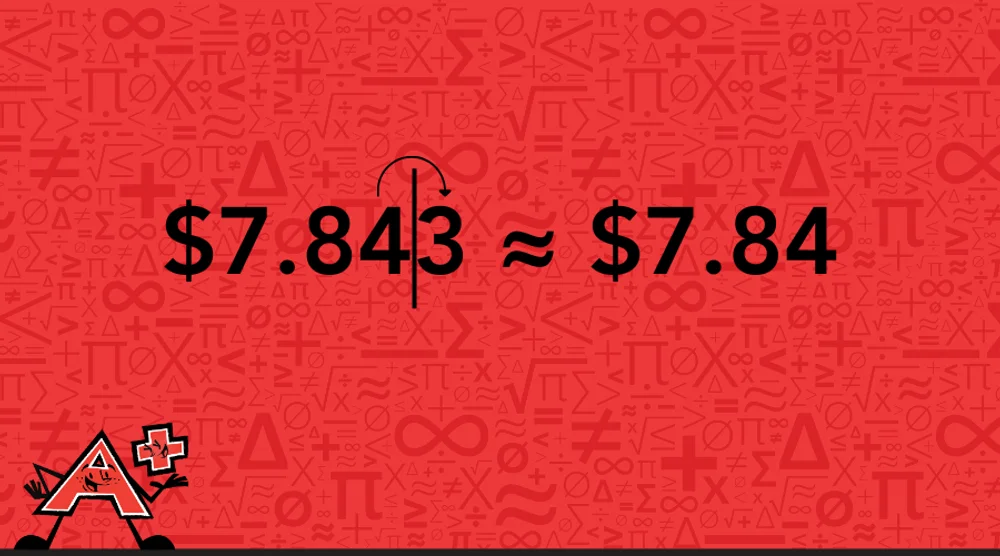
Solved Examples of Rounding to the Nearest Cent
Let's try a few more together, each one a little different, so we're ready for whatever comes up.
Example 1
How do we round $4.632 to the nearest cent?
-
Step 1: We find the cents place; that's the hundredths place, the second digit to the right of the decimal point. Here, that's the 3.
-
Step 2: We look at the digit to the right, or the thousandths place. That's 2. Since 2 is 0–4, the cents stay the same.
-
Step 3: We write the final amount with two decimal places: $4.632 → $4.63
Example 2
This time, we'll turn it up a notch with $21.304. How do we round this to the nearest cent?
-
Step 1: We find the cents place, a.k.a. the hundredths place, the second digit to the right of the decimal point. Here, that's the 0.
-
Step 2: We look at the digit to the right, or the thousandths place. That's 4. Since 4 is 0–4, the cents stay the same.
-
Step 3: We write the final amount with two decimal places: $21.304 → $21.30
Example 3
Say we ordered pizza with friends, and the total after splitting came to $8.995. How do we round this to the nearest cent?
-
Step 1: We find the cents place; that’s the hundredths place, the second digit to the right of the decimal point. Here, that's the 9.
-
Step 2: We look at the digit to the right, or the thousandths place. That's 5. Since 5 is 5–9, the cents go up by one.
-
Step 3: But wait, 9 + 1 = 10, so the hundredths place becomes 0, and we carry 1 to the tenths place. We write the final amount with two decimal places: $8.995 → $9.00
📕 You May Also Like: Do We Round Up or Down at 5? The Rounding Rule Explained
Your Turn: Practice Rounding to the Nearest Cent
Now it's your turn to try. Our instructors have prepared six challenges for you. Work through each carefully.
When you’re finished, check your answers at the bottom of the guide.
-
Round $3.467 to the nearest cent.
-
Round $12.321 to the nearest cent.
-
Round $6.985 to the nearest cent.
-
Round $0.999 to the nearest cent.
-
Three friends split a $25 dinner bill three ways. The calculator shows $8.3333. What does each person pay?
-
You bought a snack for $2.674 and a drink for $1.328. What is the total rounded to the nearest cent?

Mathnasium uses personalized learning plans and interactive, fun teaching techniques to help students master any skill, rounding included.
How Mathnasium Helps Students Master Any Math Skill
Mathnasium is a math-only learning center empowering students of all skill levels to learn and master math.
When students come to us for support, whether they need to strengthen foundational skills like place value or work through a specific skill like rounding numbers, we focus on teaching for understanding. This means we don’t use a one-size-fits-all curriculum but a proprietary teaching approach, the Mathnasium Method™, designed around individual students’ needs and goals.
Our approach starts with a diagnostic assessment. This is a relaxed interaction that helps us identify each student's strengths and knowledge gaps. With the assessment-based insights, we create a personalized learning plan tailored to their needs.
Once the plan is ready, our specially trained instructors follow it closely, delivering face-to-face math instruction in an engaging and supportive environment.
When we teach skills like rounding to the nearest cent, we use simple, everyday language and a mix of verbal, visual, mental, tactile, and written techniques so students can see the concept from different angles and truly make sense of it.
If a student gets stuck on a concept, we break it down into manageable bits, guiding them through both the how and the why. In time, this builds the problem-solving skills and critical thinking they can use across all areas of math and beyond.
Fun is an important part of the Mathnasium Method™. Our activities are often game-based, and students earn rewards along the way, keeping them engaged and truly enjoying the process. We track their progress and celebrate every win, so confidence grows with every session.
Families see measurable results:
-
94% of parents report an improvement in their child's math skills and understanding
-
93% of parents report an improved attitude toward math after attending Mathnasium
-
90% of students saw an improvement in their school grades
With over 1,100 learning centers across North America, Mathnasium brings top-rated math instruction close to you.
For families in and around Midlothian, VA, Mathnasium of Midlothian is a trusted local center with years of experience building confident math thinkers.
Whether your child needs to catch up, keep up, or get ahead on their math journey, our team is happy to help!
📅 Schedule a Free Diagnostic Assessment at Mathnasium of Midlothian
Not near Midlothian?
📍 Find Mathnasium Learning Centers Near You
Pssst! Check Your Answers Here
If you've given our challenges a go, check your results below.
-
$3.467 → the digit to the right of the cents place is 7, that's 5–9, so we round up → $3.47
-
$12.321 → the digit to the right is 1, that's 0–4, so the cents stay the same → $12.32
-
$6.985 → $6.99
-
$0.999 → $1.00
-
$8.3333 → $8.33
-
$2.674 + $1.328 = $4.002 → $4.00


 (804) 378-2211