It is 9 PM. What time will it be in 8 hours? If we add 9 and 8, the result is 17. However, a standard clock shows 5 AM after 8 hours pass. The numbers wrap around after 12.
This familiar clock math acts as a doorway to a broader mathematical concept called modular arithmetic.
We are Mathnasium of North Potomac, a team of math tutors in Gaithersburg, MD, and today we will show you what modular arithmetic actually is and how the math behind the clock works, with a few extra real-life examples of modular arithmetic.
Stay with us until the end for a few low-prep ideas on how to practice it with your child at home.

What Is Modular Arithmetic?
Modular arithmetic is a way of working with numbers in repeating cycles. Instead of tracking a number’s full size, it focuses on where the number lands in the cycle.
To work with this idea, we only need two simple terms:
In any repeating cycle, complete groups bring us back to the start, and the remainder marks the ending spot.
For example, 17 leaves a remainder of 5 when we divide it by 12.
17 ÷ 12 = 1 R5
If we write it in mathematical notation, it looks like this:
17 ≡ 5 (mod 12)
This statement means 17 and 5 are in the same position in the cycle of 12. Modular arithmetic simply treats numbers with the same remainder as equivalent within that chosen cycle.
To keep this concept simple, we need to remember these three main ideas:
-
Remainders mark the spot. They show exactly where a number lands after complete cycles are removed.
-
Patterns are everywhere. This same system powers calendars, games, design patterns, and technology.
📕 You May Also Like: How to Do Long Division with Remainders - A Kid-Friendly Guide
What Is “Clock Math”?
“Clock math” is modular arithmetic on a 12-hour clock. The clock uses a modulus of 12 because it repeats after 12 positions.
On a 12-hour clock, for example, 17 and 5 land in the exact same spot.
Why Don’t Clocks Keep Counting Forever?
Clocks wrap around because they repeat every 12 positions. Let’s compare a standard 12-hour clock to a number line that goes on forever. The clock face has 12 set positions, and the moment its hand moves past 12, the numbers start over at 1.
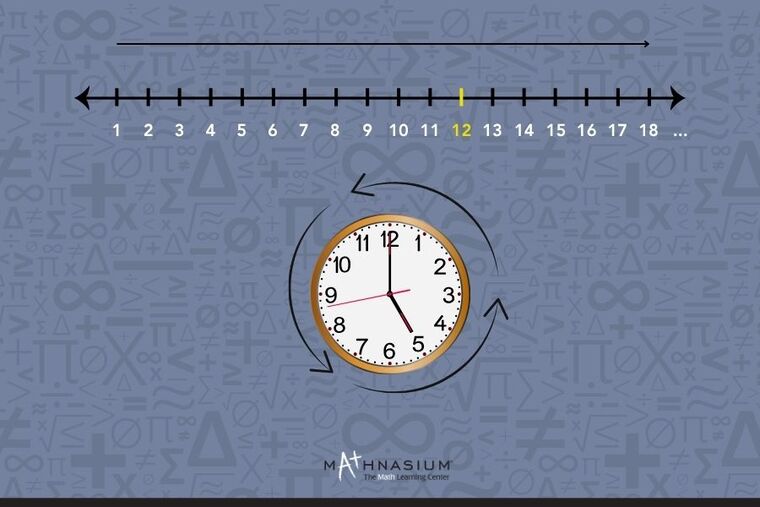
Because of this repeating loop, different numbers end up at the exact same spot. Whenever we add 12, it sends the hand through one full trip around the circle and lands right back where it started. For example, the positions for 5, 17, 29, and 41 align on the same mark (5).
-
17 ÷ 12 = 1 R5
-
29 ÷ 12 = 2 R5
-
41 ÷12 = 3 R5
Each number leaves a remainder of 5, so each one lands on 5 after the full trips around the clock are removed.

How Clocks Help Us Practice Modular Arithmetic
Clocks give us a simple way to practice modular arithmetic. The steps are simple:
For example, let’s say it is 3 PM, and we want to know what time it will be in 10 hours.
Step 1: Add
First, we need to add the hours:
3 + 10 = 13
Step 2: Divide
Then, we divide the result of the addition by 12 to remove the complete trips around the clock:
13 ÷ 12 = 1 R1
Since 12 fits into 13 once, we took 1 complete trip around the clock.
Step 3: Interpret
The remainder (1) is our answer position. So, it will be 1 AM.
Other Examples of Modular Arithmetic
Modular arithmetic applies to many everyday situations outside of telling time. Any system that repeats follows these exact rules. Let’s look at the table below to see a few other examples.
|
Example
|
Cycle length
|
Modular-arithmetic question to think about
|
|
Days of the week
|
7
|
What day will it be 16 days from Tuesday?
|
|
Months of the year
|
12
|
What month is 15 months after October?
|
|
Four people taking turns
|
4
|
Whose turn is number 14?
|
|
Red-blue-green pattern
|
3
|
What color is in position 20?
|
Each of these examples relies on complete cycles and a remainder. If we strip away the cycles, that leaves us with the remainder, which points straight to the answer.
Let’s try to answer the days of the week question together. If we compare this example to the clock example, we see that we are adding 16 days to Tuesday instead of to a number. So, we skip the addition part and go straight to the division.
16 ÷ 7 = 2 R2
What do we see? It took 2 full cycles, and our remainder is 2. So, we count 2 days after Tuesday. The answer is Thursday.
What do you think the answers are to the other three questions?
📕 You May Also Like: How Playing with Patterns Boosts Your Child’s Math Skills
How to Practice Modular Arithmetic With Your Child at Home
You only need a few minutes and everyday materials. Choose one activity at a time and let your child make a prediction. Then, test it together.
1. Clock Jumps
Use an analog clock or draw a clock face on a piece of paper. Ask your child to put a finger on 4 and move forward 3 spaces. They should land on 7.
Keep the starting point (4) the same, but change the number of spaces and ask:
-
If we move forward 15 spaces. Where do we land?
-
If we move forward 27 spaces. Where do we land?
-
If we move forward 39 spaces. Where do we land?
Each time, the answer is 7. Ask your child what they notice about 3, 15, 27, and 39. These numbers are all 12 apart. If your child moves 12 spaces, they make one full trip around the clock, so the ending position stays the same.
2. Clap, Tap, Snap
Make a three-action pattern together, such as clap, tap your knees, snap. Repeat the pattern several times. Then ask:
The answer is to tap your knees each time. Ask your child what they notice about 2, 5, 8, and 11. The numbers are 3 apart, and the action pattern repeats every 3 steps.
3. Shape Pattern Challenge
Draw or line up a repeating pattern of circle, square, triangle. Repeat the same three shapes several times. Then you can ask:
-
What shape is in position 2?
-
What shape is in position 5?
-
What shape is in position 8?
-
What shape is in position 11?
The answer is a square each time. Invite your child to choose a new three-item pattern and make a question for you. They can use colors, toys, coins, or simple drawings.
📕 You May Also Like: How Shape Learning Builds the Foundation for Math
 At Mathnasium, we work with students through the reasoning behind the math to help them build lasting confidence.
How Mathnasium Makes Math Learning Fun
Mathnasium is a math-only learning center dedicated to helping K–12 students of all skill levels excel in math.
Math often goes beyond school textbooks, formulas, and memorization. It is all around us, and a topic like modular arithmetic is just one example that shows that math can be fun and drive students’ curiosity.
In our everyday work with students, we use the Mathnasium Method™, our proprietary teaching approach, to meet students where they are and guide them forward step by step.
Each student begins their Mathnasium journey with a diagnostic assessment that helps us understand their current skill level, learning goals, knowledge gaps, and how they think and feel about math.
With those insights, we build a personalized learning plan tailored to their needs and pace.
Our specially trained tutors follow the plan closely and provide live, face-to-face instruction in a caring and fun group environment. We use mental, verbal, visual, tactile, and written techniques so math concepts can land.
If students get stuck on any math concepts, we break them down into manageable steps and teach both the how and the why behind them.
As time goes on, students learn to do the same independently. They walk out of our centers with the problem-solving skills and critical thinking tools they can use in the math classroom and beyond.
Fun is an important part of how we work. Sessions often include game-based and hands-on activities that keep students engaged and make learning more enjoyable. Students earn rewards along the way, and we celebrate every bit of progress, so confidence grows alongside mastery.
Our approach brings measurable results:
-
94% of parents report an improvement in their child's math skills and understanding
-
93% of parents report their child's improved attitude toward math after attending Mathnasium
-
90% of students saw an improvement in their school grades
With over 1,100 learning centers across North America, there is likely a Mathnasium close to you.
For families in and near North Potomac, Maryland, Mathnasium of North Potomac is a trusted local center with years of experience helping students excel in math.
Whether your student is looking to catch up, keep up, or get ahead in math, our team is happy to support them!
Ready to get started?
📅 Schedule a Free Assessment at Mathnasium of North Potomac
Not near North Potomac?
📍 Find a Mathnasium Learning Center Near You


 (240) 252-1184