When students first encounter integers in 5th or 6th grade, their understanding of numbers undergoes a major change. Up until this point, numbers only move in one direction, and that's up from zero. Integers introduce negative values and show us for the first time that numbers stretch in both directions.
If you're still getting used to this change, Mathnasium tutors have your back. Today, we'll cover what integers are, how they differ from whole numbers, four practical ways to visualize them, and how to build confidence with positive and negative values.

What Are Integers in Math?
An integer is a whole number that can be positive, negative, or zero.
Integers include positive counting numbers (like 1, 2, and 3), negative numbers (like -1, -2, and -3), and zero. They do not include fractions (like \(\Large\frac{2}{3}\)) or decimals (like 3.5).
Integers simply add another layer to the number groups we've been using since elementary school:
-
Natural numbers are the counting numbers: 1, 2, 3, and so on.
-
Whole numbers expand this group by including zero: 0, 1, 2, 3...
-
Integers take it a step further by including negative whole numbers alongside zero and positive whole numbers: ...-3, -2, -1, 0, 1, 2, 3...
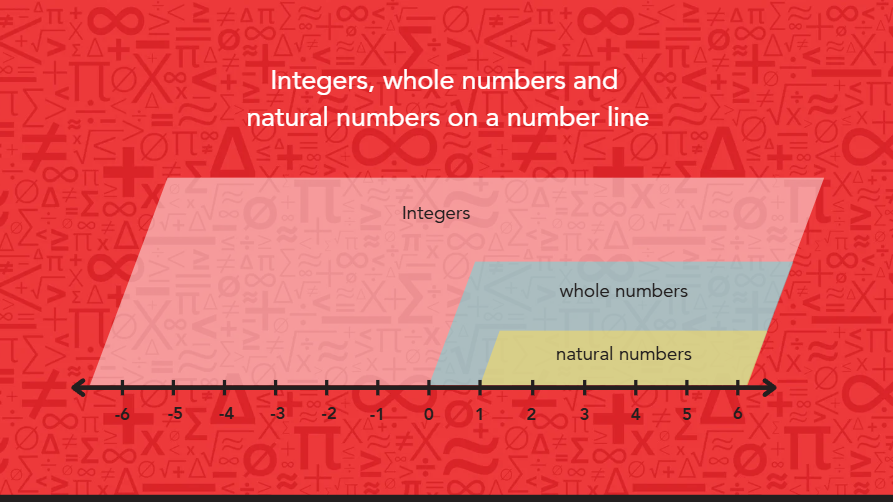
We can use a number line to bring this to life visually. Zero sits right in the middle, acting like a mirror point. Positive integers stretch out to the right (1, 2, 3, and so on), while negative integers stretch out to the left (-1, -2, -3, and so on).

How Integers Differ From Whole Numbers
When we work with students at Mathnasium, we know how easy it is to mix up whole numbers and integers.
Let’s clear up the confusion.
Whole numbers start at zero and only move upward, while integers include negative numbers too.
Remember, every whole number is already an integer, but not every integer is a whole number!
To make the difference clear at a glance, we can compare them side-by-side:
|
Whole Numbers
|
Integers
|
| 0, 1, 2, 3, 4... |
...-3, -2, -1, 0, 1, 2, 3... |
| Start at zero, move upward only |
Include negative numbers, zero, and positive numbers |
| No negative values |
Extend in both directions from zero |
📕 You May Also Like: How to Subtract Positive and Negative Integers? A Simple Guide
4 Practical Ways to Understand Integers
To build a deep understanding of how integers work, our tutors recommend focusing on four practical strategies:
1. Use a Number Line as a Visual Anchor
This way, a number line turns integers into something we can point to and move along, instead of just numbers on a page.
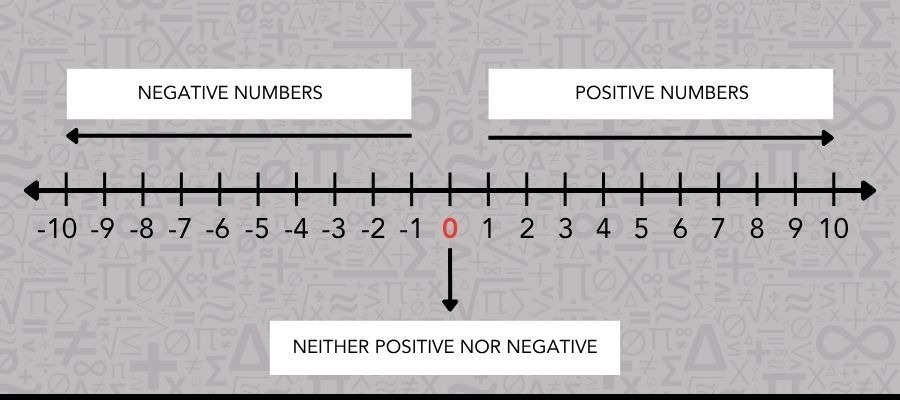
This kind of visual helps us see the difference between "more negative" and "more positive" and makes it clear which number holds the greater value.
2. Connect Integers to Things We Already Know
Integers show up in places we already know, even if we haven't always called them "integers." We can spot them in action when we look at:
-
Temperature: An outdoor thermometer dropping from 5° down to -5°.
-
Gaming: A video game score dipping into negative points after a tough round.
-
Elevators: A building button panel heading down to parking level -2 or B2.
-
Bank Accounts: A balance dropping from 10$ down to -15$ after buying something that costs a bit too much.
3. Use Two-Color Counters for Hands-On Practice
Two-color counters, like buttons or coins with two different colored sides, let us build integers right with our hands.
Here is how we can use them:
-
Pick your colors: We choose one color to represent positive numbers and another for negative numbers.
-
Make a zero pair: When we pair one positive counter with one negative counter, they cancel each other out to equal 0.
-
Watch them balance out: If we start with 4 positive counters and 4 negative counters, pairing them all up shows us why 4 plus -4 equals 0, without needing any tricky rules!
4. Talk Through Real-Life Integer Stories with Parents or Friends
Another approach we like to use at Mathnasium is working through real-life scenarios together.
Think about a football game where a team gains 5 yards on one play and loses 8 yards on the next. When we trace that movement out loud, it becomes clear how the team lands at -3 yards from the starting line.
Whether we are tracking game scores with a friend or looking at temperature changes during a family trip, these stories show us how numbers move in two directions. Integers simply tell us how far we went and which way we traveled.
📕 You May Also Like: How Number Lines Improve Math Understanding (Grades 1-5)
 Mathnasium uses personalized learning plans and interactive techniques to help students master any math skill.
How Mathnasium Helps Students Master Integers (And Any Other Math Concept)
Mathnasium is a math-only learning center dedicated to helping K–12 students of all skill levels excel in math.
Whether students are learning integers for the first time, building confidence with positive and negative numbers, or preparing for the more advanced number concepts they’ll encounter in middle school, we can support them.
Our proprietary teaching approach, the Mathnasium Method™, is designed around each student's needs and learning style to help them learn and master math. Our approach includes:
-
Assessment and Personalized Learning Plans: Each student begins their Mathnasium journey with a diagnostic assessment that identifies current skills, strengths, and gaps. From those findings, we build a personalized learning plan tailored to their goals.
-
Teaching for Understanding: Our specially trained tutors use natural language and a mix of verbal, visual, mental, tactile, and written techniques so each concept lands before we move forward.
-
Problem-Solving and Critical Thinking: We give students time to work through problems independently. That productive struggle helps them learn to trust their own reasoning. When we do step in, we explain both the how and the why behind each answer, so students build problem-solving and critical thinking skills they can use in math and beyond.
-
An Engaging and Fun Learning Environment: Sessions include games, earned rewards, and consistent celebration of progress. Students build confidence alongside fluency, and many develop a more positive relationship with math over time.
The impact extends beyond the classroom:
-
94% of parents report improvement in their child's math skills and understanding
-
93% of parents report an improved attitude toward math after attending Mathnasium
-
90% of students saw improvement in their school grades
With over 1,100 learning centers across North America, there is likely a Mathnasium close to you.
Families across Northwood and nearby areas, including Woodbury and Rise Park, Stonegate and Novel Park, Cypress Village, Northwood Pointe, Walnut and Cadence Park, Beacon Park, and Parasol Park, trust Mathnasium of Northwood to help their children build lasting confidence in math.
If integers or other number concepts are giving your child trouble, our team is ready to help.
📅 Schedule a Free Assessment at Mathnasium of Northwood
Not near Northwood, Irvine?
📍 Find a Mathnasium Learning Center Near You


 (949) 688-6284