You probably have noticed a small raised 2 after units like cm² or ft² on floor tile packages or measuring tools. We call that small raised number an exponent, and it carries an important mathematical instruction.
If you are ready to learn more, our Mathnasium tutors will show you how to read and say exponents aloud, what squared and cubed mean, and where they appear beyond the classroom.

What Is an Exponent in Math?
An exponent is a small number written above and to the right of another number that tells us how many times to use that number as a factor in multiplication. For example, in 5², the exponent tells us to use 5 as a factor twice.
Two more math vocabulary terms help us describe exponent notation:
-
The base is the number we multiply. In 52, the base is 5.
-
The power is the complete expression made up of the base and exponent. In our example, the expression 5² is a power.
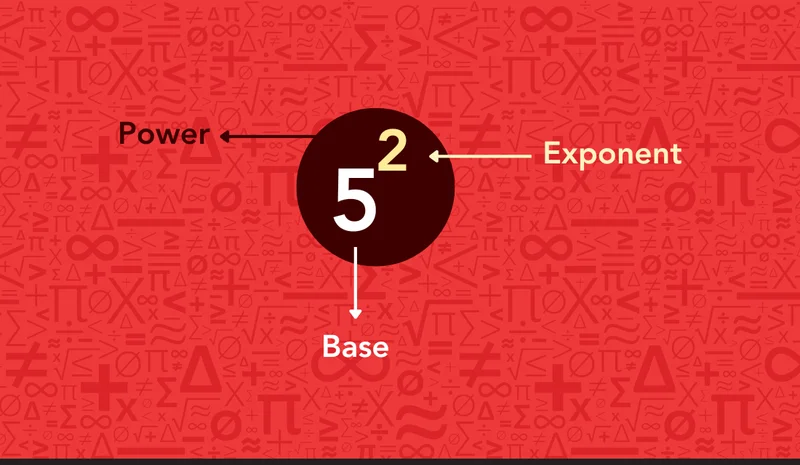
Now we can put everything together. The expression 52 means 5 × 5, which equals 25. Without an exponent, we write the repeated multiplication in full (5 × 5). With an exponent, we write the same instruction in a shorter form (52).
In California, students formally write and evaluate numerical expressions with whole-number exponents in Grade 6 under standard 6.EE.1, although the notation appears informally in area and volume problems from Grade 4 onward.
📕 You May Also Like: What Is A Negative Exponent? A Guide for Middle-Schoolers
How to Read and Write Exponent Notation
We read exponent notation by saying the base first, followed by the exponent.
Let's now see how to pronounce each expression, visualize and understand what the exponent means through repeated multiplication, and calculate the final result.
|
Exponent Form
|
How We Say It
|
Expanded Form
|
Answer |
|
62
|
six squared OR six to the second power
|
6 × 6 |
36 |
|
52
|
5.2 points
|
5 × 5
|
25 |
|
43
|
6.4 points
|
4 × 4 × 4 |
64 |
|
33
|
5.1 points
|
3 × 3 × 3
|
27 |
Once we can read and write an exponent expression accurately, there is one more thing to watch for.
The Most Common Mistake When Interpreting Exponents
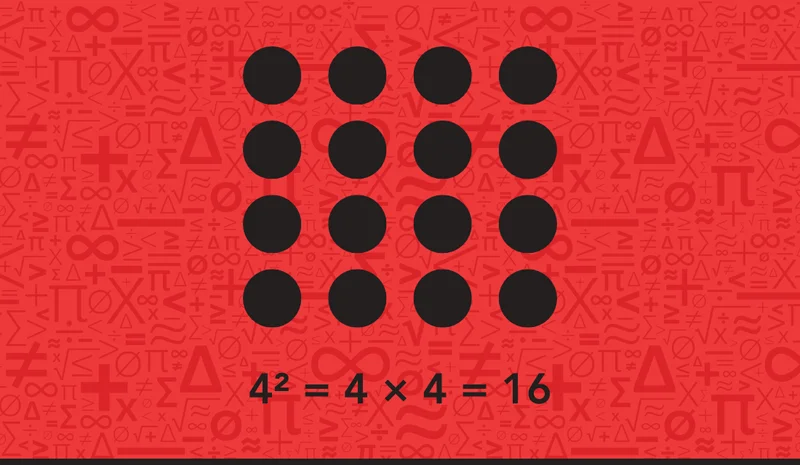
The most common mistake when interpreting exponents is thinking the exponent tells us to multiply the base by the exponent rather than to write the base as a repeated factor.
We can see the difference with a simple example:
-
Wrong: 4² = 4 × 2 = 8
-
Correct: 4² = 4 × 4 = 16
The exponent sits right next to the base, and the brain may naturally read that proximity as multiplication. So, the fix is to ask, "How many times do I write the base?" before doing any calculation. In our example, that means writing 4 twice instead of multiplying 4 by 2.
📕 You May Also Like: 3 Beginner-Friendly Visual Strategies to Learn Exponents
What Squared and Cubed Mean in Exponent Notation
The words squared and cubed come from the shapes they describe, respectively, the square and the cube.
Those same names also appear in units of measurement, so whenever you see a small 2 or 3 after a unit, it tells you how many dimensions we're measuring.
Here’s how squares and cubes connect to exponents:
-
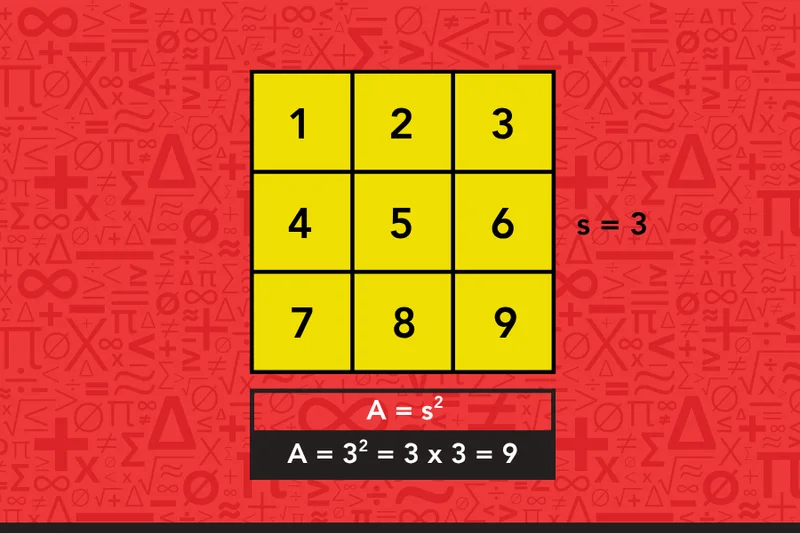
Squared (exponent of 2): To find the area of a square, we multiply two equal side lengths. If each side is 3 units long, the area is 3 × 3, which we write as 3² square units. The exponent 2 reminds us that we measured two dimensions (2D): length and width. As a result, area measurements use small 2, such as cm² and ft².
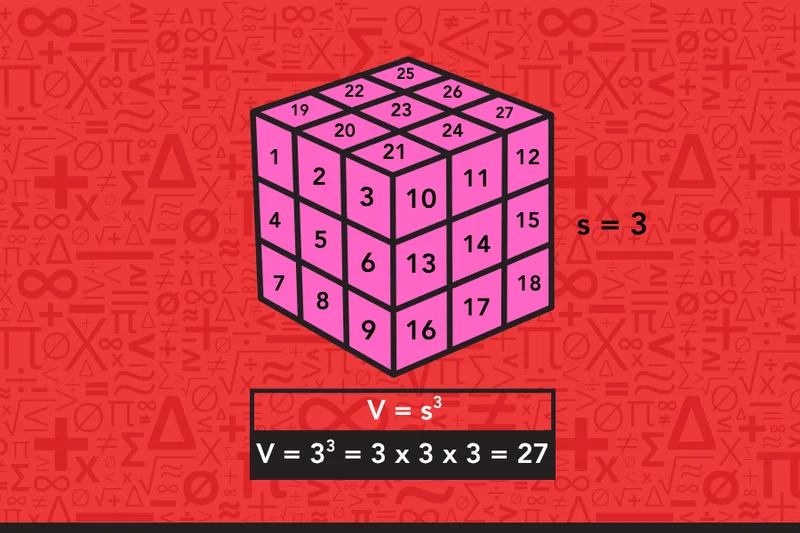
- Cubed (exponent of 3): Volume measures the space inside a cube, so we multiply three equal side lengths. If each side is 3 units long, the volume is 3 × 3 × 3, which we write as 3³ cubic units. The exponent 3 reminds us that we measured three dimensions (3D): length, width, and height. For that reason, volume measurements use small 3, such as cm³ and m³.
📕 You May Also Like: What Is Area in Math? A Complete & Kid-Friendly Guide
Exponents You Already Know: Powers of 10 in Place Value
Powers of 10 are the most familiar example of exponents. We first use them when learning place value in elementary school, where each place in our base-10 number system represents 10 multiplied by itself a certain number of times.
Here's how powers of 10 connect to place value.
|
Power
|
Expanded Form
|
Value |
Place Value Name
|
|
101
|
10
|
10 |
Tens
|
|
102
|
10 × 10
|
100 |
Hundreds
|
|
103
|
10 × 10 × 10
|
1,000 |
Thousands
|
|
104
|
10 × 10 × 10 × 10
|
10,000 |
Ten Thousands
|
In Grade 8, students extend this pattern to write very large and very small numbers in scientific notation and use powers of 10 as a compact shorthand.
📕 You May Also Like: How to Move the Decimal Point: A Place-Value Explanation
Where Exponents Appear in the Real World
The same tiny raised number that appears in a sixth-grade homework problem also helps measure weather, store computer data, and describe distances between stars.
You may be surprised by how often you run into exponents outside the classroom, so let's look at some of the places they show up in the world around us.
|
Context
|
How We Say It
|
Expanded Form
|
|
Computer storage
|
Digital storage uses powers of 10 to describe file sizes and memory capacity.
|
1 megabyte is approximately 106 bytes; 1 gigabyte is approximately 109 bytes |
|
Astronomy
|
Very large distances in space are often written using powers of 10.
|
The distance from Earth to the Sun is approximately 1.5 × 10¹¹ meters
|
|
Sound intensity
|
Each increase of 10 in decibels represents a sound that is 101 times more intense.
|
A loud sound at 80 decibels is 104 times more intense than a quiet sound at 40 decibels
|
|
Area and volume in design
|
Squared and cubed units measure surfaces and spaces.
|
A basketball court covers approximately 4,700 ft2, and a shipping container holds about 1,360 ft3
|
Biology and disease spread
|
Exponents model how infections multiply across populations. |
One person infecting two others, who each infect two more, creates the pattern 21, 22, 23 |
Finance and compound interest
|
Compound interest uses exponents to show how money grows over time.
|
Imagine 10 dollars that doubles three times. In a compound interest formula, this looks like 10 × 23, which equals 80 dollars |
📕 You May Also Like: Exponential Growth in the Real World: From Bacteria to Viral Videos

At Mathnasium, we turn mathematical notation into ideas that students can recognize, understand, and use.
How Mathnasium Helps Students Build Confidence with Exponents (And Any Other Math Concept)
Mathnasium is a math-only learning center dedicated to helping K–12 students of all skill levels excel in math.
Whether students are encountering exponents for the first time, working to build fluency with powers and notation, or preparing for the algebraic reasoning that exponents support in middle school, we can support them.
Our proprietary teaching approach, the Mathnasium Method™, is designed around each student's needs and learning style to help them learn and master math. Our approach includes:
-
Assessment and Personalized Learning Plans: Each student begins their Mathnasium journey with a diagnostic assessment that identifies current skills, strengths, and gaps. From those findings, we build a personalized learning plan tailored to their goals, whether that means mastering exponent notation, building fluency with powers of 10, or preparing for the order of operations and algebraic expressions that build on exponents in middle school.
-
Teaching for Understanding: Our specially trained tutors use natural language and a mix of verbal, visual, mental, tactile, and written techniques so each concept lands before we move forward.
-
Problem-Solving and Critical Thinking: We give students time to work through problems independently. That productive struggle helps them learn to trust their own reasoning. When we do step in, we explain both the how and the why behind each answer, so students build problem-solving and critical thinking skills they can use in math and beyond.
-
An Engaging and Fun Learning Environment: Sessions include games, earned rewards, and consistent celebration of progress. Students build confidence alongside fluency, and many develop a more positive relationship with math over time.
The impact extends beyond the classroom:
-
94% of parents report improvement in their child's math skills and understanding
-
93% of parents report an improved attitude toward math after attending Mathnasium
-
90% of students saw improvement in their school grades
With over 1,100 learning centers across North America, there is likely a Mathnasium close to you.
Families across Northwood and nearby areas, including Woodbury and Rise Park, Stonegate and Novel Park, Cypress Village, Northwood Pointe, Walnut and Cadence Park, Beacon Park, and Parasol Park, trust Mathnasium of Northwood to help their children build lasting confidence in math.
If exponents or any other math concept is giving your child trouble, our team is ready to help.
📅 Schedule a Free Assessment at Mathnasium of Northwood
Not near Northwood?
📍 Find a Mathnasium Learning Center Near You


 (949) 688-6284